

How to plan email campaigns that drive ecommerce growth
TL;DR:
- A strategic framework focusing on segmentation, goals, and automation boosts ecommerce email performance.
- Advanced segmentation and automation drive 5 to 13 times higher revenue per recipient.
- Continuous analysis and process discipline are key to sustained email marketing growth.
Many ecommerce marketing managers pour hours into email campaigns only to watch open rates plateau and revenue stay flat. The problem is rarely effort. It’s the absence of a repeatable, strategic framework. This guide walks you through exactly how to plan, execute, and optimize ecommerce email campaigns using Klaviyo, covering segmentation, automation, event readiness, and performance analysis. Whether you’re managing a growing DTC brand or scaling an established store, you’ll leave with a concrete process you can apply to your next send and every send after that.
Table of Contents
- Laying the groundwork: goals, segmentation, and tools
- Step-by-step campaign planning framework
- Advanced strategies: segmentation, automation, and event readiness
- Analysis, optimization, and common pitfalls
- What most email campaign advice misses: sustainable growth comes from process, not hacks
- Unlock expert support for your next campaign
- Frequently asked questions
Key Takeaways
| Point | Details |
|---|---|
| Segment for lift | Regular segmentation multiplies revenue per recipient and improves deliverability. |
| Follow a repeatable process | A structured planning framework outperforms ad hoc campaign tactics every time. |
| Analyze and iterate | Campaign success depends on measuring RPR and optimizing flows based on actionable insights. |
| Start early for key events | High-stakes campaigns like BFCM need months of advance prep to maximize returns. |
Laying the groundwork: goals, segmentation, and tools
Before you write a single subject line, you need clarity on what success looks like. That sounds obvious, but most underperforming campaigns trace back to a vague goal like “drive sales” rather than a specific, measurable target like “increase repeat purchase revenue by 15% this quarter.” Define your objective first, then build everything else around it.
Your goals should map to one of three core outcomes: revenue generation, engagement improvement, or customer retention. Each requires a different approach to content, frequency, and segmentation. A retention campaign for lapsed customers looks nothing like a launch campaign for a new product line. Mixing them up wastes budget and dilutes your message.
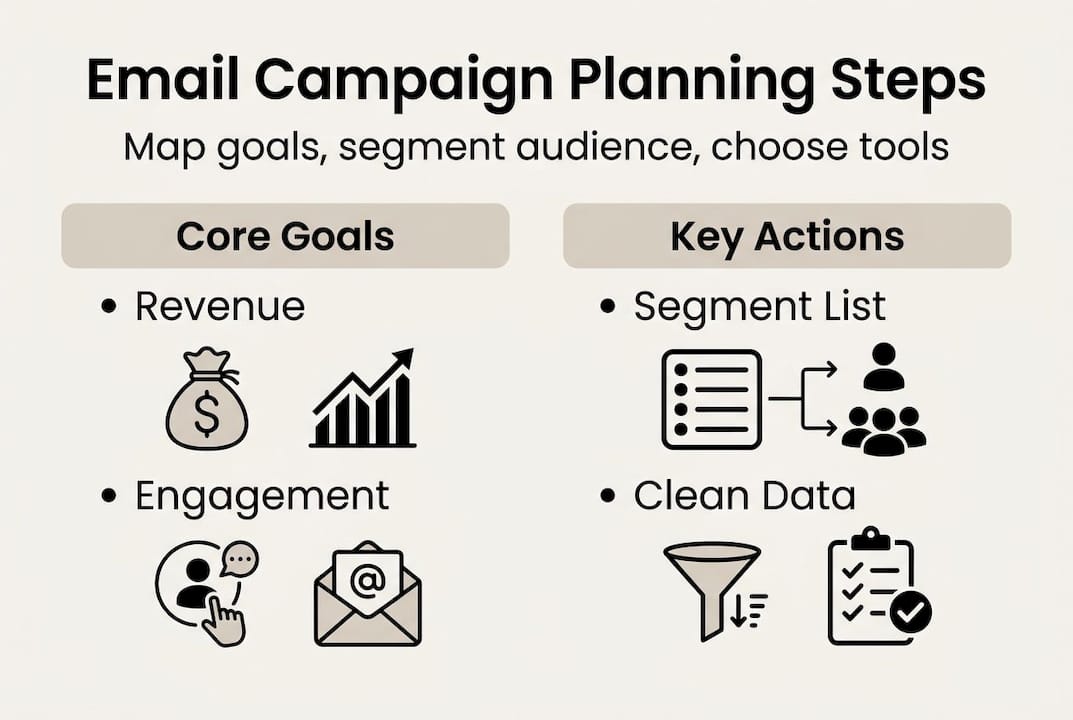
Once your goals are set, audit your data. Clean customer lists are non-negotiable. Dirty data, duplicate profiles, and unverified emails will tank your deliverability before your campaign even has a chance. In Klaviyo, this means reviewing your suppression lists, checking for profile merges, and confirming your integrations with your ecommerce platform are syncing correctly.
Segmentation is where the real lift happens. Segmentation strategies built around RFM analysis (recency, frequency, monetary value) let you target your best customers differently from one-time buyers or churn risks. According to email & SMS marketing priorities, prioritizing segmentation and automation can deliver a 5 to 13x lift in revenue per recipient, based on findings across 100-plus audits.
Here’s a quick reference for the core segments you should build before any campaign:
| Segment | Definition | Campaign use case |
|---|---|---|
| VIP customers | High RFM score, recent buyers | Early access, loyalty rewards |
| One-time buyers | Single purchase, no repeat | Win-back, cross-sell |
| Engaged non-buyers | Opens/clicks but no purchase | Conversion nudge, offer |
| Lapsed customers | No activity 90+ days | Re-engagement, incentive |
| Unengaged | No opens in 180+ days | Sunset or suppress |
Your toolset checklist before launch:
- ESP: Klaviyo configured with all integrations active
- Analytics: Google Analytics or Klaviyo attribution set up
- Templates: Brand-approved, mobile-tested email templates
- Content library: Product images, copy blocks, and CTAs ready
- Approval workflow: Defined owner for each campaign step
Pro Tip: If you’re new to building structured campaigns, reviewing email basics can help you avoid foundational mistakes before you layer on advanced tactics. Also, campaign goal examples from Klaviyo outline 7 core steps: set goals, segment by demographics and behavior, build a template, write your CTA, develop content, schedule (Wednesdays tend to perform best), and analyze results.
Step-by-step campaign planning framework
Once your groundwork is set, you can move systematically through an optimized planning process. A repeatable workflow removes guesswork and makes it easier to scale what works.
Here’s the framework we recommend:
- Set a specific goal and KPI — Define the metric you’re optimizing for (RPR, click rate, conversion rate).
- Choose your segment — Pull the right audience from Klaviyo based on behavior, purchase history, or RFM tier.
- Design your template — Use a brand-consistent layout that’s been tested on mobile. Keep it clean and scannable.
- Write your copy — Lead with value. One message, one CTA. Don’t bury the offer.
- Build your CTA — Make it specific. “Shop the sale” outperforms “Click here” every time.
- Schedule strategically — Klaviyo’s detailed campaign steps confirm Wednesdays as a top-performing send day, but test your own audience’s patterns.
- Send and monitor — Watch early engagement signals in the first two hours. Low open rates may signal a subject line issue worth addressing in a resend to non-openers.
- Analyze and document — Record what worked and why. This is your institutional knowledge for the next campaign.
Not all campaigns are equal. Here’s how the three main types compare:
| Campaign type | Targeting | Effort | Avg. RPR |
|---|---|---|---|
| Batch blast | Full list | Low | Low |
| Segmented campaign | Defined segment | Medium | Medium-High |
| Automated flow | Behavior-triggered | High (setup) | Highest |
For most ecommerce brands, the sweet spot is a mix of segmented campaigns for planned sends and automated flows for always-on revenue. Batch blasts have their place for major announcements, but they should never be your default.
Assigning clear ownership matters more than most teams realize. When everyone assumes someone else approved the copy or checked the links, errors slip through. Assign one person per campaign step and use a shared checklist in your project management tool.
Pro Tip: Repurposing content from high-performing campaigns into new segments or flows is one of the fastest ways to increase output without increasing workload. Also, reviewing top email marketing tips can sharpen your copy and CTA strategy before you finalize any send.
Advanced strategies: segmentation, automation, and event readiness
If you want to outperform competitors, next-level segmentation and event readiness can make the difference. Basic segmentation gets you in the game. Advanced segmentation wins it.

RFM-based segmentation lets you identify your most valuable customers and treat them accordingly. VIPs get early access and exclusive offers. One-time buyers get cross-sell sequences. Churn risks get re-engagement flows with a time-sensitive incentive. Each of these groups responds to very different messaging, and sending the same email to all of them is a missed opportunity every single time.
Top performers use advanced segmentation including RFM tiers, behavioral triggers, and exclusion lists. They also run seven or more active flows, including price drop alerts and low-stock notifications, and they measure success by RPR rather than open rates.
Here’s where most brands leave money on the table: they set up a welcome flow and an abandoned cart flow, then stop. But flows like price drop, back-in-stock, and post-purchase upsell sequences are where automation workflows generate compounding returns with zero manual effort after setup.
Key actions for high-stakes events like Black Friday and Cyber Monday:
- Start planning in July or August — BFCM campaign strategy from Klaviyo confirms that early planning is a top differentiator for high performers.
- Analyze past event data — What offers converted? Which segments responded best? Use that data to inform this year’s approach.
- Clean your list before the event — Sending to unengaged contacts during peak season hurts deliverability when it matters most.
- Segment tightly — Separate VIPs, engaged subscribers, and past BFCM buyers into distinct flows with distinct messaging.
- Test offers before launch — Run A/B tests on subject lines and offers 4 to 6 weeks before the event.
- Post-event review — Document what worked so you’re not starting from scratch next year.
Statistic callout: Brands that combine advanced segmentation with automation see 5 to 13x higher revenue per recipient compared to those relying on batch-and-blast campaigns. That’s not a marginal improvement. It’s a structural advantage.
Pro Tip: AI personalization in Klaviyo can amplify your results, but only after your segmentation is solid. Applying AI to a poorly segmented list scales your problems, not your revenue. Also, exploring newsletter ideas can help you maintain consistent engagement between major campaign pushes.
Analysis, optimization, and common pitfalls
After executing your campaign, you’ll want to maximize what you learn and avoid future missteps. The brands that compound their gains over time are the ones that treat every campaign as a data point, not just a one-time send.
Your north-star metric should be revenue per recipient (RPR), not open rate or click rate. Those engagement metrics are useful signals, but they don’t pay the bills. RPR tells you how much actual revenue each email is generating, which makes it far easier to compare campaigns, justify budget, and prioritize improvements.
When analyzing your Klaviyo campaign reports, look for patterns across segments, not just overall performance. A campaign with a mediocre average RPR might be hiding a high-performing VIP segment and a completely unresponsive lapsed segment. Splitting those out tells you where to invest and where to suppress.
According to AI in email marketing, flows consistently outperform campaigns on RPR because they’re triggered by behavior, but campaigns remain essential for building awareness and driving traffic during promotional windows. The mistake is treating them as either/or rather than complementary.
Common pitfalls to avoid:
- Over-broad campaigns — Sending to your full list when a segment would have converted better
- Batch-and-blast defaults — Using volume as a substitute for relevance
- Ignoring suppression lists — Recent buyers and unengaged contacts should be excluded from most campaigns
- AI overuse without strategy — Email & SMS marketing priorities confirm that AI without clear goals and segmentation exposes weak foundations rather than fixing them
- Mobile neglect — A significant share of opens happen on mobile; untested layouts destroy conversion rates
Troubleshooting steps for an underperforming campaign:
- Check your open rate. If it’s low, test a new subject line and resend to non-openers.
- Check your click rate. If opens are fine but clicks are low, your CTA or offer isn’t landing.
- Check your conversion rate. If clicks are high but conversions are low, the landing page or product page is the problem.
- Review segment overlap. Are you sending to the same contacts too frequently?
- Audit attribution. Klaviyo’s attribution window can inflate revenue numbers; verify against your actual orders.
For more on avoiding these errors, email marketing mistakes covers the most common traps ecommerce brands fall into, and sales-boosting email tips offers practical fixes you can apply immediately.
What most email campaign advice misses: sustainable growth comes from process, not hacks
Here’s the uncomfortable truth: most email marketing content focuses on tactics. Better subject lines. Prettier templates. The latest AI feature. Those things matter at the margins, but they’re not what separates brands that grow consistently from those that spike and plateau.
What actually drives sustained RPR gains is a boring, disciplined process. Set clear goals. Audit your segmentation regularly. Review your outcomes honestly. Course-correct based on data, not gut feel. Repeat.
We’ve seen brands chase every new Klaviyo feature while their core segmentation remains broken. And we’ve seen brands with simple setups and rigorous review cycles consistently outperform them. The framework is the competitive advantage, not the tactic.
The moments when you should break from your template are just as important. Sometimes suppressing your entire list except VIPs for a launch is the right call. Sometimes a plain-text email outperforms a beautifully designed one. You only know that if you’re tracking outcomes and asking why. Real campaign tips can help you build that judgment over time.
Unlock expert support for your next campaign
Planning and executing high-performing email campaigns takes more than good intentions. It takes the right process, clean data, and consistent optimization. If your team is stretched thin or you’re not seeing the RPR gains your strategy should be delivering, working with specialists can close that gap faster than iterating alone.
At Take Action, we work with ecommerce brands to design, audit, and manage Klaviyo campaigns and flows that drive measurable revenue growth. From segmentation audits to full campaign builds, our retention services are built for brands that want email to be a primary growth channel, not an afterthought. Reach out for a free campaign review and see exactly where your biggest opportunities are.
Frequently asked questions
What is the most important metric to track in ecommerce email campaigns?
Revenue per recipient (RPR) is the key metric because it reflects actual revenue influence rather than vanity engagement numbers. Top performers consistently prioritize RPR over open or click rates.
How far in advance should I plan my Black Friday or other high-stakes campaigns?
Begin planning at least 3 to 4 months in advance to analyze past results, segment your list, and test offers. Klaviyo recommends starting BFCM planning as early as July or August for best results.
How do I avoid deliverability issues with email campaigns?
Segment tightly, regularly clean your list, and exclude recent buyers and unengaged users to protect deliverability. Proper exclusion handling is one of the most effective ways to maintain inbox placement during high-volume periods.
Should I use AI for campaign personalization in 2026?
AI can scale your strategy but only works if you have strong segmentation and clear goals already in place. As Klaviyo’s research confirms, AI without a solid foundation amplifies weaknesses rather than strengths.
Recommended
- Boost ecommerce sales with top email marketing tips | Take Action Blog | Take Action
- Blog - Email Marketing Insights | Take Action | Take Action
- How to Repurpose Content for Ecommerce Email Success | Take Action Blog | Take Action
- Digital Media Strategy: Unlocking Ecommerce Growth | Take Action Blog | Take Action