

Digital Media Strategy: Unlocking Ecommerce Growth
Every DTC marketer feels the pressure to stand out in a crowded ecommerce market where every channel, from Google Shopping to Instagram, competes for attention. A strong digital media strategy connects these platforms, transforming scattered efforts into a unified system that nurtures leads and builds loyalty over time. With tools like Klaviyo, brands can use data to move beyond basic campaigns and create dynamic, customer-focused experiences that actually grow revenue and retention.
Table of Contents
- Digital Media Strategy Fundamentals for Ecommerce
- Types of Digital Media Campaigns Explained
- Effective Email Automation and Segmentation Tactics
- Data-Driven Personalization and AI Integration
- Risks, Compliance, and Common Pitfalls
Key Takeaways
| Point | Details |
|---|---|
| Digital Media Strategy Integration | A cohesive digital media strategy connects paid channels, organic reach, email engagement, and customer experience to effectively reach customers online. |
| Data-Driven Personalization | Implement AI-driven personalization for tailored customer experiences, enhancing engagement and conversion rates while respecting data privacy. |
| Email Automation and Segmentation | Utilize email automation alongside customer segmentation to ensure messages resonate, driving revenue growth through targeted communication. |
| Risk Awareness and Compliance | Stay informed of data privacy regulations and implement strong security measures to maintain customer trust and avoid potential legal issues. |
Digital Media Strategy Fundamentals for Ecommerce
At its core, a digital media strategy is your roadmap for reaching customers where they actually spend time online. For ecommerce brands, this means moving beyond traditional approaches and building a cohesive plan that connects paid channels, organic reach, email engagement, and customer experience into one unified system. The shift toward digital channels fundamentally changes how brands connect with audiences, replacing one-way messaging with dynamic, data-driven interactions that happen across multiple touchpoints simultaneously.
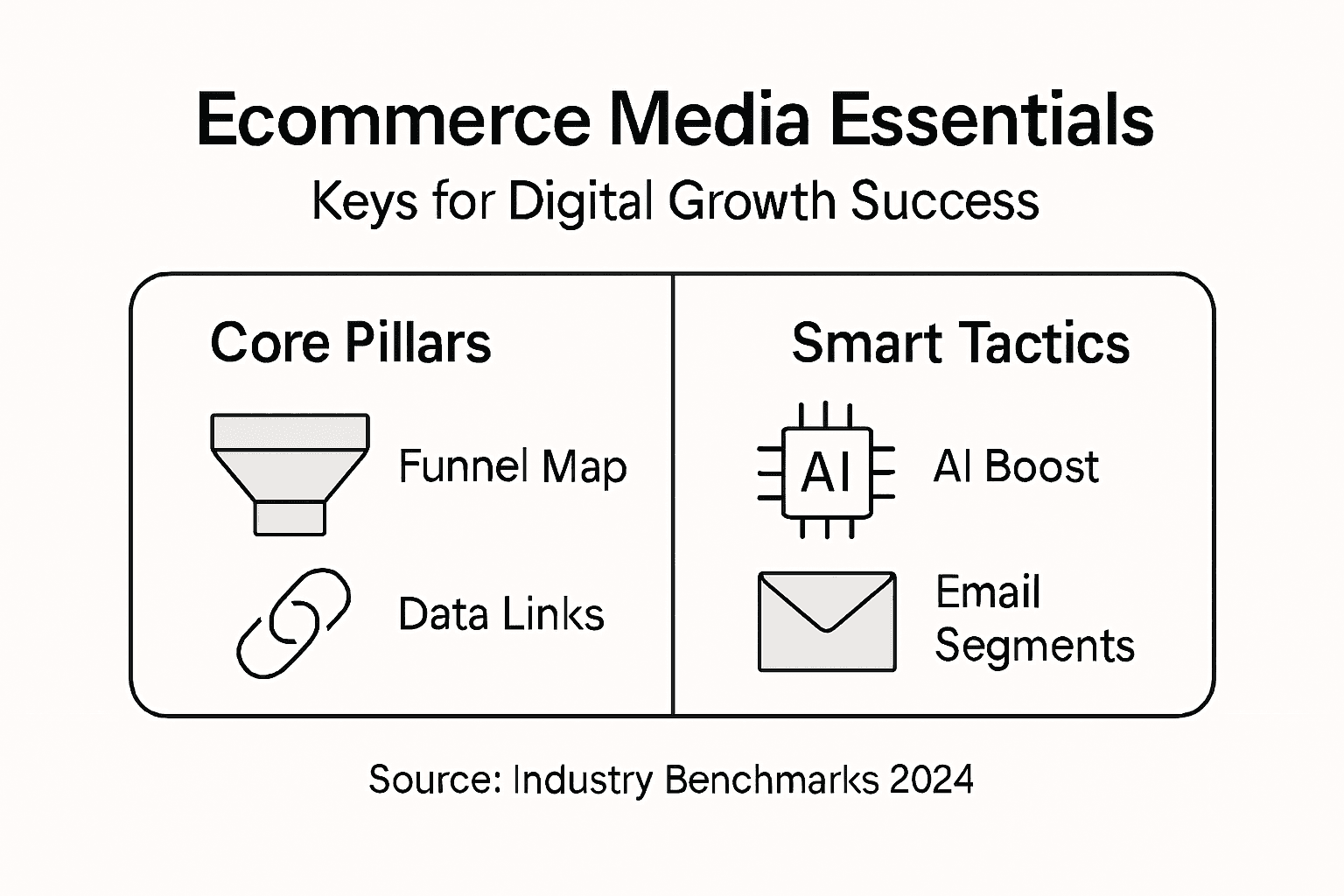
The foundation rests on three critical pillars. First, understanding your marketing funnel means knowing exactly where customers enter your ecosystem and what nudges move them forward. This isn’t just about awareness anymore. It’s about recognizing that a customer who abandons their cart needs a different message than someone discovering your brand for the first time. Second, channel selection matters enormously. Your DTC brand might thrive on Instagram, but that doesn’t mean you should ignore Google Shopping or email automation through Klaviyo’s segmentation capabilities that drive the actual revenue. Third, you need measurable objectives tied to real business outcomes. Not vanity metrics like followers or impressions, but concrete targets: reducing cart abandonment by 15 percent, increasing average order value through post-purchase sequences, or doubling customer lifetime value through strategic retention campaigns.
What sets successful strategies apart is their ability to connect data across channels. Many brands treat email, paid ads, and content as separate silos when they should feed information into one another. When your Klaviyo email data reveals that customers who receive a welcome sequence have 3x higher retention rates, that insight directly impacts how much you should spend acquiring new subscribers. When your paid advertising data shows that product content performs better than lifestyle imagery, your content calendar shifts accordingly. The strategy isn’t static. It evolves as you learn what actually resonates with your audience, not what you assume will work.
Pro tip: Start by mapping out your current customer journey in brutally honest terms: Where do you lose people? Where do they stall? Your biggest growth opportunity usually sits at one of these friction points, and fixing it often requires less investment than acquiring entirely new customers.
Types of Digital Media Campaigns Explained
Digital media campaigns come in many flavors, and understanding each type helps you allocate budget strategically rather than spreading yourself thin across everything at once. The major categories include email campaigns, paid search, social media, video, content marketing, and influencer partnerships. Each serves a distinct purpose in your customer journey, though the most effective strategies weave them together into one cohesive experience. Think of it this way: if your brand awareness lives on social media and your conversion happens through email, you need both channels working in concert. Without one, the other underperforms.
Email campaigns remain the workhorse for ecommerce growth because they reach customers you already have permission to contact. This includes drip marketing sequences that nurture leads automatically, welcome series that set expectations on day one, abandoned cart recovery that captures lost sales, and post-purchase flows that drive repeat orders. Paid search (Google Shopping, search ads) captures high-intent customers actively looking for what you sell. Social media campaigns build awareness and community while driving traffic back to your site. Video campaigns, whether on YouTube or TikTok, tell your brand story in ways that text and static images cannot. Content marketing through blogs establishes authority and feeds your SEO strategy. The key distinction is that various digital media types serve different communication functions, so your mix depends entirely on where your customers actually are and what decision stage they’re in.

Most DTC brands using Klaviyo make a critical mistake here. They optimize each channel independently rather than asking which campaigns generate the highest lifetime value customers. A customer acquired through a social media discount code might have lower retention than someone who lands through organic search and enters a strategic email nurture sequence. Your strongest campaigns are often the ones that complement each other rather than compete. For instance, retargeting ads on Facebook work exponentially better when paired with a compelling email follow-up sequence. Similarly, your best customers often started with paid traffic but were converted through strategic post-purchase automation.
Here’s a concise summary of digital media campaign types and their core strengths for ecommerce:
| Campaign Type | Primary Strength | Best Use Case |
|---|---|---|
| Email Campaigns | Nurtures existing leads | Cart recovery, retention |
| Paid Search | Captures high intent | Immediate sales |
| Social Media | Builds awareness | Community engagement |
| Video Campaigns | Storytelling power | Brand introduction |
| Content Marketing | Authority building | SEO, education |
| Influencer | Trust/credibility boost | Niche audience access |
Pro tip: Map out your customer acquisition sources and track which channels produce customers with the highest CLV and repeat purchase rates. Double down on that source and use other channels to support it, not replace it.
Effective Email Automation and Segmentation Tactics
Email automation and segmentation are where most DTC brands finally start seeing real revenue growth. These two tactics work together: automation handles the timing and delivery of messages, while segmentation ensures those messages actually resonate with the specific person receiving them. Without segmentation, you’re sending the same message to everyone, which means you’re optimizing for the average customer. The average customer doesn’t exist. A first-time buyer needs completely different messaging than a repeat customer who abandoned their cart three days ago. Automation powered by data-driven customer segmentation strategies ensures your Klaviyo account works while you sleep, delivering the right message at the right moment without manual intervention.
The power of segmentation in email lies in precision. You can segment by purchase history, browsing behavior, customer lifetime value, engagement level, or even seasonal patterns. A customer who bought winter coats in December shouldn’t receive the same spring sale email as someone who never engages with seasonal content. When you segment effectively, open rates climb, click rates climb, and most importantly, revenue climbs. Customers feel like you understand them because your messages actually address their specific situation. Automation workflows streamline communication and nurture leads automatically, meaning you create the sequence once and it runs indefinitely, adapting to each customer’s actions. A welcome series brings new subscribers up to speed. An abandoned cart recovery flow captures sales you would otherwise lose. A post-purchase automation sequence builds loyalty and drives repeat orders. These aren’t one-off campaigns. They’re systems that generate revenue month after month.
The biggest mistake brands make is treating automation as set-and-forget. Your flows need continuous refinement based on performance data. If your welcome sequence has a 35 percent open rate but only a 5 percent click rate, the problem isn’t the open rate. People are reading your email but not clicking. Maybe your call-to-action isn’t compelling. Maybe the offer doesn’t match what they clicked to subscribe for. Testing different subject lines, send times, and content variations reveals what actually moves your audience. Start with the highest-impact segments: your best customers, your lapsed customers, and your high-value prospects. Once you see results there, expand your segmentation strategy to include behavioral triggers and purchase frequency patterns.
Pro tip: Segment your email list by customer lifetime value and test your best automation sequences with your highest-value customers first. This ensures your most important revenue generators experience your best messaging, and you can refine tactics before rolling out to broader segments.
Data-Driven Personalization and AI Integration
Personalization used to mean slapping a customer’s first name into an email subject line. That approach is dead. Modern personalization means using behavioral data, purchase history, browsing patterns, and engagement signals to deliver experiences that feel individually crafted rather than mass-produced. This is where AI steps in. Machine learning algorithms process thousands of data points to predict what each customer actually wants, then automatically adjust messaging, product recommendations, and offers in real time. For DTC brands running Klaviyo, this means moving beyond static segments into dynamic, behavior-triggered personalization that adapts as customer actions change. AI-driven personalization enhances customer engagement through tailored recommendations and dynamic content, creating experiences that directly impact conversion rates and customer satisfaction.
The practical power of AI in email marketing comes from predictive analytics. Instead of guessing which customers might churn, your system identifies them with precision based on engagement decline patterns. Instead of manually deciding who gets which offer, AI calculates the optimal send time, subject line variation, and call-to-action for each individual. Your welcome sequence learns from millions of data points across your customer base, then personalizes itself for each new subscriber based on their initial behavior. If someone lands on your site through a paid ad promoting a specific product, AI recognizes that intent and tailors the welcome series around that product category. If someone browses your bestseller page for three minutes, AI flags them as a high-intent prospect and adjusts the nurture sequence accordingly. This level of personalization scales infinitely because the system handles the optimization, not your marketing team manually tweaking campaigns.
The challenge isn’t whether to use AI in personalization. It’s how to implement it responsibly while maintaining customer trust. Data privacy matters. If customers feel like you know too much about them, it creeps them out rather than delights them. Transparency helps. If your personalization feels natural and relevant, customers appreciate it. If it feels invasive or based on information they didn’t knowingly share, they lose trust. Start by focusing personalization on data you explicitly collect and that customers expect you to use: their purchase history, their email engagement, the products they viewed. As you build trust through relevant, helpful personalization, you can expand into more sophisticated predictive models. The goal is making customers feel understood, not surveilled.
Pro tip: Begin with behavioral personalization using only first-party data like purchase history and email engagement before implementing predictive AI models. This builds customer trust while you validate that personalization actually increases your revenue, then scale from there.
Risks, Compliance, and Common Pitfalls
Digital media strategies operate in an increasingly regulated environment where missteps carry real consequences. Data privacy laws like GDPR, CCPA, and similar regulations across different jurisdictions impose strict requirements on how you collect, store, and use customer data. Beyond legal penalties, privacy violations destroy customer trust. A data breach doesn’t just expose information. It signals to your audience that you can’t be trusted with their details. For ecommerce brands relying on Klaviyo and other platforms to maintain customer relationships, compliance isn’t optional. It’s foundational. The risks extend beyond privacy regulations. Digital media strategies introduce challenges such as surveillance, data misuse, and algorithmic discrimination that require robust safeguards and ethical frameworks to mitigate effectively.
Common pitfalls fall into several categories. First, consent violations. Many brands assume they can email anyone who visits their site or use any data they collect without explicit permission. Wrong. GDPR requires affirmative opt-in consent before you can send marketing emails. CCPA gives California residents the right to know what data you collect and demand deletion. Second, inadequate data security. Customer information is a target. Hackers attack small brands constantly because they assume security is lax. A single breach exposes thousands of customer records, leading to lawsuits, regulatory fines, and brand destruction. Third, algorithmic bias. If your AI-driven personalization learns from biased historical data, it perpetuates discrimination. Maybe your algorithm recommends certain products only to certain demographic groups based on past purchase patterns, creating unfair outcomes. Fourth, phishing and social engineering attacks exploit your email channel. If attackers compromise your Klaviyo account, they can send fraudulent emails to your entire customer list, damaging your reputation irreparably.
To help brands avoid common pitfalls, here’s a quick comparison of major digital compliance risks and their consequences:
| Risk Category | Example Scenario | Consequences |
|---|---|---|
| Consent Violations | Emailing users without permission | GDPR fines, lost trust |
| Data Security Lapse | Customer info breached | Lawsuits, reputation damage |
| Algorithmic Bias | AI recommends unfairly | Discrimination, legal issues |
| Phishing Attacks | Accounts spoofed and misused | Brand damage, financial loss |
Compliance requires three core actions. First, audit your data collection. Know exactly what you’re collecting, where it’s stored, who has access, and whether you have proper consent. Second, implement security measures. Use strong passwords, enable two-factor authentication, regularly update software, and educate your team on phishing attacks. Social media and digital channels present specific vulnerabilities including identity theft, data scraping, phishing, and malware threats. Third, document your processes. Keep records of consent decisions, retention schedules, and access logs. If regulators come knocking, documentation proves you acted responsibly. The goal isn’t just avoiding fines. It’s building customer confidence that you handle their information with respect.
Pro tip: Conduct a privacy audit of your entire marketing stack right now. Document your consent mechanisms, data retention policies, and access controls. Then identify the biggest gaps and fix them before they cause damage.
Transform Your Ecommerce Growth with Targeted Email Automation
If you are facing challenges with fragmented digital media strategies and want to unlock ecommerce growth through cohesive, data-driven campaigns, you are not alone. Many brands struggle to connect paid ads, social media, and email efforts in ways that generate predictable revenue and increase customer lifetime value. The key themes highlighted in the article, such as automation, segmentation, and AI-driven personalization, are exactly where specialized support can make a measurable difference.
At Take Action, we focus on turning your email marketing into a powerful growth engine that recovers lost sales, nurtures leads with precision, and boosts repeat purchases. Our expertise in Klaviyo automations like welcome flows, abandoned cart recovery, and post-purchase sequences aligns directly with the proven strategies you need to reduce customer churn and scale sustainable revenue. We combine human creativity with AI insights to optimize engagement rates and deliver personalized messages at the right moment, ensuring your campaigns resonate deeply with your unique audience.
Ready to stop losing customers and start automating your ecommerce growth? Partner with Take Action today to implement sophisticated email campaigns that complement your broader digital media efforts. Visit our website now to learn how our strategic approach can help you maximize customer retention, increase average order value, and create an unstoppable retention machine.
Frequently Asked Questions
What is a digital media strategy in ecommerce?
A digital media strategy in ecommerce is a comprehensive plan that connects various digital channels such as paid ads, social media, email marketing, and customer experience to effectively reach and engage customers online.
Why is understanding the marketing funnel important for ecommerce?
Understanding the marketing funnel is crucial because it allows brands to tailor their messaging and strategies according to where customers are in their buying journey, ensuring that potential buyers receive the right communication at each stage.
How can email automation and segmentation boost ecommerce sales?
Email automation and segmentation can boost ecommerce sales by delivering targeted messages to specific customer segments, allowing brands to nurture leads and convert them effectively based on their behaviors and preferences.
What role does AI play in enhancing personalization in ecommerce?
AI enhances personalization in ecommerce by analyzing customer data to deliver tailored experiences and recommendations, adapting in real-time to individual customer behaviors, which helps improve engagement and conversion rates.
Recommended
- Digital Media Buying Agency Impact on Ecommerce | Take Action Blog | Take Action
- 7 Essential Ecommerce Marketing Strategies for Growth | Take Action Blog | Take Action
- Increasing Website Visibility for Ecommerce Growth Success | Take Action Blog | Take Action
- How to Plan Content for Scalable Ecommerce Growth | Take Action Blog | Take Action