

Complete Guide to Email Marketing for Beginners
More than 80 percent of businesses rely on email marketing to connect with their audience and drive sales. This approach stands out because it offers direct access to people who have already shown interest in your brand. Understanding email marketing basics and key concepts helps you move beyond crowded inboxes, creating messages that build loyalty and boost your results.
Table of Contents
- Email Marketing Basics And Key Concepts
- Types Of Email Campaigns For Ecommerce
- How Klaviyo Automation And Segmentation Work
- Crafting Conversion-Focused Email Content
- Avoiding Common Mistakes And Compliance Risks
Key Takeaways
| Point | Details |
|---|---|
| Personalization is Essential | Tailoring content to individual preferences and behaviors significantly increases engagement and conversion rates. |
| Segmentation Improves Results | Dividing your audience into targeted segments allows for more effective communication and higher marketing effectiveness. |
| Automation Enhances Efficiency | Utilizing automation workflows can streamline email marketing processes, providing timely and tailored responses to customer actions. |
| Compliance is Crucial | Adhering to legal requirements regarding consent, data handling, and unsubscribe requests is vital to maintain brand reputation and avoid penalties. |
Email Marketing Basics and Key Concepts
Email marketing represents a powerful digital communication strategy that enables businesses to connect directly with customers, nurture relationships, and drive measurable revenue growth. According to research from Jetir, effective email marketing campaigns are critical for customer acquisition, retention, and conversion.
At its core, email marketing involves sending targeted, personalized messages to a curated list of subscribers who have opted into receiving communications from your brand. These messages can range from promotional announcements and product updates to educational content and transactional information. The key lies in delivering relevant, valuable content that resonates with your specific audience segments.
Successful email marketing strategies typically incorporate several fundamental elements:
- Audience Segmentation: Dividing subscribers into distinct groups based on demographics, behaviors, or engagement levels
- Compelling Content: Crafting messages that provide genuine value and spark recipient interest
- Clear Call-to-Action: Including direct, persuasive instructions that guide subscribers toward desired outcomes
- Consistent Branding: Maintaining a cohesive visual and tonal identity across all communications
As highlighted by Dergipark, email marketing has evolved from a simple communication tool to a sophisticated strategic approach that demands careful planning and execution. Modern brands use advanced techniques like dynamic personalization, behavioral triggered emails, and automated workflows to create more sophisticated, responsive marketing ecosystems.
To truly excel in email marketing, brands must focus on building genuine connections. This means prioritizing subscriber experience, respecting communication preferences, and consistently delivering content that adds real value to the recipient’s inbox. Learn more about email campaign best practices in our guide on email campaign strategies.
Types of Email Campaigns for Ecommerce
Email marketing for ecommerce requires a strategic approach with multiple campaign types designed to engage customers at different stages of their purchasing journey. According to research from Coursera, successful ecommerce brands leverage various email strategies to drive conversions and build lasting customer relationships.
Promotional Campaigns represent the most recognizable email marketing approach. These emails typically showcase special offers, discounts, seasonal sales, and new product launches. The primary goal is to stimulate immediate purchasing behavior by creating a sense of urgency and presenting compelling value propositions that motivate subscribers to click and buy.

Key types of ecommerce email campaigns include:
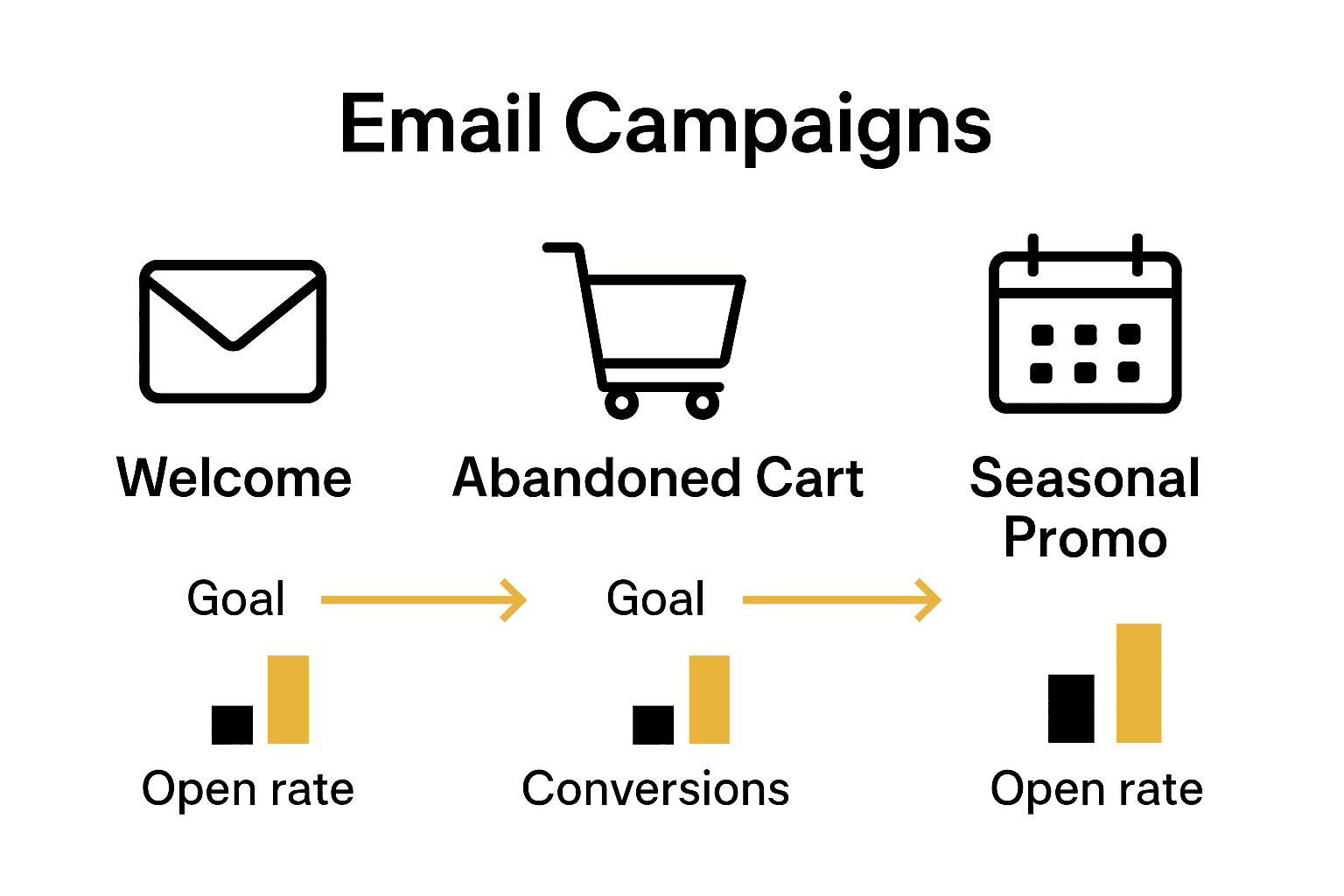
- Welcome Emails: First communication after signup, introducing brand personality and offering initial incentives
- Abandoned Cart Emails: Targeted messages reminding customers about items left in their online shopping cart
- Post-Purchase Follow-ups: Communications sent after a transaction to enhance customer experience
- Re-engagement Campaigns: Designed to reconnect with inactive subscribers and reignite their interest
- Seasonal Promotions: Timely emails aligned with holidays, events, or specific shopping seasons
Research from IJERMT emphasizes that personalization is crucial in modern ecommerce email strategies. By segmenting audiences and tailoring content to specific customer behaviors and preferences, brands can dramatically improve engagement rates and conversion potential.
Transactional emails like order confirmations, shipping notifications, and delivery updates also play a critical role.
 While primarily informative, these emails represent excellent opportunities for additional engagement, cross-selling, and building customer trust. Learn more about strategic email marketing approaches in our guide on ecommerce growth strategies.
How Klaviyo Automation and Segmentation Work
Klaviyo represents a powerful email marketing platform that revolutionizes how ecommerce brands approach customer communication through advanced automation and segmentation techniques. According to research from ArXiv, modern marketing AI systems like Klaviyo utilize sophisticated frameworks that enable precise targeting and personalized messaging strategies.
Automation Workflows are the cornerstone of Klaviyo’s effectiveness. These intelligent systems allow brands to create trigger-based email sequences that respond automatically to specific customer actions. For instance, when a customer abandons their cart, makes a purchase, or reaches a particular engagement milestone, Klaviyo can instantly dispatch a tailored communication without manual intervention.
Key segmentation and automation capabilities include:
- Behavioral Segmentation: Grouping customers based on purchase history, browsing patterns, and engagement levels
- Predictive Analytics: Using machine learning to forecast customer likelihood of purchase
- Dynamic Content Personalization: Automatically adjusting email content based on individual customer preferences
- Lifecycle Stage Tracking: Identifying and targeting customers at different stages of their purchasing journey
Research from ArXiv highlights the importance of incorporating semantic and structural information in email marketing systems. Klaviyo excels at this by analyzing not just basic customer data, but complex interaction patterns that enable more nuanced and effective communication strategies.
The platform’s segmentation capabilities allow for incredibly granular targeting. Brands can create segments based on complex criteria like total customer lifetime value, recent purchase frequency, product preferences, and even predicted future behaviors. Learn more about boosting engagement with Klaviyo automation in our detailed guide.
Crafting Conversion-Focused Email Content
Creating email content that drives conversions requires a strategic approach that blends compelling storytelling with clear, actionable messaging. According to research from JETIR, successful email marketing campaigns hinge on developing content that not only captures attention but also motivates recipients to take specific actions.
Psychological Triggers play a crucial role in conversion-focused content. This means understanding and leveraging emotional and cognitive mechanisms that prompt readers to engage. Key elements include creating a sense of urgency, highlighting unique value propositions, and addressing specific pain points that resonate with your target audience.
Essential components of high-converting email content include:
- Compelling Subject Lines: Crafted to spark curiosity and drive open rates
- Personalized Messaging: Tailored to individual customer segments and preferences
- Clear Value Proposition: Explicitly stating the benefit of taking action
- Strategic Storytelling: Connecting emotionally with the reader
- Powerful Call-to-Action (CTA): Direct, visually prominent, and action-oriented
Research from IJERMT emphasizes that personalization is the cornerstone of effective email marketing. This goes beyond simply using a customer’s name - it involves creating content that feels individually crafted, addressing specific customer needs, preferences, and previous interactions.
The art of conversion-focused content is about creating a seamless narrative that guides readers toward a desired action. This means carefully balancing informative content with persuasive elements, using language that is both engaging and direct. Explore more strategies for increasing conversions with our comprehensive guide on boosting sales.
Avoiding Common Mistakes and Compliance Risks
Email marketing success requires more than just creative content - it demands a careful approach to legal compliance and strategic communication. According to research from ArXiv, many businesses unknowingly expose themselves to significant risks through improper email marketing practices.
Consent and Permission are the foundational pillars of ethical email marketing. This means implementing robust opt-in processes that clearly communicate what subscribers can expect. Key red flags include purchasing email lists, sending unsolicited communications, or failing to provide clear unsubscribe mechanisms. Each of these practices can result in potential legal penalties and damage to your brand’s reputation.
Common email marketing mistakes to avoid:
- Ignoring Unsubscribe Requests: Legally and ethically mandatory to process immediately
- Misleading Subject Lines: Can trigger spam filters and legal challenges
- Inconsistent Sender Information: Reduces trust and can violate email regulations
- Lack of Email Authentication: Increases vulnerability to spoofing and phishing
- Non-Compliant Data Handling: Risking violations of privacy regulations
Research from ArXiv highlights the critical importance of distinguishing between legitimate email communications and potential spam. This involves understanding sophisticated email traffic analysis that helps brands maintain high deliverability and compliance standards.
Effective compliance requires a proactive approach. This means regularly auditing your email practices, staying updated on changing regulations like GDPR and CAN-SPAM, and implementing transparent communication protocols. Learn more about navigating email marketing compliance in our comprehensive guide on conversion optimization.
Unlock the Full Potential of Email Marketing for Your Brand
If you are ready to move beyond basic email blasts and truly master automation, segmentation, and dynamic campaigns then your journey starts now. Many beginners struggle with crafting personalized messages that connect deeply with customers or leveraging tools like Klaviyo to automate workflows such as welcome emails and abandoned cart reminders. These challenges often lead to missed revenue opportunities and disengaged audiences.
At Take Action, we specialize in transforming these exact pain points into measurable growth. By combining human expertise with AI-driven insights, we help ecommerce brands create data-driven, conversion-focused campaigns that increase open rates, recover lost sales, and build lasting customer relationships. Imagine automated sequences that speak directly to your customers’ behavior and lifecycle stage, freeing you to focus on scaling your business.
Ready to harness proven strategies that turn your email channel into a primary growth engine?
Explore how our tailored email flow setup solutions can automate your customer retention processes and elevate engagement. Visit Take Action today and start turning every email into a growth opportunity.
Frequently Asked Questions
What is email marketing?
Email marketing is a digital communication strategy that involves sending targeted, personalized messages to a list of subscribers who have opted to receive communications from a brand. It aims to connect with customers, nurture relationships, and drive revenue growth.
How can I improve my email marketing campaigns?
Improving email marketing campaigns involves several strategies such as audience segmentation, crafting compelling content, including a clear call-to-action, and maintaining consistent branding across all communications. Personalizing emails for specific audience segments also helps enhance engagement and conversion rates.
What types of email campaigns are effective for ecommerce?
Effective email campaigns for ecommerce include promotional campaigns, welcome emails, abandoned cart emails, post-purchase follow-ups, re-engagement campaigns, and seasonal promotions. These campaigns engage customers at different stages of the purchasing journey.
How does email automation work in email marketing?
Email automation in marketing refers to using platforms like Klaviyo to set up trigger-based email sequences that respond automatically to specific customer actions. This could include sending emails when a customer abandons a cart or makes a purchase, allowing for timely and personalized communication.
Recommended
- Email Marketing Explained: Strategies for Ecommerce Growth | Take Action Blog | Take Action
- Email Campaign Best Practices for 2025 Success | Take Action Blog | Take Action
- Marketing Automation Checklist for Ecommerce Growth Success | Take Action Blog | Take Action
- 7 Essential Ecommerce Marketing Strategies for Growth | Take Action Blog | Take Action