

What Is Emotional Email Marketing: A 2026 Guide
TL;DR:
- Emotional email marketing builds genuine connections that increase customer loyalty and lifetime value. It uses storytelling and psychological triggers to evoke feelings and drive actions effectively. Authenticity and segmentation are key to creating impactful, trustworthy campaigns.
Emotional email marketing is the practice of crafting emails that intentionally evoke feelings and build genuine emotional connections with recipients to improve engagement and drive business results. Unlike standard promotional emails, this approach draws on email marketing psychology to move people before logic ever enters the picture. Emotionally connected customers are 52% more valuable than highly satisfied customers. That gap exists because loyalty, repeat purchases, and referrals all flow from emotional bonds, not satisfaction scores. For marketing professionals and business owners, understanding this distinction is the foundation of every high-performing retention strategy.
What is emotional email marketing and why does it work?
Emotional email marketing is the deliberate use of psychological triggers, storytelling, and empathetic language to make recipients feel something specific when they open your email. The industry term for the broader discipline is “emotional marketing,” and it applies across channels. In email, it becomes the most direct and personal expression of that strategy because the inbox is an intimate space.

The emotional brain reacts instantly to email messaging, often before rational processing begins. Without a clear emotional hook in the subject line or opening sentence, most emails are ignored or deleted within seconds in a saturated inbox. That reaction is not a failure of attention. It is the brain doing exactly what it evolved to do: filter for what feels relevant and discard the rest.
The neuroscience here is straightforward. The limbic system, which governs emotional response, processes stimuli faster than the prefrontal cortex, which handles logic. People buy with emotions and justify with logic, which means effective email campaigns must lead with feeling and follow with facts. Brands that reverse this order, leading with features and ending with a vague emotional appeal, consistently underperform.
Pro Tip: Write your subject line last. Once you know the core emotion your email is designed to trigger, you can write a subject line that delivers that feeling in six words or fewer.
How does emotional email marketing influence customer behavior?
Emotion shapes every decision a reader makes inside an email, from whether they keep reading to whether they click. The impact of emotions in email is not subtle. It determines open rates, click-through rates, and ultimately whether a customer buys again.
Three behavioral mechanisms explain this:
- Attention capture. An emotionally charged subject line or preview text bypasses the brain’s filtering instinct. Curiosity, warmth, and urgency all signal relevance before the email is even opened.
- Memory encoding. Emotional experiences are stored more vividly than neutral ones. A customer who felt genuinely moved by a post-purchase email will remember your brand the next time they need what you sell.
- Action motivation. Emotions reduce the friction between intent and action. A reader who feels inspired is far more likely to click than one who feels merely informed.
Research from the University of Sydney illustrates this effect with striking clarity. An emotion-based campaign achieved an ROI of 1,891%, raising A$7,250 from 13 donations, while an informational campaign raised A$130 from just 4 donations. The difference was not budget or audience size. It was the emotional frame around the message.
Pro Tip: Test two versions of the same email: one leading with a fact, one leading with a short personal story. The story version will almost always generate a higher click rate, even when the offer is identical.
What emotional triggers and strategies work best in email marketing?
The most effective emotional triggers in email are inspiration, curiosity, warmth, and belonging. Each one activates a different psychological response and works best in specific campaign contexts.
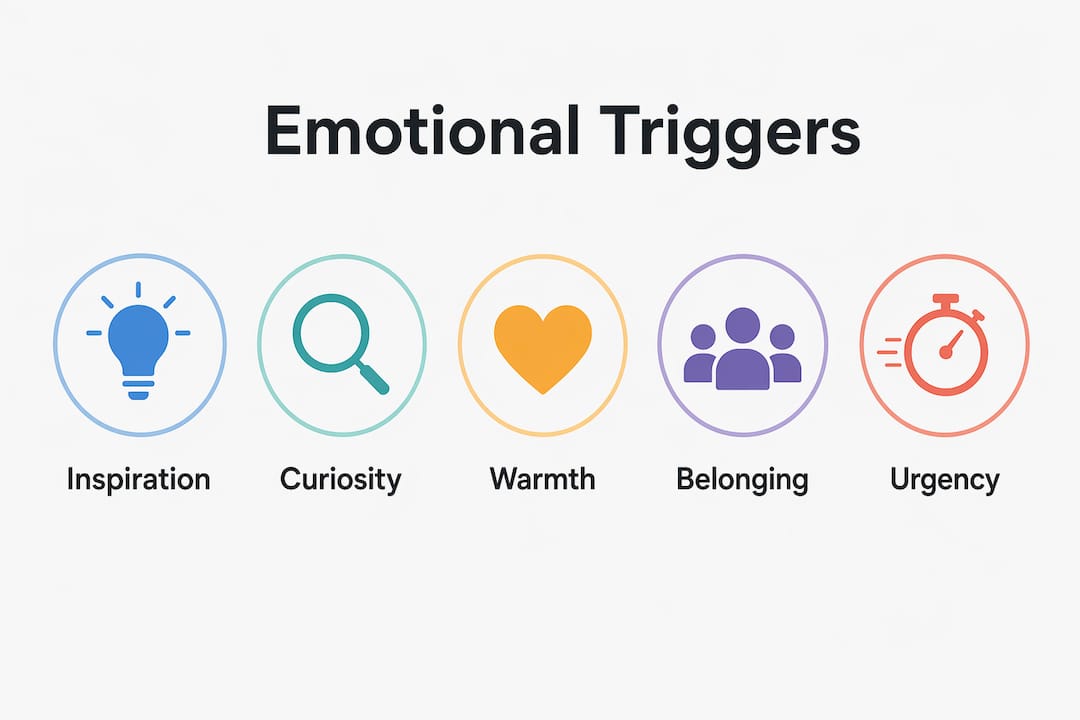
| Emotional trigger | Best campaign context | Example approach |
|---|---|---|
| Inspiration | Launch, milestone, cause campaigns | Share a customer transformation story |
| Curiosity | Teaser, re-engagement, product reveal | Use an open loop in the subject line |
| Warmth | Welcome series, post-purchase, loyalty | Write as if to a friend, not a subscriber |
| Belonging | Community, VIP, anniversary emails | Acknowledge the reader’s place in your brand story |
| Urgency | Flash sale, cart abandonment, expiry | Frame scarcity around loss, not just time |
Storytelling is the delivery mechanism for all of these triggers. A welcome email that opens with a founder’s personal struggle creates warmth and belonging simultaneously. A cart abandonment email that frames the abandoned product as something the customer deserves creates urgency without pressure.
Emails that sound like human conversations consistently outperform polished, feature-heavy templates. Relatable small human moments build trust faster than automated personalization tactics like inserting a first name into a generic template. The distinction matters: personalization is a tactic, but emotional honesty is a strategy.
Language simplicity amplifies emotional impact. Short sentences, plain words, and a conversational tone lower the reader’s guard. When the guard is down, emotion lands cleanly. Overly formal or corporate language signals distance, and distance kills emotional connection.
Pro Tip: Read your email aloud before sending. If any sentence sounds like something a company would say rather than a person, rewrite it.
Emotional copy must be genuinely felt by the writer to resonate authentically with readers. Brands that simulate excitement without feeling it produce copy that readers sense is hollow, even if they cannot articulate why. The fix is not better writing technique. It is writing from a real place.
What common pitfalls arise in emotional email marketing?
Emotional email marketing fails in predictable ways. Knowing the failure modes protects your brand and your list.
-
Emotional leakage. This occurs when internal stress, frustration, or urgency inside your team projects into the tone of your campaign copy. A cooling-off period of several hours or a full day before finalizing emotionally sensitive campaigns allows for objective tone assessment. What feels passionate in the moment often reads as aggressive or desperate to a subscriber.
-
Email incivility. Rude, dismissive, or passive-aggressive language in emails does measurable psychological damage. Email incivility triggers rumination, increases anxiety, and lowers positive recipient actions. Subscribers who feel disrespected do not just unsubscribe. They remember the feeling and associate it with your brand.
-
Uncanny valley personalization. Hyper-specific personalization that feels surveillance-like triggers discomfort rather than connection. Knowing a customer’s name is useful. Referencing their browsing behavior in a way that feels intrusive is not.
-
Ignoring brand image as context. The same emotional tone can excite loyal customers but read as spammy to cold prospects. Your existing brand image shapes how every emotional trigger lands. Test emotional campaigns on warm segments before rolling them out to your full list.
-
Manipulative framing. False urgency, manufactured scarcity, and guilt-based copy erode trust over time. Readers are sophisticated. They recognize manipulation, and it damages the relationship permanently.
“Emotional copy is human, not manipulative. Authentic emotional feeling from the writer is what makes it resonate. Brands should not simulate excitement but genuinely feel the emotions they convey.”
How to apply emotional email marketing in your campaigns
Applying emotional email marketing effectively requires a clear process, not just good instincts. The following framework works for both new campaigns and existing flows that need improvement.
-
Define the target emotion first. Before writing a single word, decide what you want the reader to feel. Inspiration? Relief? Excitement? Every creative decision, from subject line to CTA, should serve that single emotional goal.
-
Segment your audience by relationship stage. A new subscriber needs warmth and belonging. A lapsed customer needs re-engagement through curiosity or nostalgia. A loyal customer responds to exclusivity and recognition. Sending the same emotional tone to all three segments wastes the opportunity. Personalized email templates built around relationship stage dramatically improve emotional resonance.
-
Write the story before the offer. Open with a human moment, a customer story, a founder reflection, or a relatable scenario. Introduce the product or offer only after the emotional frame is established.
-
Use design to reinforce emotion. Color, imagery, and white space all carry emotional weight. Warm tones and candid photography support warmth and authenticity. Clean layouts with bold typography support urgency and clarity. Design and copy must point toward the same feeling.
-
Measure emotional engagement, not just clicks. Track reply rates, forward rates, and unsubscribe rates alongside open and click rates. Replies and forwards are the strongest signals that an email created genuine emotional impact. High unsubscribe rates after a campaign often signal a tone mismatch.
Successful examples of emotional email campaigns share one trait: they treat the reader as a person, not a conversion target. A post-purchase email that acknowledges the customer’s decision and expresses genuine appreciation outperforms a generic order confirmation every time. The role of email in customer retention depends almost entirely on whether customers feel seen and valued across the full lifecycle.
- Map each automated flow to a specific emotion: welcome series to warmth, abandoned cart to curiosity or mild urgency, post-purchase to appreciation, win-back to nostalgia.
- A/B test emotional angles, not just subject lines. Test a story-led version against a benefit-led version of the same email.
- Review your highest-performing emails for emotional patterns. The ones that generated replies are your emotional benchmarks.
Key Takeaways
Emotional email marketing outperforms informational email because it activates the brain’s decision-making system before logic can intervene, creating loyalty and revenue that satisfaction alone cannot produce.
| Point | Details |
|---|---|
| Emotion drives value | Emotionally connected customers are 52% more valuable than highly satisfied ones. |
| Lead with feeling | The emotional brain reacts before rational thought, so emotional hooks must come first. |
| Authenticity is non-negotiable | Copy that simulates emotion without genuine feeling reads as hollow and erodes trust. |
| Segment before you send | The same emotional tone lands differently on loyal customers versus cold prospects. |
| Measure beyond clicks | Reply rates and forward rates reveal true emotional impact better than open rates alone. |
What I’ve learned about emotion in email after working with real brands
Most brands I work with treat emotional email marketing as a copywriting upgrade. They think the fix is better adjectives or a warmer sign-off. It is not. The real shift is structural. Emotion has to be the brief, not the polish.
The brands that see the biggest gains from emotional email are the ones that start every campaign by asking, “What do we want the reader to feel?” before they ask, “What do we want the reader to do?” That sequence change sounds small. In practice, it rewires how the entire email gets built.
One thing 2026 research keeps confirming is that authenticity is not a soft concept. It is a measurable variable. When the writer genuinely feels the emotion they are trying to convey, the copy lands. When they do not, readers sense it, even if they cannot explain why. The practical implication is that emotionally sensitive campaigns should be written by someone who actually cares about the outcome, not delegated to whoever has bandwidth.
The hardest thing to get brands to accept is that their existing brand image shapes how every emotional trigger is received. A brand with a cold, corporate history cannot suddenly send a warm, personal email and expect it to land. Emotional marketing requires consistency over time. You build the permission to be emotional by being human in every email, not just the ones where you need something from the reader.
— Take
How Take-action helps brands build emotionally intelligent email programs
Take-action works with ecommerce brands that want email to do more than announce sales. The agency designs campaigns and automated flows that are built around emotional strategy from the start, not layered on top of generic templates.
Every engagement starts with understanding where a brand’s audience sits emotionally and what flows are missing from the customer lifecycle. Take-action then builds or rebuilds those flows, from welcome series to post-purchase sequences, with emotional intent baked into the brief. The result is email that customers actually want to read. If you want campaigns that create genuine connection and measurable retention, Take-action’s email marketing services are built exactly for that.
FAQ
What is emotional email marketing in simple terms?
Emotional email marketing is the practice of writing emails that intentionally make the reader feel something specific, such as warmth, curiosity, or inspiration, to drive engagement and build long-term loyalty.
Why do emotions matter more than information in email?
The emotional brain processes email content before rational thought kicks in, so emails without a clear emotional hook are filtered out or deleted before the information is ever read.
What are the most effective emotional triggers in email campaigns?
Inspiration, curiosity, warmth, belonging, and urgency are the five most effective emotional triggers, each working best in specific campaign contexts such as launches, welcome series, or cart abandonment flows.
How do I avoid emotional manipulation in my emails?
Write from a genuine place, avoid false scarcity or guilt-based framing, and use a cooling-off period before sending emotionally sensitive campaigns to check that the tone reflects your brand values rather than internal pressure.
How do I measure whether my emotional emails are working?
Track reply rates, forward rates, and unsubscribe rates alongside standard click metrics. High reply and forward rates are the clearest signals that an email created real emotional impact.