

What Is an Email Marketing Stack? Your 2026 Guide
TL;DR:
- A successful email marketing stack consists of four connected layers: Data, Flow, Campaign, and Optimization. Proper authentication protocols like SPF, DKIM, and DMARC are essential for inbox placement and deliverability. Separating marketing and transactional emails onto different subdomains protects deliverability and maintains trust.
An email marketing stack is defined as a layered architecture of integrated tools that collects customer data, automates workflows, manages campaigns, and measures performance to drive revenue. Most marketers treat email as a single platform. The reality is that a high-performing program runs on four distinct functional layers, each doing a specific job. Understanding what is email marketing stack architecture means understanding how those layers connect, what breaks when they don’t, and why authentication standards like SPF, DKIM, and DMARC are not optional. This guide covers every component, from data capture to deliverability, so you can build or audit your own setup with confidence.
What are the essential layers and components of an email marketing stack?
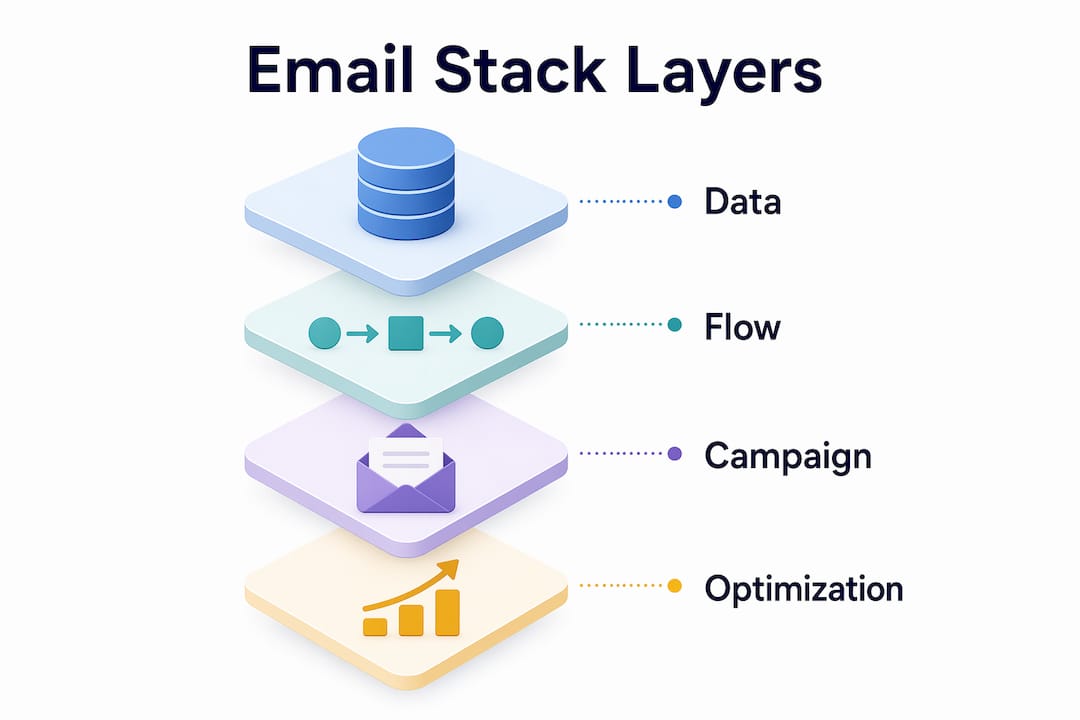
A modern email marketing stack consists of four functional layers: Data, Flow, Campaign, and Optimization. Each layer serves a distinct role, and the stack only performs at full capacity when all four connect cleanly.
The data layer
The data layer is the foundation. It captures zero-party data through quizzes, preference centers, and signup forms, then combines it with behavioral event tracking from your ecommerce platform or website. Customer data platforms (CDPs) unify these inputs into a single profile per contact. Without clean, unified profiles, every automation downstream is guessing. Zero-party data collection is the most reliable way to build profiles that actually reflect what customers want.
The flow layer
The flow layer handles automated sequences triggered by customer behavior. Welcome series, cart abandonment flows, post-purchase sequences, and win-back campaigns all live here. These flows run without manual intervention, which is why automated email workflows generate revenue around the clock. The quality of your flow layer depends entirely on the data layer feeding it.

The campaign layer
The campaign layer covers broadcast emails: promotional sends, segmented newsletters, and seasonal campaigns. This is the layer most marketers think of first, and the one that gets the most attention. It is also the layer most dependent on the other three. A campaign sent to a poorly segmented list, through weak infrastructure, with no optimization feedback loop, will underperform regardless of how good the creative is.
The optimization layer
The optimization layer closes the loop. A/B testing, deliverability monitoring, and predictive analytics all belong here. Customer lifetime value now drives email strategy more than open rates, which means the optimization layer needs to feed LTV signals back into the data and flow layers continuously.
| Layer | Core function | Tool category |
|---|---|---|
| Data | Profile building, event tracking | CDP, form tools, ecommerce integrations |
| Flow | Triggered automation sequences | Marketing automation platforms |
| Campaign | Broadcast and segmented sends | Email service providers (ESPs) |
| Optimization | Testing, analytics, deliverability | A/B testing tools, inbox monitoring |
Pro Tip: Map your current tools to each layer before adding anything new. Most stacks have gaps in the data or optimization layer, not the campaign layer.
How does technical email infrastructure support deliverability?
Email authentication protocols are mandatory for inbox placement. SPF, DKIM, and DMARC are not optional settings. Missing any one of them causes inbox placement failure regardless of how good your email platform is.
SPF (Sender Policy Framework) tells receiving mail servers which IP addresses are authorized to send on behalf of your domain. DKIM (DomainKeys Identified Mail) adds a cryptographic signature to each message, proving it was not altered in transit. DMARC (Domain-based Message Authentication, Reporting, and Conformance) instructs receiving servers on what to do when SPF or DKIM checks fail. Together, these three protocols form the authentication baseline every sender must meet in 2026.
Transactional emails should use dedicated IPs and subdomain isolation with strict authentication. Marketing emails can use shared or dedicated IPs depending on volume and reputation strategy. Keeping these two streams on separate subdomains prevents a deliverability problem in one from contaminating the other.
High-volume senders using AI-driven reputation monitoring and managed IP warm-up achieve inbox placement rates of 95–98%. That number reflects what is possible when infrastructure is treated as a core investment, not an afterthought.
| Protocol | Function | Best practice |
|---|---|---|
| SPF | Authorizes sending IPs | Publish one SPF record per domain |
| DKIM | Signs messages cryptographically | Use 2048-bit keys, rotate annually |
| DMARC | Enforces authentication policy | Start with p=none, move to p=reject |
| IP warm-up | Builds sender reputation gradually | Ramp volume over 4–6 weeks |
Pro Tip: Set up a dedicated subdomain for marketing sends (e.g., mail.yourdomain.com) and keep your root domain clean for transactional messages. This protects your most critical communications.
What strategies improve email marketing effectiveness across the stack?
Customer lifetime value segmentation is the single biggest shift in email strategy over the past two years. The brands winning with email are not sending more. They are sending smarter, using predictive scoring to identify which customers are worth re-engaging and which are not.
Data hygiene is the largest hidden bottleneck in most stacks. Without mapping zero-party data and event tracking to unified profiles, automation cannot personalize flows effectively. A contact with incomplete data gets generic messages. Generic messages produce low engagement. Low engagement damages sender reputation. The chain reaction starts with dirty data.
Best practices for improving stack performance:
- Separate marketing and transactional emails onto different subdomains and sending infrastructure from day one.
- Build multi-flow architecture with distinct sequences for welcome, cart abandonment, post-purchase, and win-back. Each flow serves a different customer moment.
- Use predictive LTV scoring to segment your list before launching win-back campaigns. Not every lapsed customer is worth the same re-engagement cost.
- Collect zero-party data actively through preference centers, quizzes, and post-purchase surveys. This data ages better than behavioral signals alone.
- Audit your list every 90 days. Remove hard bounces immediately and suppress contacts with no engagement in 180 days.
- Monitor deliverability weekly, not monthly. Reputation problems compound faster than most marketers expect.
Pro Tip: Build your win-back flow around LTV tiers, not just recency. A customer who spent $500 once two years ago deserves a different sequence than someone who bought once for $20 last month.
The email marketing ROI tactics that consistently outperform rely on this kind of segmentation precision. Broad blasts to unsegmented lists are the fastest way to erode a sender reputation that took months to build.
Integration with your ecommerce platform is non-negotiable. Your flow layer needs real-time purchase events, browse abandonment signals, and product catalog data to trigger the right message at the right moment. Platforms like Klaviyo are built specifically for this kind of ecommerce data integration, which is why they dominate among direct-to-consumer brands.
How do you select and integrate email marketing tools?
All-in-one email platforms suit small or less technical businesses, but scaling brands benefit from best-of-breed tools integrated for optimal performance. The choice is not about which platform has the best feature list. It is about which architecture matches your team’s technical capacity and your business’s growth trajectory.
A practical framework for tool selection and integration:
- Audit your current stack against the four layers. Identify which layers have no dedicated tool and which have redundant ones.
- Define your sending volume and growth rate. Entry-level platforms handle up to a few thousand contacts well. Enterprise-grade infrastructure becomes necessary as you scale past 100,000 contacts.
- Evaluate API versus SMTP sending. API integration gives you more control over sending logic and event tracking. SMTP is simpler to set up but offers less flexibility for complex automation.
- Check native integrations with your CRM and ecommerce platform. A tool that requires custom middleware for every connection creates maintenance debt.
- Assess usability for your marketing team. A technically superior platform that your team cannot use confidently will underperform a simpler one they use well.
- Separate your transactional sending infrastructure. Using the same SMTP service for marketing and transactional emails risks marketing deliverability issues disrupting critical order notifications.
Pro Tip: Never use one sending domain for both marketing and transactional emails. A single spam complaint spike from a promotional campaign can delay order confirmation emails, which directly damages customer trust.
Retail email automation tools vary widely in how well they handle the flow layer specifically. Evaluate any platform’s automation builder against your actual flow requirements before committing.
Key takeaways
An email marketing stack performs at full capacity only when all four layers, Data, Flow, Campaign, and Optimization, are connected, authenticated, and fed by clean customer data.
| Point | Details |
|---|---|
| Four-layer architecture | Every effective stack needs Data, Flow, Campaign, and Optimization layers working together. |
| Authentication is mandatory | SPF, DKIM, and DMARC are prerequisites for inbox placement, not optional configurations. |
| Separate email types | Keep marketing and transactional emails on different subdomains to protect deliverability. |
| LTV drives strategy | Use predictive scoring to segment by customer lifetime value, not just recency or open rates. |
| Data hygiene is foundational | Clean, unified customer profiles are what make automation personalization possible. |
What I’ve learned about stacks that most guides skip
Most articles about building an email marketing stack focus on tool selection. That is the wrong starting point. The real work is in the data layer, and most brands skip it entirely.
I have seen ecommerce brands with sophisticated automation platforms and beautifully designed campaigns that still underperform because their contact profiles are incomplete. They have email addresses and purchase history, but no preference data, no browse behavior mapped to profiles, and no LTV scores informing their segmentation. The result is a flow layer running on assumptions instead of signals.
The shift from open rates to customer lifetime value as the primary metric is not just a trend. It is a structural change in how email programs need to be built. A stack optimized for opens will send more. A stack optimized for LTV will send smarter, and the revenue difference is significant.
The other thing most guides understate is infrastructure separation. Marketers treat transactional and marketing emails as the same problem. They are not. A deliverability issue in your marketing stream should never be able to delay a customer’s order confirmation. That requires separate subdomains, separate IPs, and separate sending services. It is not complicated to set up, but it requires intentional architecture from the start.
The brands I see scaling email revenue consistently are not the ones with the most tools. They are the ones who invested in clean data, disciplined flow architecture, and weekly deliverability monitoring. The stack is only as good as the discipline behind it.
— Take
How Take-action builds email stacks that drive real revenue
Building an email marketing stack that actually performs takes more than picking the right platform. It takes architecture decisions, authentication setup, flow design, and ongoing optimization working together.
Take-action specializes in designing and managing integrated email stacks for ecommerce brands, primarily using Klaviyo. The agency handles everything from authentication setup and subdomain configuration to multi-flow architecture, LTV-driven segmentation, and deliverability monitoring. If your current program relies on broadcast campaigns without a real flow layer, or if your data layer is not feeding clean signals into your automation, Take-action can rebuild it from the ground up. See the full range of services and find out what a properly built stack can do for your retention revenue.
FAQ
What is an email marketing stack in simple terms?
An email marketing stack is a set of integrated tools that work together to collect customer data, send automated and broadcast emails, and measure results. It typically includes four layers: Data, Flow, Campaign, and Optimization.
What are the core components of email marketing?
The core components are a data layer for profile building, a flow layer for automated sequences, a campaign layer for broadcast sends, and an optimization layer for testing and deliverability monitoring.
Why do SPF, DKIM, and DMARC matter for email marketing?
SPF, DKIM, and DMARC are authentication protocols that prove your emails are legitimate. Missing any one of them causes inbox placement failure regardless of the quality of your email platform.
Should marketing and transactional emails use the same infrastructure?
No. Using the same sending service for both types risks a marketing deliverability issue disrupting critical transactional messages like order confirmations. Separate subdomains and sending infrastructure are the standard best practice.
When should a business move from an all-in-one platform to a best-of-breed stack?
All-in-one platforms work well for smaller businesses with limited technical resources. Scaling brands that need more flexibility, deeper integrations, or higher sending volumes benefit from integrating specialized best-of-breed tools across each stack layer.