

What Is a Sampling Campaign Email? A Marketer’s Guide
TL;DR:
- Sampling campaign emails offer targeted product trials to build trust and generate authentic user content. They require precise audience targeting, measurable tracking, and disciplined follow-up to maximize long-term sales impact. Proper execution turns sampling into a scalable, data-driven growth tool.
A sampling campaign email is a targeted message sent to consumers, creators, or high-value customers that offers free or discounted product samples to drive trials, collect feedback, and generate authentic user content. Unlike a standard promotional email pushing a discount code, this format is a formal marketing channel with measurable workflows and clear performance metrics. The sampling campaign definition centers on distributing physical products to build social proof and purchase intent, not to generate immediate revenue. Brands that understand this distinction use sampling emails to build trust at scale, which is something no coupon can replicate.

What is a sampling campaign email and how does it work?
A sampling campaign email is the entry point of a structured product distribution workflow. It identifies a target recipient, makes an offer, and triggers a sequence of follow-up actions tied to measurable outcomes.
The workflow breaks down into four stages:
- Audience identification. You select recipients based on purchase history, engagement score, or creator status. High-value customers, micro-influencers, and brand advocates are the most common targets. Sending samples to unqualified recipients wastes budget and dilutes data.
- The offer email. This message presents the sample offer clearly, explains what the recipient needs to do in return (write a review, post content, or complete a survey), and includes a unique tracking code or UTM parameter tied to that recipient segment.
- Sample fulfillment and content creation. Once a recipient claims the sample, the product ships. The follow-up email sequence prompts the recipient to share feedback or create content within a defined window, typically 7–14 days after delivery.
- Tracking and attribution. UTM parameters and unique discount codes connect content creation and purchases back to the original campaign. This turns product gifting into a repeatable system that generates measurable revenue outcomes rather than vague brand awareness.
Sampling emails also integrate naturally into Klaviyo flows. A post-purchase flow can trigger a sample offer after a customer hits a spending threshold. A winback flow can use a sample as the re-engagement hook instead of a discount.
Pro Tip: Tag every sample recipient in your email platform with a custom property. This lets you build a dedicated segment for follow-up campaigns and track long-term purchase behavior from that cohort.
What are the benefits and challenges of sampling campaign emails?
Sampling campaign emails outperform traditional promotions on one critical metric: trust. Direct product experience creates authentic impressions that advertising cannot manufacture. A customer who has used your product and loved it becomes a credible advocate. That credibility converts better than any headline.
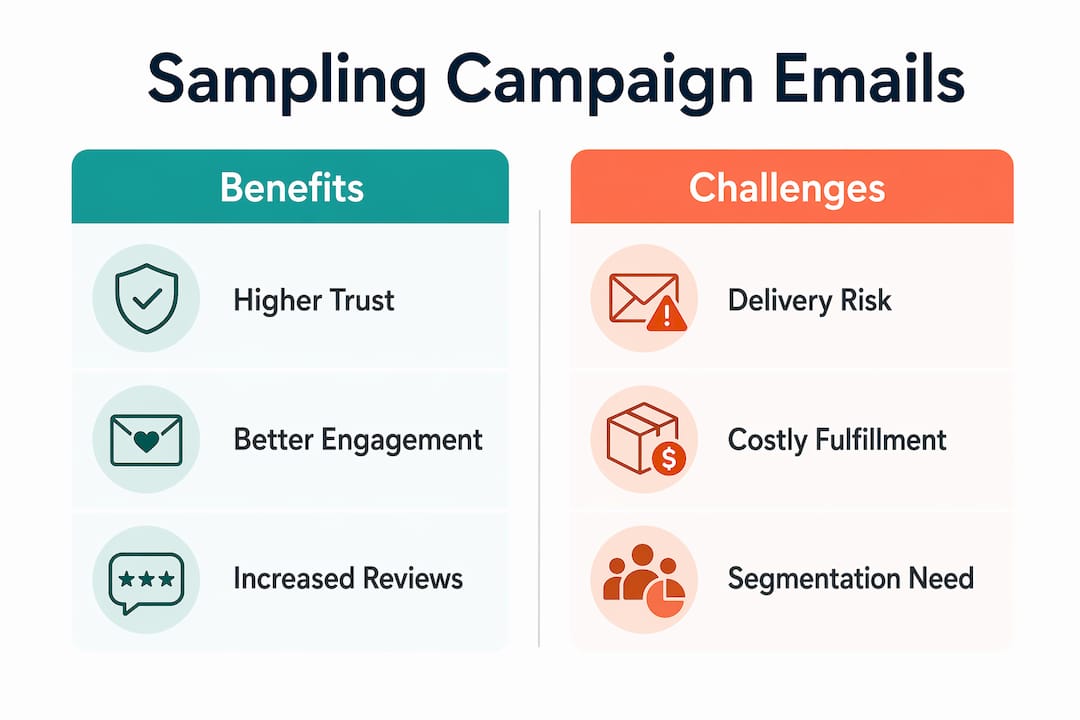
The long-term sales impact is another key advantage. Sampling campaigns can sustain sales lift for over a year, far beyond the tracking window of a typical coupon campaign. That duration matters for new product launches and market entry, where building lasting awareness is more valuable than a short-term spike.
The benefits are real, but so are the challenges:
- High cost per acquisition. Physical samples require production, packaging, and shipping. The upfront investment is significant compared to a digital promotion.
- Targeting precision. Sending samples to the wrong audience wastes money and generates low-quality feedback. Tight segmentation is non-negotiable.
- Email deliverability risks. Spam trigger phrases like “free” or “guarantee” can damage your domain reputation, even on a warmed sending domain. Complaint and unsubscribe rates above acceptable thresholds signal content or list problems that require a campaign pause.
- Attribution complexity. Connecting a sample sent in march to a purchase made in june requires disciplined tracking from day one.
Social media product research influences about 32% of consumer behavior. That figure shows why sampling campaigns that generate creator content pay dividends well beyond the initial email send.
Pro Tip: Avoid the word “free” in your subject line. Use “complimentary sample” or “exclusive product trial” instead. You preserve the offer’s appeal without triggering spam filters.
How to design an effective email sampling strategy
A strong email sampling strategy starts with a clear objective. Are you collecting reviews for a product launch? Building a creator content library? Re-engaging lapsed customers? Each goal requires a different audience, offer structure, and success metric.
Define your audience and distribution method
Segment your list before you write a single word of copy. High-value customers (top 10% by lifetime value), recent purchasers of a related product, and vetted micro-influencers are the three segments that consistently deliver the best return. Sampling allows testing across delivery methods, including direct mail, in-store distribution, and digital campaigns, so your channel choice should match where your audience is most responsive.
Craft email content that avoids deliverability pitfalls
Your subject line, preview text, and body copy all affect inbox placement. Keep the subject line under 50 characters. Avoid all-caps words and excessive punctuation. Use plain, direct language that matches your brand voice. The call to action should be a single, specific request: “Claim your sample” or “Request your trial kit.”
Here is a comparison of two email sampling approaches by objective:
| Objective | Audience | Offer structure | Primary KPI |
|---|---|---|---|
| Product launch reviews | Recent buyers, top spenders | Free sample, review request | Review volume |
| Creator content library | Micro-influencers, brand advocates | Free sample, content brief | Content pieces created |
| Winback campaign | Lapsed customers (90+ days) | Complimentary trial, discount on next order | Reactivation rate |
| Market entry | New segment, cold list | Sample with survey | Survey completion, purchase intent score |
Use feedback to build your follow-up sequence
Every sampling campaign generates data. Survey responses, review text, and content posts all feed back into your email program. Repurposing user-generated content from sampling into follow-up emails increases social proof without additional production cost. A post-campaign email featuring real customer photos and quotes from sample recipients consistently outperforms generic product photography.
Pro Tip: Build a dedicated Klaviyo segment for sampling campaign participants. Track their purchase frequency and average order value for 90 days post-campaign. This data justifies future sampling budgets with hard numbers.
How do you measure the success of sampling campaign emails?
Measurement is what separates a sampling campaign from a giveaway. Every send needs a tracking architecture in place before the first email goes out.
The core KPIs for an email sampling strategy are:
- Review volume and quality. Count the number of reviews generated and assess their average rating and length. Detailed reviews signal genuine product engagement.
- Email engagement rates. Open rate, click rate, and reply rate on the sample offer email show whether your audience found the offer compelling.
- Conversion tracking. Unique discount codes and UTM parameters connect sample recipients to downstream purchases. This is your direct revenue attribution.
- Content output. For creator campaigns, track the number of posts, total reach, and engagement rate on content generated from the sample.
Seed-list testing is the only reliable method to verify actual inbox placement. Platform dashboards often count spam folder delivery as a successful send. A seed list of real email addresses across major providers (Gmail, Outlook, Yahoo) tells you exactly where your campaign lands. Run a seed test before every major campaign send, and run a triggered test after any significant change to your email template or sending domain.
Longitudinal tracking matters as much as immediate results. Sampling’s sales impact can extend well beyond the initial campaign window. Build a 90-day and 180-day cohort report for every sampling campaign to capture the full revenue picture.
Pro Tip: For email copy tests to detect small improvements in the 3–5% range, you need a minimum of 200 recipients per test variant. If your list is smaller, aggregate data across several sends before drawing conclusions.
Key Takeaways
A sampling campaign email is a formal, trackable marketing channel that builds consumer trust through direct product experience and generates measurable revenue outcomes when executed with clear objectives and disciplined tracking.
| Point | Details |
|---|---|
| Core definition | A sampling campaign email distributes free or discounted products to drive trials, reviews, and authentic user content. |
| Long-term sales impact | Sampling campaigns can sustain sales lift for over a year, far outlasting typical coupon campaign effects. |
| Deliverability discipline | Avoid spam trigger words and run seed-list tests before every major send to protect inbox placement. |
| Tracking architecture | UTM parameters and unique codes connect sample recipients to downstream purchases for accurate attribution. |
| Content repurposing | User-generated content from sampling campaigns feeds directly into follow-up email sequences to increase social proof. |
Why sampling emails are the most underrated tool in email marketing
Most brands treat sampling as a one-off activation, a box of products sent out before a launch with no follow-up system and no tracking. That approach wastes the entire potential of the channel.
What I have seen work consistently is treating sampling as a lifecycle marketing input, not a standalone campaign. The content, reviews, and behavioral data generated by a sampling send feed every other channel: paid ads, organic social, and especially email flows. A well-executed sampling campaign gives you 90 days of follow-up material and a cohort of high-intent customers you can market to with precision.
The biggest mistake I see is skipping the measurement layer. Brands send samples, see some social posts, and call it a success. Without UTM tracking, unique codes, and a dedicated recipient segment, you cannot prove ROI, and you cannot improve the next campaign. Sampling without tracking is just gifting.
The future of this channel sits at the intersection of creator outreach and influencer marketing ROI. Brands that build repeatable sampling workflows now, complete with automated flows, segmented follow-ups, and content repurposing systems, will have a compounding advantage over brands still relying on paid ads alone.
— Take
How Take-action turns sampling campaigns into a growth channel
Sampling campaign emails require more than a good offer. They need a tracking architecture, a follow-up flow, and a content repurposing system working together from day one.
Take-action builds exactly that. As a specialized email marketing and retention agency, Take-action designs sampling campaign flows inside Klaviyo, sets up UTM tracking and custom segments, and builds the post-campaign sequences that turn sample recipients into repeat buyers. Whether you are launching a new product, re-engaging lapsed customers, or building a creator content library, Take-action structures the entire workflow so every sample you send generates measurable revenue. Reach out to discuss a sampling strategy built for your brand.
FAQ
What is a sampling campaign email?
A sampling campaign email is a targeted message that offers free or discounted product samples to consumers or creators to drive trials, collect feedback, and generate authentic reviews. It functions as a formal marketing channel with measurable workflows, not a simple giveaway.
How does email sampling differ from a discount email?
A discount email drives immediate purchases through price reduction. A sampling email focuses on product trial, review generation, and long-term trust building, with sales impact that can extend well beyond the initial campaign window.
What metrics should I track for a sampling campaign?
Track review volume, email engagement rates, conversion rates via unique codes and UTM parameters, and content output for creator campaigns. Run seed-list tests to confirm actual inbox placement before drawing conclusions from dashboard delivery rates.
How do I avoid spam filters in sampling campaign emails?
Avoid trigger phrases like “free” or “guarantee” in subject lines, keep formatting clean, and monitor unsubscribe and complaint rates closely. Use terms like “complimentary sample” or “exclusive trial” to preserve the offer’s appeal without harming domain reputation.
Can sampling campaign emails integrate with Klaviyo flows?
Yes. Sampling offers work well inside post-purchase flows triggered by spending thresholds and winback flows targeting lapsed customers. Klaviyo’s segmentation tools let you tag sample recipients and track their purchase behavior for 90 days or more after the campaign.