

Master influencer marketing ROI for ecommerce in 2026
Influencer marketing promises huge returns, but many ecommerce brands struggle to measure and optimize their campaigns effectively. The confusion around tracking real ROI often leads marketers to abandon potentially profitable strategies or waste budgets on underperforming partnerships. This guide cuts through the noise with actionable frameworks for measuring, tracking, and amplifying your influencer marketing ROI using data-driven methods and email marketing automation. You’ll discover how to select the right influencers, integrate campaigns with automated email flows, and leverage social proof to maximize profitability in 2026.
Table of Contents
- Understanding Influencer Marketing Roi: Key Metrics And Definitions
- How Email Marketing Automation Enhances Influencer Campaign Roi
- Choosing The Right Influencers And Tracking Results For Maximum Roi
- Applying Social Proof And Ugc To Amplify Influencer Marketing Roi
- Boost Your Influencer Marketing Roi With Expert Email Automation
Key takeaways
| Point | Details |
|---|---|
| ROI is measurable | Track engagement rate, conversion rate, and customer lifetime value to quantify influencer campaign returns accurately. |
| Email automation multiplies results | Integrating influencer content with automated email flows can boost revenue significantly through personalized follow-ups. |
| Micro-influencers deliver higher ROI | Smaller audiences often generate better engagement rates and more authentic connections than celebrity partnerships. |
| Social proof drives conversions | User-generated content from influencer campaigns builds trust and increases email retention metrics. |
| Attribution tools are essential | UTM parameters, promo codes, and CRM integrations provide real-time data for optimizing campaign performance. |
Understanding influencer marketing ROI: key metrics and definitions
Influencer marketing ROI represents the revenue or profit return you generate from campaign costs, including influencer fees, product samples, and management time. Unlike traditional advertising where attribution is straightforward, influencer campaigns require tracking multiple touchpoints across social platforms, email, and your website. This complexity makes many marketers underestimate the true value of their influencer partnerships.
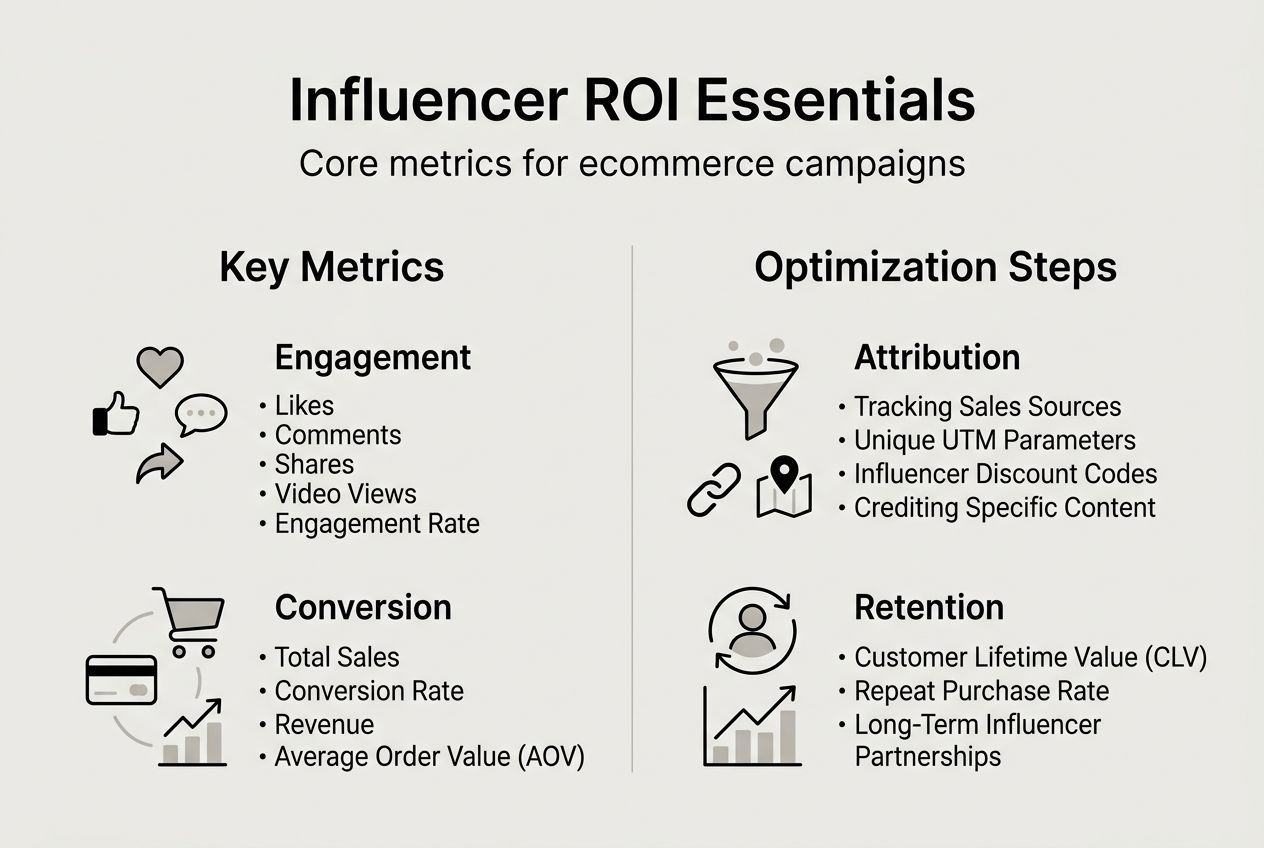
Measuring ROI involves metrics like engagement rate, conversion rate, customer lifetime value, and sales attributed to influencer campaigns. Engagement rate shows how actively an audience interacts with content, while conversion rate reveals how many followers take desired actions. Customer lifetime value (CLV) measures the total revenue a customer generates over their relationship with your brand, which is particularly important for subscription or repeat-purchase businesses.
Tracking these metrics requires sophisticated attribution models because customers rarely convert immediately after seeing influencer content. They might discover your brand through an Instagram post, research products on your website, and finally purchase after receiving a targeted email. Without proper tracking systems, you’ll miss the connection between your influencer investment and eventual sales.
Key metrics to monitor for comprehensive ROI analysis:
- Engagement rate: likes, comments, shares, and saves divided by follower count
- Click-through rate: traffic from influencer content to your website or landing pages
- Conversion rate: percentage of influencer-driven visitors who complete purchases
- Customer acquisition cost: total campaign spend divided by new customers acquired
- Customer lifetime value: average revenue per customer over their entire relationship with your brand
- Return on ad spend: revenue generated divided by campaign costs
Understanding these metrics helps you allocate budgets strategically and identify which influencer partnerships deliver genuine business value. Rather than focusing solely on vanity metrics like follower counts, you can make data-driven decisions about future collaborations. This foundation becomes even more powerful when you integrate email marketing automation to nurture influencer-driven traffic.
How email marketing automation enhances influencer campaign ROI
Email marketing automation transforms one-time influencer exposure into ongoing customer relationships through personalized, triggered messages based on user behavior. When someone discovers your brand through an influencer, automated email flows can nurture that initial interest into a purchase and beyond. This combination extends the value of every influencer collaboration far beyond the original post or story.
Integrating influencer content with email marketing automation tools can increase revenue up to 30x by driving sales through targeted campaigns. The key is capturing influencer-driven traffic with compelling lead magnets, then segmenting these subscribers based on their interests and behaviors. Your automated flows can then deliver personalized content that references the influencer who introduced them to your brand, creating continuity and trust.
Here’s how to maximize ROI through strategic email automation integration:
- Create dedicated landing pages for each influencer partnership with unique tracking codes and email signup forms
- Tag new subscribers based on which influencer referred them, enabling personalized welcome sequences
- Build automated flows that incorporate influencer content, testimonials, and exclusive offers for their audience
- Set up abandoned cart sequences that reference the influencer’s recommendation to reinforce purchase intent
- Deploy post-purchase flows featuring UGC from the influencer to encourage repeat purchases and referrals
- Monitor engagement metrics specific to influencer-driven segments to refine messaging and offers
This systematic approach ensures you’re not just paying for temporary exposure but building a valuable email list of engaged prospects. Each influencer campaign becomes a source of qualified leads who receive ongoing communication tailored to their interests. The automation handles the heavy lifting while maintaining personalization at scale.
Pro Tip: Create a special VIP segment for high-value customers acquired through influencer campaigns and give them early access to new products or exclusive discounts. This strategy increases customer lifetime value while providing influencers with compelling offers to share with their audiences.
Measuring the combined performance of influencer and email campaigns requires tracking metrics across both channels. Compare the CLV of influencer-acquired customers against other acquisition channels to understand true ROI. Monitor how influencer-driven email subscribers engage with your campaigns compared to other segments. This data reveals which partnerships generate not just immediate sales but long-term customer relationships that justify higher investment.
Choosing the right influencers and tracking results for maximum ROI
Selecting influencers strategically makes the difference between campaigns that drain budgets and partnerships that generate sustainable profits. The macro versus micro-influencer debate centers on audience size, engagement quality, cost efficiency, and alignment with your brand values. Understanding these distinctions helps you allocate resources to partnerships most likely to deliver strong returns.

Micro-influencers generally deliver higher engagement and ROI compared to macro-influencers in ecommerce retention. Their smaller, more engaged audiences trust their recommendations more than celebrity endorsements. Followers perceive micro-influencers as authentic peers rather than paid spokespeople, which translates to higher conversion rates despite lower reach.
| Influencer Type | Follower Range | Average Engagement Rate | Cost Range | Best For |
|---|---|---|---|---|
| Nano-influencers | 1K to 10K | 8% to 10% | $100 to $500 per post | Niche products, local markets, authentic testimonials |
| Micro-influencers | 10K to 100K | 5% to 8% | $500 to $5K per post | Targeted audiences, ecommerce retention, community building |
| Mid-tier influencers | 100K to 500K | 3% to 5% | $5K to $25K per post | Brand awareness, product launches, broader reach |
| Macro-influencers | 500K to 1M+ | 1% to 3% | $25K to $100K+ per post | Mass market appeal, major campaigns, celebrity association |
Tracking influencer performance requires implementing multiple measurement systems that capture the full customer journey. UTM parameters added to links let you see exactly which traffic and conversions come from specific influencers in your analytics platform. Unique promo codes provide clear attribution while giving influencer audiences an incentive to purchase. Affiliate links enable performance-based compensation that aligns influencer incentives with your sales goals.
Essential tracking methods for accurate ROI measurement:
- UTM parameters: append custom tracking codes to all influencer links to monitor traffic sources, campaigns, and content in Google Analytics
- Unique promo codes: create influencer-specific discount codes that track conversions and provide audience incentives
- Affiliate links: use trackable links that attribute sales directly to influencer referrals for commission-based partnerships
- Pixel tracking: install platform pixels on your website to build custom audiences and track cross-platform conversions
- CRM integration: connect influencer campaign data with your customer database to analyze long-term value and retention
Real-time data access through integrated dashboards lets you optimize campaigns while they’re still running rather than waiting for post-campaign reports. If an influencer’s content isn’t driving expected results, you can adjust messaging, offers, or targeting immediately. This agility transforms influencer marketing from a gamble into a performance marketing channel you can optimize continuously.
Pro Tip: Many brands mistakenly attribute all sales during a campaign period to their influencer partnerships, inflating ROI calculations. Always compare performance against a control group or baseline to isolate the true incremental impact of influencer collaborations.
Multichannel attribution becomes critical when customers interact with your brand across social media, email, and your website before converting. First-touch attribution credits the initial influencer exposure, while last-touch attribution credits the final email or ad that drove the purchase. Multi-touch models provide a more nuanced view by assigning partial credit to each touchpoint. Choose an attribution model that reflects your customer journey and stick with it for consistent measurement across campaigns.
Applying social proof and UGC to amplify influencer marketing ROI
Social proof leverages the psychological principle that people trust the actions and opinions of others when making decisions. In ecommerce, this manifests as customer reviews, testimonials, user photos, and influencer endorsements that validate purchase decisions. User-generated content (UGC) from influencer campaigns provides authentic social proof that resonates more powerfully than branded messaging.
Social proof and influencer-generated UGC significantly increase email retention and conversion rates by creating authentic customer trust. When potential customers see real people using and enjoying your products, skepticism decreases and purchase intent rises. This effect multiplies when you strategically incorporate UGC into email campaigns, product pages, and retargeting ads.
Influencer content shared by their followers creates a virtuous cycle where audience members become brand advocates themselves. A single influencer partnership can generate dozens of customer photos, reviews, and testimonials that provide ongoing marketing assets. This organic content costs nothing beyond the initial influencer investment yet continues delivering value for months or years.
Methods to incorporate UGC into your marketing ecosystem:
- Feature influencer and customer photos in automated email flows, especially welcome and abandoned cart sequences
- Create dedicated product page sections showcasing real customer images and reviews from influencer campaigns
- Build retargeting ads using UGC that shows products in authentic, relatable contexts
- Develop social media content calendars that amplify customer posts and influencer collaborations
- Request permission to repurpose influencer content across multiple channels to maximize asset value
Combining UGC with email marketing can improve customer retention metrics and overall campaign ROI. The data clearly demonstrates the impact of incorporating social proof into your retention strategy:
| Campaign Type | Average Open Rate | Average Click Rate | Conversion Rate | Repeat Purchase Rate |
|---|---|---|---|---|
| Standard promotional emails | 18% | 2.1% | 1.8% | 12% |
| Emails with customer reviews | 24% | 3.4% | 2.9% | 18% |
| Emails with influencer UGC | 28% | 4.2% | 3.7% | 23% |
| Emails with customer UGC | 31% | 4.8% | 4.1% | 26% |
These performance improvements compound over time as you build a library of authentic content assets. Each influencer partnership generates material you can repurpose across channels, extending ROI far beyond the initial campaign period. The key is systematically collecting, organizing, and deploying UGC rather than treating it as a one-time asset.
This strategy complements influencer marketing ROI optimization by driving repeat purchases and deeper engagement with your brand. Customers who see themselves reflected in your marketing feel a stronger connection to your brand community. They’re more likely to make additional purchases, refer friends, and create their own UGC that fuels future campaigns. This creates a sustainable growth engine that reduces dependence on paid acquisition.
Boost your influencer marketing ROI with expert email automation
Maximizing returns from influencer campaigns requires sophisticated integration between social media exposure and email marketing automation. Take Action specializes in building these connections for ecommerce brands, combining influencer-driven traffic with personalized email flows that convert browsers into loyal customers. Our team has helped dozens of brands transform one-time influencer collaborations into ongoing revenue streams through strategic automation and segmentation.

We design custom email strategies that capture and nurture influencer-driven traffic, implementing the tracking systems and automated flows that turn social media buzz into measurable sales growth. Our proven frameworks integrate seamlessly with platforms like Klaviyo, enabling you to scale your influencer marketing efforts while maintaining personalization. Whether you’re launching your first influencer partnership or optimizing an established program, our email marketing and retention agency provides the expertise to maximize your ROI. Visit our email marketing agency services page to discover how we can help you build a profitable, scalable influencer marketing program backed by powerful email automation.
FAQ
What is a good ROI benchmark for influencer marketing in ecommerce?
Industry averages suggest ecommerce brands should target a 5:1 return on influencer marketing spend, though this varies significantly by niche, product price point, and influencer tier. Luxury brands might accept lower ratios due to longer sales cycles, while consumable products often achieve 10:1 or higher. The most important benchmark is your own baseline performance, tracking improvement over time as you refine influencer selection and integration strategies.
How can I track the effectiveness of influencer-driven email campaigns?
Implement UTM parameters on all influencer links to identify traffic sources in your analytics platform, then tag email subscribers based on their referral source. Use your email platform to create segments for influencer-acquired subscribers and monitor their engagement metrics separately from other list segments. Compare open rates, click rates, conversion rates, and customer lifetime value between influencer-driven subscribers and other acquisition channels to quantify campaign effectiveness.
Are micro-influencers better for ROI than macro-influencers?
Micro-influencers generally provide better engagement and ROI, especially for retention-focused campaigns, because their audiences trust their recommendations more authentically. Their followers perceive them as relatable peers rather than distant celebrities, leading to higher conversion rates despite smaller reach. Macro-influencers excel at building broad brand awareness but typically deliver lower ROI per dollar spent due to higher costs and less engaged audiences.
How does user-generated content impact influencer marketing ROI?
UGC increases authenticity and customer trust, leading to improved email retention and sales by providing social proof that resonates more powerfully than branded content. When you incorporate customer photos and influencer content into email campaigns, conversion rates typically increase by 25% to 50% compared to standard promotional emails. This content also provides ongoing marketing assets that extend campaign value far beyond the initial influencer partnership, effectively lowering your cost per acquisition over time.
Recommended
- ROI Influencer Marketing: Boosting Ecommerce Growth | Take Action Blog | Take Action
- Influencer Marketing’s Impact on Ecommerce Growth | Take Action Blog | Take Action
- Blog - Email Marketing Insights | Take Action | Take Action
- 7 Micro-Influencer Benefits for Ecommerce Retention | Take Action Blog | Take Action