

Social media marketing in digital marketing for ecommerce
TL;DR:
- Posting frequently without clear goals wastes resources and hinders measurable growth in ecommerce social media marketing. Effective strategies involve platform selection based on audience and content format, with integration into email workflows enhancing conversion and retention. Tracking meaningful benchmarks and connecting social efforts to measurable outcomes are essential for sustainable, data-driven growth.
Posting three times a week and hoping for sales is one of the most expensive mistakes ecommerce brands make. Social media marketing is not a volume game. It is a precision discipline built on measurable outcomes, audience relationships, and strategic integration with the rest of your digital marketing stack. If your social channels feel like a content treadmill with no clear return, this guide will show you exactly how to reframe your approach, choose the right platforms, set meaningful benchmarks, and connect social media to email automation for growth that actually compounds.
Table of Contents
- Defining social media marketing within digital marketing
- Key platforms and strategies for ecommerce brands
- Measuring social media marketing success: benchmarks and analytics
- Integrating social media with email automation for compounding results
- The hard truth: Why most ecommerce brands fail at social media marketing
- Grow your ecommerce brand with expert-led social media & email strategies
- Frequently asked questions
Key Takeaways
| Point | Details |
|---|---|
| SMM builds relationships | Social media marketing fosters real connections with customers, driving both trust and sales. |
| Measurement is key | Benchmarking your outcomes against standards ensures your campaigns actually perform. |
| Platform matters | Different platforms suit different products; a strategic approach yields better results. |
| Email automation synergy | Combining social media with email automation multiplies impact and retention. |
| Expert help accelerates growth | Specialized agencies can deliver measurable, scalable ecommerce marketing gains. |
Defining social media marketing within digital marketing
Social media marketing means using platforms like Instagram, Facebook, and TikTok to build relationships, promote your products, and drive measurable outcomes. According to Investopedia, SMM involves promoting products and building audience relationships through social platforms with full measurability. That last word matters more than most ecommerce owners realize.
Digital marketing covers a wide ecosystem: paid search, SEO, email, content marketing, and social media. Each channel plays a distinct role. Social media sits at the top and middle of the funnel. It creates awareness, sparks interest, and nurtures relationships before someone ever lands on your product page. Email then closes the loop by converting that warm audience into buyers and repeat customers.
“Social media marketing gives companies a way to engage with existing customers and reach new ones while allowing them to promote their desired culture, mission, or tone.” — Investopedia
The integration point is critical. Social media does not operate in a vacuum. Every post, story, and paid ad feeds into a larger customer journey. Brands that treat social as a standalone channel miss the compounding effect that comes from connecting social actions to social content strategy and email workflows. The relationship between channels is where real growth lives.
What separates effective SMM from random posting is intentionality. You need a clear goal for each piece of content: Is it building brand awareness? Driving traffic? Collecting emails? Re-engaging past buyers? When every post has a purpose tied to a measurable outcome, your feed stops being a time sink and starts being a revenue driver.
Key platforms and strategies for ecommerce brands
Platform selection is one of the most consequential decisions you will make in social media marketing. Every platform has a different audience composition, content format, and purchase behavior. Spreading your budget and effort evenly across every platform is a fast path to mediocrity on all of them.
Here is a practical comparison of major platforms for ecommerce brands in 2026:
| Platform | Best for | Content format | Avg. purchase intent |
|---|---|---|---|
| Fashion, beauty, lifestyle, home | Reels, Stories, carousels | High | |
| TikTok | Youth-focused brands, trending products | Short video, live | Very high (impulse) |
| Broad demographics, retargeting | Ads, groups, video | Medium to high | |
| Home decor, food, DIY, weddings | Static pins, idea boards | High (discovery) | |
| B2B ecommerce, wholesale buyers | Articles, thought leadership | Low for retail |
The role of social media in apparel illustrates how visual platforms like Instagram and Pinterest consistently outperform text-heavy ones when the product sells on aesthetics. If your product is visually driven, your platform strategy should reflect that completely.
Effective strategies by platform include:
- Instagram: Prioritize Reels for reach and Stories for daily engagement. Use shoppable tags to reduce the steps between discovery and purchase.
- TikTok: Create content that fits naturally into the feed. Hard-sell posts underperform dramatically. Product demos, behind-the-scenes clips, and user-generated content work best.
- Facebook: Retargeting ads remain one of the highest-return investments in ecommerce. Use Facebook’s audience tools to reach warm visitors who did not convert.
- Pinterest: Optimize pin descriptions with keywords. Pinterest functions as a visual search engine, so SEO principles apply directly.
- LinkedIn: Only invest here if you sell to business buyers or operate in wholesale. Consumer retail rarely sees strong ROI on LinkedIn.
Measuring social platform effectiveness requires knowing which platform is actually driving conversions, not just impressions. Use UTM parameters on every link so your analytics can attribute traffic accurately.
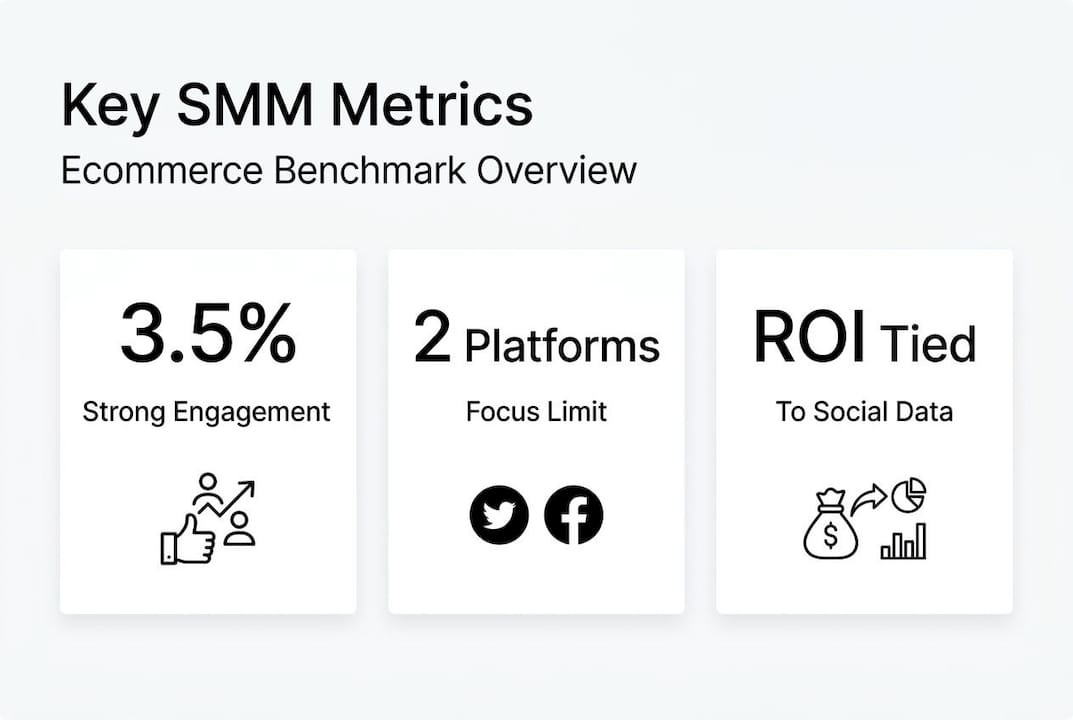
Pro Tip: Choose two platforms where your target customer actually spends time and go deep on those. Brands that dominate one or two platforms consistently outperform brands spreading effort across five. Quality of presence beats quantity of presence every time. Once you see measurable traction, layer in influencer marketing success strategies to amplify what is already working.
Measurability is central to why platform selection matters so much. You cannot optimize what you cannot track. Set up platform-native analytics from day one, and connect them to your ecommerce dashboard so you can see the full picture from impression to sale.
Measuring social media marketing success: benchmarks and analytics
Most ecommerce brands measure social media performance against themselves. “Our engagement went up 12% this month” sounds positive until you realize your competitors are seeing 30% gains and the industry average is 18%. Numbers without context are just numbers.
Benchmarking performance is an essential methodology: according to Hootsuite, a good social media performance level is assessed relative to industry norms and similar brands, not in isolation. This changes how you interpret your data entirely.
Key metrics to track for ecommerce social media:
- Engagement rate: Likes, comments, shares, and saves divided by reach or followers. Shows how resonant your content is.
- Reach and impressions: Reach is unique viewers; impressions are total views including repeat. High impressions with low reach means your existing audience is seeing content repeatedly, which can indicate algorithm saturation.
- Follower growth rate: Track monthly percentage growth, not raw numbers. A brand with 5,000 followers growing 8% monthly is outperforming a 50,000-follower account growing 0.5%.
- Click-through rate (CTR): The percentage of people who click your link after seeing a post or ad. Industry benchmarks vary, but most ecommerce brands target 1% to 3% on organic content.
- Video play rate and watch time: Critical on TikTok and Instagram Reels. If people are not watching past the first three seconds, your hook needs work.
- Conversion rate from social: Track using UTM links and Google Analytics or your ecommerce platform’s attribution tool.
Here is a simplified benchmark reference for ecommerce brands in 2026:
| Metric | Below average | Average | Strong |
|---|---|---|---|
| Engagement rate (Instagram) | Below 1% | 1 to 3% | Above 3% |
| Follower growth (monthly) | Below 0.5% | 0.5 to 2% | Above 2% |
| CTR (paid social) | Below 0.5% | 0.5 to 1.5% | Above 1.5% |
| Video watch rate (first 3 sec) | Below 40% | 40 to 60% | Above 60% |
The impact of benchmarks in fashion shows that apparel brands with clear benchmark tracking respond faster to trend shifts and capture more seasonal revenue as a result. The same principle applies across ecommerce categories.
Here is a simple process for setting up benchmarks:
- Export the last 90 days of data from each platform’s native analytics.
- Identify your baseline for each metric listed above.
- Find industry benchmarks using tools like Hootsuite, Sprout Social, or Rival IQ.
- Set realistic 30, 60, and 90-day improvement targets for each metric.
- Review weekly and adjust content strategy based on what the data shows, not intuition.
For deeper campaign analysis, connect your social data to ROI influencer marketing frameworks that show the full revenue contribution of social-driven traffic. This is especially important when working with creators or affiliates whose content lives on social platforms.
Pro Tip: Do not obsess over follower count. A highly engaged audience of 3,000 loyal buyers is worth more than 30,000 passive followers who never click. Prioritize influencer ROI in ecommerce metrics that tie directly to revenue: click-throughs, add-to-cart rates, and post-social email signups.
Integrating social media with email automation for compounding results
Social media brings people into your world. Email automation keeps them there and turns them into repeat buyers. When these two channels work together, the results multiply rather than add.

SMM’s measurability delivers value specifically when integrated with other digital channels, including email automation. This is not a theoretical claim. Brands that connect social signals to email triggers consistently see higher conversion rates and lower customer acquisition costs than those running disconnected campaigns.
Here is how the integration works in practice:
- Lead capture from social: Run a gated offer (discount, free guide, exclusive content) through Instagram Stories or TikTok. Capture the email at the point of interest and immediately trigger a welcome sequence in Klaviyo.
- Retargeting with email segments: Sync your Klaviyo segments with Facebook and Instagram Custom Audiences. Show ads specifically to your VIP buyers, lapsed customers, or cart abandoners. The targeting precision reduces wasted ad spend significantly.
- Post-social-engagement flows: If someone clicks a social ad and visits a product page but does not buy, trigger an abandoned browse email within one hour. This sequence alone recovers substantial revenue that most brands leave behind.
- Social proof in email campaigns: Pull in user-generated content (UGC) from social into your email templates. Seeing real customers using your product inside an email drives click rates higher than polished brand photography in many categories.
- Event-based triggers: When a follower likes or saves a specific product post (trackable through some integrations), trigger a personalized email highlighting that product with a time-limited offer.
The Klaviyo and social media integration opportunity is one of the highest-leverage moves available to ecommerce brands right now. Klaviyo’s audience sync feature directly connects your email segments to paid social platforms, creating a feedback loop where your best customers inform your ad targeting and your ads feed new subscribers into email automation.
Strong community building strategies also benefit from this integration. When you use social media to build a community around your brand and then nurture that community through email, you create a retention engine that reduces reliance on expensive paid acquisition over time.
Pro Tip: Time your email automations to fire within 60 minutes of a social-driven site visit. Research consistently shows that response rates drop sharply after the first hour. The warm intent from a social interaction fades quickly. Catching someone in that window with a relevant, personalized email dramatically increases the chance of conversion.
The hard truth: Why most ecommerce brands fail at social media marketing
Here is something most marketing blogs will not tell you: the majority of ecommerce brands that struggle with social media are not failing because of bad content. They are failing because they are measuring the wrong things and building the wrong habits.
Posting consistently feels productive. It creates a sense of motion. But motion is not the same as progress. We have seen brands publish daily for two years with zero meaningful revenue attribution from social because they never connected their content to a measurable outcome or an email capture strategy.
The second failure point is benchmark avoidance. Looking at your own numbers in isolation is comfortable. It protects you from the uncomfortable reality that your engagement rate might be half what it should be for your category. Brands that refuse to benchmark against industry norms keep making the same mistakes because the data never tells them they are underperforming.
The third issue is platform dilution. Ecommerce owners see competitors on every platform and assume they need to match that presence. What they cannot see is that those competitors are often wasting most of their effort on platforms that do not convert for their specific product type. Following the herd on platform strategy is one of the fastest ways to burn your social media budget.
What actually moves the needle is a ruthless focus on three things: knowing your audience deeply, measuring against meaningful benchmarks, and integrating social with retention channels like email. Collecting customer feedback tactics directly from your social audience gives you the insight to create content that resonates instead of content that fills a calendar.
The brands that win at social media marketing treat it as a data-driven acquisition and retention channel, not a branding exercise. They pick two platforms, go deep, track everything, and connect every social interaction to an email automation that nurtures and converts. That is the approach that builds compounding growth, not posting three times a week and hoping the algorithm rewards you.
Grow your ecommerce brand with expert-led social media & email strategies
Understanding the strategy is one thing. Executing it at scale, with precision tracking and automation that actually converts, is where most ecommerce teams hit a wall.
At Take Action, we specialize in turning social media momentum into measurable email-driven revenue. Our team builds Klaviyo automation flows that connect directly to your social campaigns: welcome sequences, abandoned cart recovery, post-purchase retention, and custom audience syncs that stretch your ad budget further. Whether you are just starting to connect your channels or you need a complete overhaul of your retention strategy, our email marketing experts know exactly what moves the needle for ecommerce brands. Explore our full suite of retention marketing services and see how we build scalable, data-driven systems tailored to your brand.
Frequently asked questions
What makes social media marketing effective for ecommerce?
Effective SMM builds relationships and delivers measurable results, helping brands reach and convert audiences through targeted, platform-specific strategies that go far beyond simple posting.
How do I know if my social media marketing is performing well?
You need to compare your key metrics against industry benchmarks because, as Hootsuite confirms, good performance is assessed relative to similar brands, not just your own historical data.
Which social media platforms should ecommerce brands focus on?
Focus on platforms where your target customers actually spend time. Instagram and TikTok typically work best for visual consumer products, while Facebook excels at retargeting and reaching broader demographics.
How does email automation integrate with social media campaigns?
Tools like Klaviyo can trigger automated email sequences based on social-driven site visits or ad clicks, recovering abandoned carts and nurturing leads that social media brings into your funnel.
Can measuring my results really help me grow faster?
Yes. Real-time analytics combined with integration across channels means SMM’s measurability delivers value that lets you cut what is not working and double down on what drives actual revenue for your specific ecommerce category.