

Social media algorithms: e-commerce engagement explained
Most e-commerce marketers assume that posting more often automatically means reaching more people. That logic feels intuitive, but it’s wrong. Post frequency alone doesn’t drive reach. What actually moves the needle is early engagement velocity, content quality, and how well your posts match what each platform’s algorithm rewards. For brands competing in crowded social feeds, understanding these systems isn’t optional anymore. It’s the difference between a product launch that sells out and one that gets buried on page two of nobody’s feed.
Table of Contents
- What is a social media algorithm?
- How social media algorithms rank content
- Platform algorithm differences: Instagram, TikTok, Facebook, and X
- Algorithm pitfalls: What hurts your reach
- How to optimize your e-commerce content for algorithms
- The double-edged sword of personalization
- Ready to amplify your e-commerce brand?
- Frequently asked questions
Key Takeaways
| Point | Details |
|---|---|
| Algorithms are engagement-driven | Relevance and interaction rates determine which posts your e-commerce audience sees. |
| Each platform ranks differently | Instagram, TikTok, Facebook, and X have unique algorithm signals and priorities. |
| Quality over quantity wins | Well-crafted, original, and engaging content always outperforms high posting frequency. |
| Avoid penalties | Stay away from repetitive content, external links, and watermarked or low-quality media. |
| Diversify for broader reach | Combine personalized content with trending topics to escape algorithmic bubbles and grow your brand. |
What is a social media algorithm?
Let’s start by getting clear on what a social media algorithm actually is. In simple terms, it’s a set of rules that decides which content gets shown to which users, and in what order. Platforms moved away from chronological feeds years ago because showing every post in time order wasn’t keeping users engaged long enough.
Social media algorithms are AI-powered systems that use machine learning to rank and personalize content based on user behavior. Every like, skip, comment, share, and second of watch time feeds data back into the system. The algorithm learns what each user responds to and serves more of it.
For e-commerce brands, this matters enormously. Appearing in the right feed at the right moment is essentially free advertising. A well-optimized post can drive product discovery, clicks, and conversions without spending a dollar on paid media. Your digital media strategy needs to account for how these systems work, not just what you want to say.
Here’s what algorithms are actually evaluating:
- Relevance: Does this content match what this user has engaged with before?
- Engagement signals: Likes, comments, shares, saves, and watch time
- Recency: How fresh is the post relative to when the user opens the app?
- Relationship: Does the user regularly interact with this account?
- Content format: Is this a Reel, carousel, story, or static image?
“Algorithms don’t reward effort. They reward outcomes. If your content gets people to stop scrolling, react, and share, the system amplifies it.”
How social media algorithms rank content
Now that you know what algorithms are, let’s unpack how they choose which posts get seen. Every platform uses a slightly different mix of signals, but the core logic is consistent: content that generates strong, fast engagement gets pushed to more people.
Ranking signals across platforms include watch time, engagement rate, recency, user relationships, content originality, trending topics, and geolocation. For e-commerce marketers, a few of these deserve special attention.

Watch time is critical for video content. If users watch your product demo all the way through, the algorithm interprets that as a quality signal and shows it to a wider audience. Engagement rate measures how many people who saw your post actually interacted with it. A post with 500 likes from 1,000 views outperforms one with 5,000 likes from 500,000 views in the algorithm’s eyes.
Engagement velocity is the speed at which your post collects interactions in the first 15 to 30 minutes after publishing. This is why timing your posts matters. A strong content strategy for engagement should include posting when your audience is most active, not just when it’s convenient for your team.
Stat to know: Video content consistently outperforms static images across platforms because watch time is one of the heaviest-weighted ranking signals in 2026.
For e-commerce specifically, saves and shares carry more weight than passive likes. When someone saves your post, they’re signaling strong purchase intent. Platforms read that as high-value content. Pair that with strong video marketing tactics and you have a formula for organic reach that compounds over time.
Platform algorithm differences: Instagram, TikTok, Facebook, and X
Not all platforms operate the same way. Here’s how top networks differ and what that means for your e-commerce content.
Instagram uses separate algorithms for Feed, Stories, Reels, and Explore. Each surface has its own ranking logic. Reels prioritize entertainment and reach, while Feed favors accounts users already follow and engage with regularly.
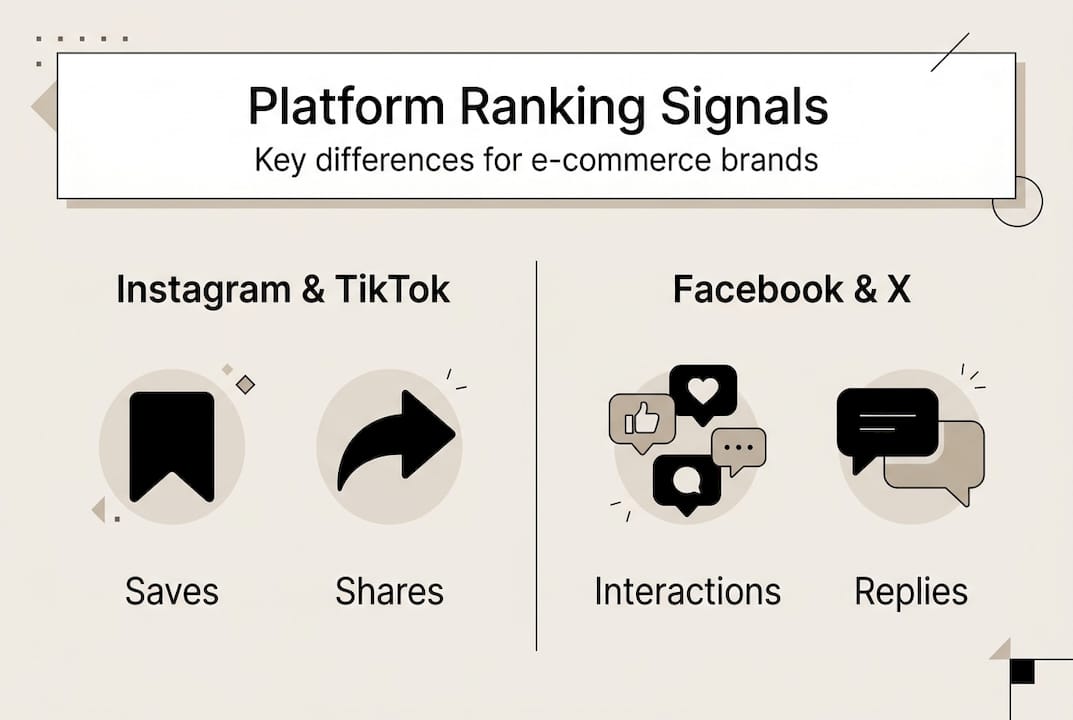
TikTok’s For You Page is interest-graph based, meaning it can surface your content to users who have never heard of your brand. It prioritizes watch completion rate, with a 70% threshold being a key benchmark, along with shares. Videos are tested in phases, starting with a small follower sample before being pushed broader.
Facebook emphasizes meaningful interactions and penalizes posts that include off-platform links. If you’re dropping a direct product URL in your Facebook post, expect reduced reach. Keep links in comments or use native shopping features instead.
X’s algorithm uses a three-stage ranking process and weights replies above retweets, which rank above likes. Interestingly, text outperforms video on X, which is the opposite of most other platforms.
| Platform | Top ranking signal | Discovery type | E-commerce strength |
|---|---|---|---|
| Saves, Reels watch time | Interest + social graph | Visual products, lifestyle | |
| TikTok | Watch completion, shares | Interest graph | Viral discovery, new audiences |
| Meaningful interactions | Social graph | Retargeting, community groups | |
| X | Replies, engagement velocity | Social + interest | Brand voice, trending topics |
For engagement rate benchmarks specific to e-commerce, TikTok consistently leads, followed by Instagram Reels. Understanding these differences helps you allocate content effort where it pays off most. The impact of algorithm changes on organic reach is real, and staying current with platform updates is part of the job now.
Check out video tactics for Instagram and TikTok to build platform-specific content that actually performs.
“On TikTok, a brand with 200 followers can outperform one with 200,000 if the content hooks viewers in the first three seconds.”
Algorithm pitfalls: What hurts your reach
Knowing what works is only half the battle. Here’s what to avoid.
Algorithms penalize spam, duplicate content, external links (X reduces reach by up to 8x for posts with links), watermarks from other platforms, and low-quality AI-generated content. These aren’t minor deductions. They can effectively make your post invisible.
Here are the most common mistakes e-commerce brands make:
- Reposting TikTok videos to Instagram Reels with the TikTok watermark still visible. Instagram’s algorithm actively detects and suppresses this.
- Dropping product links directly in post captions on Facebook. This triggers the off-platform link penalty immediately.
- Posting the same caption across all platforms at once. Algorithms detect duplicate content and reduce distribution.
- Using engagement bait phrases like “Comment YES if you agree” without genuine conversation following.
- Publishing AI-generated images or copy that feels generic. Platforms are increasingly flagging low-effort AI content as low quality.
Pro Tip: Before cross-posting any video, remove watermarks using the original export file. Each platform should receive a clean, native upload. This single habit can dramatically improve your reach without changing anything else about your content.
Strong branding tips for content quality will help you build a content production process that avoids these traps from the start.
How to optimize your e-commerce content for algorithms
With the basics and pitfalls covered, here’s how you can win with your next post.
Short videos and Reels with high retention rates, calls to save or share, and original content without watermarks consistently boost reach across platforms. That’s the foundation. Here’s how to build on it.
| Tactic | Why it works | Platform priority |
|---|---|---|
| Hook in first 3 seconds | Stops the scroll, boosts watch time | TikTok, Instagram, Facebook |
| Ask for saves, not just likes | Saves signal purchase intent | |
| Use trending audio | Boosts Explore and For You placement | TikTok, Instagram |
| Post when audience is active | Maximizes early engagement velocity | All platforms |
| Reply to every comment fast | Signals active community to algorithm | All platforms |
Pro Tip: Post your content, then spend 20 to 30 minutes actively engaging with comments and similar accounts. This early activity signals to the algorithm that your post is generating conversation, which accelerates distribution.
For e-commerce brands, the goal is to connect social content directly to your retention funnel. Community-building strategies that turn followers into repeat buyers are where social and email intersect most powerfully. Integrating your social efforts with email through social and email integration tactics can amplify both channels significantly.
Building content pillars for retention gives your team a repeatable framework so every post serves both the algorithm and your brand’s long-term growth goals.
The double-edged sword of personalization
Finally, let’s look at one of the biggest debates in algorithm-driven marketing and what it means for your brand.
Personalization is what makes algorithms feel magical to users. But for brands, it creates a real risk. Over-personalization creates filter bubbles, reducing exposure to diverse content and limiting how many new users your brand can reach. If your content only ever reaches people who already know you, growth stalls.
“A filter bubble isn’t just a user problem. It’s a brand growth problem. When algorithms only show your content to existing fans, you stop acquiring new customers.”
Here’s how to break out of the bubble:
- Create content around trending topics that attract users outside your existing audience
- Use broad hashtags alongside niche ones to expand discovery potential
- Collaborate with creators whose audiences don’t overlap with yours
- Experiment with new formats like live video or interactive polls that platforms actively promote to wider audiences
- Vary your content themes so the algorithm doesn’t pigeonhole your account into one narrow interest category
Diversifying your content mix through smart promotion strategies for diversity keeps your brand visible to both loyal customers and new prospects. The brands that grow fastest on social aren’t just feeding the algorithm. They’re actively working to expand who the algorithm shows them to.
Ready to amplify your e-commerce brand?
Mastering social media algorithms gives your brand a real competitive edge, but organic reach is only one piece of the puzzle. The brands that scale fastest combine strong social content with a retention engine that converts followers into loyal, repeat buyers.
At Take Action Agency, we specialize in building exactly that kind of system. From Klaviyo automation to segmentation strategies that turn social traffic into email subscribers and paying customers, we help e-commerce brands build revenue channels that don’t depend entirely on platform algorithms. If you’re ready to connect your social strategy to a retention system that compounds over time, explore our e-commerce retention solutions and let’s build something that lasts.
Frequently asked questions
What are the most important ranking signals for e-commerce brands in 2026?
Engagement rate, watch time, content originality, and early engagement velocity are the top signals across all major social platforms. Engagement velocity in the first 15 to 30 minutes is especially critical on X and TikTok.
Does posting more often help you reach more customers?
No. Post quality and engagement signals drive reach far more than frequency. Posting five mediocre times a week will underperform two high-quality posts that generate strong early engagement.
How should I adapt my content for TikTok versus Instagram?
On TikTok, focus on high watch completion rates and trending sounds to maximize For You Page placement. On Instagram, prioritize original Reels and carousels without watermarks and optimize for saves.
Why do some posts lose reach or get hidden by algorithms?
Duplicate content, external links, watermarks, and spammy engagement tactics all trigger algorithm penalties. Even low-quality AI-generated content is increasingly flagged and suppressed across platforms.
Can algorithms limit my brand’s growth through filter bubbles?
Yes. Over-personalization reduces content diversity and can trap your brand in a loop of only reaching existing followers. Balancing personalized content with trend-based and broad-appeal posts is essential for sustained audience growth.
Recommended
- Digital Media Strategy: Unlocking Ecommerce Growth | Take Action Blog | Take Action
- Klaviyo Integration: 30x Revenue Boost from Social Media | Take Action Blog | Take Action
- SEO Digital Marketing Agency: Impact on Ecommerce | Take Action Blog | Take Action
- Social Proof Influencer Marketing for Ecommerce Success | Take Action Blog | Take Action