

How to Increase Website Traffic for Small Businesses
TL;DR:
- Increasing website traffic involves combining SEO, content marketing, social media, and paid advertising into a strategic system. Small businesses should prioritize organic growth through keyword research, consistent content, and targeted social engagement while tracking results with GA4 and UTM parameters. Paid ads serve as an accelerant, complement organic efforts, but require clear measurement and proper planning for sustained success.
Increasing website traffic is the process of strategically using SEO, content marketing, social media, and paid advertising to attract more qualified visitors to your site. For small business owners and marketers, the challenge is not a shortage of tactics. It is knowing which ones to prioritize, how to measure them, and how to combine them into a system that compounds over time. This guide covers the most effective organic and paid methods, explains how to track what is actually working using Google Analytics 4 and UTM parameters, and highlights emerging channels that give small businesses a real competitive edge.
How to increase website traffic with organic strategies
Organic traffic is the foundation of any sustainable online presence. It costs less per visitor over time than paid advertising, and it builds authority that compounds as your site ages. The two pillars are search engine optimization (SEO) and content marketing, and they work best when treated as a single system rather than separate projects.
SEO starts with keyword research. You need to understand what your customers are typing into Google before you write a single page. Tools like Google Search Console, Ahrefs, and Semrush help you identify high-intent search terms your site can realistically rank for. Once you have your keywords, place them in title tags, meta descriptions, H1 headings, and the first 100 words of each page. Internal linking matters too. Structuring internal links strategically reinforces page importance to search engines and guides users toward your highest-converting pages.
Content marketing amplifies SEO by giving you more pages to rank and more reasons for other sites to link to you. A consistent blog, a YouTube channel, or even a podcast builds topical authority in your niche. The key is consistency over volume. Two well-researched posts per month outperform eight thin articles every time. Video content, in particular, is underused by small businesses despite its reach. Take-action’s video marketing guide outlines how ecommerce brands are using YouTube to drive qualified shoppers directly to product pages.
Social media organic engagement is a third lever. Platforms like Instagram, LinkedIn, and Pinterest can send meaningful referral traffic when your content is genuinely useful rather than purely promotional. Social analytics tracking reach, engagement, and conversions tells you which posts actually move people to your site, so you can double down on what works and cut what does not.

One realistic expectation to set: SEO results typically appear within 3 to 6 months for most sites. That timeline means you need to start now, track progress monthly, and resist the urge to abandon a strategy after four weeks.
Pro Tip: Use a link destination strategy in your social campaigns. Instead of linking every post to your homepage, create dedicated landing pages for each campaign. This lets you measure exactly which social content drives real traffic and which content just gets likes.
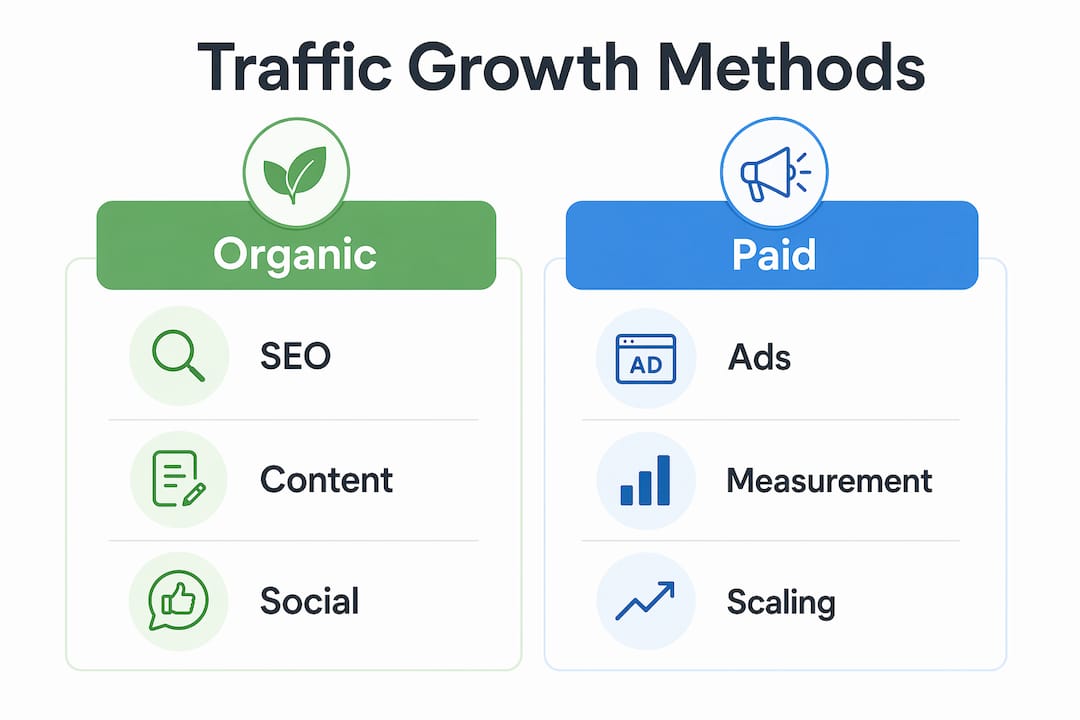
How can paid advertising complement organic traffic growth?
Paid advertising and organic growth are not competing strategies. They are two gears in the same engine. Paid ads give you immediate visibility while your SEO builds momentum. Organic traffic gives you staying power when your ad budget runs out.
Here is how to think about the two main paid channels:
- Paid search ads (Google Ads, Microsoft Advertising) capture people who are already searching for what you sell. These visitors have high intent, which means they convert at higher rates. The trade-off is cost per click, which can be steep in competitive categories.
- Paid social ads (Meta Ads, LinkedIn Ads, Pinterest Ads) reach people based on demographics and interests rather than active search. They are better for building awareness and retargeting visitors who have already been to your site.
- Remarketing campaigns re-engage people who visited your site but did not convert. These campaigns typically deliver the lowest cost per acquisition because the audience already knows your brand.
- Keyword testing via paid ads is one of the most underused tactics in small business marketing. Run a paid search campaign on keywords you want to rank for organically. The click-through and conversion data tells you which terms are worth the months of SEO effort before you invest them.
- Budget planning matters more than budget size. Paid search drives fast traffic bursts but traffic stops the moment your budget ends. Treat paid ads as a short-term accelerant, not a long-term traffic source. Allocate a portion of your paid budget to support organic pages that are close to ranking on page one.
The most common mistake small businesses make with paid ads is running campaigns without a clear measurement framework. If you cannot trace a click to a conversion, you are flying blind. Set up conversion tracking in Google Ads before you spend a dollar, and connect your campaigns to GA4 for a full picture of user behavior after the click.
Pro Tip: Before scaling any paid campaign, review your paid advertising fundamentals. Scaling a poorly structured campaign just amplifies the waste.
How to measure and optimize your website traffic using analytics tools
Measurement is where most small businesses leave money on the table. Driving traffic without tracking it is like running a store with no cash register. You know people are coming in, but you have no idea what they are buying or why.
Google Analytics 4 (GA4) is the standard tool for traffic analysis. It shows you where visitors come from, what pages they land on, how long they stay, and whether they complete a goal like a purchase or a form submission. The key reports to check weekly are the Traffic Acquisition report (which channels are sending visitors) and the Engagement report (which pages hold attention and which lose it).
UTM parameters are the connective tissue between your marketing campaigns and GA4. A UTM parameter is a short tag you add to a URL that tells GA4 exactly where a visitor came from. UTM parameters like utm_source, utm_medium, and utm_campaign provide essential source tracking and should be applied consistently to every link you share in email, social media, and paid ads. Without them, GA4 lumps a large portion of your traffic into the “direct” bucket, which tells you nothing useful. For a deeper look at setting this up correctly, this analytics for ecommerce guide walks through the full GA4 and UTM workflow.
Google Search Console is the other tool every small business needs. It shows you which search queries trigger your pages to appear in Google results, and crucially, which pages get impressions but few clicks. Rewriting title tags and meta descriptions on high-impression, low-CTR pages can quickly improve click-through rates without any change in your actual ranking. That is free traffic you are currently leaving on the table.
Here is a simple weekly analytics workflow:
- Check GA4 Traffic Acquisition report for channel trends
- Review Search Console for new keyword opportunities and CTR drops
- Audit UTM coverage on any new links published that week
- Flag any pages with high bounce rates for content or UX review
Pro Tip: Link Google Search Console to your GA4 property. This surfaces search query data directly inside GA4, so you can see which keywords drive traffic AND what those visitors do after they land. Most small businesses skip this step and miss the full picture.
What emerging channels can small businesses use to diversify traffic?
Relying on a single traffic source is a business risk. Algorithm changes, rising ad costs, or a platform policy shift can cut your traffic overnight. Adding new channels early, including video search, online communities, and AI-referred traffic, reduces that dependency and opens growth paths your competitors have not found yet.
Video search is the clearest opportunity. YouTube received nearly 10 times more visits than TikTok in the period from May 2025 to April 2026, with 352.8 billion visits versus TikTok’s 35.81 billion. That gap means YouTube should be the first video platform most small businesses invest in, not TikTok or Twitch, despite the cultural noise around short-form content.
| Platform | Monthly visits (approx.) | Best use case |
|---|---|---|
| YouTube | 352.8B | Long-form tutorials, product demos, SEO-driven video |
| TikTok | 35.81B | Brand awareness, trend-driven content |
| Twitch | Primarily live | Niche community building, live product launches |
Online communities are a second underused channel. Platforms like Reddit, Discord, and LinkedIn Groups contain highly concentrated audiences with specific problems your business can solve. Participating genuinely in these communities by answering questions and sharing expertise earns natural mentions and consistent referral traffic. The rule is simple: add value first, link second.
AI-referred traffic is the newest channel to watch. As tools like ChatGPT, Perplexity, and Google’s AI Overviews increasingly answer user queries directly, they also cite and link to sources. Structuring your content with clear definitions, direct answers, and named entities in the first 30% of each article increases the likelihood that AI tools will cite your pages. This is not a replacement for traditional SEO. It is an extension of it.
Take-action’s ecommerce marketing strategy guide covers how to build a multi-channel traffic system that does not collapse when one source underperforms.
Key takeaways
Sustainable traffic growth requires combining SEO, paid advertising, analytics tracking, and channel diversification into one coordinated system rather than treating each tactic in isolation.
| Point | Details |
|---|---|
| SEO takes time, start now | Most sites see organic results in 3 to 6 months, so begin optimizing high-priority pages immediately. |
| Paid ads accelerate, not replace, organic | Use paid search and social ads as short-term traffic bursts while organic rankings build. |
| UTM parameters are non-negotiable | Tag every link you share so GA4 can accurately attribute traffic to the right campaign. |
| YouTube leads video platforms by volume | With 352.8B visits versus TikTok’s 35.81B, YouTube delivers far more traffic potential for most businesses. |
| Community presence drives referral traffic | Authentic participation in Reddit, Discord, and LinkedIn Groups generates consistent, high-quality referral visits. |
What I have learned about traffic growth that most guides skip
After working with ecommerce brands across different stages of growth, the pattern I see most often is this: small businesses spread themselves across six channels, do none of them well, and then conclude that “digital marketing does not work.” The real problem is not the channels. It is the dilution.
The brands that grow consistently pick two or three channels, go deep on them, and measure obsessively. They treat Google Search Console as a weekly ritual, not a quarterly check-in. They use UTM parameters on every link, not just paid campaigns. And they treat social media as a traffic tool, not a vanity metric. Follower counts mean nothing if none of those followers ever visit your site.
The other thing most guides will not tell you: the first three months of SEO feel like nothing is happening. That is normal. The compounding effect of well-optimized content does not show up in a straight line. It shows up suddenly, after you have built enough topical authority for Google to trust your site. The businesses that quit at month two never see month six.
My honest recommendation for any small business starting from scratch: spend the first 90 days on SEO fundamentals and one social channel. Add paid search in month four to test your highest-intent keywords. Add a second social channel or video content in month six once you have data on what your audience actually responds to. That sequence is slower than trying everything at once, but it produces results you can actually learn from.
— Take
How Take-action helps you turn traffic into revenue
Driving more visitors to your site is only half the equation. The other half is converting that traffic into customers and keeping them coming back. Take-action specializes in email marketing and retention strategies built on Klaviyo, designed specifically for ecommerce brands that want to turn site visitors into repeat buyers. From welcome sequences and abandoned cart flows to advanced segmentation and campaign strategy, Take-action builds the automated systems that capture revenue your traffic is already generating but leaving behind. If you are ready to make your traffic work harder, start with Take-action and see what a retention-focused strategy can do for your bottom line.
FAQ
How long does it take to see results from SEO?
Most websites see measurable SEO impact within 3 to 6 months, according to Shopify’s 2026 traffic guide. Results depend on competition level, content quality, and how consistently you optimize high-priority pages.
What is the best free tool to track website traffic sources?
Google Analytics 4 combined with Google Search Console is the most effective free setup for tracking traffic sources. GA4 shows channel-level data while Search Console reveals which search queries and pages drive organic clicks.
How do UTM parameters help increase website traffic?
UTM parameters do not directly increase traffic. They tell you which campaigns are already driving traffic so you can invest more in what works and cut what does not. Apply them to every link you share across email, social media, and paid ads.
Is social media a reliable way to drive website visitors?
Social media can drive consistent referral traffic when you link to targeted landing pages rather than your homepage, and when you track performance beyond likes and follower counts. Buffer’s 2026 guide confirms that tracking reach, engagement, and conversions is what separates effective social strategies from ineffective ones.
Should small businesses invest in paid ads or focus on organic traffic first?
Start with SEO and organic content to build a sustainable foundation, then add paid search ads once you have identified your highest-converting keywords. Paid ads deliver immediate traffic but stop the moment your budget ends, making organic growth the more cost-effective long-term investment.
Recommended
- Cheap Marketing Strategy for Small Businesses in 2026 | Take Action Blog | Take Action
- Email marketing strategies for small ecommerce businesses | Take Action Blog | Take Action
- SEO for service businesses: your step-by-step growth guide | Take Action Blog | Take Action
- Blog writing for business: frameworks for ecommerce growth | Take Action Blog | Take Action