

Introduction to paid advertising for ecommerce success
Most ecommerce brands believe paid advertising is just an expensive way to buy traffic with uncertain returns. The reality is far more strategic. When integrated properly with email marketing, paid advertising platforms become powerful engines for acquiring high-intent customers who turn into loyal repeat buyers. This guide walks you through the mechanics, proven strategies, common pitfalls, and how to blend paid ads with email flows to maximize both acquisition and retention profitability.
Table of Contents
- Key takeaways
- How paid advertising works: platforms, models, and auction mechanics
- Top ecommerce paid advertising strategies to drive acquisition and retention
- Measuring success and avoiding common pitfalls in ecommerce paid ads
- How paid advertising complements email marketing for ecommerce retention
- Boost your ecommerce growth with expert paid advertising and email marketing
- Frequently asked questions
Key Takeaways
| Point | Details |
|---|---|
| Auction mechanics and bidding | Paid ads use bids, predicted engagement, and user value to determine wins across Google, Meta, and Amazon. |
| Platform roles overview | Google captures high intent; Meta enables discovery; Amazon targets buyers inside the marketplace. |
| Key ecommerce strategies | Shopping campaigns, Performance Max, and retargeting form the core for acquisition and retention. |
| Email and ads synergy | Integrating paid ads with email flows boosts retention and lifetime value. |
| Common optimization pitfalls | Broad targeting waste and poor tracking reduce ROAS. |
How paid advertising works: platforms, models, and auction mechanics
Paid advertising involves paying platforms like Google Ads, Meta, and Amazon to display ads targeting specific audiences using models like CPC, CPM, CPV, and auction-based bidding where Total Value equals Bid times Estimated Action Rate plus User Value determines winners. Understanding these fundamentals helps you allocate budget intelligently and set realistic expectations for campaign performance.
The three dominant platforms serve different purposes in your ecommerce stack. Google Ads excels at capturing high-intent search traffic when customers actively look for products. Meta platforms (Facebook and Instagram) shine for discovery and social proof, reaching users based on interests and behaviors. Amazon Ads targets shoppers already in buying mode within the marketplace ecosystem.
Pricing models determine how you pay for ad exposure:
- CPC (Cost Per Click): You pay each time someone clicks your ad, ideal for driving traffic to product pages
- CPM (Cost Per Thousand Impressions): You pay for every 1,000 times your ad displays, useful for brand awareness
- CPV (Cost Per View): You pay when users watch video ads, effective for engagement campaigns
Auction-based bidding combines your bid and predicted user actions to decide ad placement. Google Shopping CPC averages around $1.16, but your actual costs vary wildly based on competition, product category, and quality score. Some competitive keywords push CPC above $50, while long-tail product searches may cost under $1.
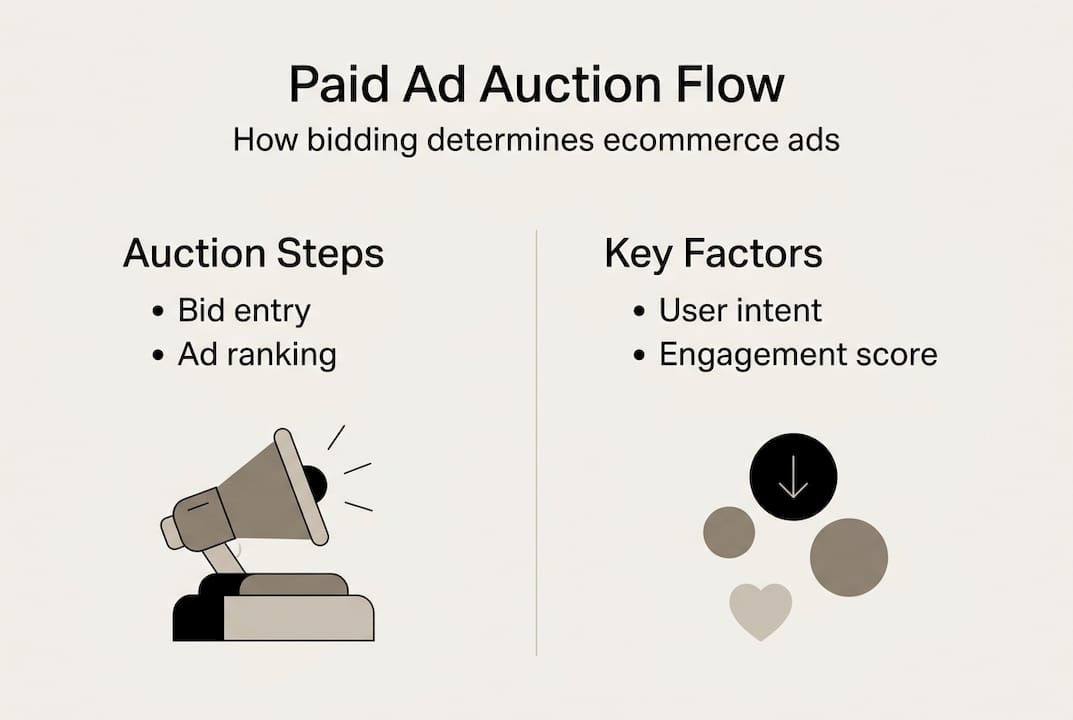
The auction system protects platforms and advertisers alike. A high bid with poor ad relevance loses to a moderate bid with strong predicted engagement. This mechanism rewards quality creative, tight targeting, and landing pages that match user intent. Your digital media strategy should optimize all three elements simultaneously rather than just increasing bids.
Pro Tip: Start with manual CPC bidding to learn what your traffic actually costs before switching to automated strategies. Automated bidding works brilliantly once you have conversion data, but manual control helps you understand baseline economics and spot budget waste early.
“The ad auction isn’t just about who pays most. Platforms prioritize user experience by weighing predicted engagement heavily, meaning better ads win at lower costs.” Google Ads auction documentation
Top ecommerce paid advertising strategies to drive acquisition and retention
Key ecommerce strategies include Shopping campaigns for high-intent visual ads, Performance Max for AI-driven multi-channel reach, retargeting for cart recovery, and starting with top products before scaling. These tactics form the foundation of profitable paid acquisition that feeds your retention engine.
Shopping campaigns display product images, prices, and store names directly in search results. Users who click these ads already see your offer and pricing, filtering out low-intent browsers. This format converts exceptionally well because it captures demand at the exact moment customers search for solutions. Set up your product feed correctly with detailed titles, accurate categorization, and high-quality images to maximize visibility.

Performance Max campaigns leverage Google’s AI to distribute your ads across Search, Shopping, Display, YouTube, Gmail, and Discover automatically. The algorithm tests placements and optimizes toward your conversion goals without manual channel management. This approach works best once you have at least 30 conversions monthly to train the machine learning model effectively.
Retargeting recovers abandoned carts and re-engages past visitors who didn’t convert. These ads show products users already viewed, reminding them to complete purchases. Retargeting campaigns achieve significantly higher conversion rates than cold traffic because you’re reaching warm audiences familiar with your brand. Studies show retargeting effectively recovers up to 70% of abandoned carts when combined with email sequences.
Start small and scale systematically:
- Launch with $50-$100 daily budgets focused on your top three products
- Run campaigns for two weeks to gather statistically significant data
- Double budgets on campaigns achieving target ROAS while pausing underperformers
- Expand to additional products only after proving profitability on initial SKUs
This disciplined approach prevents burning cash on unproven strategies. Many brands waste thousands testing too many products simultaneously before understanding what actually converts. Your performance marketing strategy should prioritize learning speed over scale in early stages.
Pro Tip: Create separate campaigns for new customer acquisition versus retargeting. Use different ROAS targets since retargeting should perform 2-3x better than cold traffic. Mixing them in reporting obscures whether your acquisition economics actually work.
Audit your tracking weekly during launch phases. Conversion pixels fire incorrectly more often than marketers admit, and scaling on bad data multiplies losses quickly. Verify that attributed conversions match actual orders in your ecommerce platform before increasing spend. Implement server-side tracking if possible to improve accuracy beyond browser-based pixels affected by ad blockers and iOS privacy changes.
Integrate your paid strategy with your broader online marketing approach to create cohesive customer journeys. Paid ads shouldn’t exist in isolation but rather work alongside email, content, and organic channels to build sustainable growth.
Measuring success and avoiding common pitfalls in ecommerce paid ads
Ecommerce ROAS benchmarks show median performance of 2.87x overall, with Google Ads achieving 3.52x and Meta delivering 1.86x, while good DTC targets range from 3-4x+ and email complements with 6-10x ROAS for retention. Understanding these benchmarks helps you set realistic goals and identify when campaigns underperform.
Cost per acquisition (CPA) varies dramatically by industry and product price point. Retail Shopping campaigns average around $38 CPA, but luxury goods or complex B2B products may justify $200+ acquisition costs if lifetime value supports it. Always calculate CPA relative to your specific margins and repeat purchase rates rather than comparing to generic industry averages.
| Platform | Median ROAS | Strong Performance | Typical CPA Range |
|---|---|---|---|
| Google Ads | 3.52x | 4-6x+ | $25-$50 |
| Meta Ads | 1.86x | 3-4x+ | $30-$60 |
| Amazon Ads | 2.5-3x | 5-7x+ | $20-$40 |
Common mistakes destroy profitability faster than most realize:
- Broad match keyword waste: Using broad match without negative keywords wastes 20-40% of budget on irrelevant searches that never convert
- Scaling prematurely: Increasing budgets before fixing checkout friction leads to 70% cart abandonment and burned cash
- Poor conversion tracking: Inaccurate attribution causes you to optimize toward phantom conversions while real revenue disappears
- Ignoring profit metrics: Chasing ROAS alone without considering margins results in profitable-looking campaigns that lose money
The broad match trap catches even experienced marketers. Google interprets broad keywords liberally, showing your ads for tangentially related searches that waste impressions. A campaign for “leather boots” might trigger on “boot repair services” or “leather cleaner,” neither of which convert for an ecommerce store selling footwear. Build comprehensive negative keyword lists from day one and review search term reports weekly.
Pro Tip: Focus on profit per order, not just ROAS, especially for lower-margin products. A 4x ROAS sounds impressive until you realize your 20% margins mean you’re losing money after fulfillment costs. Calculate contribution margin after ad spend to understand true profitability.
Conversion tracking breaks more often than platforms admit. iOS privacy updates, cookie restrictions, and ad blockers create attribution gaps that hide 20-30% of actual conversions. Implement first-party tracking through your ecommerce platform and compare platform-reported conversions to actual revenue weekly. Discrepancies signal tracking issues that need immediate fixes before scaling.
Some products simply don’t work for paid advertising. Extremely niche items with tiny search volumes can’t generate enough impression volume to optimize campaigns. Ultra-low-margin commodity products rarely achieve profitable CACs against established competitors. Test systematically, but don’t throw good money after bad if economics don’t work after reasonable optimization efforts.
Your digital media buying approach should balance aggressive testing with disciplined budget management. Allocate 20% of spend to experimental campaigns while protecting 80% for proven performers. This ratio lets you discover new opportunities without risking your profitable baseline.
How paid advertising complements email marketing for ecommerce retention
Paid ads complement email retention by acquiring customers for owned channels, where 5% retention lift equals 25-95% profit boost, and retargeting recovers 70% of abandoned carts when integrated with email sequences. This synergy transforms one-time buyers into loyal repeat customers who drive sustainable profitability.
The customer journey doesn’t end at first purchase. Paid ads excel at acquisition, bringing new customers into your ecosystem quickly. Email marketing then nurtures these relationships through automated flows that drive repeat purchases at near-zero marginal cost. Post-purchase emails achieve 70-80% open rates because customers actively want order updates, creating perfect opportunities to introduce loyalty programs and complementary products.
Advanced strategies multiply this synergy:
- pLTV bidding optimization: Configure campaigns to optimize for predicted lifetime value instead of first-order ROAS, allowing higher acquisition costs for customers likely to repurchase
- Creative velocity programs: Launch 3-5 new ad variants weekly to sustain engagement and combat ad fatigue that kills campaign performance
- SMART goal frameworks: Set Specific, Measurable, Achievable, Relevant, Time-bound objectives that align paid and email metrics
- Hybrid channel strategies: Balance paid ads (60%), SEO (30%), and organic social (10%) to reduce platform dependency and improve overall CAC
Expert retention strategies emphasize pLTV bidding over first-order ROAS for retention focus, creative velocity with 3-5 new variants weekly, SMART goals, and hybrid paid-organic strategies balancing paid 60%, SEO 30%, and social 10%. These nuances separate sophisticated retention programs from basic acquisition campaigns.
Pro Tip: Tag customers acquired through paid ads in your email platform to measure true lifetime value by channel. You’ll often discover that Meta customers have higher repeat rates than Google customers despite lower first-order ROAS, changing your budget allocation strategy completely.
“The brands winning retention integrate paid acquisition with owned channel nurture. They’re not just buying customers; they’re buying relationships that compound over time through email automation.”
Your content creation strategy should fuel both paid ads and email campaigns with cohesive messaging. Repurpose high-performing email content as ad creative, and use winning ad angles in email subject lines. This cross-pollination improves consistency and maximizes ROI from content investments.
Implement triggered email sequences based on paid ad interactions. When someone clicks a retargeting ad but doesn’t purchase, add them to an abandoned browse sequence. When they do convert from an ad, immediately enroll them in your welcome series to build the relationship. These integrations require proper tracking setup but dramatically improve overall conversion rates.
Scale your blog promotion efforts by using paid ads to amplify high-value content that educates customers and builds authority. Content-focused ads typically achieve lower CPCs than direct product ads while building brand equity that improves all future marketing performance.
Boost your ecommerce growth with expert paid advertising and email marketing
Integrating paid advertising with email marketing requires specialized expertise that most ecommerce teams lack in-house. The technical complexity of tracking setup, the strategic nuance of budget allocation, and the creative demands of maintaining ad performance create overwhelming challenges for brands trying to scale.
Take Action specializes in helping ecommerce brands build integrated acquisition and retention systems that maximize customer lifetime value. Our team combines paid advertising expertise with deep email marketing knowledge, particularly in Klaviyo automation, to create seamless customer journeys from first click to loyal advocate. We handle the technical complexity while you focus on product and operations.
Whether you’re just starting with paid ads or looking to optimize existing campaigns, our data-driven approach identifies opportunities others miss. We audit your current setup, fix tracking issues, optimize targeting and creative, and build email flows that turn paid traffic into profitable repeat customers. Ready to transform your ecommerce growth? Explore our email marketing and retention services or visit our homepage to learn how we help brands scale sustainably.
Frequently asked questions
What is paid advertising in ecommerce?
Paid advertising means paying platforms like Google, Meta, or Amazon to display ads targeting potential customers based on bidding models such as CPC and CPM. It drives traffic quickly to product pages and supports both acquisition and retention marketing goals through retargeting.
How does paid advertising complement email marketing?
Paid ads acquire new customers who then enter email marketing funnels for long-term nurture. Email sequences drive repeat purchases from these customers at near-zero marginal cost, turning one-time buyers into loyal advocates. This integration maximizes lifetime value while reducing dependence on continuous paid spend. Learn more about building cohesive online marketing strategies that blend channels effectively.
What are common paid advertising mistakes to avoid in ecommerce?
Avoid using broad match keywords without negative lists, which wastes 20-40% of budget on irrelevant traffic. Ensure accurate conversion tracking before scaling, and always fix checkout friction first since 70% cart abandonment kills campaign profitability. Focus on profit per order rather than just ROAS, especially for low-margin products where attractive ROAS numbers hide actual losses. Work with experienced digital media buying specialists to avoid these costly pitfalls.
Which ecommerce platforms work best for paid advertising?
Google Ads excels with Shopping and Performance Max campaigns that capture high-intent search traffic ready to purchase. Meta platforms (Facebook and Instagram) work brilliantly for social retargeting and building brand awareness through discovery. Amazon Ads targets shoppers already in buying mode within the marketplace, ideal for brands selling through Amazon alongside their own stores.
Recommended
- Digital Media Buying Agency Impact on Ecommerce | Take Action Blog | Take Action
- Content Marketing: Driving Ecommerce Growth Globally | Take Action Blog | Take Action
- Blog - Email Marketing Insights | Take Action | Take Action
- Digital Marketing Agency Content That Drives Ecommerce Growth | Take Action Blog | Take Action