

Email marketing strategies for small ecommerce businesses
TL;DR:
- Email marketing offers high ROI and directly reaches customers, outperforming social media and paid ads.
- Strategic automation flows in platforms like Klaviyo maximize engagement, retention, and revenue growth.
- Common mistakes include over-sending and neglecting list hygiene, which harm deliverability and engagement.
Most small ecommerce brands assume email marketing is either too technical to set up properly or too saturated to deliver real returns. Both of those assumptions are wrong. Email consistently outperforms social media and paid ads for direct customer engagement, and modern platforms like Klaviyo have made sophisticated automation accessible to teams of any size. This article walks you through the strategies, tools, and automation flows that drive real growth for small ecommerce businesses, so you can stop leaving revenue on the table and start building a channel that works around the clock.
Table of Contents
- Why email marketing remains vital for small ecommerce brands
- Choosing the right email marketing platform: Klaviyo vs. simpler alternatives
- Setting up automated email campaigns in Klaviyo
- Retention and customer lifetime value: Maximizing results through email
- Common pitfalls and how to avoid them in small business email marketing
- What most small ecommerce brands miss about email marketing
- Ready to elevate your ecommerce email marketing?
- Frequently asked questions
Key Takeaways
| Point | Details |
|---|---|
| Email still works | Email marketing delivers strong ROI by reaching customers directly when social algorithms fluctuate. |
| Platform choice matters | Klaviyo gives ecommerce brands advanced tools, but simpler alternatives can fit very small or non-ecom needs. |
| Automation is essential | Automated email flows like welcome, cart recovery, and winback drive engagement and sales on autopilot. |
| Avoid common pitfalls | Don’t over-send or ignore segmentation—regularly clean your list and optimize automation for best results. |
Why email marketing remains vital for small ecommerce brands
Let us get one thing straight: email is not dying. If anything, it is one of the most reliable growth channels available to ecommerce brands today. While social media reach continues to shrink due to ever-changing algorithms, an email you send goes directly to your subscriber’s inbox. That direct line of communication is something no paid social platform can guarantee.
For small ecommerce brands specifically, email is a leveling force. You do not need a massive advertising budget to reach your customers. You need a list, a strategy, and the right tool. When you boost ecommerce sales with email consistently, you build momentum that compounds over time.
Here is what the data tells us about email’s enduring power:
- Email marketing generates an average of $36 to $42 in return for every $1 spent, making it one of the highest ROI channels in digital marketing.
- Repeat customers spend 67% more than new ones, and email is the primary channel for nurturing those relationships.
- Personalized email campaigns can drive 6x higher transaction rates compared to generic blasts.
“Small brands often think they can’t compete with big retailers in email. But a well-segmented, automated sequence from a niche brand will always outperform a generic mass email from a giant retailer. Relevance wins every time.”
The key to competing is not spending more. It is knowing your customer better and using that data to send the right message at the right time. That is exactly what Klaviyo is built for. It excels for ecommerce with deep Shopify synchronization and predictive analytics that let you anticipate what a customer will do next before they even do it.
Building your foundation starts with growing the right audience. Learning how to properly build an ecommerce email list is just as important as sending great campaigns, because even the best sequence fails if it reaches the wrong people.
Choosing the right email marketing platform: Klaviyo vs. simpler alternatives
Picking a platform is where many small brands make their first costly mistake. They choose based on price alone, ignore the long-term implications, and then outgrow the tool within 12 months. Before you commit, understand what you actually need.

Here is a practical comparison to help you decide:
| Platform | Best for | Shopify integration | Automation depth | Starting cost |
|---|---|---|---|---|
| Klaviyo | Growing ecommerce brands | Deep native sync | Advanced | Free up to 250 contacts |
| MailerLite | Beginners and bloggers | Basic | Moderate | Free up to 1,000 contacts |
| Brevo | B2B and service businesses | Limited | Moderate | Free up to 300/day |
| Mailchimp | Non-ecommerce small businesses | Basic | Basic | Free up to 500 contacts |
As you can see, Klaviyo vs simpler ESPs comes down to depth versus simplicity. Klaviyo has a steeper learning curve and gets more expensive as your list grows, but it offers automation and analytics that other platforms simply cannot match for ecommerce use cases.
Alternatives like MailerLite and Brevo work well if you are running a small content newsletter or a service-based business. But if you are selling products online, Klaviyo’s ability to pull in real-time purchase data, predict next order dates, and trigger flows based on browsing behavior is genuinely transformative.
What to consider before choosing:
- Your store size: If you have fewer than 500 contacts and sell only a handful of products, start simple. If you plan to scale, invest in Klaviyo now.
- Your tech stack: Shopify users get the most out of Klaviyo. The integration is seamless and real-time.
- Your team’s bandwidth: Klaviyo takes time to learn, but the payoff is significant once set up.
Pro Tip: When you compare email automation tools side by side, look beyond the monthly fee. Calculate the lifetime value of a customer and ask how much lift each platform’s automation capabilities can realistically add. That math almost always favors investing in the more powerful tool.
For brands serious about building an identity through their campaigns, learning how Klaviyo automation supports branding is a strong next move after choosing your platform.
Setting up automated email campaigns in Klaviyo
Once you have chosen Klaviyo, the next step is building the flows that do the heavy lifting. Automated email flows are sequences that trigger based on a subscriber’s behavior, meaning they run 24/7 without you touching them.
The four essential flows every small ecommerce brand needs are:
- Welcome series: Sent when someone joins your list. This is your brand’s first impression. Use it to tell your story, set expectations, and make a compelling first offer. A strong welcome sequence can generate 3x the revenue of a standard promotional email.
- Abandoned cart flow: Triggered when someone adds items to their cart but does not check out. Three emails spread over 24 to 72 hours recover a significant portion of otherwise lost revenue. Include urgency, social proof, and a clear call to action.
- Post-purchase flow: Sent after a completed order. Thank the customer, provide order details, set expectations about delivery, and introduce complementary products. This is your best chance to turn a one-time buyer into a loyal repeat customer.
- Winback flow: Targeted at customers who have not bought in 90 to 180 days. A well-crafted winback sequence with a personalized offer can reactivate 10 to 15% of dormant customers.
Setting up each flow in Klaviyo follows a similar pattern:
- Define your trigger (e.g., “Placed Order,” “Added to Cart,” “Subscribed to List”).
- Set your time delays between emails (immediately, 4 hours, 24 hours, 3 days).
- Write your email content and subject lines with personalization tokens.
- Build your segment or filter to control who enters the flow.
- Add exclusions so active buyers do not receive cart abandonment emails, for example.
- Activate the flow and monitor performance in Klaviyo’s analytics dashboard.
“The brands that win with automation are not the ones that set it and forget it. They are the ones that revisit their flows every 60 to 90 days and optimize based on real data.”
To consistently improve customer engagement with Klaviyo, treat your automation as a living system, not a one-time project. New customers, seasonal trends, and product launches all warrant tweaks to your existing flows.
If you are brand new to this, a solid beginner’s guide to email marketing will give you the foundational knowledge before you jump into Klaviyo’s more advanced features. And when you are ready to optimize, learning how to boost open rates with Klaviyo can make a dramatic difference in campaign performance.
While Klaviyo suits scaling ecommerce brands well, it is worth noting that evaluating cost and learning curve against simpler tools is a smart step if your business is still in its earliest stage.
Pro Tip: Use Klaviyo’s “Smart Sending” feature to prevent subscribers from receiving too many emails in a short window. Pair this with flow-level exclusions to ensure customers in an active post-purchase flow are not simultaneously being pulled into a winback sequence.
Retention and customer lifetime value: Maximizing results through email
Running campaigns is one thing. Making each customer worth more to your business over time is where real growth happens. Email is the single best channel for retention because it is personal, direct, and completely owned by you.
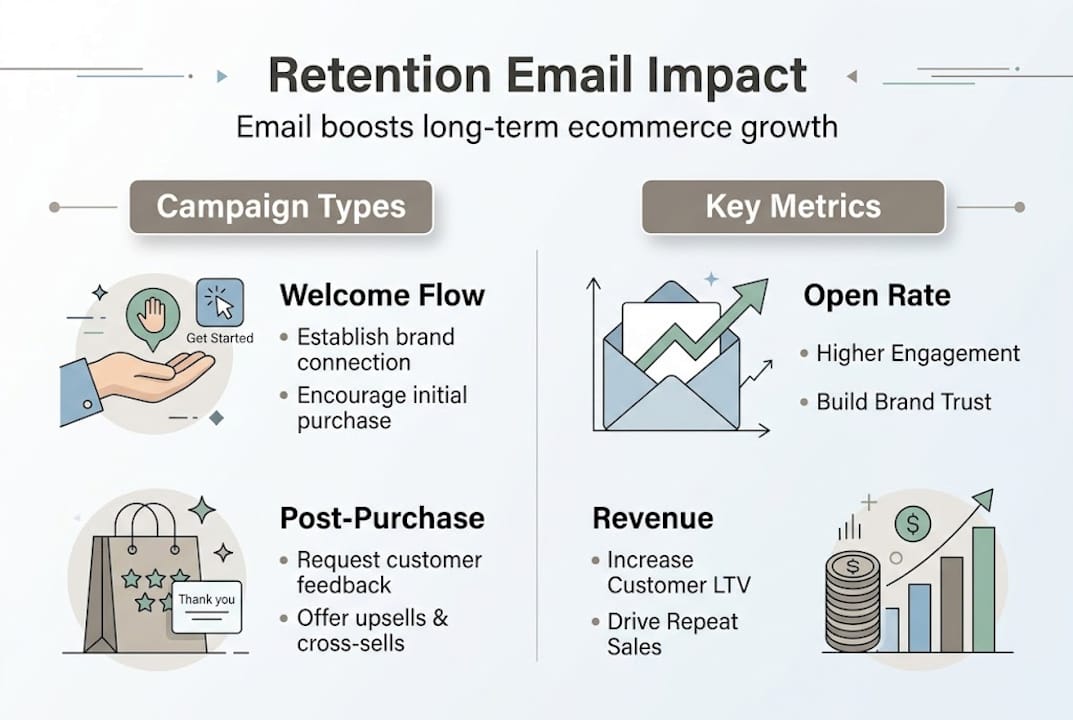
Here is how retention-focused campaigns affect the numbers:
| Campaign type | Average open rate | Avg revenue per recipient | Retention impact |
|---|---|---|---|
| Post-purchase follow-up | 42% | $0.85 | High |
| Loyalty and VIP offers | 38% | $1.20 | Very high |
| Anniversary or birthday | 45% | $0.95 | High |
| Reactivation (winback) | 14% | $0.60 | Moderate |
| Product replenishment | 50% | $1.40 | Very high |
The brands that drive growth with automated retention understand that increasing customer lifetime value (LTV) by even 15 to 20% can dramatically change the economics of a business. You spend less on acquisition, and each customer generates more revenue over their relationship with your brand.
Actionable tactics to improve retention through email:
- Personalize offers based on purchase history. Klaviyo’s segmentation lets you send targeted product recommendations to customers who bought specific items, increasing relevance and click rates.
- Build a VIP tier. Identify your top 10% of buyers by total spend and create a dedicated flow with exclusive early access, free shipping, or special discounts.
- Use replenishment reminders. If you sell consumables (supplements, skincare, coffee), set up a flow that triggers 20 to 25 days after a purchase to remind customers to reorder before they run out.
- Send anniversary emails. A personalized message on the anniversary of a customer’s first purchase with a small offer feels genuine and drives action.
Deliverability is also critical here. As you avoid email marketing mistakes, pay particular attention to sender reputation. Klaviyo flags list health issues, but you still need to avoid common pitfalls like over-sending, skipping exclusions, and neglecting to suppress unengaged subscribers. Damaged deliverability means even your best customers stop seeing your emails.
Common pitfalls and how to avoid them in small business email marketing
Most small ecommerce brands make the same handful of mistakes repeatedly. Knowing what they are saves you months of underperformance and potential damage to your sender reputation.
The most common pitfalls and how to fix them:
- Over-sending to your entire list. Blasting every subscriber with every campaign destroys engagement. Segment your list by behavior, purchase history, and engagement level. Only send content that is relevant to each group.
- Ignoring deliverability metrics. Open rates, spam complaints, and bounce rates are your early warning system. If spam complaints rise above 0.1%, you need to investigate immediately.
- No list hygiene routine. Unengaged subscribers who have not opened an email in 90 to 120 days drag down your deliverability. Run a re-engagement flow, and if they still do not respond, suppress them.
- Generic subject lines. “New arrivals are here!” is not a reason to open an email. Use curiosity, specificity, and personalization to earn that click.
- Forgetting mobile optimization. More than 60% of emails are opened on mobile. If your template does not render cleanly on a phone screen, you are losing conversions before anyone reads a word.
The set-and-forget mentality is perhaps the most dangerous mistake of all. You set up a welcome flow in January, and by September it is still running the same content with outdated offers and broken product links. Automation requires maintenance.
Also, make sure your flows have proper exclusions and filters in place. A customer who just bought should never receive an abandoned cart email for that same session. These overlaps frustrate subscribers and signal poor management to email service providers.
Pro Tip: Schedule a monthly email audit. Review your top three flows, check click-through rates and revenue generated, update copy or offers that have gone stale, and verify that all exclusion logic is still working correctly. Thirty minutes a month can prevent significant revenue loss.
What most small ecommerce brands miss about email marketing
Here is the uncomfortable truth: most small brands treat email as a last resort instead of a first priority. They pour budget into paid ads, watch costs rise, and then try email when margins get tight. By that point, they have no list, no automation, and no strategy.
The conventional wisdom that email is “old news” ignores one fundamental reality: no other channel gives you this level of direct, owned access to your customers. Social platforms can de-rank you overnight. Ad costs can double in a quarter. Your email list is an asset you control completely.
What we have seen consistently is that brands using ecommerce growth marketing ideas built around email and retention significantly outperform those chasing paid traffic. Small teams with modest budgets are competing with major retailers because they know their customers better and communicate with them more personally.
The other thing most brands miss is that email is not a “send and hope” channel. It is a feedback loop. Every open, click, and purchase tells you something about what your customers want. Klaviyo surfaces that data in a way that should constantly be informing your product decisions, promotional calendar, and content strategy.
Stop treating email as a broadcast tool. Start treating it as a conversation. The brands that get this right build loyal communities, not just customer lists.
Ready to elevate your ecommerce email marketing?
If you have read this far, you know that email marketing is not optional for ecommerce growth. It is the engine. The challenge is turning strategy into execution without wasting months figuring it out through trial and error.
Take Action specializes in building the exact systems described in this article: welcome flows, abandoned cart recovery, post-purchase sequences, retention campaigns, and long-term optimization. Our team combines platform expertise with data-driven strategy to help ecommerce brands like yours turn email into a primary revenue channel. Whether you need a full setup or an audit of what you already have, our email marketing services are built to deliver measurable results. Visit our ecommerce email agency page to book a consultation and start growing smarter.
Frequently asked questions
Why should ecommerce small businesses consider Klaviyo for email marketing?
Klaviyo offers advanced automation and deep Shopify integration with predictive analytics, making it uniquely suited for online stores that want to scale beyond basic email blasts.
What is the most common mistake small ecommerce brands make in email marketing?
Over-sending to unsegmented lists is the fastest way to damage deliverability, as over-sending harms sender reputation and reduces long-term engagement across your entire list.
How does retention-focused email impact ecommerce growth?
Retention campaigns increase customer lifetime value and generate repeat purchases at a fraction of the cost of acquiring new customers, making them the highest-leverage use of your email channel.
Is email marketing too complicated for small teams?
Modern platforms like Klaviyo offer templates and guided flow setup that simplify campaign management, though a steeper learning curve compared to basic tools means some upfront investment in learning is expected.
Recommended
- 7 Service Business Marketing Ideas for Ecommerce Growth | Take Action Blog | Take Action
- Email Segmentation Strategies for Ecommerce Growth | Take Action Blog | Take Action
- Boost ecommerce sales with top email marketing tips | Take Action Blog | Take Action
- Blog - Email Marketing Insights | Take Action | Take Action