

Master email marketing for course creators: boost sales
Email marketing consistently delivers results that social media simply cannot match for course creators. While Instagram algorithms shift and TikTok reach fluctuates unpredictably, your email list is an asset you fully own. Unlike social platforms where you’re essentially building on rented land, email gives you direct, unfiltered access to your audience every single time you hit send. This guide walks you through automation, segmentation, and proven campaign strategies that move leads from curious subscribers to paying students, and keep them coming back for more.
Table of Contents
- Why email marketing outperforms social media for course creators
- Essential automation workflows for selling online courses
- Segmentation: The strategy that doubles your course revenue
- Advanced tactics: Re-engagement, A/B testing, and AI segmentation
- Choosing the right tools: Platforms and integrations for course creators
- The uncomfortable truth: Automation is not a shortcut—here’s what most fail to plan for
- Take your email marketing to the next level with support
- Frequently asked questions
Key Takeaways
| Point | Details |
|---|---|
| Own your audience | Building your email list protects you from social media changes and ensures reliable course promotion. |
| Automate for growth | Automation workflows like welcome, nurture, and win-back sequences convert more leads with less effort. |
| Segment to boost results | Strategic segmentation based on student behavior and purchase history dramatically increases engagement and sales. |
| Refine and personalize | Continually test, clean your list, and humanize your messaging for long-term email marketing success. |
Why email marketing outperforms social media for course creators
Social media feels powerful because it’s visible. You post, people react, and the feedback is instant. But that visibility is borrowed. Platform algorithms decide who sees your content, and a single policy change or account suspension can erase years of audience-building overnight. Email works differently. Your list belongs to you, not to a tech company.
This distinction matters more than most course creators realize. Email as owned media means your outreach isn’t subject to reach throttling or ad spend requirements. You send, they receive. That reliability compounds over time, especially when you layer in automation that works around the clock without you lifting a finger.
Here’s what email automation actually gives you as a course creator:
- Consistent outreach without daily manual effort
- Scalable nurturing that works whether you have 100 or 100,000 subscribers
- Predictable sales cycles tied to your launch calendar or evergreen funnels
- Time savings after the initial setup, freeing you to focus on content creation
The moment you understand email automation basics, you stop trading time for reach and start building a system that sells for you.
“Your email list is the only audience you truly own. Every other channel is a platform you’re renting.”
For course creators specifically, this ownership translates into launch flexibility, re-engagement control, and the ability to test messaging without paying for impressions. Social media is a great discovery tool. Email is where the sale actually happens.

Essential automation workflows for selling online courses
Knowing email is powerful is one thing. Building the workflows that actually convert subscribers into students is another. Automation for course creators generally falls into three categories: lead engines, sales engines, and action engines.
- Lead engines capture interest through lead magnets, free mini-courses, and waitlists. These workflows welcome new subscribers and begin building trust before any offer is made.
- Sales engines run during promotions, launches, and upsell sequences. They move warm leads toward a purchase decision with timed emails and social proof.
- Action engines handle onboarding, course completion nudges, and win-back campaigns for students who’ve gone quiet.
The welcome sequence is where most course creators either win or lose a subscriber. A well-structured welcome flow introduces your story, delivers on the lead magnet promise, and sets expectations for what’s coming. Automation workflows for course creators confirm that welcome and nurture sequences are the highest-leverage automations for building trust and driving first purchases.
| Workflow type | Trigger | Objective |
|---|---|---|
| Welcome sequence | New subscriber opt-in | Build trust, deliver value |
| Nurture sequence | No purchase after 7 days | Educate, handle objections |
| Sales sequence | Launch or promo start | Convert warm leads |
| Onboarding flow | Course purchase | Activate and retain students |
| Win-back campaign | 60+ days of inactivity | Re-engage lapsed subscribers |
Each workflow serves a specific moment in the student journey. Skipping any one of them leaves money and engagement on the table. You can explore automated workflow examples to see how these translate into real sequences.
Pro Tip: Use tagging in your email platform to automatically route new subscribers into the right sequence based on where they opted in. A lead magnet about productivity gets a different nurture path than one about course creation.
Segmentation: The strategy that doubles your course revenue
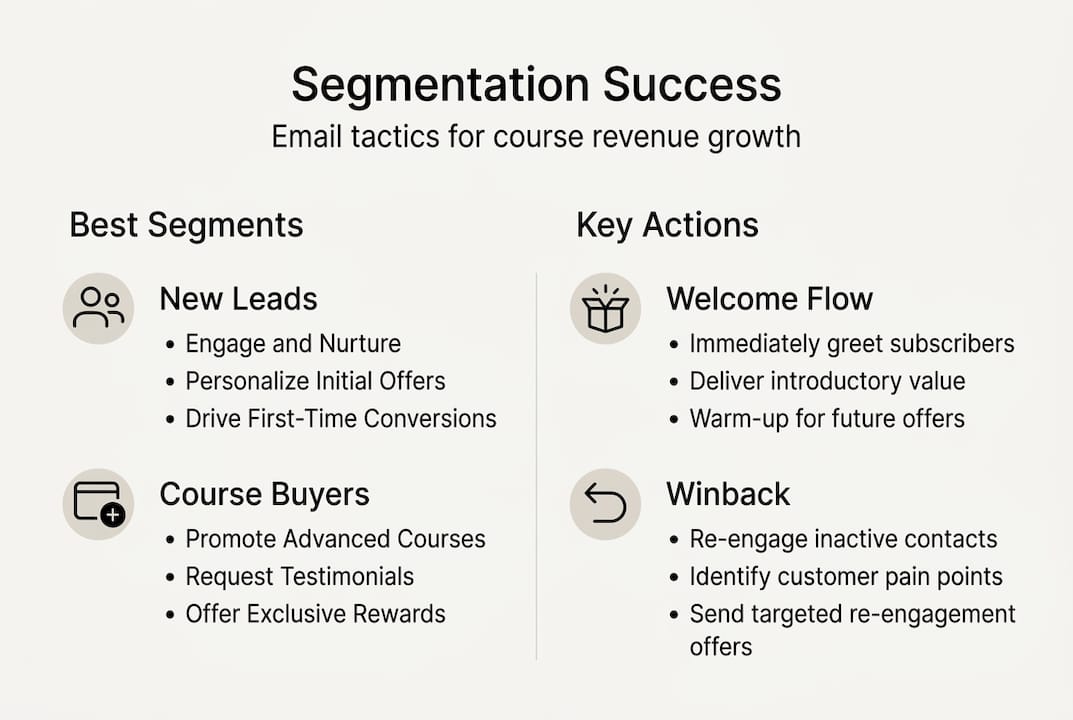
Sending the same email to every subscriber is the fastest way to train your audience to ignore you. Segmentation fixes that by delivering the right message to the right person at the right time.
For course creators, three segmentation types deliver the most impact:
- Demographic segmentation: Tailoring content by role, experience level, or industry
- Behavioral segmentation: Grouping subscribers by email opens, link clicks, or course activity
- Purchase history segmentation: Separating buyers from non-buyers and identifying upsell candidates
Segmentation best practices show that proper segmentation boosts open rates by 14 to 30 percent and can increase click rates by up to 100 percent. That’s not a marginal improvement. That’s the difference between a campaign that breaks even and one that funds your next course launch.
| Segmentation type | Trigger | Benefit for course creators |
|---|---|---|
| Demographic | Sign-up survey response | Personalized content alignment |
| Behavioral | Email opens, link clicks | Identify hot leads for follow-up |
| Purchase history | Completed transaction | Upsell, cross-sell, loyalty offers |
| Engagement level | 30 or 90 day activity | Re-engagement or list cleaning |
You can go deeper with segmentation strategy ideas or look at how unlocking email revenue through segmentation applies directly to course businesses.
Stat callout: Businesses that adopt segmentation report up to a 44% lift in revenue compared to those sending unsegmented broadcasts.
Start simple. Even splitting your list into buyers and non-buyers and sending different emails to each group will noticeably improve your results. From there, layer in behavioral data as your platform collects it.
Advanced tactics: Re-engagement, A/B testing, and AI segmentation
Once your core automations are running and your list is segmented, the next level is optimization. This is where most course creators stop growing because they assume the system is set. It isn’t.
Re-engagement campaigns are essential for list health. Subscribers who haven’t opened an email in 60 to 90 days drag down your deliverability scores, which affects how often your emails land in the inbox versus the spam folder. A structured win-back sequence with a compelling incentive, like a discount, a free bonus module, or early access to new content, can recover a meaningful portion of those subscribers.
- Clean your list regularly. Remove hard bounces and persistent non-openers to protect sender reputation.
- Verify email addresses to keep bounce rates below 3 percent, which is the threshold most providers flag.
- A/B test subject lines to learn what language resonates with your specific audience.
- Optimize for mobile since the majority of emails are now opened on phones, not desktops.
- Test your CTAs by comparing button text, placement, and offer framing to find what drives clicks.
Re-engagement and AI segmentation research shows that AI-powered segmentation outperforms behavioral-only targeting by two to three times in engagement and conversion metrics. AI tools analyze patterns humans miss, like the time of day a subscriber is most likely to open, or which content topic predicts a purchase.
“The best email marketers don’t just send more emails. They send smarter ones to the right people at exactly the right moment.”
For engagement-boosting newsletter ideas that apply to course audiences, or to sharpen your list segmentation tips, there are practical frameworks worth studying.
Pro Tip: Before running a re-engagement campaign, tag subscribers by their last engagement date. This lets you send progressively stronger win-back offers without burning your entire list.
Choosing the right tools: Platforms and integrations for course creators
Your strategy is only as strong as the platform supporting it. Choosing the wrong email tool early on means migrating your list later, which is painful and disruptive.
When evaluating platforms as a course creator, prioritize these criteria:
- Visual automation builders that let you map out sequences without coding
- Tagging and segmentation capabilities built into the core product, not locked behind premium tiers
- Native integrations with your course platform, whether that’s Teachable, Thinkific, Kajabi, or another
- Deliverability track record backed by real data, not just marketing claims
- Scalable pricing that doesn’t penalize you for growing your list
Best email software for online courses points to ConvertKit and ActiveCampaign as top choices for creators. Both offer visual automation builders, robust tagging systems, and direct integrations with the major course platforms. ConvertKit is particularly creator-friendly with its clean interface and subscriber-first pricing model. ActiveCampaign gives you more advanced CRM features if you’re managing a larger operation.
For a broader look at your options, platform comparisons break down the leading tools side by side. You can also review an email automation tool review to understand how feature sets differ in practice.
Pro Tip: Start with a platform that supports segmentation and automation from day one, even if your list is small. Building good habits early prevents painful migrations when you scale.
The right tool won’t make a weak strategy work. But the wrong tool will absolutely hold a strong strategy back.
The uncomfortable truth: Automation is not a shortcut—here’s what most fail to plan for
Here’s what we see consistently: course creators invest in automation setup, launch their sequences, and then wonder why results are underwhelming. The assumption is that automation will fix engagement problems or compensate for an offer that isn’t resonating. It won’t.
Automation scales what’s already working. If your messaging is unclear, your welcome sequence will deliver that confusion to every new subscriber, efficiently and repeatedly. If your offer doesn’t solve a real problem your audience cares about, no amount of segmentation will change the conversion rate.
What high-performing course creators do differently is commit to message-market fit before scaling automation. They test subject lines manually. They read reply emails from students. They adjust positioning based on what questions keep coming up. Then they automate.
List hygiene, ongoing A/B testing, and genuine personal connection aren’t optional extras. They’re the foundation that makes everything else work. Repurposing content for email is one practical way to keep your sequences fresh without starting from scratch every time.
The creators who get the best results treat their email list like a relationship, not a broadcast channel. Automation handles the consistency. You bring the substance.
Take your email marketing to the next level with support
Implementing everything covered here, from automation workflows to advanced segmentation and re-engagement campaigns, takes real time and expertise. Most course creators are already stretched building content, supporting students, and managing launches.
That’s exactly where a specialized email marketing agency makes the difference. At Take Action, we handle the strategy, the automation setup, the segmentation logic, and the copywriting so your email channel actually performs. Whether you need a full system built from scratch or want an expert review of what you already have, our email retention experts are ready to help you turn your list into a consistent revenue driver. Reach out for a free consultation and see what’s possible.
Frequently asked questions
How often should I email my course students and leads?
Most successful creators email their list at least once per week, mixing educational content with promotional emails to maintain engagement without overwhelming subscribers.
What types of segmentation drive the best results for online educators?
Behavioral and purchase history segmentation consistently generate the highest returns, with segmentation best practices showing 14 to 100 percent higher engagement compared to unsegmented sends.
Does using automation affect deliverability or student experience?
Automation improves consistency, but clean lists and verification are essential to protect deliverability and ensure students receive a personalized, relevant experience.
Can email marketing really outperform my social media posts?
Yes, because email as owned media gives you direct audience access without algorithm interference, making engagement and sales far more predictable than social platforms.
Recommended
- Boost ecommerce sales with top email marketing tips | Take Action Blog | Take Action
- Blog - Email Marketing Insights | Take Action | Take Action
- Master online marketing basics for ecommerce growth in 2026 | Take Action Blog | Take Action
- What is online marketing: mastering email automation | Take Action Blog | Take Action