

Master online marketing basics for ecommerce growth in 2026
Many ecommerce marketing managers believe online marketing is too complex and overwhelming to master. You might feel lost navigating endless tactics, platforms, and strategies while trying to grow your brand. The truth is simpler than you think. Focusing on core marketing fundamentals, especially email marketing with Klaviyo, can transform your customer retention and revenue without requiring a massive team or budget. This guide breaks down the essential online marketing basics you need to drive sustainable ecommerce growth in 2026, from foundational concepts to practical implementation steps that deliver measurable results.
Table of Contents
- Understanding Online Marketing Fundamentals For Ecommerce
- Email Marketing Essentials With Klaviyo: Tools, Segmentation, And Automation
- Measuring Success: Key Metrics And Optimization Strategies
- Integrating Email Marketing With Your Overall Ecommerce Strategy
- Boost Your Ecommerce Growth With Expert Email Marketing Support
Key takeaways
| Point | Details |
|---|---|
| Core fundamentals drive success | Understanding basic channels and customer journeys simplifies your marketing approach and accelerates growth. |
| Email marketing powers retention | Klaviyo automation and segmentation turn one-time buyers into loyal customers who generate consistent revenue. |
| Metrics guide optimization | Tracking open rates, conversions, and revenue per email reveals what works and where to improve campaigns. |
| Integration amplifies results | Coordinating email with SEO and content marketing creates cohesive experiences that boost customer lifetime value. |
Understanding online marketing fundamentals for ecommerce
Online marketing encompasses the digital channels and strategies you use to attract, engage, and convert customers for your ecommerce brand. At its core, marketing involves understanding your customer journey from awareness through purchase and beyond, then strategically placing your brand at each touchpoint. For ecommerce businesses in 2026, digital marketing strategies remain foundational to growth, combining multiple channels to create a cohesive experience that drives sales and builds lasting relationships.
Email marketing stands out as the most powerful retention channel in your marketing stack. Unlike paid advertising that stops working when you stop spending, email creates an owned asset that generates revenue on autopilot. Klaviyo integrates seamlessly with your ecommerce platform, capturing customer data and behavior to trigger personalized messages that feel relevant rather than intrusive. This integration transforms email from a broadcast channel into a sophisticated retention engine.
Your marketing stack should include these essential channels working together:
- Email marketing for retention and automated revenue generation
- Search engine optimization to capture organic traffic from buyers actively searching
- Content marketing to educate prospects and establish authority in your niche
- Social media to build community and amplify your brand message
- Paid advertising to accelerate customer acquisition when profitable
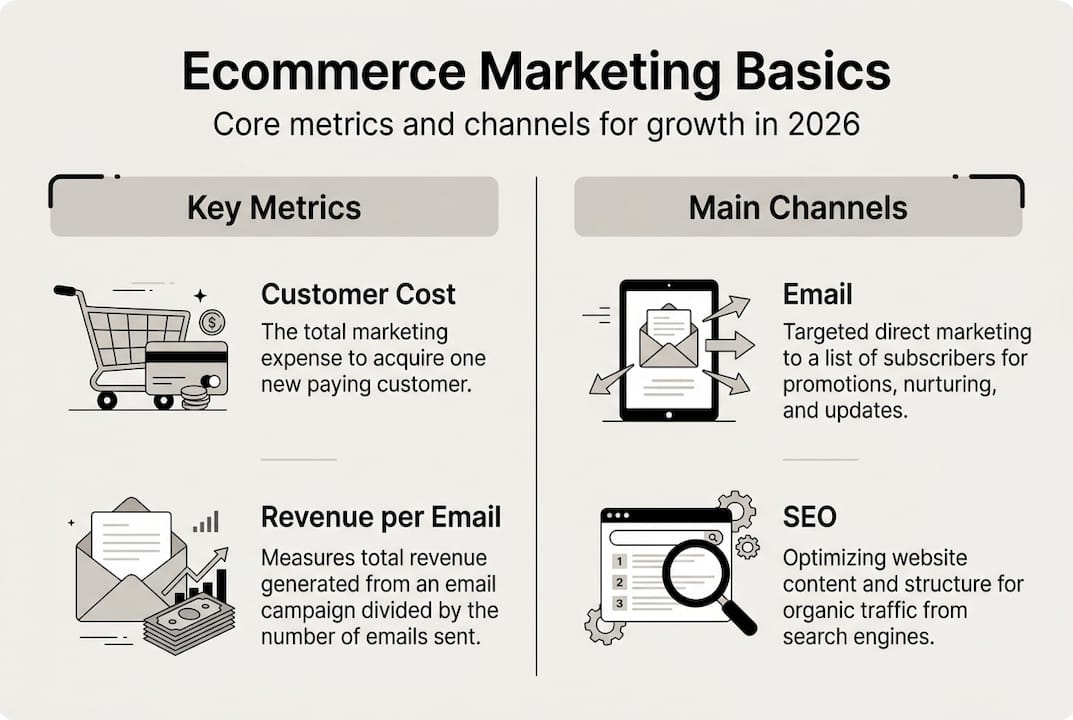
Successful ecommerce managers monitor specific metrics that reveal marketing performance. Customer acquisition cost tells you how much you spend to gain each new buyer. Customer lifetime value shows total revenue generated per customer over time. The ratio between these numbers determines whether your marketing is profitable or burning cash. Email open rates, click rates, and conversion rates expose how well your messages resonate with subscribers.
Developing an effective online marketing strategy for ecommerce starts with mapping your customer journey. Identify the awareness stage where prospects first discover your brand, the consideration phase where they evaluate options, and the decision moment when they purchase. Then create touchpoints at each stage that guide buyers forward. Email plays a critical role throughout this journey, nurturing prospects who are not ready to buy and re-engaging customers after their first purchase to drive repeat orders.
Email marketing essentials with Klaviyo: tools, segmentation, and automation
Klaviyo provides ecommerce brands with specialized email marketing capabilities designed specifically for online retail. Unlike generic email platforms, Klaviyo connects directly to your store data, tracking every product view, cart addition, and purchase. This deep integration enables sophisticated segmentation and personalization that generic tools cannot match. You can trigger messages based on specific behaviors, creating timely communications that feel personal rather than mass-marketed.
Building effective audience segments starts with understanding customer behavior patterns. Create segments for engaged subscribers who open emails regularly, VIP customers who spend above average, at-risk customers who have not purchased recently, and cart abandoners who showed buying intent. Follow these steps to maximize segmentation:
- Start with behavioral data like purchase history and browsing patterns rather than demographic assumptions
- Create dynamic segments that automatically update as customer behavior changes
- Test segment definitions to ensure they capture the right audience size and characteristics
- Layer multiple conditions to create highly targeted micro-segments for specialized campaigns
- Regularly audit segment performance to identify which groups generate the best engagement and revenue
Automated flows generate revenue while you sleep by triggering personalized messages based on customer actions. Welcome series introduce new subscribers to your brand story and product benefits, typically generating higher engagement than regular campaigns. Cart abandonment flows recover lost sales by reminding shoppers about items left behind, often including dynamic product images and incentives. Post-purchase flows thank customers, request reviews, and recommend complementary products to drive second orders.

Personalized dynamic content transforms generic emails into relevant conversations. Use Klaviyo’s merge tags to insert customer names, recently viewed products, and purchase history into your messages. Show different product recommendations based on browsing behavior or past purchases. Adjust email copy and offers based on customer segment, speaking differently to VIPs versus first-time buyers. This personalization drives significantly higher email marketing engagement compared to one-size-fits-all blasts.
Pro Tip: Avoid over-segmentation that creates too many tiny audiences requiring separate content creation. Start with three to five core segments based on engagement level and purchase behavior, then expand only when you have resources to create truly differentiated content for each group. Many brands waste time building dozens of segments they never actually use in campaigns.
Flow triggers require careful setup to avoid annoying customers with poorly timed messages. Set appropriate delays between emails in each series, typically 24 to 48 hours for abandoned cart reminders and three to seven days between welcome series messages. Implement smart sending that prevents customers from receiving multiple automated emails on the same day. Create exclusion rules so customers who make a purchase exit abandonment flows immediately rather than receiving irrelevant reminders.
Measuring success: key metrics and optimization strategies
Email marketing success depends on tracking the right metrics and understanding what they reveal about campaign performance. Open rate measures the percentage of recipients who opened your email, indicating subject line effectiveness and sender reputation. Click-through rate shows what percentage of openers clicked a link, revealing message relevance and call-to-action strength. Conversion rate tracks the percentage of clickers who completed your desired action, whether purchasing, signing up, or downloading content.
Revenue metrics matter most for ecommerce brands focused on growth. Revenue per email divides total revenue generated by emails sent, showing overall campaign profitability. Monitoring metrics like open rates, CTR, and revenue per email helps identify high-performing campaigns worth replicating. Average order value from email campaigns compared to other channels reveals whether email attracts higher-value customers. Customer lifetime value segmented by email engagement level demonstrates long-term retention impact.
| Metric | Good Benchmark | Excellent Benchmark | What It Reveals |
|---|---|---|---|
| Open Rate | 15-25% | 30%+ | Subject line appeal and sender trust |
| Click Rate | 2-5% | 7%+ | Message relevance and CTA effectiveness |
| Conversion Rate | 1-3% | 5%+ | Offer strength and landing page quality |
| Revenue per Email | $0.10-0.25 | $0.50+ | Overall campaign profitability |
| Unsubscribe Rate | Below 0.5% | Below 0.2% | Content relevance and send frequency |
Klaviyo’s analytics dashboard provides real-time performance tracking across all campaigns and flows. Monitor campaign performance immediately after sending to identify issues requiring quick fixes. Track flow performance over rolling 30-day and 90-day periods to spot trends and optimization opportunities. Use cohort analysis to compare how different customer segments respond to the same messages, revealing which audiences deserve more attention.
Optimization starts with systematic testing rather than random changes. A/B test subject lines by sending two versions to small audience samples, then automatically sending the winner to remaining subscribers. Test send times by comparing morning versus evening performance for your specific audience. Experiment with email length, trying both concise messages and longer storytelling approaches. Test different calls to action, offer types, and visual layouts to discover what resonates.
Implement these optimization best practices for continuous improvement:
- Review top-performing emails monthly to identify common elements worth replicating
- Analyze worst-performing messages to understand what to avoid in future campaigns
- Segment performance data to see which customer groups respond best to different approaches
- Track metrics over time to identify seasonal patterns and optimal sending frequencies
- Compare your metrics against digital media strategy benchmarks to gauge competitive performance
Pro Tip: Avoid obsessing over open rates in 2026, as privacy changes have made this metric less reliable. Focus instead on click rates and revenue metrics that directly measure engagement and business impact. Many marketers waste time optimizing opens while ignoring the clicks and conversions that actually drive revenue growth.
Integrating email marketing with your overall ecommerce strategy
Email marketing delivers maximum impact when coordinated with your other marketing channels rather than operating in isolation. Multi-channel marketing synergy occurs when each channel reinforces the others, creating a cohesive brand experience across touchpoints. Your SEO content attracts organic traffic that converts into email subscribers. Those subscribers receive nurturing campaigns that drive purchases. Post-purchase emails encourage reviews and social sharing that boost SEO and social proof.
| Channel | Primary Role | Email Integration | Combined Impact |
|---|---|---|---|
| Email Marketing | Retention and repeat revenue | Core channel driving automation | Highest ROI for customer lifetime value |
| SEO | Organic traffic acquisition | Captures visitors for list growth | Compounds over time as content ranks |
| Content Marketing | Education and authority building | Provides valuable email content | Nurtures prospects not ready to buy |
| Paid Advertising | Accelerated customer acquisition | Retargets email subscribers | Improves conversion rates and ROAS |
Campaign coordination multiplies effectiveness by timing messages across channels strategically. Launch new products with email announcements to your existing list while running paid ads to cold audiences. Create blog content that educates prospects, then email subscribers with related product recommendations. Use email to promote your best-performing social content, driving engagement across platforms. This coordination ensures customers encounter consistent messaging regardless of where they interact with your brand.
Consistent messaging and timing prevent customer confusion and reinforce your brand positioning. When your email promotes a sale, your website homepage should feature the same offer prominently. Social media posts should echo email campaign themes and visual style. Product launch timing should align across all channels so customers hear about new items simultaneously rather than receiving scattered, conflicting information. This consistency builds trust and makes your marketing feel intentional rather than chaotic.
Successful content marketing for ecommerce growth depends on repurposing content across channels efficiently. Turn your best-performing blog posts into email series that educate subscribers. Convert customer testimonials into social proof for both email campaigns and product pages. Use email survey responses to identify content topics your audience wants, then create blog posts and videos addressing those needs. This content recycling maximizes your team’s effort while maintaining quality.
Follow these integration tips to align email with your broader ecommerce strategy:
- Schedule monthly cross-channel planning meetings to coordinate campaigns and messaging
- Create a shared content calendar showing email sends, blog publishes, and social posts
- Use consistent visual branding across email templates, website design, and social graphics
- Track customer journeys across channels to understand how touchpoints work together
- Partner with an SEO marketing agency focused on ecommerce to align organic and email strategies
Your customer data platform should unify information from all channels, giving you a complete view of each customer’s interactions. When someone clicks an email link, browses your site, and later converts through a paid ad, you need to see that full journey. This unified data reveals which channel combinations drive the best results, informing budget allocation and strategy decisions. Klaviyo’s integration capabilities make this cross-channel tracking possible without complex technical implementations.
Boost your ecommerce growth with expert email marketing support
Mastering online marketing basics provides the foundation, but executing sophisticated email strategies requires specialized expertise and consistent optimization. Take Action specializes in helping ecommerce brands transform email into their primary growth channel through Klaviyo automation and strategic campaigns. Our team combines deep platform knowledge with proven retention strategies that increase customer lifetime value and diversify revenue beyond paid advertising.
We handle everything from initial Klaviyo setup and flow optimization to ongoing campaign strategy and performance analysis. Our data-driven approach identifies exactly which segments and messages drive the highest revenue for your specific audience. Whether you are launching your first automated flows or scaling an established email program, our email marketing and retention agency delivers measurable results that compound over time. Contact us to explore how personalized email strategies can accelerate your ecommerce growth in 2026.
Frequently asked questions
What are the essential components of online marketing basics?
Online marketing basics include understanding core channels like email, SEO, content marketing, and social media, plus developing strategic plans that guide customers through awareness to purchase. Effective measurement through key metrics and customer segmentation based on behavior patterns are equally essential components. Mastering these fundamentals creates a solid foundation for sustainable ecommerce growth.
How can Klaviyo improve customer retention for ecommerce brands?
Klaviyo enables targeted messaging through behavioral segmentation and automated email flows that engage customers at critical moments like cart abandonment and post-purchase. Personalized product recommendations based on browsing and purchase history increase relevance, driving higher engagement and repeat purchases. This automation fosters deeper customer loyalty by delivering timely, valuable communications that feel personal rather than generic.
Which key metrics should ecommerce marketers monitor for email campaigns?
Ecommerce marketers should prioritize open rate, click-through rate, conversion rate, and revenue per email as crucial performance indicators. Tracking bounce rates and unsubscribe rates helps maintain list health and sender reputation over time. These metrics reveal campaign effectiveness and identify optimization opportunities that directly impact revenue growth.
How does email marketing fit into a broader ecommerce strategy?
Email marketing works most effectively when integrated with SEO and content strategies to deliver consistent brand messaging across all customer touchpoints. Cross-channel coordination amplifies engagement by reinforcing messages through multiple channels, increasing both conversion rates and customer lifetime value. This integration transforms isolated tactics into a cohesive growth system that compounds results over time.
Recommended
- Blog - Email Marketing Insights | Take Action | Take Action
- 7 Habits of Successful Entrepreneurs for Ecommerce Growth | Take Action Blog | Take Action
- 7 Top Content Marketing Trends for Ecommerce Growth | Take Action Blog | Take Action
- 7 Steps Ecommerce Marketing Checklist for Brand Growth Success | Take Action Blog | Take Action