

Ecommerce email content creation that drives real retention
TL;DR:
- Effective ecommerce email relies on content strategy, timing, and automation working together.
- Segment customers using RFM data to tailor messaging at each stage of their journey.
- Focus on revenue-driven metrics and continuous optimization rather than open rates.
A well-timed post-purchase flow can boost profits by 30%, but only when your content and automation are working together. Most ecommerce brands launch email campaigns and then wonder why customers don’t come back. The real problem isn’t the tool, it’s the content strategy behind it. Poor timing, generic messaging, and over-reliance on discounts quietly kill retention. In this guide, you’ll get a clear, actionable framework for building email content that automates customer engagement, drives repeat purchases, and turns one-time buyers into loyal customers.
Table of Contents
- What you need for effective ecommerce content creation
- Planning your content: Segmentation, timing, and topics
- How to execute: Automation, sequence design, and content building
- Measuring success and optimizing your content
- Our perspective: What most ecommerce brands get wrong and how to stand out
- Boost your results with expert help
- Frequently asked questions
Key Takeaways
| Point | Details |
|---|---|
| Right content, right time | Upsells and educational content scheduled strategically boost profits and retention. |
| Smart segmentation wins | Personalize by value and engagement to maximize impact and avoid over-discounting. |
| Measure what matters | Track revenue per recipient and engagement, not just open rates, for true email ROI. |
| Prioritize creative assets | A strong modular content library accelerates creation and keeps messages effective. |
What you need for effective ecommerce content creation
Now that we’ve established the stakes, here’s what you need before you start.
Before you write a single subject line or set up a single flow, you need to shift how you think about email. Most brands treat email as a broadcast channel: “we have something to sell, let’s send a blast.” That mindset produces forgettable content and shrinking open rates. The brands that win in 2026 treat email as a lifecycle channel, meaning every message is tied to where a customer is in their relationship with your brand.
The mindset shift
Stop thinking in campaigns. Start thinking in conversations. A first-time buyer needs a different message than someone who bought twice in 60 days. A lapsed customer who spent $400 last year deserves a different approach than a one-time $25 purchaser. Your content strategy should reflect these differences at every stage.
The tools you actually need
You don’t need twenty tools. You need the right three: an email service provider with automation capabilities (Klaviyo is the industry standard for ecommerce), a customer data layer that tracks purchase history and behavior, and an analytics dashboard that goes beyond open rates. These three working together give you the infrastructure to personalize at scale.
| Tool category | Purpose | Example |
|---|---|---|
| Email service provider | Sends, automates, segments | Klaviyo |
| Customer data platform | Tracks behavior and purchase history | Shopify, Segment |
| Analytics | Measures revenue impact | Klaviyo reports, GA4 |
Data inputs that drive smart content
Content without data is guesswork. The most powerful input for ecommerce email is RFM segmentation, which stands for Recency, Frequency, and Monetary value. It tells you who bought recently, how often they buy, and how much they spend. With this, you can create content that feels personal without manually writing individual emails.
Key data inputs to gather before you build content:
- Purchase history: What did they buy, when, and how often?
- Browse behavior: What did they look at but not purchase?
- Email engagement: What have they opened or clicked in the past 90 days?
- Customer lifetime value: Are they a high-value or low-value buyer?
Pro Tip: Build a modular content library before you launch any flow. This means having reusable blocks: a product feature block, a testimonial block, an educational snippet block. This cuts production time dramatically and keeps your brand voice consistent across every automated email.
Fast content creation tips are especially useful when you’re setting up multiple flows at once. And if you’re starting from scratch, a solid content pillar strategy gives you a repeatable system for generating email topics that align with your brand and customer needs.
Post-purchase flows should include immediate upsells within the first 15 minutes, educational content between days 3 and 5 post-delivery to reduce returns, and RFM-based segmentation for win-back sequences that avoid over-discounting. Having your asset library ready means you can plug content into these flows without starting from zero every time.

Planning your content: Segmentation, timing, and topics
With the right foundation, let’s look at how to plan your content for real results.
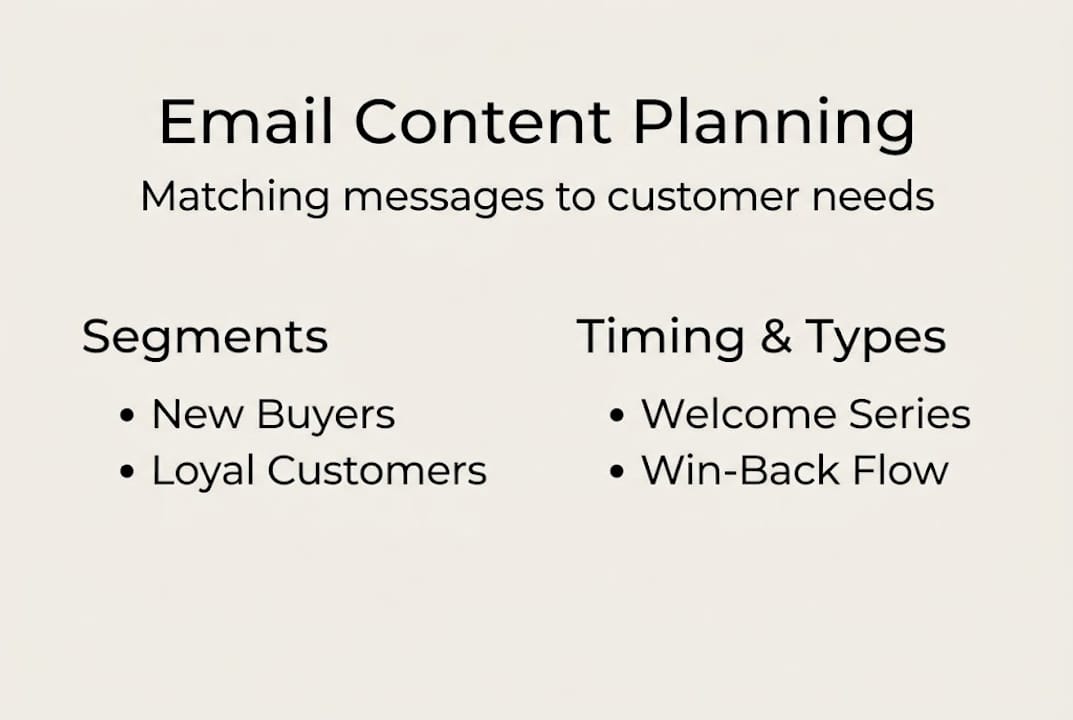
Great content planning in email is really about matching the right message to the right person at the right moment. Sounds simple. In practice, most brands skip this step and send the same content to everyone, which tanks engagement and trains subscribers to ignore them.
Understanding RFM segmentation in practice
RFM breaks your list into distinct groups based on three dimensions. Here’s how each segment typically maps to content type:
| RFM segment | Who they are | Best content type |
|---|---|---|
| High recency, high frequency | Active loyal buyers | Loyalty rewards, exclusive access |
| High recency, low frequency | New customers | Educational, product tutorials |
| Low recency, high monetary | Lapsed high-value customers | Premium win-back, no discounts yet |
| Low recency, low monetary | Disengaged one-timers | Sunset or last-chance offers |
This table isn’t theoretical. Each row demands different copy, different offers, and different send cadence. Sending a deep discount to a high-value lapsed customer before you’ve tried anything else is leaving money on the table.
Mapping content to the customer journey
Think of your email content in three stages:
- Transactional: Order confirmation, shipping updates, delivery confirmation. These are already expected, but they’re also your highest-open-rate emails. Use them to plant seeds for the next purchase.
- Educational: Product usage guides, how-to content, care instructions. Best sent 3 to 5 days after delivery, these reduce returns and build trust.
- Retention and win-back: Loyalty programs, personalized recommendations, re-engagement campaigns. These depend heavily on segment data.
Timing is everything. Avoid early discounts in automated sequences because they train customers to wait for a deal rather than buying at full price. Instead, lead with free shipping, curated product picks, or early access offers. Save discounts for the final stage of a win-back flow when you’ve exhausted other options.
Pro Tip: Suppress non-engagers after your win-back sequence ends. Continuing to email people who haven’t opened in 90 to 180 days destroys your sender reputation and hurts deliverability for everyone else on your list.
For topic ideas, ecommerce newsletter ideas give you a solid starting point. And for structuring campaigns across an entire quarter, content planning for ecommerce growth lays out a framework that keeps your messaging aligned with business goals rather than just what feels relevant that week.
When you plan content systematically, you stop scrambling before every send and start building a library of high-performing emails that can be reused, refreshed, and repurposed as your product catalog evolves.
How to execute: Automation, sequence design, and content building
Planning done, it’s time to build and automate your email flows.
Knowing what to send is one thing. Building the actual system that sends it reliably, at scale, without constant manual input is a different challenge. Here’s how to approach it step by step.
Building your core automated flows
Start with the four flows every ecommerce brand needs before anything else:
- Welcome series: 3 to 5 emails introducing your brand, values, and bestsellers. This sets the tone for the entire relationship.
- Post-purchase flow: Immediate upsell within 15 minutes of purchase, followed by educational content on days 3 through 5, then a review request on day 10.
- Abandoned cart flow: A reminder within 1 hour, a follow-up with social proof at 24 hours, and a final email with a soft incentive at 48 to 72 hours.
- Win-back flow: A “we miss you” message first, followed by a value-focused reminder, then a last-chance offer only if previous emails went unanswered.
Each of these flows should branch based on behavior. Did they click but not buy? Escalate the urgency. Did they buy a second time? Pull them out of the win-back flow and push them into a loyalty sequence instead.
Composing content that converts
Your content mix inside each flow should balance promotional and value-driven messages. Not every email should ask for a sale. A rough guide:
- 60% value content: Educational tips, how-to guides, product tutorials, brand stories
- 30% promotional: New arrivals, bestsellers, curated picks, upsells
- 10% re-engagement or loyalty: Reviews, referrals, VIP access
Mobile-first, accessible design isn’t optional in 2026. More than half of all email opens happen on a phone. If your template breaks on mobile, your content doesn’t matter. Use single-column layouts, large tap targets, and high-contrast text. This is a baseline requirement, not a nice-to-have.
Measuring revenue per recipient (RPR) and placed order rate rather than vanity metrics like opens is the expert standard in 2026. Apple’s Mail Privacy Protection has made open rates unreliable as a primary metric. Focus on what actually moves the needle for your business.
For inspiration on how well-designed flows look in practice, automated workflow examples show real sequence structures you can model. And if you’ve already created content elsewhere, repurposing content for email walks you through turning blog posts, video scripts, and social captions into email-ready material.
Blend automation with manual sends for product launches, seasonal campaigns, or anything time-sensitive. Automation handles consistency. Manual sends handle momentum. Together, they give you a complete content engine.
Measuring success and optimizing your content
Now, let’s make sure all your hard work delivers real results.
Building great flows means nothing if you can’t tell whether they’re working. Measurement in ecommerce email has evolved, and the brands still chasing open rates are flying blind.
Metrics that actually matter
Stop leading with opens. Start with these:
- Revenue per recipient (RPR): Total revenue divided by emails delivered. This is the clearest measure of how much each email is worth.
- Placed order rate: The percentage of recipients who completed a purchase after receiving your email. Tracks actual conversion, not just clicks.
- Churn prediction score: Available in Klaviyo, this predicts which customers are at risk of going inactive so you can reach them before they’re gone.
- List growth rate minus unsubscribes: Net growth tells you whether your content is building your asset or slowly eroding it.
- Deliverability rate: Are your emails reaching inboxes at all? Below 95% is a warning sign.
Stat to know: Well-executed post-purchase flows generate a 15 to 30% lift in overall email revenue. That’s not from discounting. That’s from timing, relevance, and smart sequencing.
Iterative optimization in practice
You don’t need a massive testing program to improve. You need a consistent system:
- Test subject lines first: They have the highest impact on open rates, which still matter for list health even if they’re not your primary KPI.
- Test one content element at a time: Change the hero image, or the CTA, or the first paragraph. Not all three at once.
- Review performance every 30 days: Flag any flow with an RPR below your baseline and investigate the drop.
- Refresh content every quarter: Product photos go stale. Testimonials get outdated. Seasonal relevance matters. Set a calendar reminder and treat it as a maintenance task.
Use the content audit checklist to work through your existing flows systematically. And for a longer-term view on what keeps customers engaged quarter after quarter, retention content pillars give you a strategic framework that aligns email content with product launches, seasons, and customer milestones.
When performance dips: What to check first
Performance problems usually fall into one of three buckets. First, deliverability: if your open rate drops suddenly across all flows, check your sender score and suppression list. Second, relevance: if click rates fall but deliverability is fine, your content isn’t matching the segment’s expectations. Third, timing: if your placed order rate drops, experiment with send windows. Sometimes a two-hour shift in delivery time makes a measurable difference.
Our perspective: What most ecommerce brands get wrong and how to stand out
Here’s the uncomfortable truth most agencies won’t say out loud: more automation doesn’t automatically mean more revenue. We see brands add flow after flow, trigger after trigger, and still watch retention flatline. Why? Because they’re automating the wrong content. They’re sending emails that say “buy this” in five different ways without ever giving the customer a real reason to care about the brand beyond the transaction.
The brands that build genuinely loyal audiences do something different. They treat email as a relationship tool first and a sales tool second. They invest in content pillars for retention that give customers educational value, community, and identity. They segment obsessively so that a customer who just bought an outdoor jacket doesn’t get an email about kitchen products the next day.
The other mistake we see constantly is the discount spiral. A brand panics when retention dips, adds a discount to every flow, and suddenly customers only engage when there’s a code involved. You’ve trained them. Reversing that takes months. The smarter move is to build content that creates value before you ever reach for the discount lever. That means educational emails, behind-the-scenes brand stories, early product access, and loyalty acknowledgment. These build the kind of relationship where customers buy because they want to, not because they’re waiting for a deal.
Boost your results with expert help
If you’ve read this far, you already understand that effective ecommerce email content isn’t about sending more. It’s about sending smarter, with the right message to the right person at the right moment, backed by data and built for scale.
Implementing all of this alongside running an actual business is where most marketing managers hit a wall. That’s where a dedicated email marketing retention agency steps in. At Take Action, we specialize in building and optimizing Klaviyo flows, content strategies, and automation systems that drive measurable revenue growth. Whether you need a full audit, a complete flow setup, or an ongoing content partner, we’re built to help ecommerce brands turn email into their most consistent revenue channel. Let’s build something that actually works.
Frequently asked questions
What type of content works best for ecommerce email automation?
Immediate upsells and educational content post-delivery are the most proven combination, driving profit increases and reducing return rates at the same time.
How do I avoid training customers to wait for a discount?
Lead with non-discount incentives like free shipping or exclusive access, and reserve discounts for win-back flows targeting segmented lapsed shoppers only after other options have been exhausted.
Which metrics should I measure for ecommerce email success?
Prioritize revenue per recipient and placed order rate over open rates, and add churn prediction scoring to catch at-risk customers before they go silent.
How often should I update my automated sequences?
Review and refresh your flows every quarter, or any time there’s a meaningful change in product line, brand direction, or performance data.
Recommended
- Content Creation Agencies: Driving Retention Growth | Take Action Blog | Take Action
- 7 Innovative Ecommerce Newsletter Ideas for Higher Retention | Take Action Blog | Take Action
- Blog - Email Marketing Insights | Take Action | Take Action
- Online Marketing Strategy: Driving Ecommerce Retention | Take Action Blog | Take Action