

Drive DTC growth with social video and automated email
TL;DR:
- Most DTC brands treat social video as a top-of-funnel branding tool, missing out on significant revenue opportunities.
- Connecting social video engagement to automated email flows transforms passive viewers into loyal customers, enhancing ROI.
Most DTC marketers treat social video as a top-of-funnel brand play and move on. That’s leaving serious revenue on the table. Social media engagement is now the fastest-growing video success metric, and 60% of companies use social clips to drive traffic back to their website. The real opportunity isn’t the video itself. It’s what happens after someone watches. When you connect social video behavior to automated email campaigns in Klaviyo, you turn passive viewers into paying customers at scale.
Table of Contents
- Why social video marketing has moved beyond brand awareness
- How to connect social video activity with automated email campaigns
- Data-driven results: Social video and email automation in action
- Beyond the inbox: Shoppable video on product pages
- Why conversion-focused metrics matter more than engagement (and how most DTC teams still get it wrong)
- Ready to integrate social video marketing and automated email?
- Frequently asked questions
Key Takeaways
| Point | Details |
|---|---|
| Conversion beats engagement | For DTC, focus on video strategies that drive sales, not just views or likes. |
| Automate with behavior data | Use social video engagement to trigger personalized, high-impact email flows. |
| A/B test placements | Continuously test video on emails and product pages to maximize incremental revenue. |
| Combine video and email | Pairing shoppable video with automated email sequences produces higher open, click, and conversion rates. |
Why social video marketing has moved beyond brand awareness
With the context set, let’s look at how the role of social video has evolved for DTC brands.
Social video used to live in the brand awareness bucket. You’d post a slick product video on Instagram, count your views, and call it a win. That model doesn’t cut it anymore. DTC brands operate in a high-pressure environment where every marketing dollar needs to pull its weight, and video marketing for ecommerce has matured to meet that demand.
The metrics tell the story. In 2026, “social media engagement” ranks third overall as a video success metric and is growing the fastest, with 22% of teams naming it their top measure. But engagement alone doesn’t pay for inventory. For DTC brands, the real KPIs are cost per acquisition (CPA), return on ad spend (ROAS), average order value (AOV), and lifetime value (LTV). These are conversion-focused metrics that measure revenue, not attention.
Here’s what that shift looks like in practice for a DTC brand:
- Views and reach tell you how many people saw your video
- Click-through rate (CTR) tells you how many were interested enough to act
- Add-to-cart rate tells you purchase intent
- CPA and ROAS tell you whether the video is actually profitable
- LTV tells you whether the customers acquired through video are worth keeping
“The brands winning with social video in 2026 aren’t just creating great content. They’re building systems that capture viewer intent and act on it automatically.”
Traffic from social video becomes exponentially more valuable when you have a data-driven follow-up system in place. A viewer who watches 75% of your skincare tutorial and then visits your product page is not the same as someone who bounces after two seconds. When you treat those signals differently, your email automation can do the heavy lifting to close the sale. The ROI of influencer marketing scales the same way: it’s not about the post, it’s about what you do with the audience after.
How to connect social video activity with automated email campaigns
Now that it’s clear social video can drive more than brand awareness, let’s get practical about integrating it with automated email.
The core idea is simple: use what someone does with your video as a trigger for personalized email. The execution requires a few deliberate steps, and the brands that get this right see dramatically better results than those blasting the same campaign to their entire list.
Here’s how to build the connection:
-
Tag and segment by video engagement level. Not all viewers are equal. Someone who watched your full product video three times is far more likely to buy than someone who caught two seconds in their feed. Use your platform tools to create audience segments based on watch percentage and send those high-intent viewers into dedicated email flows.
-
Set up behavior-based triggers in Klaviyo. When a viewer clicks through from your social video to a product page but doesn’t purchase, that event can trigger a browse abandonment flow. Klaviyo’s event-based architecture makes this straightforward once your data sources are connected properly. Check out the social content strategy for email to understand how to map content to specific flow triggers.
-
Embed shoppable video inside email flows. This is where things get genuinely exciting. Tools like Firework integrate directly with Klaviyo to let you embed shoppable video inside your email flows and use viewer behavior to trigger personalized video experiences, including abandoned cart recovery videos. Instead of a static image of the product someone left behind, they get a video showing it in action.
-
Map video content to funnel stage. A new subscriber who just watched a brand awareness video shouldn’t get the same email as a repeat visitor who watched a comparison video for your hero product. Match the email content to where the viewer is in their decision process.
-
Set send timing based on engagement recency. Behavioral email performs best when it’s timely. Trigger your first follow-up email within one to two hours of a high-intent action like watching a full product video and clicking to your site.
Pro Tip: Use UTM parameters on every social video link to track which specific videos are driving the most email sign-ups, cart additions, and purchases. This data helps you double down on the video formats and topics that actually move revenue, not just views.
“Behavior-triggered email isn’t just faster. It’s contextual. It arrives when someone already has your brand top of mind, which is exactly when they’re most likely to buy.”
The Klaviyo integration for revenue is one of the most underused levers in DTC email strategy. When you connect your social video data pipeline to Klaviyo’s segmentation and automation engine, you stop guessing what each subscriber needs and start responding to what they’ve already shown you.

Data-driven results: Social video and email automation in action
Having covered the how, let’s look at the measurable business impact of social video automation with real numbers.
The data here is striking and worth sitting with for a moment. Email automation accounts for 41% of email-driven orders while representing only 2% of total sends. That ratio is extraordinary. You’re getting nearly half your email revenue from a tiny slice of your send volume, simply because those sends are triggered by real behavior and timed to match purchase intent.
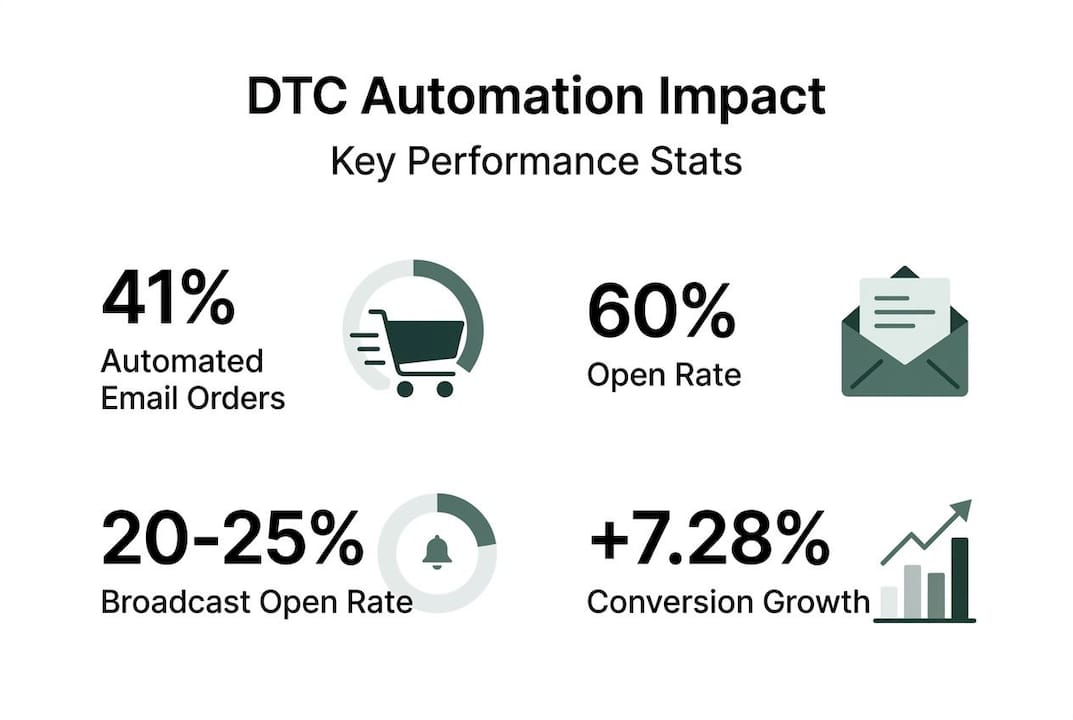
Here’s how the benchmark numbers stack up for DTC email retargeting:
| Metric | DTC retargeting/automation | Standard broadcast campaigns |
|---|---|---|
| Average open rate | ~60% | ~20-25% |
| Average CTR | ~15% | ~2-3% |
| Conversion rate | ~30% (retargeting) | ~1.5% (prospecting) |
| Median conversion | 3.8% | 1.5% |
These numbers reflect what happens when email is triggered by actual shopper behavior rather than sent on a calendar schedule to a cold list. The difference isn’t marginal. It’s a completely different performance tier.
The video angle makes it even better. When you use viewer data to trigger video-powered abandoned cart emails, cart recovery can improve by up to 40%. Think about what that means for a DTC brand doing $2 million a year in revenue with a 70% cart abandonment rate. A 40% recovery lift on abandoned carts is not a rounding error.
Key takeaways from the performance data:
- Automation density matters. The more granular your triggers (video viewed, product page visited, add-to-cart without purchase), the better your segmentation, and the better your results.
- Retargeting email converts at double the rate of prospecting. Customers who’ve already seen your product video are primed. Email them while that intent is fresh.
- Video in email raises CTR. Behavioral email combined with product video content consistently outperforms static image emails on click-through.
For DTC brands focused on ecommerce retention with video, the combination of social video engagement signals and automated email flows creates a compounding effect on LTV. You acquire better customers, retain them longer, and spend less per order over time. The top email automation tools can handle the technical heavy lifting, but the strategy behind the triggers is what separates brands seeing 2x revenue growth from those running the same recycled campaigns. These email tips for DTC brands cover the tactical side in more depth if you want to go further on campaign structure.
Beyond the inbox: Shoppable video on product pages
Automated email is only part of the equation. Let’s take it further by bringing video to your product pages.
Your product detail page (PDP) is where purchase decisions are finalized or abandoned. Static images and bullet-point descriptions can only do so much. Adding shoppable video carousels to your PDPs creates another touchpoint where social video content continues doing conversion work, long after the original post.
Sacheu Beauty is a strong case study here. After adding shoppable video carousels to their product detail pages, they reported a 7.28% increase in conversion rate. That’s not a small number for an ecommerce business. A 7% CVR lift on a high-traffic PDP compounding across thousands of monthly visitors translates directly to significant incremental revenue per session.
| Implementation approach | CVR impact | Key requirement |
|---|---|---|
| Shoppable video carousel on PDP | +7.28% (Sacheu case) | A/B tested against control |
| Behavior-triggered email with video | Up to 40% cart recovery lift | Real-time viewer data |
| Social video + email flow combo | ~60% open rate, ~15% CTR | Klaviyo integration |
The important caveat is that shoppable video performance depends heavily on iteration and validation. Traffic and revenue gains from PDP video can vary based on placement, page speed, and whether you’re actually measuring incremental lift rather than just observed correlation. A brand that adds a video widget to their PDP and sees a sales increase might be capturing intent that was already there, not creating new intent.
That’s why A/B testing is non-negotiable. Run the shoppable video against a control group. Track revenue per session, not just conversion rate. Measure page load time and its effect on bounce rate. These nuances separate brands that see real, sustained lifts from those chasing one-time gains. The social proof in ecommerce principle also applies here. User-generated video testimonials on PDPs outperform polished brand videos for conversion because they’re more believable.
Pro Tip: Place your shoppable video carousel above the fold on your PDP, near the add-to-cart button. Placement below reviews or in the page footer dramatically reduces engagement. Test placement before you draw conclusions about whether video is working.
Building a digital media strategy that connects social video production, PDP placement, and email automation means your video assets work across multiple stages of the funnel simultaneously.
Why conversion-focused metrics matter more than engagement (and how most DTC teams still get it wrong)
Let’s cut through the confusion about metrics and talk about what actually produces growth for DTC brands.
Here’s an uncomfortable truth: most DTC teams are optimizing the wrong thing. They celebrate a video that hits 500,000 views, then wonder why their revenue didn’t move. The problem isn’t the video. It’s the definition of success.
Video views and engagement are not the same as conversion. A view is passive. An add-to-cart is a decision. Brands that confuse the two end up producing more viral content and fewer profitable customers. The metric that matters for DTC is always the downstream action: clicks, add-to-cart, purchase, and repeat purchase.
We see this pattern constantly. A brand spends $30,000 producing a beautifully shot brand video that gets great engagement, then runs the same abandoned cart email they’ve used for two years. All the conversion leverage is in the email automation, but the budget and attention went to the video production. The allocation doesn’t match the revenue opportunity.
The other common pitfall is treating every video performance insight as final. Shoppable video performance is placement and moment dependent, which means a video that underperforms in one context might outperform in another. DTC teams that write off video email or PDP carousels after one test cycle miss the iterative gains that come from systematic optimization.
The right framework is to define your success metric before you launch any campaign, tie it directly to a revenue outcome, and build a testing cadence that tells you whether you’re creating new intent or just rerouting existing demand. Get ecommerce retention insights right and your video investment starts compounding over time.
Ready to integrate social video marketing and automated email?
For brands ready to operationalize these insights, getting expert help can make all the difference. Building the connection between social video behavior and automated email is technically achievable, but the strategic layer, knowing which triggers to build, how to sequence flows, and how to measure true incrementality, is where most in-house teams get stuck.
Take Action is a specialized email marketing and retention agency that helps DTC brands turn email into a primary growth channel using Klaviyo. From setting up behavior-triggered flows that respond to social video engagement, to building abandoned cart sequences powered by shoppable video, the team combines human strategy with data-driven execution. If you’re serious about scaling email revenue beyond what standard campaign blasts can deliver, explore what email marketing agency services can do for your brand. The infrastructure for connecting social video to automated email exists. The question is whether your strategy is built to use it.
Frequently asked questions
What types of social videos perform best for DTC brands?
Short, authentic product demos and user-generated testimonials tend to drive the highest conversion rates for DTC ecommerce, because they show real use cases and build trust faster than polished brand videos.
Should I prioritize engagement or sales metrics when measuring social video ROI?
For DTC, tying metrics to conversion outcomes is more effective than focusing on engagement alone. CPA, ROAS, LTV, and AOV reflect actual revenue performance, while engagement metrics measure attention that may never convert.
How does shoppable video impact my website’s performance?
When implemented thoughtfully, shoppable video can drive higher conversions, but page speed and widget selection must be monitored carefully to avoid slowing your site and increasing bounce rate.
Can automated emails using video really increase sales?
Yes, behavior-triggered video in email flows can deliver major gains. Firework’s Klaviyo integration enables shoppable video inside automated flows, including abandoned cart sequences powered by real viewer data.