

Build brand trust online: proven email strategies for ecommerce
TL;DR:
- Trust significantly impacts ecommerce conversions, retention, and customer lifetime value.
- Effective trust signals include reviews, transparent policies, and personalized, consistent communication.
- Email automation focused on post-purchase and loyalty builds long-term trust and brand loyalty.
81% of consumers say they need to trust a brand before they’ll buy from it. That’s not a soft metric. That’s your conversion rate, your repeat purchase rate, and your customer lifetime value sitting behind a single psychological barrier. Most ecommerce brands respond to this by throwing more promotions at their list or adding another pop-up discount. But trust isn’t built with a 10% off coupon. It’s built through consistent, relevant, and human communication at every stage of the customer journey. This guide breaks down exactly how strategic email marketing builds that trust, and what your brand can do right now to make it happen.
Table of Contents
- What drives brand trust in ecommerce today?
- Why email marketing is the trust-building engine for ecommerce
- How to design trust-building email journeys: Practical frameworks
- Common pitfalls and advanced trust-builders: What most brands miss
- Why email trust-building is about retention, not acquisition
- Partner with ecommerce email experts to maximize brand loyalty
- Frequently asked questions
Key Takeaways
| Point | Details |
|---|---|
| Trust drives sales | Ecommerce shoppers buy when brands show transparent policies and authentic reviews, not just discounts. |
| Email builds loyalty | Lifecycle email automations turn first-time buyers into loyal, retained customers far more efficiently than batch promotions. |
| Personalization matters | Zero-party data and AI-enhanced emails deepen trust, but authenticity always requires a human touch. |
| Retention beats acquisition | Investing in repeat relationships through trust-rich emails provides bigger returns than chasing new subscribers. |
What drives brand trust in ecommerce today?
Trust in ecommerce isn’t one thing. It’s a stack of signals that shoppers process in seconds, often without realizing it. When a new visitor lands on your store, they’re scanning for proof that you’re legitimate, fair, and worth their money. The signals that matter most include site security (SSL certificates and secure checkout), verified customer reviews, transparent return and shipping policies, fast and intuitive UX, and visible contact information.
Here’s what the data actually shows about which trust signals convert:
| Trust signal | Impact on conversion |
|---|---|
| 5+ product reviews | Up to 270% higher conversion |
| User-generated content | 161% higher conversion |
| Personalized experience | Significant lift in engagement and sales |
| Visible return policy | Reduces cart abandonment |
| Trust badges at checkout | Increases purchase confidence |
Those numbers are striking. Products with five or more reviews convert at nearly triple the rate of products without them. And shoppers engaging with UGC convert 161% higher. That’s not marginal. That’s a business-changing gap.
But here’s what most brands miss: trust isn’t just an acquisition problem. It’s a retention problem. You can win someone’s first purchase with a great product page and a trustworthy checkout. Keeping them, getting them to buy again, and turning them into advocates? That requires a whole different kind of trust. The kind that comes from consistent communication, delivering on promises, and making customers feel seen.
“Authenticity and transparency in communication are what separate brands customers return to from brands they forget after one purchase.”
The importance of customer testimonials in ecommerce goes beyond social proof. They signal that real people had real experiences worth sharing. Pair that with strong business ethics and you create a brand identity that customers can actually believe in.
Key trust-building factors to prioritize:
- Verified reviews displayed prominently on product pages
- Transparent policies for returns, shipping, and data privacy
- Responsive customer service with visible contact options
- Consistent branding across every touchpoint
- Personalization that shows you know your customer, not just their email address
The brands winning on trust right now aren’t just optimizing their product pages. They’re investing in the full post-purchase experience, because that’s where personalization benefits compound over time.
Why email marketing is the trust-building engine for ecommerce
Once you understand what drives trust, the next question is: which channel delivers it most efficiently? Social media is noisy and algorithmic. Paid ads are expensive and transactional. Email is different. It’s permission-based, direct, and compounding. When someone gives you their email address, they’re inviting you into their inbox. That’s a level of access no other channel offers.
The ROI case for email is well-documented. Returns range from $36 to $72 for every $1 spent, and with AI-assisted personalization, that number pushes toward $76. But the real story isn’t just ROI. It’s the behavioral difference between automated lifecycle flows and standard batch campaigns.
| Email type | Click-through rate | Conversion rate |
|---|---|---|
| Batch campaigns | Baseline | Baseline |
| Automated lifecycle flows | 332% higher CTR | 2361% higher conversions |
That’s not a rounding error. Automated flows, which represent a small fraction of total email volume, drive the majority of email-attributed revenue. Why? Because they’re triggered by behavior, not a calendar. They arrive when the customer is already engaged, curious, or making a decision.
The lifecycle automations that build the most trust are:
- Welcome series: Sets expectations, tells your brand story, and delivers immediate value
- Post-purchase flows: Confirms the decision, provides usage tips, and begins the loyalty loop
- Review request emails: Asks for feedback after value delivery, not immediately after checkout
- Win-back sequences: Re-engages lapsed customers with relevant offers and genuine check-ins
- Personalized recommendations: Uses purchase history to suggest products that actually make sense
Pro Tip: Don’t treat your welcome series as a one-email event. A three to five email sequence that educates, tells your story, and delivers value before asking for another purchase will outperform a single discount email every time.
Explore automated workflow examples to see how these flows work in practice. And if you’re looking for tactical starting points, these email marketing tips cover the fundamentals of driving sales through strategic sends.
Email builds trust because it’s consistent. Every touchpoint is an opportunity to reinforce your brand promise, deliver useful information, and remind customers why they chose you.
How to design trust-building email journeys: Practical frameworks
Knowing which flows to build is one thing. Knowing how to sequence, time, and write them is where most brands fall short. Here’s a practical framework for each major trust-building automation.
-
Welcome series (Days 0 to 7): Send the first email immediately after signup. Focus on brand story and values, not a hard sell. Follow up on day two with your best content or a product education piece. Close the series on day five to seven with a soft offer tied to their expressed interest.
-
Post-purchase flow (Days 1 to 14): Confirm the order and set delivery expectations on day one. Send care or usage tips on day three. On day seven, ask how they’re enjoying the product. On day fourteen, request a review. This sequence turns a transaction into a relationship.
-
Review request (Day 14 to 21 post-delivery): Timing matters here. Ask too early and the product hasn’t been used. Ask too late and the emotional peak has passed. Day fourteen to twenty-one post-delivery is the sweet spot.
-
Win-back sequence (60 to 90 days inactive): Start with a genuine check-in, not a discount. Ask what they’ve been up to. Offer value before you offer a coupon. Reserve the discount for the third email if earlier sends don’t re-engage.
-
Personalized recommendations (Ongoing): Use purchase history and browsing behavior to send relevant product suggestions monthly.
| Flow | Optimal timing | Primary trust signal |
|---|---|---|
| Welcome | Immediate + days 2, 5 | Brand authenticity |
| Post-purchase | Days 1, 3, 7, 14 | Reliability and care |
| Review request | Days 14 to 21 post-delivery | Social proof |
| Win-back | Days 60 to 90 inactive | Genuine relationship |
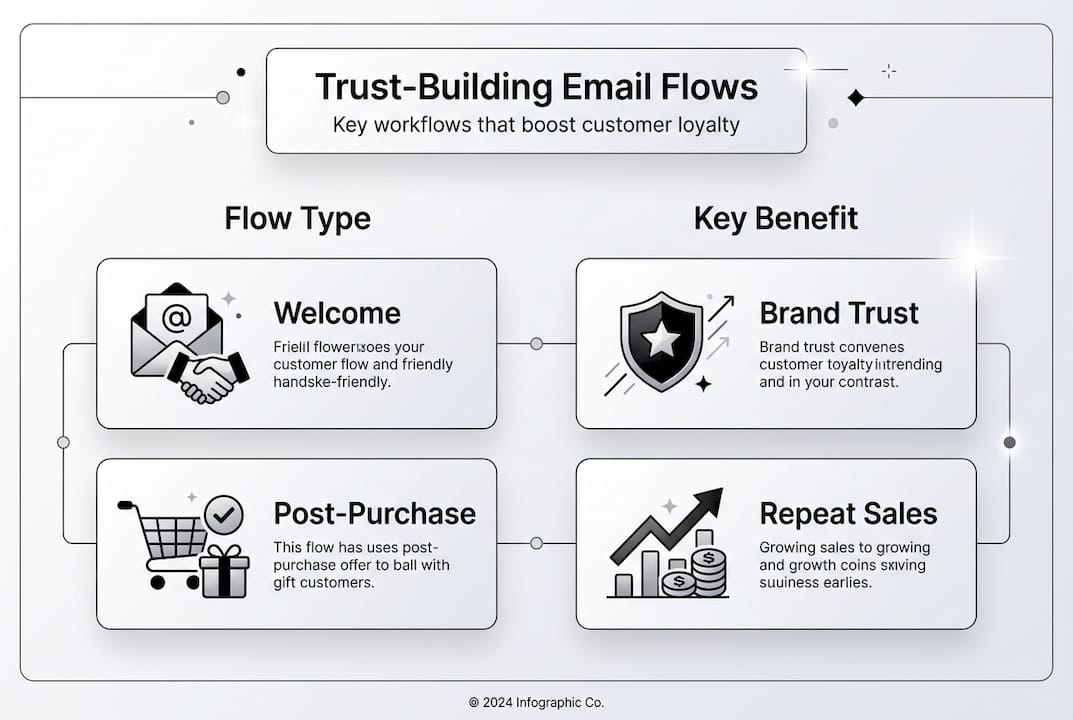
Welcome emails average 50 to 80% open rates, which makes them the highest-attention moment in the entire customer lifecycle. Use that attention wisely.

Pro Tip: Use zero-party data (information customers voluntarily share, like preferences or quiz answers) to personalize flows from the very first email. It signals that you’re paying attention.
Strong segmentation strategies are what make these flows feel personal rather than automated. Combine that with smart lead nurturing practices and your newsletter retention ideas to keep subscribers engaged long-term.
Common pitfalls and advanced trust-builders: What most brands miss
Even well-intentioned email programs can erode trust fast. Here are the mistakes we see most often, and what to do instead.
Over-sending is the biggest trust killer. When your unsubscribe rate climbs above 0.5%, that’s a signal your audience doesn’t find your emails valuable. Mixing 3 to 5 star reviews with brand responses increases perceived authenticity, but blasting your list with daily promotions cancels out that goodwill immediately.
Common pitfalls to avoid:
- Sending the same campaign to your entire list regardless of purchase history
- Ignoring inactive subscribers until they hurt your deliverability
- Asking for reviews before the customer has had time to use the product
- Responding to negative reviews defensively instead of constructively
- Measuring success only by open rates instead of repeat purchase rate and customer lifetime value
“Brands that respond to negative reviews publicly and constructively earn more trust than brands with only five-star ratings. Perfection looks fake. Accountability looks human.”
Advanced strategies that separate trusted brands from the rest:
- AI-powered personalization: Use behavioral data to trigger hyper-relevant sends, but always write with a human voice. Automation without authenticity feels cold.
- RFM segmentation (Recency, Frequency, Monetary value): Identify your highest-value customers and create VIP flows that make them feel recognized.
- Email-driven social proof: Use post-purchase emails to collect reviews, then feature that UGC in future campaigns and on your product pages.
- Sunset flows: Automatically remove subscribers who haven’t engaged in 90 to 180 days. A smaller, engaged list is worth more than a large, disengaged one.
For brands serious about growth with email retention, the shift from volume to relevance is the single most impactful change you can make.
Why email trust-building is about retention, not acquisition
Here’s the insight most brands resist: the biggest email ROI doesn’t come from acquiring new subscribers. It comes from what you do after someone buys.
We’ve worked with ecommerce teams across dozens of categories, and the pattern is consistent. Brands that treat email as an acquisition tool, focused on growing their list and converting first-time buyers, plateau. Brands that treat email as retention infrastructure, focused on deepening trust with existing customers, compound. They see higher customer lifetime value, lower customer acquisition costs, and more organic referrals.
The math is simple. Retaining an existing customer costs five to seven times less than acquiring a new one. But the compounding effect is what most brands underestimate. A customer who trusts you buys more often, spends more per order, refers friends, and forgives the occasional mistake. That’s not just retention. That’s a growth engine.
The brands obsessing over open rates while ignoring repeat purchase rates are optimizing for the wrong thing. Open rates tell you if your subject line worked. Repeat purchase rates tell you if your brand is trusted.
Shifting your email program toward retention means investing in automated workflows that nurture customers long after the first sale. It means measuring success by CLV, not clicks. And it means accepting that trust takes time to build, but once built, it’s your most durable competitive advantage.
Partner with ecommerce email experts to maximize brand loyalty
Building a trust-driven email program isn’t a one-time project. It’s an ongoing system that requires strategy, testing, and refinement. If you’re ready to move beyond batch campaigns and build email flows that actually compound loyalty and revenue, expert support makes the difference between a program that runs and one that scales.
At Take Action, we specialize in building retention-focused email systems for ecommerce brands using Klaviyo. From welcome series to win-back flows, we design automations that reflect your brand voice and drive measurable results. Whether you need a full strategy overhaul or a targeted audit, our ecommerce retention services are built to turn your email list into your most reliable revenue channel. Let’s build something that lasts.
Frequently asked questions
What is the fastest way to build brand trust online?
Leverage verified reviews and clear policies alongside personalized email sequences that guide buyers beyond the first sale. These three elements work together to remove doubt at every stage of the purchase journey.
Which email flows build the most trust with ecommerce customers?
Welcome, post-purchase, and review request automations are the highest-trust flows, especially when timed and personalized to each user’s specific journey stage.
How should ecommerce brands measure trust success beyond open rates?
Track repeat purchase rates and CLV alongside the percentage of revenue driven by lifecycle automations. These metrics reflect genuine trust far better than open rates alone.
What are the risks of sending too many emails to your list?
Oversending pushes unsubscribes above 0.5% and damages deliverability, which means fewer emails reach inboxes and your brand’s credibility takes a measurable hit.
Recommended
- Boost ecommerce sales with top email marketing tips | Take Action Blog | Take Action
- Essential digital branding tips for ecommerce growth | Take Action Blog | Take Action
- How to build an email list for ecommerce success in 2026 | Take Action Blog | Take Action
- Digital Media Strategy: Unlocking Ecommerce Growth | Take Action Blog | Take Action
- Increasing User Engagement in your Marketing Message