

Build a winning social media content strategy for DTC
TL;DR:
- Building a data-driven social strategy is essential to turn content into measurable revenue growth.
- Focus on creating consistent systems with content pillars, UGC, and targeted platform efforts.
- Prioritize engagement metrics like saves and shares over vanity metrics to boost long-term ROI.
Paid ads are getting more expensive, organic reach keeps shrinking, and your competitors are flooding every platform with content that looks identical to yours. For DTC brands, this isn’t just a marketing problem. It’s a revenue problem. When social media stops converting, growth stalls and customer acquisition costs spiral. The brands winning in 2026 aren’t the ones posting the most or chasing every trend. They’re the ones operating from a clear, data-driven strategy that turns social content into a measurable growth channel, not just a branding exercise. Here’s exactly how to build that strategy from the ground up.
Table of Contents
- Audit your current social content performance
- Set goals, choose platforms, and research your audience
- Build your content supply chain and pillar framework
- Boost engagement and sales with UGC and authenticity
- What most DTC brands get wrong about social content
- How Take Action accelerates your social content ROI
- Frequently asked questions
Key Takeaways
| Point | Details |
|---|---|
| Benchmark current performance | Regularly audit your social metrics and compare them to DTC benchmarks to uncover growth opportunities. |
| Choose platforms and goals wisely | Select 2-3 best-fit channels, set SMART goals, and align content with audience research for maximum ROI. |
| Scale with systems and pillars | Build a repeatable content supply chain using value-focused content pillars and routine testing. |
| Embrace UGC and authenticity | Prioritize user-generated content and authentic voices to build trust, engagement, and direct sales. |
| Look beyond vanity metrics | Track saves, shares, and revenue attribution, not just likes or followers, to measure what matters. |
Audit your current social content performance
Before you change anything, you need to know what’s actually happening with your content right now. Most ecommerce marketing teams skip this step and jump straight to tactics. That’s a mistake that leads to wasted creative budget and misaligned effort.
Start by pulling your engagement rate, return on ad spend (ROAS), reach, saves, shares, and follower growth across every active platform. Don’t rely on platform native dashboards alone. Export your data into a spreadsheet so you can compare performance across channels side by side. Understanding social content strategy benchmarks before you make changes will save you from fixing things that aren’t broken.
Once you have the raw numbers, compare them against what top-performing ecommerce brands are achieving. According to 2026 e-commerce social media benchmarks, TikTok engagement rates range from 3.70% to 4.86% (up 49% year over year), Instagram sits between 0.48% and 4.3%, and Facebook falls between 0.15% and 3.6%. DTC brands average a 2.8x ROAS on Meta and 2.1x on TikTok, while top-quartile performers hit 4.5x or more. Saves and shares are now weighted more heavily than likes by platform algorithms, and brands that post consistently for 20 or more weeks see up to 450% more engagement than sporadic posters.
Use this data to build a simple performance audit table:
| Platform | Your engagement rate | Benchmark | Gap | Action needed |
|---|---|---|---|---|
| TikTok | 1.2% | 3.70 to 4.86% | Large | Increase video frequency, test UGC |
| 0.9% | 0.48 to 4.3% | Moderate | Test Reels, improve caption strategy | |
| 0.3% | 0.15 to 3.6% | Small | Optimize for saves and shares |
Beyond engagement rates, look at:
- Post frequency per channel and whether it matches platform algorithm expectations
- Save and share rates on your top 10 posts (these signal content people find genuinely useful)
- ROAS by content type to identify which formats drive actual revenue
- Audience growth rate month over month to spot stagnation early
- Content format breakdown to see if your mix of video, static, and carousel matches what performs best
Running a thorough DTC marketing audit helps you stop guessing and start operating with evidence. It also gives your team a clear baseline to measure progress against over the next quarter.
You can also explore how ecommerce content marketing principles can reshape how you interpret these metrics and act on them.
Pro Tip: Save at least two full quarters of historical data before making major strategy changes. Single-month snapshots can be misleading due to seasonal spikes, algorithm changes, or one-off viral posts that skew your averages.
Set goals, choose platforms, and research your audience
Having assessed your current results, the next step is to set clear goals and choose platforms that match your strengths and your target market’s actual behavior. Random posting without specific targets is one of the fastest ways to exhaust your team and waste your budget.
Every social media goal you set should be SMART: specific, measurable, attainable, relevant, and time-bound. Instead of “grow our Instagram audience,” a SMART goal looks like: “Increase Instagram Reels average save rate from 1.2% to 2.5% by the end of Q3 2026 by publishing three Reels per week focused on product education.” That version gives your team something concrete to execute against and a way to know if it worked.
Direct-to-consumer marketing best practice emphasizes building goals across the full funnel. Top-of-funnel goals focus on awareness through short-form video and UGC. Middle-of-funnel goals prioritize education and trust-building. Bottom-of-funnel goals target retargeting and conversion through dynamic ads and social commerce features.
Here’s how the major platforms compare for DTC brands right now:
| Platform | Best for | Weakness | Content type | Audience |
|---|---|---|---|---|
| TikTok | Viral reach, discovery | Short content lifespan | Short-form video, UGC | 18 to 34 year olds |
| Visual brand building, social commerce | Declining organic reach | Reels, Stories, carousel | 25 to 44 year olds | |
| Retargeting, older demographics | Low organic engagement | Video, groups, ads | 35 to 55+ year olds |
Audience research is where most brands take shortcuts and pay for it later. Build detailed buyer personas based on actual purchase data, not assumptions. Layer that with social listening tools to understand what your customers talk about, complain about, and aspire to beyond your product category. Tools like Sprout Social, Brandwatch, and even native TikTok analytics give you behavioral signals that help you create content people actually want to share.
You should also stay current on social trends that shift platform behavior and content preferences, since what worked six months ago may already be outdated.
Once you know your audience and platforms, align your goals with specific content types using this process:
- Map each SMART goal to a stage of the funnel (awareness, consideration, conversion)
- Identify which platform best serves that funnel stage for your specific audience
- Assign content formats that fit that platform’s algorithm preferences
- Set a weekly posting cadence that’s realistic for your team’s production capacity
- Define the key performance indicator for each goal so you can track it weekly
Building content pillars for retention into this goal-setting process ensures your social strategy and your retention strategy reinforce each other from day one.
Pro Tip: Focus on just two to three platforms instead of spreading thin across every channel. Depth of execution on fewer platforms beats shallow presence everywhere, especially for smaller DTC teams.
Build your content supply chain and pillar framework
With platforms and goals set, you need systems to deliver consistent, high-impact content without burning out your team. This is where most brands break down. They have good ideas but no infrastructure to execute consistently.

A content supply chain is the end-to-end process that takes a content idea from brief to published post. It includes ideation, scripting or copywriting, asset creation, review and approval, scheduling, and performance tracking. Without a defined supply chain, content creation becomes reactive, inconsistent, and expensive.
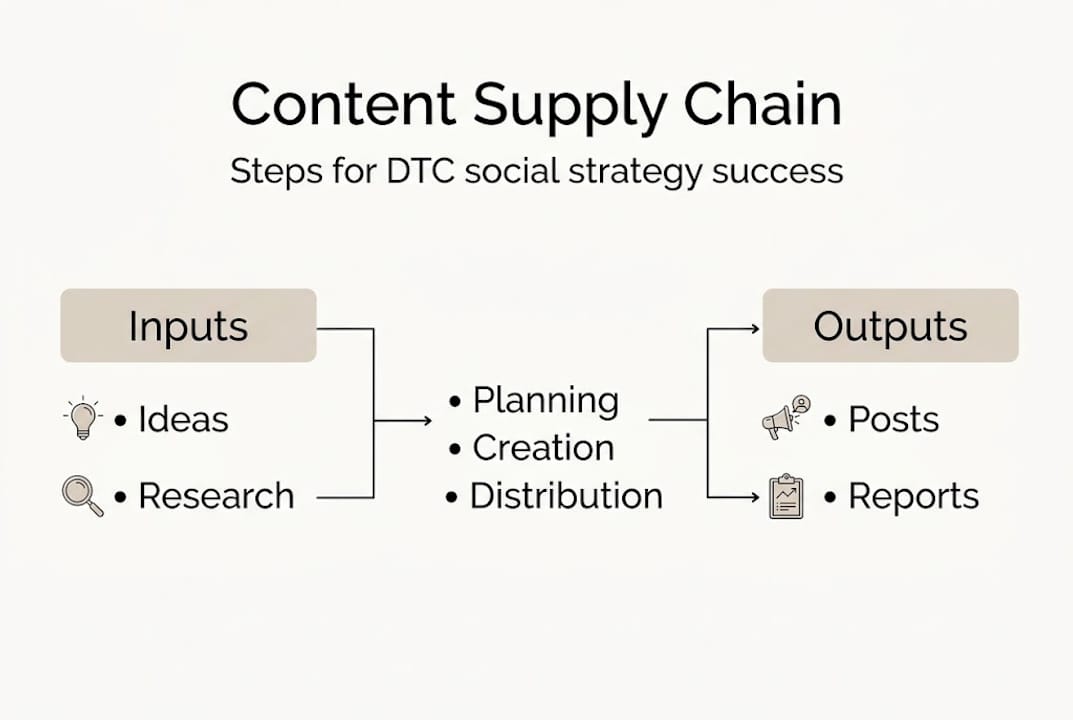
Ecommerce social media marketing strategies that scale successfully all share one thing: they treat content like a production line, not a one-off creative sprint. Volume requires systems. Weekly creative testing, rapid iteration on winning formats, and unified attribution across channels are what separate brands that scale from brands that plateau.
Content pillars give your supply chain direction. A pillar is a core theme that guides a category of content. For most DTC brands, three to four pillars cover the full customer journey:
- Brand story pillar: Who you are, why you exist, founder journey, mission and values content
- Education and value pillar: How-to content, product usage tips, ingredient or process breakdowns, myth-busting posts
- Social proof and community pillar: Customer reviews, UGC reposts, before-and-after content, testimonials
- Promotional and sales pillar: Product launches, limited-time offers, social commerce posts, retargeting content
The 80/20 rule applies directly here. Roughly 80% of your content should entertain, educate, or build community. Only 20% should directly push a sale. Brands that invert this ratio see engagement collapse because audiences tune out what feels like a constant advertisement.
Your workflow tools and creation stack matter too:
- Notion or Asana for editorial calendars and team task management
- CapCut or Adobe Express for fast, on-brand short-form video editing
- Canva Brand Kit for consistent visual templates across all static formats
- Metricool or Later for scheduling and cross-platform analytics
- AI tools like ChatGPT or Claude for scaling caption drafts and brief generation
Exploring UGC for e-commerce as part of your supply chain is one of the most cost-effective ways to increase output without increasing headcount.
Pro Tip: Run a weekly creative test where you publish two versions of the same content concept with one variable changed (hook text, opening visual, or call to action). After four weeks, you’ll have clear data on what drives saves and shares, not just impressions.
Boost engagement and sales with UGC and authenticity
Once your content pipeline is in place, the types of content you prioritize will determine whether your strategy actually converts or just generates traffic. One format consistently outperforms everything else for DTC brands: user-generated content.
UGC (content created by real customers, micro-influencers, or employees) works because it looks and feels different from polished brand advertising. Audiences are increasingly skeptical of studio-produced ads. When they see someone who looks like them using and genuinely enjoying a product, trust transfers automatically. That trust directly impacts conversion rates.
According to HubSpot’s content pillars research, brands that prioritize UGC and founder-led authentic content over polished ad creative consistently see higher engagement rates and stronger ROAS. Saves and shares are the key signals to watch because they indicate content people find valuable enough to return to or forward to someone else.
Here’s a simple process for sourcing and using UGC without legal risk:
- Create a branded hashtag and feature it prominently in post captions, packaging inserts, and post-purchase emails
- Ask customers directly for permission via DM before reposting their content on your channels
- Build a UGC submission form into your post-purchase email flow offering an incentive like a discount or feature shoutout
- Partner with micro-influencers (10,000 to 100,000 followers) using a clear content rights agreement that grants you reuse permission
- Repurpose approved UGC across paid ads, email campaigns, and product pages for maximum value from each asset
“Saves and shares are the new currency of social content. When your content strategy optimizes for saves over likes, you’re building an audience that actually wants to hear from you again.”
Social commerce features on Instagram and TikTok Shops reduce purchase friction dramatically. When a customer can go from discovery to checkout without leaving the app, conversion rates improve significantly. Integrate your product catalog with these platforms and tag products directly in your highest-performing organic content.
Social media’s influence on purchase decisions is also shaping how consumers discover products through search within platforms, not just feeds. Optimizing your captions with relevant keywords helps your content surface when users search for product categories, ingredients, or problems your brand solves.
You can find authentic UGC examples and strategies that DTC brands have used to scale content output without scaling ad spend proportionally.
Pro Tip: Treat your captions like micro-SEO. Include the product category, key benefit, and one specific use case in every caption. TikTok and Instagram search algorithms now surface content based on caption keywords, not just hashtags.
What most DTC brands get wrong about social content
Here’s the hard truth: most DTC brands are optimizing for the wrong things. They celebrate follower milestones and viral moments while their actual revenue from social stays flat. Follower count is a lagging indicator at best and a vanity metric at worst. What matters is whether your social content drives revenue and retains customers.
The other common mistake is trying to be everywhere at once. Brands stretch their teams across six platforms, producing mediocre content on all of them. A focused presence on two platforms where your audience genuinely engages will always outperform a scattered presence across six.
Sustainable social growth comes from systems, not moments. One viral video might spike your follower count. But a reliable content supply chain, combined with advanced content strategy for ecommerce, is what compounds over time into loyal customers and predictable revenue.
The metric that should actually keep you up at night isn’t your engagement rate. It’s your LTV:CAC ratio (lifetime value compared to customer acquisition cost). Social content that builds genuine community and converts trend buyers into repeat customers through social commerce and email is what moves that number in the right direction.
“The brands we see winning long-term aren’t the ones with the most followers. They’re the ones who built content systems that convert social audiences into email subscribers and loyal buyers.”
How Take Action accelerates your social content ROI
Ready to implement a full-funnel, data-driven content strategy? Here’s how our team can get you there.

At Take Action, we work with DTC brands to connect social content strategy directly to revenue outcomes. We don’t just help you post more. We help you build the retention infrastructure that captures social audiences into email flows, automates follow-up, and turns one-time buyers into loyal customers. Our team specializes in combining social content frameworks with Klaviyo-powered automation so every piece of content works harder across multiple channels. If you’re ready to move beyond vanity metrics and build a strategy that compounds, talk to our DTC marketing experts about what that looks like for your brand.
Frequently asked questions
How often should DTC brands post on social media for best results?
Brands posting for 20 or more weeks per year see up to 450% more engagement, so consistency over time matters far more than posting frequency in any single week.
What metrics actually matter for measuring social content success?
Prioritize saves, shares, ROAS, and attributed revenue. As HubSpot’s research confirms, metrics like LTV:CAC and revenue attribution reveal true social ROI in ways that likes and follower counts simply can’t.
What’s the best performing social platform for ecommerce DTC brands?
TikTok currently leads with engagement rates of 3.70 to 4.86%, up 49% year over year, but the best platform for your brand depends on where your specific audience spends time and what content formats your team can consistently produce.
How do you safely use user-generated content on brand channels?
Always get explicit written permission via DM or a formal content rights agreement before reposting. Using branded hashtags to invite submissions helps too, but permission must still be confirmed before you repurpose UGC on paid channels or product pages.