

Influencer partnerships explained: DTC ecommerce guide
Many ecommerce marketing managers struggle with influencer partnerships, unsure how these collaborations actually translate into measurable sales and lasting customer relationships. The confusion often stems from overemphasis on vanity metrics like follower counts rather than strategic integration with retention channels. This guide clarifies what influencer partnerships truly entail for DTC brands and shows you how to leverage them alongside email marketing to drive authentic engagement and revenue growth.
Table of Contents
- Key takeaways
- What are influencer partnerships and how do they work
- Building an effective influencer partnership strategy for DTC ecommerce
- Integrating influencer partnerships with email marketing for higher engagement and sales
- Measuring success and mitigating risks in influencer partnerships
- How Take Action Agency can help optimize your influencer and email marketing
- FAQ
Key Takeaways
| Point | Details |
|---|---|
| Influencer collaboration models | Brands use affiliate programs, flat fee campaigns, product gifting, and long term ambassadorships to drive sales and content. |
| Trust based endorsements | Influencer recommendations transfer trust to audiences and boost purchase intent beyond traditional ads. |
| Content as assets | Influencer generated content becomes evergreen assets for ads, emails, and landing pages. |
| Vetting and tracking | Thorough candidate vetting and robust attribution tracking ensure safer partnerships and measurable results. |
| Micro influencer ROI | Micro influencers consistently outperform larger creators for DTC brands because of authentic engagement and trusted recommendations. |
What are influencer partnerships and how do they work
Influencer partnerships involve brands collaborating with creators to leverage audience trust, content creation, and distribution for ecommerce promotion. These relationships go far beyond simple sponsored posts. They create authentic touchpoints where your brand message reaches engaged communities through voices people already trust.
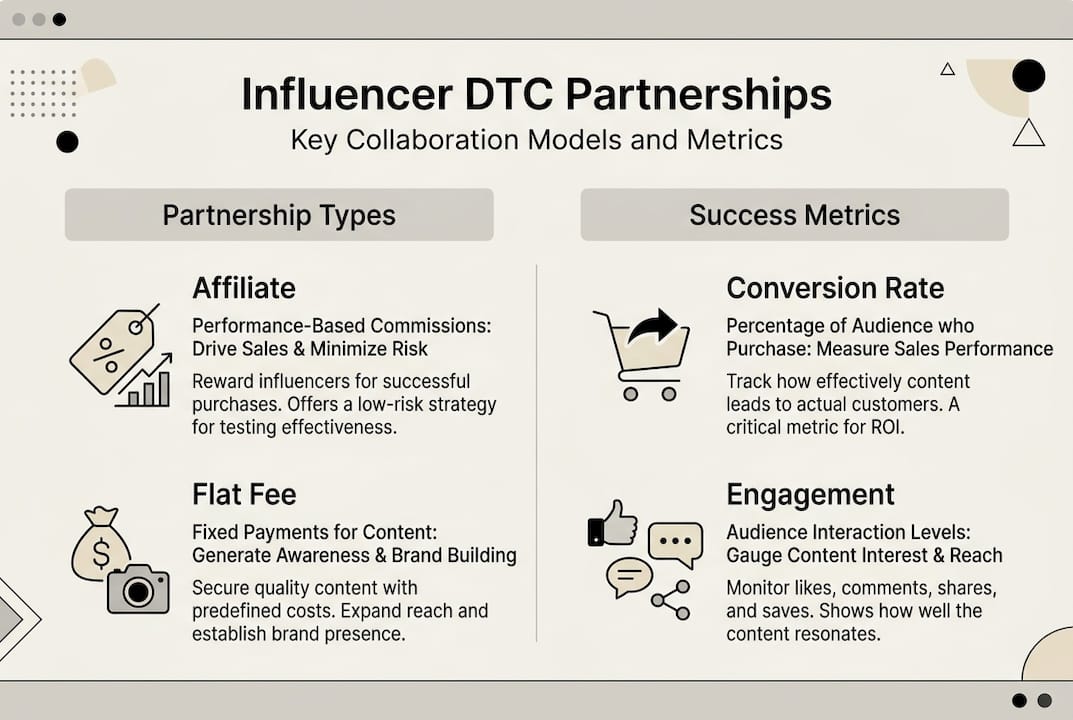
Several collaboration models power successful partnerships:
- Affiliate programs where creators earn commission on sales through unique tracking links or discount codes
- Flat fee arrangements for dedicated posts or content series with guaranteed deliverables
- Product gifting campaigns that generate user-generated content without upfront cash investment
- Long-term ambassadorships building sustained brand advocacy over months or years
The core value lies in trust transfer. When an influencer genuinely recommends your product, their audience perceives it as peer advice rather than corporate advertising. This psychological shift dramatically increases purchase intent and conversion likelihood. For DTC ecommerce brands competing in crowded markets, this authentic endorsement cuts through ad fatigue that plagues traditional paid channels.
Influencer-generated content also serves as high-performing creative assets you can repurpose across your marketing stack. Product photos, unboxing videos, styling tutorials, and testimonial clips become evergreen materials for ads, email campaigns, and landing pages. Understanding influencer marketing ecommerce growth potential helps you see these partnerships as content engines, not just promotional tactics.
The model works especially well for DTC brands because it addresses the biggest challenge in ecommerce: building trust with customers who cannot physically interact with products before purchase. Influencer content provides social proof at scale, showing real people using and endorsing your offerings in authentic contexts.
Building an effective influencer partnership strategy for DTC ecommerce
Successful influencer campaigns start with crystal-clear objectives tied to specific business outcomes. Vague goals like “increase brand awareness” lead to wasted budgets and disappointing results. Instead, define whether you are driving immediate sales, building email list growth, generating content assets, or establishing long-term brand positioning.
Follow this step-by-step methodology for maximum impact:
- Establish measurable goals with specific KPIs like cost per acquisition, return on ad spend, or email subscriber growth rate
- Focus discovery efforts on micro-influencers with 1,000 to 100,000 followers who demonstrate authentic engagement
- Vet candidates thoroughly by analyzing audience demographics, engagement patterns, past brand partnerships, and content quality
- Negotiate detailed contracts covering content rights, exclusivity periods, posting schedules, and performance expectations
- Implement robust tracking using UTM parameters, unique promo codes, and affiliate links to measure attribution accurately
- Integrate influencer activities into your broader growth stack including paid acquisition, content marketing, and retention workflows
Micro-influencers deserve special attention because they consistently outperform larger creators for DTC brands. Their smaller, highly engaged audiences trust their recommendations more deeply than celebrity endorsements. The micro-influencer benefits ecommerce retention extend beyond initial conversions to building loyal customer communities.
Vetting requires more than surface-level follower counts. Examine comment quality to spot bot activity. Review past sponsored content to assess how naturally they integrate brand messages. Analyze audience overlap with your existing customer base using social listening tools. Check for FTC compliance in previous partnerships to avoid legal risks.

Pro Tip: Automate influencer discovery and outreach using platforms that score creators based on your specific criteria, then build standardized onboarding workflows that maintain quality while scaling to dozens of partnerships simultaneously.
Tracking mechanisms must capture both direct and indirect impact. Unique discount codes measure immediate conversions. UTM parameters in bio links track website traffic and browsing behavior. Affiliate dashboards provide ongoing performance visibility. This data infrastructure lets you calculate true roi influencer marketing ecommerce and optimize partner selection over time.
Integrating influencer partnerships with email marketing for higher engagement and sales
The real leverage in influencer partnerships emerges when you systematically integrate with email marketing to create compounding retention value. Email remains your owned channel with the highest ROI, and influencer content supercharges its performance through authentic social proof.
Incorporate influencer-generated assets throughout your email program:
- Welcome series emails featuring influencer testimonials and product demonstrations to build immediate credibility
- Promotional campaigns showcasing influencer styling tips or use cases that inspire purchases
- Abandoned cart recovery flows with influencer reviews addressing common objections
- Post-purchase nurture sequences using influencer content to validate buying decisions and reduce returns
Automated triggered flows benefit enormously from this integration. When a new subscriber joins your list through an influencer’s unique link, tag them accordingly and send a customized welcome series featuring that specific creator. This personalization maintains the trust relationship that drove the signup while introducing your brand story.
Reverse the funnel by recruiting influencers directly from your email audience. Your existing customers already love your products and understand your brand voice. Send targeted campaigns inviting engaged subscribers to apply for ambassador programs or UGC opportunities. This approach yields highly authentic partnerships because these creators genuinely use and appreciate your offerings.
Drive email list growth through influencer collaborations by offering exclusive content, early access, or special discounts available only to email subscribers. Influencers promote the value exchange, their audience opts in, and you capture qualified leads for ongoing nurture. Understanding ugc influencer marketing email retention dynamics helps you design these campaigns for maximum lifetime value.
The measurable impact shows up clearly in email metrics. Campaigns featuring influencer content typically see 15 to 30 percent higher open rates because subscribers recognize and trust the faces in preview images. Click-through rates jump when emails showcase real people using products rather than sterile product shots. Conversion rates increase as social proof reduces purchase hesitation.
Pro Tip: Use platforms like Klaviyo or Postscript to build conditional logic that automatically pulls influencer content into emails based on subscriber source, browsing behavior, or purchase history, creating hyper-personalized experiences at scale.
Repurposing strategies multiply your content ROI. A single influencer Instagram story becomes an email header image, a product page testimonial, a Facebook ad creative, and a website homepage element. Learning how to repurpose content ecommerce email systematically ensures every partnership delivers compounding value across channels. Compare email automation tools for retailers comparison to find platforms that support this level of dynamic content integration.
Measuring success and mitigating risks in influencer partnerships
Understanding true performance requires looking beyond surface metrics to comprehensive ROI analysis. Empirical benchmarks show average ROI ranging from 5.2x to 8.3x, with micro-influencers outperforming macro-influencers by 22% for DTC brands. Realistic expectations for your campaigns should target 4x to 6x return on investment when properly executed.
Vanity metrics like likes, follower counts, and impressions provide incomplete pictures of campaign effectiveness. They measure reach but not business impact. Focus instead on multi-touch attribution that tracks the customer journey from influencer exposure through email nurture to final purchase. Brand lift studies measuring awareness and consideration changes offer qualitative validation of influencer impact beyond direct sales.
Calculate cost per acquisition by dividing total campaign investment including product costs, fees, and management time by new customers acquired. Compare this to your other acquisition channels to assess relative efficiency. Track customer lifetime value for influencer-sourced buyers versus other channels, as these customers often demonstrate higher retention and repeat purchase rates.
Common risks threaten campaign success and brand reputation:
- Fake followers and engagement bots that inflate metrics without delivering real reach
- FTC non-compliance in sponsored content disclosures creating legal liability
- Audience demographic misalignment resulting in low conversion despite high engagement
- Reputational scandals when influencer behavior conflicts with brand values
Mitigation starts with thorough vetting. AI-based tools detect fakes by analyzing follower growth patterns, engagement timing, and comment authenticity. Manual review of past content reveals how influencers handle brand partnerships and whether their audience genuinely engages. Background checks on larger partnerships protect against reputation risks.
Clear contracts establish expectations and provide exit mechanisms if partnerships underperform or problems emerge. Include specific content approval processes, posting schedules, exclusivity terms, and performance benchmarks that trigger payment or continuation decisions. Pilot small campaigns before committing to long-term or high-budget partnerships, allowing you to validate fit and performance with limited risk.
| Influencer type | Reach | Typical cost | Engagement rate | Risk level |
|---|---|---|---|---|
| Nano (1k-10k) | Hyper-local | $10-100 per post | 8-12% | Low |
| Micro (10k-100k) | Niche communities | $100-1,000 per post | 5-8% | Low to medium |
| Mid-tier (100k-500k) | Broad audiences | $1,000-10,000 per post | 3-5% | Medium |
| Macro (500k-1M) | Mass market | $10,000-50,000 per post | 2-3% | Medium to high |
| Mega (1M+) | Celebrity status | $50,000+ per post | 1-2% | High |
The table illustrates why micro-influencers offer the sweet spot for most DTC brands. They balance meaningful reach with authentic engagement and manageable costs while minimizing risks associated with larger personalities. Deep expertise in master influencer marketing roi ecommerce 2026 strategies helps you navigate these tradeoffs and build sustainable partnership programs.
How Take Action Agency can help optimize your influencer and email marketing
You now understand how strategic influencer partnerships integrated with sophisticated email marketing create compounding growth for DTC ecommerce brands. Executing this strategy effectively requires specialized expertise in both channels and the technical infrastructure to connect them seamlessly.
Take Action Agency specializes in email marketing & retention strategies that transform one-time buyers into loyal customers. Our team has extensive experience integrating influencer-generated content into automated email flows using platforms like Klaviyo, creating personalized customer journeys that leverage social proof at every touchpoint.

We help brands design influencer partnership programs specifically optimized for email capture and retention rather than vanity metrics. Our data-driven approach measures true ROI across the customer lifecycle, ensuring your influencer investments deliver sustainable growth. Ready to build an influencer and email strategy that actually drives revenue? Contact Take Action Agency to discuss how we can help scale your ecommerce brand through integrated retention marketing.
FAQ
What are the best influencer partnership models for DTC brands?
Affiliate partnerships where creators earn commission on sales they drive offer low upfront risk and align incentives perfectly with revenue goals. Product gifting programs generate authentic user-generated content at minimal cost, ideal for brands with strong products and limited budgets. Long-term ambassadorships build sustained brand association and deeper storytelling opportunities. Micro-influencers typically perform best across all these models due to higher engagement rates and authentic audience relationships.
How can ecommerce marketers measure the ROI of influencer partnerships?
Track direct sales through unique discount codes, affiliate links, and UTM parameters to calculate immediate return on investment. Measure broader impact using brand lift surveys that assess awareness and consideration changes among target audiences. Implement multi-touch attribution models that credit influencer touchpoints in longer customer journeys leading to purchase. Avoid relying solely on vanity metrics like follower counts or post likes, as these rarely correlate with actual business outcomes.
What are common risks in influencer marketing and how can they be mitigated?
Fake followers and bot engagement inflate metrics without delivering real reach or conversions, wasting your budget on phantom audiences. FTC non-compliance in sponsored content disclosures creates legal liability for both brands and creators. Audience demographic misalignment results in high engagement but low conversion when followers do not match your target customer profile. Mitigate these risks through AI-powered vetting tools that detect fake followers, detailed contracts specifying disclosure requirements, thorough audience analysis before partnerships, and small pilot campaigns that validate performance before scaling investment.
How does influencer-generated content improve email marketing performance?
Influencer content adds authentic social proof that increases email open rates by 15 to 30 percent as subscribers recognize trusted faces in preview images. Click-through rates improve when emails feature real people demonstrating products rather than sterile product photography. Conversion rates rise because influencer testimonials and use cases reduce purchase hesitation and validate buying decisions. Automated email flows incorporating this content nurture customers more effectively throughout their lifecycle, driving higher repeat purchase rates and customer lifetime value.
Should DTC brands focus on micro-influencers or larger creators?
Micro-influencers with 1,000 to 100,000 followers consistently outperform larger creators for DTC ecommerce brands, delivering 22% higher engagement rates and superior ROI. Their smaller audiences demonstrate deeper trust and authentic relationships with the creator, translating recommendations into purchases more effectively. Costs remain manageable, allowing brands to work with multiple micro-influencers simultaneously for diversified reach. Larger creators make sense primarily for mass market awareness campaigns with substantial budgets, but micro-influencers drive better performance for conversion-focused DTC strategies.
Recommended
- ROI Influencer Marketing: Boosting Ecommerce Growth | Take Action Blog | Take Action
- Social Proof Influencer Marketing for Ecommerce Success | Take Action Blog | Take Action
- Master influencer marketing ROI for ecommerce in 2026 | Take Action Blog | Take Action
- 7 Micro-Influencer Benefits for Ecommerce Retention | Take Action Blog | Take Action