

What Is Digital Marketing All About for Business Growth
TL;DR:
- Digital marketing leverages online platforms and data to target audiences with measurable campaigns across various channels. Its real-time feedback and precise targeting outperform traditional marketing, making it highly cost-effective for businesses. An effective strategy involves integrated planning, continuous monitoring, and optimization to maximize revenue and customer engagement.
Digital marketing is the strategic use of online platforms, digital technologies, and data to promote products, services, and brands to measurable audiences. Unlike a billboard or a TV spot, every digital campaign tells you exactly who clicked, who bought, and what it cost to acquire them. The discipline covers eight core channels including SEO, SEM, content marketing, social media, email, PPC, display advertising, and mobile engagement. For business owners and marketers asking what is digital marketing all about, the short answer is this: it is the most accountable form of marketing ever built.
What is digital marketing all about, and why does it matter?
Digital marketing is defined as the practice of using internet-connected technologies and data-driven channels to reach, engage, and convert customers. The standard industry term is “digital marketing,” though you will also hear “online marketing” and “digital media marketing” used interchangeably in practice. What separates it from traditional marketing is not the medium alone. It is the feedback loop. A print ad runs and disappears. A Google Ads campaign tells you the cost per click, the conversion rate, and the revenue generated before you spend another dollar.

For small and medium businesses, this feedback loop is the real value. Digital marketing offers a more affordable entry point and measurable performance compared to traditional media, connecting brands with audiences on the platforms where users already spend their time. Facebook, Google Search, YouTube, and email inboxes are where purchasing decisions get made. A business that shows up there with the right message, at the right moment, wins the sale.
The discipline also redefines the relationship between brand and customer. Digital marketing operates as a dynamic, two-way conversation focused on the entire customer journey, not just the moment of purchase. That shift from broadcast to dialogue is what makes modern digital marketing fundamentally different from anything that came before it.
What are the main digital marketing channels and their roles?
Eight channels dominate the digital marketing mix, and each one serves a distinct function in moving a customer from awareness to purchase.
- SEO (Search Engine Optimization): Positions your website to rank organically on Google and Bing for searches your customers are already making. It builds long-term visibility without paying per click.
- SEM (Search Engine Marketing): Paid search ads that appear at the top of results pages. Google Ads is the dominant platform. SEM delivers immediate traffic while SEO compounds over time.
- Content marketing: Blog posts, videos, guides, and podcasts that educate and attract audiences. HubSpot built a billion-dollar business largely on this channel alone.
- Social media marketing: Organic and paid activity on platforms like Instagram, LinkedIn, TikTok, and Facebook. It builds community and brand awareness at scale.
- Email marketing: The highest-ROI channel in digital marketing. It reaches customers directly in their inbox with personalized, automated messages.
- PPC advertising: Pay-per-click ads across search and social. You pay only when someone clicks, making budget control precise.
- Display advertising: Banner and visual ads served across websites through networks like the Google Display Network. Best for retargeting and brand recall.
- Mobile engagement: SMS, push notifications, and in-app messaging that reach customers on their phones. Mobile now accounts for the majority of web traffic globally.
No single channel wins alone. Integration across channels enhances overall marketing effectiveness because customers rarely convert on first contact. A customer might discover your brand through a TikTok ad, research you on Google, read a blog post, and then convert through an email promotion. Each channel plays a role in that sequence.
Pro Tip: Map your channels to customer journey stages before you activate them. Awareness channels like social media and display ads serve a different purpose than conversion channels like email and PPC. Mixing them up wastes budget.
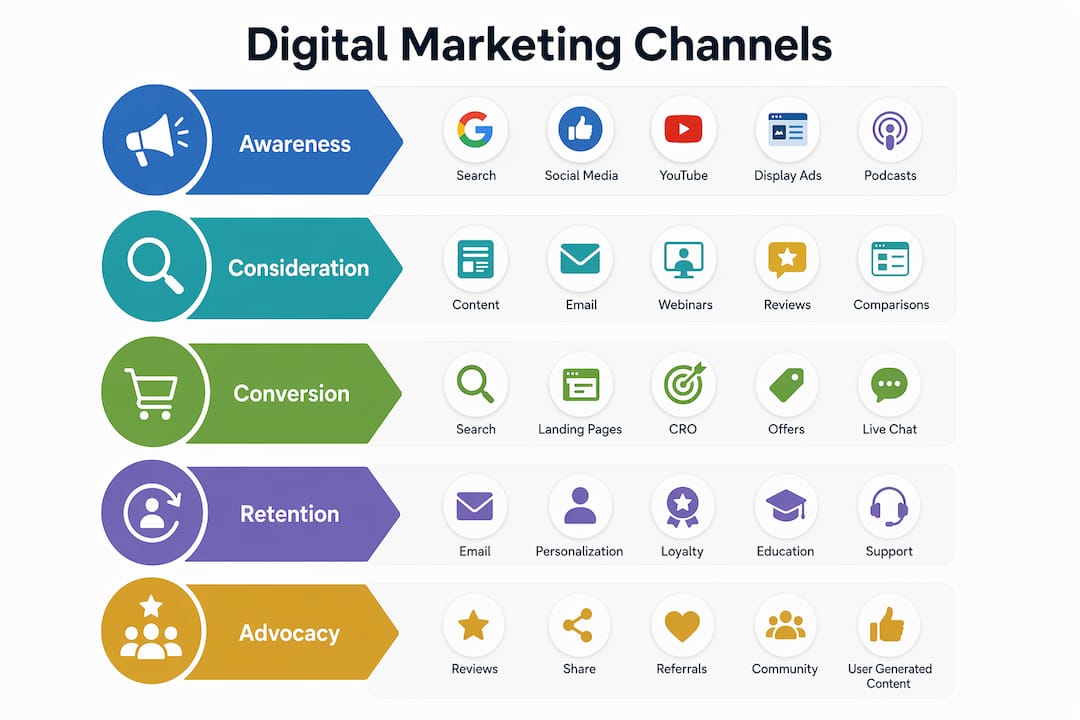
You can explore how these channels drive ecommerce success with specific campaign examples that show each channel’s contribution to revenue.
How does a typical digital marketing strategy work?
Effective digital marketing strategies follow four integrated stages: planning, content activation, performance monitoring, and optimization. Treating these as a cycle rather than a checklist is what separates brands that scale from those that plateau.
-
Strategic planning and audience definition. Before any content goes live, you define who you are targeting, what they need, and where they spend time online. This includes building audience personas, selecting channels, and setting KPIs. Defining KPIs upfront such as cost per acquisition, conversion rate, and return on ad spend is critical to tracking campaign impact on revenue precisely.
-
Content creation and channel activation. This is where strategy becomes execution. You produce the ads, emails, blog posts, and landing pages that carry your message. The content must match the channel. A LinkedIn post and a Google Search ad require completely different formats, tones, and calls to action.
-
Performance monitoring. Tools like Google Analytics 4, Meta Ads Manager, and Klaviyo provide real-time data on how campaigns perform. You track clicks, opens, conversions, and revenue attribution. Without this step, you are flying blind.
-
Data-driven optimization. You use what the data tells you to improve. A low click-through rate on an email subject line gets A/B tested. A landing page with high traffic but low conversion gets redesigned. This iterative process is what compounds results over time.
Understanding the customer journey stages is what ties these four stages together. When you know exactly where customers drop off, you know exactly where to optimize.
Pro Tip: Run a 30-day audit before launching any new campaign. Pull your existing data from Google Analytics 4 or your email platform and identify where customers currently abandon the funnel. Fix the leak before you pour in more traffic.
Successful strategies also balance paid, owned, and earned media. Balancing these media types reduces acquisition costs over time because owned channels like email and earned channels like organic search do not charge you per impression.
Why is digital marketing more cost-efficient than traditional marketing?
The cost advantage of digital marketing over traditional channels is structural, not accidental. A full-page newspaper ad reaches everyone who picks up that paper, regardless of whether they want what you sell. A Google Search ad reaches only people who typed in a query related to your product. That precision is worth more than raw reach.
| Factor | Traditional marketing | Digital marketing |
|---|---|---|
| Targeting | Broad demographics | Behavior, intent, and interest |
| Measurement | Estimated reach | Real-time clicks, conversions, revenue |
| Budget flexibility | Fixed, high minimums | Scalable from any starting point |
| Feedback speed | Weeks or months | Hours or days |
| Two-way engagement | One-way broadcast | Interactive and conversational |
The table above captures what is meant by digital marketing when business owners ask why it outperforms traditional channels. The answer is control. You control who sees your message, what you spend, and how fast you respond to results.
“Digital marketing enables businesses to connect with audiences on platforms where users spend most of their time online, at a fraction of the cost of traditional media.” — US Chamber of Commerce
For ecommerce brands specifically, the ability to track blended ROAS across paid and organic channels gives a complete picture of marketing efficiency that no traditional medium can match. A brand spending $10,000 on Meta ads and $5,000 on email can calculate the exact revenue contribution of each channel and reallocate accordingly.
Common misconceptions and pitfalls to avoid
Most businesses that struggle with digital marketing are not failing because of bad ads or weak content. They are failing because of strategic misalignment. Here are the most common mistakes and what to do instead.
-
Treating channels as isolated tasks. Posting on Instagram is not a digital marketing strategy. Running Google Ads is not a digital marketing strategy. Treating digital marketing as isolated tasks instead of an integrated ecosystem is the most common reason campaigns underperform despite significant ad spend.
-
Confusing tools with strategy. Klaviyo, Salesforce Marketing Cloud, and HubSpot are powerful platforms. But marketing technology should support a clear media strategy, not substitute for one. Buying software before defining objectives leads to expensive underutilization.
-
Skipping the measurement setup. Campaigns must define KPIs before launch to measure revenue impact. Without KPIs, marketing efforts consume budget without validating effectiveness. Set your cost per acquisition target, your conversion rate benchmark, and your ROAS floor before the first ad goes live.
-
Ignoring mobile experience. Channel misalignment kills conversions. Paid ads driving to non-mobile-friendly landing pages are one of the most preventable causes of wasted spend. More than half of all web traffic comes from mobile devices, and a slow or broken mobile page erases every dollar spent on acquisition.
Pro Tip: Before scaling any paid channel, run your landing pages through Google PageSpeed Insights and test them on three different mobile devices. A one-second delay in page load time measurably reduces conversion rates.
A digital media strategy for ecommerce that accounts for channel integration from the start avoids most of these pitfalls before they cost you money.
Key takeaways
Digital marketing works because it combines precise targeting, real-time measurement, and multi-channel integration to convert audiences into customers at a lower cost than any traditional alternative.
| Point | Details |
|---|---|
| Eight core channels | SEO, SEM, email, social, PPC, content, display, and mobile each serve distinct funnel roles. |
| Four-stage strategy | Planning, activation, monitoring, and optimization must run as a cycle, not a checklist. |
| Measurement first | Define KPIs like CPA and ROAS before any campaign launches to track revenue impact. |
| Integration over isolation | Channels working together outperform any single channel running alone. |
| Cost and control | Digital marketing scales from any budget and delivers real-time feedback traditional media cannot. |
The shift I keep watching businesses miss
After working with ecommerce brands on email and retention strategy, the pattern I see most often is not a lack of tools or budget. It is a lack of sequence. Business owners hear “digital marketing” and immediately ask which channel to start with. That is the wrong first question.
The right first question is: where does my customer go after they first hear about me? Map that path before you activate anything. I have seen brands with sophisticated Meta ad setups lose 60% of their traffic on a landing page that was never tested on mobile. The ads were excellent. The strategy was broken.
The other thing worth saying plainly: AI is reshaping marketing campaigns by enabling real-time, data-driven personalization that strengthens human connection rather than replacing it. That is not a future trend. It is happening now in email segmentation, dynamic ad creative, and predictive send-time optimization. Brands that treat AI as a shortcut to skip strategy will get mediocre results. Brands that use AI to sharpen a strategy they already understand will pull ahead fast.
Start simple. Pick two channels. Define your KPIs. Run for 60 days. Then let the data tell you where to go next. That is what digital marketing basics actually look like in practice, and it works better than any elaborate multi-channel launch with no measurement foundation.
— Take
Ready to turn email into your most reliable revenue channel?
Understanding what digital marketing is all about is the foundation. Executing it well, especially across email and retention, is where most brands leave money on the table.
Take-action is a specialized email marketing and retention agency that helps ecommerce brands build automated, revenue-generating email systems using Klaviyo. From welcome flows and abandoned cart sequences to full campaign strategy, Take-action combines human expertise with data-driven execution to make email your most consistent growth channel. If you are ready to stop relying solely on paid ads and build an owned channel that compounds over time, explore what Take-action offers and see how the right retention strategy changes your numbers.
FAQ
What exactly is digital marketing in simple terms?
Digital marketing is the use of online channels, platforms, and data to promote a business and reach customers. It includes SEO, email, social media, paid ads, and content, all working together to drive awareness and sales.
What is the difference between digital marketing and traditional marketing?
Traditional marketing uses broadcast channels like TV, radio, and print with limited targeting and delayed feedback. Digital marketing uses online platforms with precise audience targeting, real-time analytics, and flexible budgets that scale with results.
What is a digital marketing business or agency?
A digital marketing business or agency provides services like SEO, paid advertising, email marketing, and content strategy to help other companies grow online. Agencies range from generalists covering all channels to specialists focused on one area, such as email retention.
What are the most important KPIs in digital marketing?
The most important KPIs include cost per acquisition (CPA), return on ad spend (ROAS), click-through rate (CTR), and conversion rate. Defining these KPIs before a campaign launches is what allows you to measure actual revenue impact rather than vanity metrics.
How do digital marketing services typically work?
Digital marketing services cover strategy, execution, and optimization across one or more channels. A provider might handle your Google Ads, manage your email flows in Klaviyo, or run your full content calendar, depending on what your growth goals require.