

ROI for Influencer Marketing: 2026 Ecommerce Guide
TL;DR:
- Measuring influencer marketing ROI is complex because it encompasses revenue, engagement quality, and brand equity. Most brands underestimate true costs and improperly attribute long-term effects, risking poor budgeting decisions. Diversifying influencer tiers and tracking extended performance can enhance ROI and campaign resilience.
Measuring the roi for influencer marketing is harder than it looks, and most ecommerce brands are doing it wrong. They chase follower counts, celebrate impressions, and declare a campaign successful before a single purchase is tracked. The reality is that influencer marketing ROI spans multiple dimensions: direct revenue, engagement quality, content asset value, and long-term brand equity. Average returns sit at $5.78 per $1 spent, with top campaigns reaching $11 to $18. Knowing where your brand falls, and why, is what separates profitable programs from expensive experiments.
Table of Contents
- Key takeaways
- ROI for influencer marketing: the fundamentals
- Influencer tiers and their real impact on ROI
- Advanced ROI considerations most brands miss
- How to set budgets and optimize ROI in practice
- My honest take on influencer ROI
- Turn influencer insights into retention revenue
- FAQ
Key takeaways
| Point | Details |
|---|---|
| ROI is multidimensional | Influencer marketing ROI includes revenue, engagement quality, content value, and brand equity. |
| Micro-influencers often outperform | Micro-influencers deliver 3x better ROI at 65% lower cost per engagement than macro-influencers. |
| Hidden costs distort results | True campaign costs run 1.4x to 1.6x the creator fee once gifting, labor, and tools are factored in. |
| Attribution takes time | Conversion ROI typically appears in 30 to 60 days; brand awareness lift shows in 3 to 6 months. |
| Ongoing programs compound returns | Twelve-month influencer programs consistently outperform short one-off campaign bursts. |
ROI for influencer marketing: the fundamentals
Most marketers default to a simple formula: revenue generated minus campaign cost, divided by campaign cost, multiplied by 100. That gives you a percentage return. The problem is that formula only works cleanly when you can directly tie a purchase to a specific influencer. Most of the time, you cannot do that with a single data point.
The formula needs to account for different campaign objectives. If your goal is sales, you track revenue generated through promo codes, UTM links, or affiliate links. If your goal is awareness, you measure reach, share of voice, and brand search volume. If your goal is content production, you calculate the cost of the UGC assets you now own versus what a production studio would charge. Each objective demands its own ROI definition before you start spending.
Here is how to set up a solid measurement foundation:
- Define your primary objective before launch. Revenue, awareness, engagement, or content assets. Pick one as your primary KPI.
- Assign UTM parameters to every influencer link. This connects social traffic to purchases inside your analytics platform.
- Issue unique promo codes per creator. Discount redemptions give you a direct sales attribution signal.
- Set up affiliate tracking for performance-based partnerships. This aligns creator incentives with your revenue goals.
- Capture content licensing rights at contract signing. This unlocks the repurposing value of influencer content down the line.
Pro Tip: Do not measure influencer campaigns in isolation. Cross-reference UTM data with email open rates during the campaign window. Customers who see an influencer post and then receive your email often convert at a higher rate than either channel alone.
The important distinction between revenue, profit, and sales lift often gets lost. Revenue is the gross number. Profit accounts for product cost and fulfillment. Sales lift compares your baseline sales trend against performance during the campaign period. Sales lift is what actually tells you whether the influencer moved the needle or whether you just had a good week.
Influencer tiers and their real impact on ROI
Not all creators are created equal, and the ROI influencer marketing data by tier reveals some counterintuitive truths. Bigger audiences do not reliably produce bigger returns for ecommerce brands.
Micro-influencers generate roughly 3x better ROI than their macro counterparts. Their audiences are smaller but more trusting, more niche, and more likely to act on a recommendation. That trust translates directly into purchase behavior.

Here is how the tiers break down in practical terms:
| Tier | Follower range | Typical engagement rate | Cost per engagement | Best use case |
|---|---|---|---|---|
| Nano | 1K to 10K | 4% to 8% | Very low | Local/niche awareness |
| Micro | 10K to 100K | 2% to 4% | Low | Conversion and retention |
| Macro | 100K to 1M | 1% to 3% | Medium to high | Brand awareness at scale |
| Mega/Celebrity | 1M+ | Under 1% | Very high | Mass brand building |
Nano and micro-influencer benefits are particularly strong for ecommerce retention, because these creators often build communities around specific product categories. A nano-influencer in the running gear space has followers who actively want running gear. That audience intent is worth far more than a raw follower number on a celebrity account.
Macro-influencers are not a bad investment. They are just a different investment. Their value lies in reach, association, and brand trust at scale. They are harder to tie directly to sales because engagement rates for macro influencers run 1% to 3% compared to 4% to 8% for nano-level creators. The cost per real engagement is significantly higher.
Pro Tip: Do not build your entire influencer budget around one macro creator. Spread the same spend across five to ten micro-influencers in your niche. You will get more content, more audience diversity, and typically a better return on every dollar.
A hybrid model works best for most ecommerce brands: a consistent pool of micro-influencers driving conversions week over week, with one or two macro activations per quarter to spike awareness. Hybrid campaigns combining both tiers generate stronger, more sustained ROI than single-tier approaches because they hit the consumer at multiple points in the purchase funnel.
Advanced ROI considerations most brands miss
Here is where most influencer marketing ROI analysis breaks down. Brands calculate creator fees and revenue, then call it done. The real picture is more complicated, and getting it right changes how you budget and justify the channel.
The hidden costs problem
The true cost of an influencer campaign is not just the creator fee. Full campaign costs typically run 1.4x to 1.6x the creator fee once you include product gifting, shipping, internal team labor for briefing and review, and any paid amplification spend on top-performing posts. If you spend $5,000 on creators but ignore $3,000 in supporting costs, your reported ROI is artificially inflated. That creates bad decisions at the next budget cycle.
Build a true cost ledger for every campaign:
- Creator fees and commissions
- Product cost and shipping for gifting
- Internal team hours (briefing, review, coordination)
- Platform or agency management fees
- Paid media spend to amplify organic posts
- Content rights and licensing fees
Attribution is not a solved problem
ROI typically shows up within 30 to 60 days for conversions, but brand awareness lift can take 3 to 6 months to register in measurable ways. Attribution complexity means ROI measurement should account for multi-touch consumer journeys where a customer sees an influencer post, searches your brand a week later, receives a retargeting ad, and then buys. Credit belongs to the influencer even if the last click was Google.
“Reach and impressions are not ROI. They are visibility. True influencer marketing ROI lives in purchase intent signals, repeat behavior, and the content assets you can reuse for the next twelve months.”
Influencer content as a production asset
This is one of the most undervalued dimensions of influencer marketing ROI analysis. When you pay an influencer to create content, you are also paying for a creative asset. Repurposed influencer UGC used in paid ads generates 2x to 3x higher engagement and lower cost per acquisition than standard brand-produced creative. If you run that content through your paid social channels for three months, the original creator fee amortizes across a much larger return.
The compounding case for long-term programs
Twelve-month continuous influencer programs yield meaningfully higher ROI than equivalent spending spread across a series of short campaigns. The reason is trust accumulation. When a creator talks about your brand repeatedly, their audience starts to see it as a genuine endorsement rather than a one-time ad. That trust is almost impossible to manufacture quickly and very hard to replicate through other channels.
How to set budgets and optimize ROI in practice
Getting the influencer marketing ROI analysis right is only valuable if it informs real budget decisions. Here is a practical framework for ecommerce marketers.
Step 1: Anchor your budget to total marketing spend. Ecommerce brands typically allocate 20% to 30% of their marketing budget to influencer programs, compared to 10% to 20% for general brands. If your total marketing spend is $100,000 per month, a well-structured ecommerce influencer program could reasonably command $20,000 to $30,000.
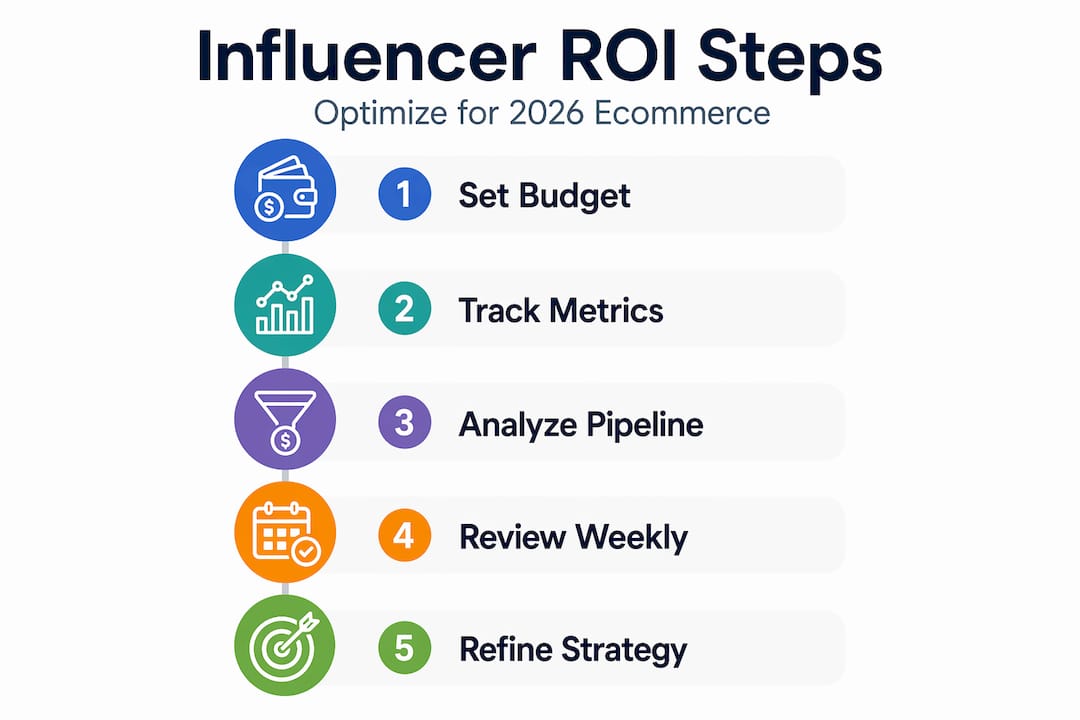
Step 2: Build a tracking architecture before you launch. Every creator needs a unique UTM link and a unique promo code. Use a unified dashboard (Google Analytics 4, Northbeam, or Triple Whale) to aggregate performance data across all creators. This is non-negotiable for calculating roi for social media campaigns accurately.
Step 3: Connect metrics to pipeline language. Top brand managers link influencer ROI to pipeline metrics like qualified leads and contract value. When reporting to a CFO or leadership team, frame influencer marketing performance in terms of customer acquisition cost compared to your paid ad benchmarks. If your paid social CPA is $45 and your influencer CPA is $28, that is a number any CFO understands immediately.
Step 4: Review performance weekly, reallocate monthly. Do not set and forget. Check UTM data weekly. If one creator is driving five times the clicks of another at similar cost, either scale that relationship or use the data to brief the underperformer more precisely. Most brands wait until campaign end to analyze results. By then, you have left money on the table.
Step 5: Prioritize effective influencer marketing strategies built around content formats that convert. Short-form video consistently outperforms static images for direct-to-consumer products. But product tutorials and unboxing content outperform lifestyle posts for categories like beauty, tech, and home. Match content format to product category and track the difference.
Pro Tip: Set a minimum performance threshold before scaling any influencer relationship. A creator who drives a 3x ROAS on a small test budget is far more valuable than one with 500K followers and no conversion data. Let the numbers guide the scaling decisions, not the vanity metrics.
Tracking consumer purchase intent signals alongside reach and engagement gives you a fuller picture of which creators are genuinely moving your business forward. A balanced scorecard combining ROAS and brand equity lift captures both short-term conversion performance and longer-term brand building, which is ultimately the complete ROI picture.
My honest take on influencer ROI
I’ve watched ecommerce brands pour serious money into influencer programs and walk away convinced the channel doesn’t work. Almost every time, the problem wasn’t the influencers. It was the measurement framework, or the complete lack of one.
What I’ve learned is that the brands winning with influencer marketing treat creator content the way a smart CMO treats production assets. They negotiate content rights upfront, repurpose top-performing posts across paid social, and track the extended lifetime of every piece of content. A single $1,500 creator video that runs in paid ads for six months is not a $1,500 expense. It is a $1,500 investment that compounds.
I’ve also seen the over-reliance on one or two large creators backfire badly. When a macro-influencer’s audience shifts or a controversy hits, brands that built their entire influencer strategy around one name are suddenly scrambling. Diversifying across micro-influencer pools creates resilience, not just ROI.
My advice: stop measuring the impact of influencer marketing by last-click attribution alone. Look at assisted conversions, brand search volume trends, and repeat purchase rates among customers who entered through influencer channels. Those numbers often tell a story that the simple revenue calculation completely misses.
— Take
Turn influencer insights into retention revenue
Understanding your influencer marketing ROI is only half the equation. The other half is what happens after a customer clicks through, makes a purchase, and enters your retention ecosystem.
At Take-action, we specialize in connecting influencer-driven acquisition with long-term customer retention through Klaviyo automation. When a new customer comes in through an influencer campaign, your post-purchase flows, win-back sequences, and VIP segments should already be working to keep them. Without that retention layer, you are paying to acquire customers and then letting them drift. If you want to see how email automation can compound the ROI from your influencer spend, Take-action’s retention solutions are built exactly for this. We help ecommerce brands turn first-time influencer-driven buyers into long-term revenue through data-driven segmentation and automated campaigns that run while you sleep.
FAQ
What is a good ROI for influencer marketing?
The average return is $5.78 for every $1 spent, with top-performing campaigns reaching $11 to $18 per dollar. Most ecommerce brands should target a minimum of 3x ROAS before scaling any influencer relationship.
How do you calculate ROI for influencer marketing?
Subtract total campaign costs from revenue generated, divide by total campaign costs, and multiply by 100. Total costs must include creator fees, gifting, internal labor, and any paid amplification, not just the creator fee alone.
Do micro-influencers deliver better ROI than macro-influencers?
Yes. Micro-influencers generate roughly 3x better ROI at 65% lower cost per engagement than macro-influencers. Their smaller, niche audiences convert at higher rates because the trust level between creator and follower is significantly stronger.
How long does it take to see ROI from influencer marketing?
Conversion-focused campaigns typically show measurable ROI within 30 to 60 days. Brand awareness campaigns take 3 to 6 months to produce measurable brand lift, so budget timelines should reflect which objective you are optimizing for.
Why do so many brands underestimate influencer marketing costs?
Most brands report only creator fees and miss hidden costs like product gifting, shipping, internal team time, and paid amplification spend. True campaign costs typically run 1.4x to 1.6x the creator fee, which significantly changes the ROI calculation.