

Digital marketing explained: Boost ecommerce retention
TL;DR:
- Digital marketing encompasses interconnected online channels like email, SEO, PPC, and social media. Automated email flows generate nearly half of email revenue, greatly enhancing retention and profitability. Most brands underutilize segmentation and AI, leading to lower engagement and revenue growth.
Most ecommerce marketing managers think digital marketing means running Meta ads and posting on Instagram. That’s a costly misunderstanding. Digital marketing is the full practice of promoting your brand through online channels, and the most powerful of those channels for retention is email, especially when it’s automated. Brands running smart Klaviyo flows are generating nearly half their email revenue from just 5% of their sends. This guide breaks down what digital marketing really means for ecommerce, which automation strategies move the revenue needle, and how data-driven segmentation turns one-time buyers into loyal customers.
Table of Contents
- Defining digital marketing and its impact in retail
- The role of email marketing automation in ecommerce retention
- Types of automation flows that maximize retention and sales
- Leveraging data-driven segmentation and AI for higher email engagement
- What most brands get wrong about digital marketing for retention
- Unlock your retention potential with expert-led email marketing
- Frequently asked questions
Key Takeaways
| Point | Details |
|---|---|
| Automation drives retention | Automated email flows far outperform manual campaigns for ecommerce retention and revenue. |
| Segmentation increases engagement | Using data-driven segmentation and AI enables more relevant emails and higher click rates. |
| Flow variety is essential | Running multiple flows like welcome, cart, post-purchase, and win-back maximizes retention impact. |
| Metrics and privacy shift | Brands must adapt to evolving privacy rules and prioritize engagement over simple open rates. |
| Expert support accelerates growth | Specialized agencies help brands maximize retention with advanced automation and proven strategies. |
Defining digital marketing and its impact in retail
Digital marketing is not a single tool. It’s a system of interconnected channels working together to move customers through awareness, consideration, purchase, and repeat purchase. For ecommerce brands, that last stage, getting customers to come back, is where real profitability lives.
The key channels in digital marketing include SEO, PPC (pay-per-click advertising), content marketing, social media marketing, email marketing, and video marketing, often coordinated in an omnichannel strategy that supports the full customer buying journey. Each channel plays a distinct role. SEO and content bring traffic. PPC accelerates it. Social builds brand awareness. Email and automation drive revenue and retention.
What most brands miss is the connective tissue between these channels. A customer might discover your brand through a TikTok ad, land on your site without buying, get retargeted by a Facebook ad, then finally convert because of a well-timed abandoned cart email. That last touchpoint, the email, often gets undervalued because attribution models favor the click closest to the sale. But email is frequently the channel that closes the deal.
For retail brands specifically, the omnichannel approach is critical. Customers don’t think in channels, they think in experiences. A seamless experience means your messaging is consistent whether someone reads an email, visits your site, or sees a retargeted ad. You can learn more about how to build this kind of coordinated approach in a digital media strategy built specifically for ecommerce.
Here’s a breakdown of how each major digital marketing channel typically functions for retail:
- SEO: Drives organic traffic through search visibility; great for long-term brand growth and reducing paid acquisition costs
- PPC: Generates immediate traffic; expensive without strong conversion optimization downstream
- Content marketing: Builds authority and trust; supports email list growth when paired with lead magnets
- Social media marketing: Builds community and brand awareness; algorithm-dependent and harder to predict
- Email marketing: Highest ROI channel; fully owned, not rented; enables direct one-to-one personalized communication
- Video marketing: Increases engagement and product understanding; increasingly integrated into email and landing pages
| Metric | Traditional marketing | Digital marketing |
|---|---|---|
| Audience targeting | Broad, demographic-based | Precise, behavioral and intent-based |
| Measurability | Limited, delayed | Real-time, granular |
| Cost per acquisition | High | Scalable, lower with optimization |
| Personalization | Near-impossible at scale | Automated and deeply segmented |
| Retention capability | Minimal direct impact | Central to lifecycle strategy |
The table above makes one thing clear: digital marketing gives ecommerce brands tools that traditional marketing simply cannot match. The ability to target, measure, and personalize in real time is what makes email automation so powerful within the broader digital marketing ecosystem.
The role of email marketing automation in ecommerce retention
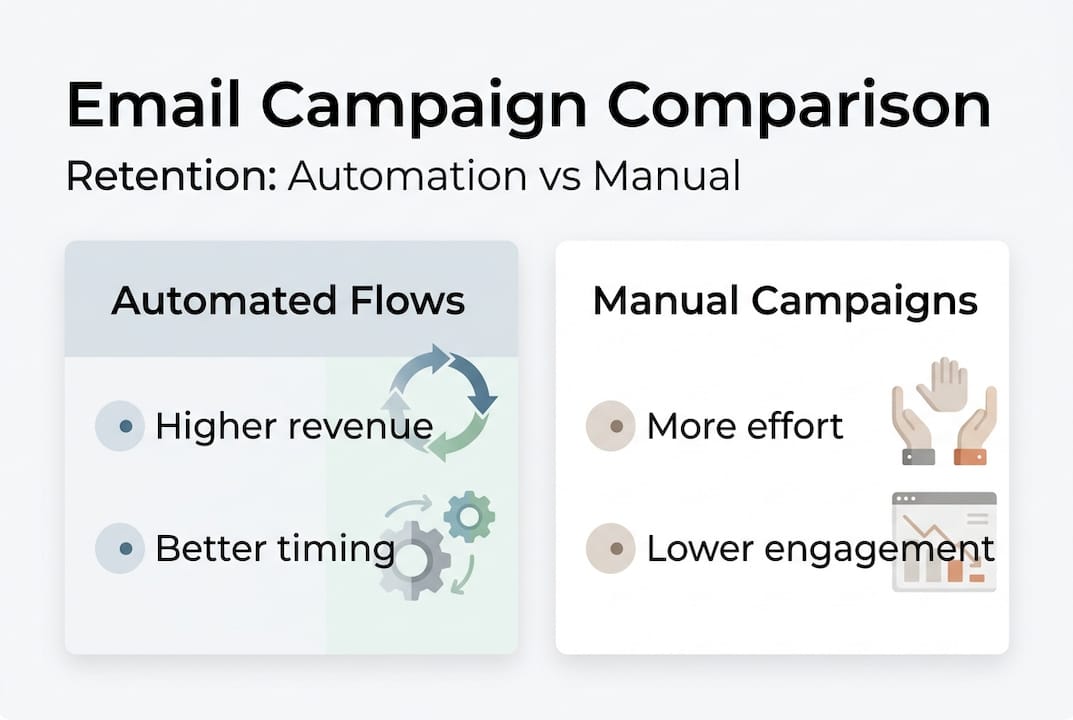
Here’s the number that should stop you mid-scroll: automated email flows generate 41% of email revenue from just 5.3% of sends, with 18x higher revenue per recipient than manual campaigns, 3x higher click rates, and 13x higher order rates. You read that correctly. A fraction of your sends, the automated ones, produce nearly half your revenue.
Manual campaigns still have a place. They’re great for promotions, product launches, and seasonal moments. But they require constant creation, they go to everyone at the same moment, and they don’t respond to individual customer behavior. Automated flows do the opposite. They trigger based on what a specific customer does or doesn’t do, at exactly the right moment in their journey.
For ecommerce brands, the retention opportunity is enormous. Increasing customer retention by just 5% can boost profits anywhere from 25% to 95%. That’s not a small improvement. That’s a business transformation. And it starts with building flows that work while you sleep.
Here are the highest-performing automated flows every ecommerce brand should have running:
- Welcome series: First impression after someone subscribes; sets brand tone and drives first purchase
- Abandoned cart flow: Recovers shoppers who added to cart but didn’t buy; highest revenue-per-recipient of any flow type
- Post-purchase flow: Thanks the customer, sets expectations, asks for reviews, and introduces upsell opportunities
- Browse abandonment flow: Re-engages visitors who looked but didn’t add to cart
- Back-in-stock flow: Converts high-intent shoppers the moment a product becomes available
- Win-back/re-engagement flow: Reactivates lapsed customers before they churn permanently
| Metric | Automated flows | Manual campaigns |
|---|---|---|
| Revenue per recipient | 18x higher | Baseline |
| Click rate | 3x higher | Baseline |
| Order rate | 13x higher | Baseline |
| % of total email sends | 5.3% | 94.7% |
| % of total email revenue | 41% | 59% |
The math here is undeniable. Explore specific automated workflow examples for ecommerce brands to see how these flows look in practice and what benchmarks you should target at each stage.
Pro Tip: Segment your flows so that disengaged contacts who haven’t opened or clicked in 90 to 120 days get sunsetted, meaning they exit your active list. Sending to unresponsive contacts hurts your sender reputation and tanks deliverability for everyone else. A smaller, engaged list always outperforms a large, disengaged one.
You can get deeper tactical guidance in resources on email marketing tips and online marketing email automation for scaling ecommerce brands.
Types of automation flows that maximize retention and sales
Understanding which flows to build is step one. Knowing how to build them well is where most brands stumble. Each flow in your Klaviyo account serves a specific moment in the customer lifecycle, and they need to be treated with that level of precision.
The welcome series is your highest-leverage flow for new subscribers. Studies consistently show it generates some of the best open rates of any automated sequence, often above 50%. Why? Because your brand is top-of-mind, trust is at its peak, and the subscriber actively chose to hear from you. A strong welcome series runs three to five emails over seven to ten days, introduces your brand story, highlights bestsellers, addresses common objections, and offers a first-purchase incentive.
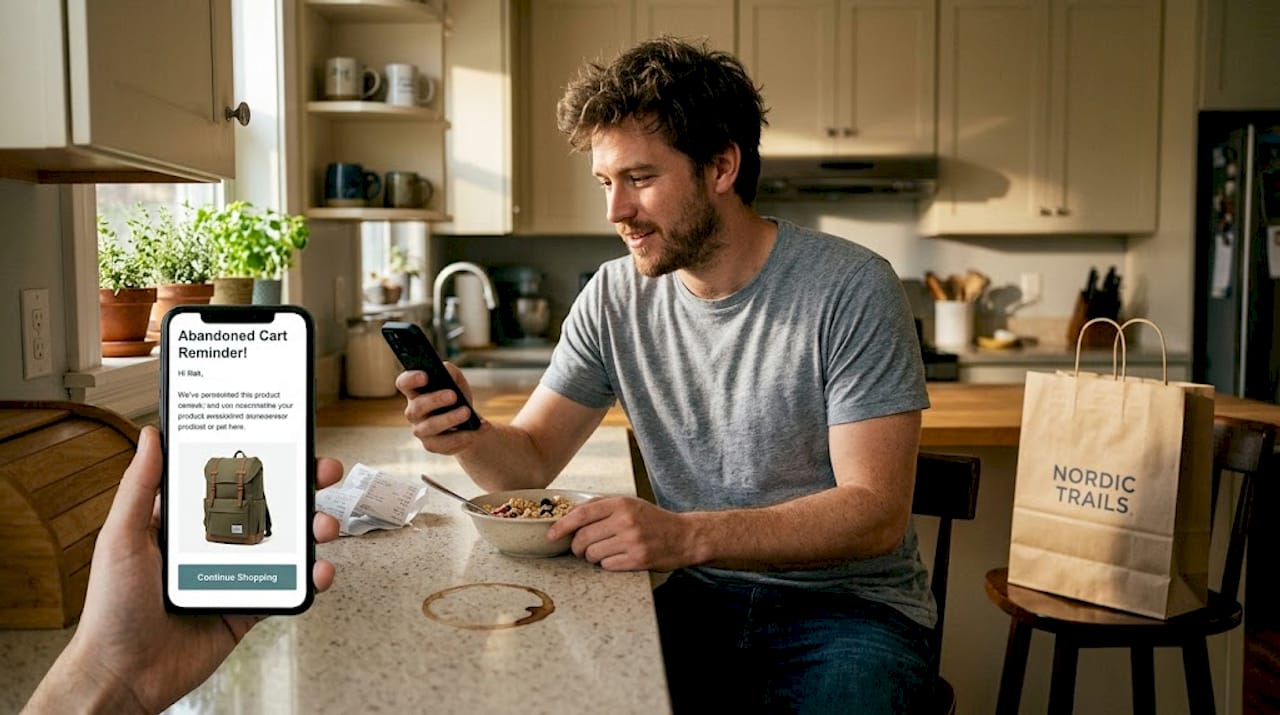
The abandoned cart flow is the undisputed revenue champion for most stores. Send the first email within one hour of abandonment. Then follow up at 24 hours, then again at 72 hours. Each email should escalate slightly in urgency and value. The first is a simple reminder. The second might highlight reviews or a guarantee. The third might offer free shipping or a small discount.
The post-purchase flow is dramatically underused. Most brands send a shipping confirmation and stop there. A great post-purchase flow educates the customer on how to use the product, asks for a review at the optimal moment (usually 7 to 14 days after delivery), introduces complementary products, and begins planting seeds for the next purchase. This single flow, done well, significantly increases repeat purchase rate.
Here are the core best practices to implement across every flow:
- Timing matters: Test send delays. The right timing for a browse abandonment email is different from a win-back email.
- Personalize subject lines and preview text: Use first names, product names, and behavioral triggers to make every email feel one-to-one.
- Use dynamic product blocks: Show the exact products a customer viewed or purchased rather than generic recommendations.
- A/B test everything: Subject lines, CTAs, email length, and send timing should all be tested over time.
- Set clear exit conditions: If someone buys, they should immediately exit the abandoned cart flow. Klaviyo makes this straightforward.
“Increasing retention by 5% can boost profits by up to 95%.” This isn’t a rounding error. It’s the compounding effect of customers buying more often, spending more per order, and costing less to acquire.
Pro Tip: Use Klaviyo’s AI features to generate subject line variations and test them automatically. AI-generated subject lines have shown open rate lifts of 10% to 22% in certain campaigns, and AI-powered product recommendations drive meaningfully higher click-through rates than static blocks.
For more specific ideas on keeping customers engaged after their first purchase, explore ecommerce newsletter ideas built specifically for retention.
Leveraging data-driven segmentation and AI for higher email engagement
Automation gets you in front of the right person at the right time. Segmentation and AI make sure you’re saying the right thing. Together, they’re what separate a good email program from a great one.
RFM segmentation (Recency, Frequency, Monetary value) is the foundational framework for understanding your customer base. Recency tells you how recently someone purchased. Frequency tells you how often they buy. Monetary value tells you how much they spend. When you combine these three dimensions, you can build segments like “high-value loyalists,” “at-risk one-time buyers,” and “recently lapsed frequent shoppers.” Each segment needs a different message with a different tone and different offer.
Here’s how to apply data-driven segmentation effectively in Klaviyo:
- Build your RFM segments using Klaviyo’s predictive analytics. Identify your top 20% of customers by revenue contribution.
- Run cohort analysis to understand which acquisition channels bring the most loyal buyers. Spend more to acquire those customers.
- Use funnel reporting to find where customers drop off in your email journey and which flows have the highest exit rates.
- Apply AI predictions for next purchase date and customer lifetime value to trigger flows before a customer goes cold.
- Measure repeat purchase rate as your primary retention KPI, not open rate. Repeat purchase rate tells you whether your strategy is actually working.
Data-driven insights via RFM segmentation, cohort analysis, funnel reporting, and AI predictions enable personalized, timely emails. Top-performing flows for Shopify brands are hitting $7.79 revenue per recipient and click rates above 10%. That’s the standard you should be benchmarking against.
| Metric | AI-personalized emails | Standard emails |
|---|---|---|
| Open rate | 38-42% | 26.9-30% |
| Click-through rate | 3.2%+ | 2-2.5% |
| Revenue per recipient | $7.79+ | $2-3 |
| ROI per $1 spent | Up to $42 | $36 average |
The email marketing statistics paint a clear picture: open rates for well-segmented lists run between 26.9% and 42%, click-to-open rates between 5.63% and 6.81%, and overall email ROI sits at $36 to $42 per dollar spent. AI personalization consistently pushes brands toward the top of those ranges. You can dig into how to properly measure email engagement across your campaigns and flows to track what’s actually driving repeat purchases.
For an integrated view of how email fits into your online marketing strategy and business growth goals, both resources give you a clear framework for connecting channel performance to bottom-line results.
What most brands get wrong about digital marketing for retention
Here’s the uncomfortable truth we see consistently working with ecommerce brands: most teams are doing digital marketing backwards. They pour budget into acquisition, then wonder why retention is low. They build flows once and never revisit them. They celebrate high open rates while their actual revenue metrics stagnate.
The biggest operational mistake is mailing unsegmented lists. Sending the same email to your full list might feel efficient, but it accelerates unsubscribes, increases spam complaints, and trains inbox providers to deprioritize your emails. Apple’s Mail Privacy Protection and Gmail/Yahoo’s updated sender requirements have fundamentally changed what open rate actually means. Opens are no longer reliable as a primary performance indicator. Click-to-open rate (CTOR) and repeat purchase rate are now your most honest retention metrics.
AI and segmentation are dramatically underused by most brands. Klaviyo’s AI features for open rate lifts of 10% to 22% and product recommendations driving 3.75% click-through rates are sitting unused for many mid-market brands. The brands winning in 2026 are the ones treating Klaviyo as a revenue engine, not just a broadcast tool.
Pro Tip: Prioritize relevance and timing over frequency. One perfectly timed, hyper-relevant email to the right segment will outperform five generic blasts to your full list every time. Build your flows to respond to behavior, not your calendar.
You can explore how email retention strategies connect directly to sustainable business growth without relying entirely on paid acquisition to fuel revenue.
Unlock your retention potential with expert-led email marketing
Automation, segmentation, and AI are only as powerful as the strategy behind them. Knowing what to build is one thing. Building it correctly, optimizing it over time, and connecting every flow to real revenue goals is where most in-house teams hit a ceiling.
That’s exactly what we do at Take Action, a dedicated email marketing and retention agency focused on ecommerce brands using Klaviyo. From welcome series to win-back flows, from RFM segmentation to AI-powered personalization, we build and manage the systems that turn one-time buyers into loyal customers. If you’re ready to stop leaving retention revenue on the table, our email retention experts are ready to build a strategy tailored to your brand, your customers, and your growth goals.
Frequently asked questions
What are the main channels in digital marketing for ecommerce?
The key channels include SEO, PPC, content marketing, social media, email, and video marketing, typically coordinated in an omnichannel strategy that supports the full customer buying journey from awareness through retention.
How does email automation drive better retention than manual campaigns?
Automated flows generate 18x higher revenue per recipient than manual campaigns, along with 3x higher click rates and 13x higher order rates, because they trigger based on individual behavior rather than a broadcast schedule.
Which email flows are crucial for ecommerce retention?
Welcome series, abandoned cart, post-purchase, browse abandonment, back-in-stock, and win-back flows are the six most effective automated sequences for driving both revenue and long-term customer loyalty.
What segmentation and personalization strategies increase email engagement?
RFM segmentation, cohort analysis, funnel reporting, and AI-driven predictions make emails significantly more relevant and timely, pushing open rates and click-through rates to the top of industry benchmarks.
How should brands adapt to changing privacy and deliverability rules?
Brands must sunset disengaged contacts regularly and shift primary focus from open rates to click-to-open rate and repeat purchase rate, which remain reliable indicators of true email engagement despite Apple MPP and Gmail policy changes.
Recommended
- Online Marketing Strategy: Driving Ecommerce Retention | Take Action Blog | Take Action
- Essential digital branding tips for ecommerce growth | Take Action Blog | Take Action
- UGC Digital Marketing: Driving Retention in Ecommerce | Take Action Blog | Take Action
- Blog - Email Marketing Insights | Take Action | Take Action