

Blog content planning strategies for ecommerce email success
TL;DR:
- Connecting blog content directly to email and SMS drives significant ecommerce revenue and customer engagement.
- Conduct regular content audits and build a synchronized calendar aligned with sales campaigns and lifecycle stages.
- Optimize each post for conversions and automation integration to maximize ROI and long-term growth.
Your blog is either quietly building compounding revenue or silently wasting your team’s time. The difference comes down to whether your content planning connects directly to your email marketing strategy. Email and SMS can drive 25-40% of ecommerce revenue when paired with a deliberate content engine. That’s not a side benefit. That’s your growth channel. This guide covers everything ecommerce marketing managers need to audit existing content, build campaign-aligned calendars, optimize each post for conversions, and wire it all into Klaviyo automation for measurable, repeatable results.
Table of Contents
- Assess your current content and set clear goals
- Build a strategic content calendar aligned with campaigns
- Optimize content for SEO, personalization, and email conversion
- Integrate blog content with multi-channel automation
- Why most ecommerce content plans fail (and how to break through)
- Level up your ecommerce content and retention strategy
- Frequently asked questions
Key Takeaways
| Point | Details |
|---|---|
| Start with a content audit | Review your existing blog posts to identify strengths and gaps before planning new campaigns. |
| Align calendar with campaigns | Map blog topics directly to sales events, customer journeys, and automation flows for maximum impact. |
| Prioritize personalization | Use AI and audience insights to tailor content and email offers, driving measurable lifts in conversions. |
| Integrate multi-channel execution | Distribute and automate content across email, SMS, and social channels to increase revenue and engagement. |
Assess your current content and set clear goals
Before you build anything new, you need to know what you already have. Most ecommerce marketing teams skip this step and end up publishing into a void. A thorough content audit tells you which posts are pulling their weight, which are outdated, and where the biggest gaps are in your funnel coverage.
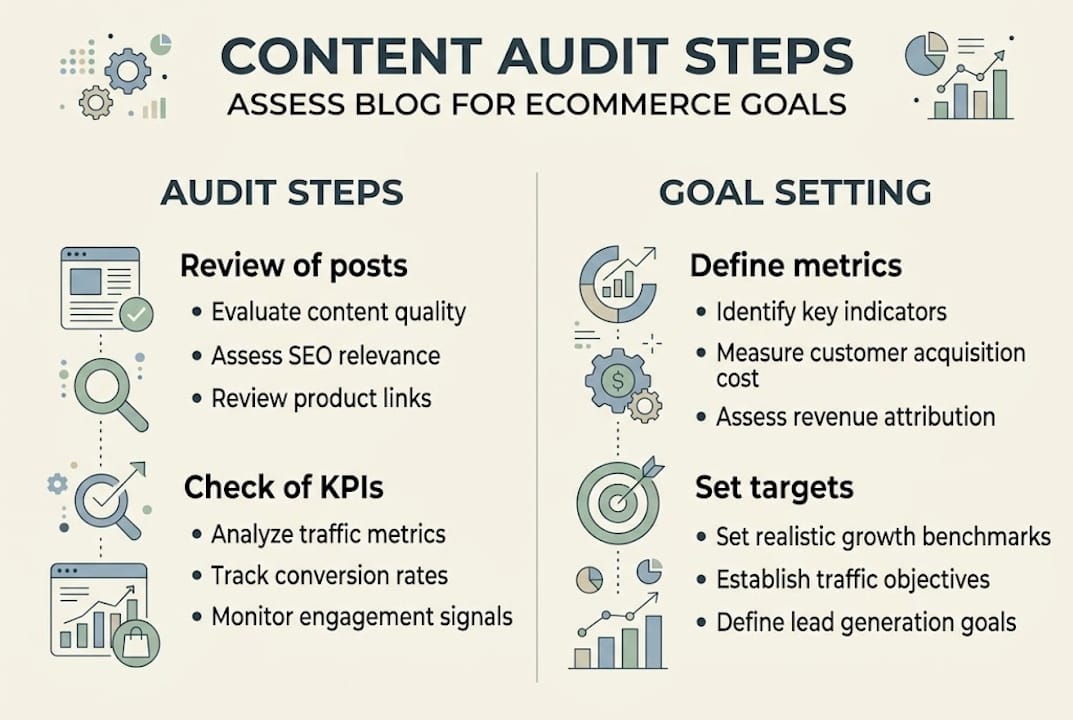
Start by pulling data from Google Search Console and your analytics platform. Tag every post by topic, publish date, traffic volume, time on page, and conversion events. You’ll quickly see patterns. Some posts may drive strong organic traffic but zero email signups. Others may have minimal traffic but high product page click-throughs. These insights tell you where to double down and where to cut losses.
What to look for in a content audit:
- Blog posts with declining traffic that could be refreshed with updated data or new keywords
- Top performers that lack a clear CTA or email opt-in, leaving conversions on the table
- Content gaps around your best-selling product categories or most common customer questions
- Posts that could be repurposed into email sequences or Klaviyo flows
- Seasonal content that could be updated and reused year after year
If you want a structured process for this, walk through our content audit checklist designed specifically for ecommerce email success. It connects blog performance directly to automation opportunities.
Once the audit is complete, set goals that are specific enough to be actionable. Vague goals like “grow traffic” lead to vague strategies. Instead, define outcomes like “increase email list growth from blog by 20% in Q2” or “rank in the top 5 for three product-category keywords by September.” These become your editorial north star.
Connect every goal to a measurable KPI: organic sessions, email signup rate, scroll depth, average order value from blog-referred traffic, or flow enrollment rates. The discipline of tying blog content to business metrics is what separates high-performing ecommerce marketing teams from those endlessly chasing publishing quotas.
| Goal type | Example KPI | Why it matters |
|---|---|---|
| SEO growth | Keyword rankings | 3,403% increase in keyword rankings is achievable with consistent optimization |
| Email list growth | Signup rate per post | Connects content directly to owned-channel revenue |
| Engagement | Avg. time on page | Signals content quality and intent match |
| Revenue attribution | Blog-assisted conversions | Justifies content investment to stakeholders |
| Retention | Flow enrollment from blog | Links content to lifetime value |
Pro Tip: Run your content audit quarterly, not annually. Ecommerce search trends shift fast, and a post that ranked well six months ago may need a refresh to stay competitive and keep feeding your email flows.
Build a strategic content calendar aligned with campaigns
With your goals locked in, the next move is creating a calendar that turns your editorial plan into a synchronized marketing machine. The biggest mistake ecommerce teams make is building a blog schedule in isolation. Your blog, email campaigns, SMS flows, and product launches should all be planned on a single calendar.
Start by plotting your major promotional dates for the quarter. Black Friday, product launches, seasonal sales, and reorder windows all create natural anchors for your content plan. Work backward from each date to identify when you need your blog content live so it has time to index, circulate in email, and warm up your audience before the campaign hits.
For each promotional event, plan a content cluster. A product launch might include an educational blog post explaining a problem the product solves, a comparison post for high-intent buyers, and a how-to guide that works inside a post-purchase email flow. Each piece serves a different stage of the customer journey while building topical authority for SEO.
Publishing 4-8 blog posts per month is the recommended frequency for ecommerce stores aiming for strong revenue impact. That range gives you enough content to sustain weekly email value without overwhelming your team. It also keeps your Klaviyo automations fresh because you always have new material to pull into flows.
Content calendar setup, step by step:
- Map all promotional campaigns for the quarter onto a single master calendar.
- Assign each campaign two to three supporting blog topics that align with buyer intent at different funnel stages.
- Classify each post as evergreen, promotional, or seasonal so you maintain a balanced mix.
- Schedule email and SMS distribution for each post immediately after the publish date.
- Connect each post to a specific Klaviyo automation, such as a welcome series, abandoned cart follow-up, or post-purchase education sequence.
- Set a review checkpoint two weeks after publish to assess performance and decide on amplification.
Explore promotion strategy best practices and the top content marketing channels for ecommerce to understand where your blog content will create the most compounding value across channels.
| Content type | Publish frequency | Primary channel | Klaviyo use case |
|---|---|---|---|
| Evergreen educational | 2x per month | Organic search | Welcome series, browse abandonment |
| Product-focused | 1-2x per month | Email + SMS | Post-purchase, upsell flows |
| Seasonal | Quarterly | Paid + email | Campaign-specific flows |
| Comparison or review | 1x per month | Organic + retargeting | Cart abandonment sequences |
Pro Tip: Use Klaviyo’s segmentation data to reverse-engineer your editorial calendar. If a customer segment shows high engagement with skincare education emails, that’s a direct signal to produce more blog content on that topic and feed it back into that segment’s flow.
Optimize content for SEO, personalization, and email conversion
Getting your calendar built is a milestone. But if the content itself isn’t optimized, you’re putting effort into posts that will underperform on every metric that matters. Optimization is not just about keywords. It’s about making every post work harder for your list, your revenue, and your retention strategy.
Every blog post should have one clear conversion goal before you write a single word. Is this post meant to capture email signups? Drive product page views? Encourage downloads of a sizing guide or a care instructions PDF? That goal shapes everything from your headline to your CTA placement.

Personalized content using AI can boost form submissions by 14% and drive a 44-53% increase in year-over-year revenue. Inside Klaviyo, you can use behavioral segments to surface personalized blog recommendations inside email flows. Someone who clicked on a skincare ingredient breakdown email should receive different follow-up content than someone who clicked on a best-sellers roundup.
Core optimization checklist for each blog post:
- Target one primary keyword and two to three supporting terms based on actual search volume and buyer intent
- Optimize your title tag and meta description for click-through rate, not just keyword inclusion
- Place your email opt-in CTA above the fold and again at the midpoint, especially on longer posts
- Link internally to relevant product pages and related blog content to extend session time
- Include a content upgrade, such as a checklist or recipe card, to increase form submission rates
- Structure headers as questions your buyer is actually asking, since they tend to rank in featured snippets
- Test CTA copy using Klaviyo data to see which language drives the most list growth from your blog
“A strategic content plan doesn’t just grow traffic. It builds the email list, nurtures the buyer, and keeps the customer coming back. Every post should close a loop in your customer lifecycle.”
A robust content strategy drives 30% revenue growth and long-term organic traffic gains that compound over time. That compounding effect is the real advantage of content over paid ads. A blog post published today can generate email signups and product purchases two years from now without any additional ad spend.
For deeper guidance, look at our keyword research tips for ecommerce growth and explore the best blog formats that drive the highest conversion rates for online stores.
Integrate blog content with multi-channel automation
Optimizing your blog is just the beginning. The real revenue lift comes when you plug your content into the full ecommerce automation stack. One blog post should not live in isolation. It should appear in email, in SMS, in social, and inside your Klaviyo flows simultaneously.
Content and automation synergy can drive up to 40% of ecommerce revenue, but only when your distribution strategy is as deliberate as your content creation strategy. Most brands write a post and share it once on social. That’s leaving most of the value on the table.
Multi-channel distribution workflow:
- Publish the post and immediately trigger an email campaign to your most engaged segment featuring a compelling excerpt.
- Send an SMS notification with a direct link to high-intent subscribers who have previously clicked on similar content.
- Schedule three to four social posts over the following two weeks, each highlighting a different angle or takeaway from the post.
- Add a snippet of the post into your post-purchase email flow for new customers as a value-add touchpoint.
- Retarget website visitors who read the post but didn’t convert with a paid ad featuring a related offer.
- Update your welcome series to include the post if it aligns with new subscriber education goals.
The key is building a content repurposing workflow so every piece of content you create gets multiple lives. A 1,200-word blog post can become an email campaign, three SMS messages, a social carousel, a short video script, and a FAQ block in your abandoned cart flow. This kind of workflow is what makes your content investment scale.
What to track across channels:
- Email open rate and click rate on blog-forward campaigns versus product-focused campaigns
- SMS click-through rate on content-linked messages
- Blog traffic sourced from email versus organic versus social, broken down by segment
- Flow enrollment rates from blog CTAs
- Revenue attributed to blog-assisted sessions across all touchpoints
You can find frameworks for this in our guides on repurposing ecommerce content, building a social content strategy that supports email engagement, and generating newsletter ideas for retention. For a practical example of how retail brands structure content planning end-to-end, this fashion retail content planning guide offers useful structural insights.
Pro Tip: Build a “content refresh” trigger inside Klaviyo. When a blog post reaches 90 days old and still shows strong engagement, automatically resurface it to subscribers who never opened the original email send. This is one of the simplest wins with the highest ROI in content automation.
Why most ecommerce content plans fail (and how to break through)
Here’s the uncomfortable truth: most ecommerce content plans fail not because of bad writing, but because they’re built around the wrong objective. Teams chase publishing frequency or keyword rankings while their customer lifecycle sits completely disconnected from the blog. The result is a content library that generates decent traffic but zero measurable impact on retention or revenue.
The brands that break through do one thing differently. They start with the customer journey and map every piece of content to a specific lifecycle moment. Not “we need a post about ingredient sourcing.” Instead: “We need a post that answers the question a new customer has on day three post-purchase, which we’ll insert into our onboarding flow to reduce churn.”
That shift is everything. Fewer posts. Deeper alignment. Deliberate distribution. When you connect your blog to email marketing insights and treat content as a lifecycle asset rather than an SEO checkbox, the returns compound in ways that publishing volume never will. The best content plans we’ve seen produce outsized results because every post has a home in the automation stack before it’s even written.
Level up your ecommerce content and retention strategy
If these strategies clicked for you, the next step is building a system that runs consistently, not just in campaign bursts. Most ecommerce marketing teams have the right instincts but not enough bandwidth to execute an integrated blog and email strategy at scale.
At Take Action, we specialize in exactly this intersection where blog strategy meets Klaviyo automation. We help ecommerce brands design content plans that feed email campaigns, power retention flows, and drive measurable revenue lifts without adding more to your team’s plate. From editorial calendars to Klaviyo automation setup and multi-channel distribution, we build the engine and help you scale it. If you’re ready to make your content work as hard as your paid ads, let’s talk.
Frequently asked questions
How many blog posts should an ecommerce store publish monthly?
Aim for 4-8 blog posts per month to maximize revenue and engagement impact. Consistency at this range gives your Klaviyo flows enough fresh content to stay relevant without burning out your team.
How much ecommerce revenue can effective content and email automation drive?
With well-planned content and automation, email and SMS can contribute 25-40% of total ecommerce revenue. The key is aligning your blog content directly to campaign flows and lifecycle triggers.
Does optimizing blog content really impact keyword rankings and organic traffic?
Strategic and consistent blogging can produce a 3,403% increase in keyword rankings and a 14% rise in organic traffic based on documented ecommerce case studies. The compounding effect of well-optimized posts builds an organic channel that paid ads cannot replicate.
What’s the best way to connect blog content with email and SMS for ecommerce?
Use Klaviyo to repurpose blog posts across automated campaigns and lifecycle flows, ensuring your content reaches subscribers at the right moment in their journey. Build distribution into your workflow before you publish, not after.