

Writing a Bio for Business: A Professional’s Guide
TL;DR:
- A business bio is a strategic narrative that showcases your expertise and value to attract opportunities.
- Regularly updating and tailoring your bio for different platforms enhances credibility and visibility.
A business bio is defined as a strategic narrative that positions your expertise, achievements, and value to attract the right opportunities. Writing a bio for business goes far beyond listing job titles. It tells a specific audience exactly who you are, what you do, and why they should pay attention. The professionals who treat their bio as a living document, not a one-time task, consistently outperform those who treat it as an afterthought. A well-crafted bio opens doors to speaking engagements, media coverage, partnerships, and client trust before you ever say a word.
What are the key components of an effective business bio?
A strong business bio leads with a hook that states your role, specialty, and the audience you serve. Effective bios answer “Who, What, and For Whom” within the first 20 words. That front-loading captures attention and improves how search engines and AI tools read your profile.
The core elements of a credible bio break down like this:
- Your current role and organization. State it plainly. “Sarah Chen is the founder of a DTC skincare brand serving 40,000 customers across North America” beats “Sarah is a passionate entrepreneur.”
- Quantifiable achievements. Numbers build trust faster than adjectives. Specific growth metrics and named client categories open doors to speaking gigs and media coverage.
- Your area of expertise. Be specific about what you do and who benefits from it. “Email retention strategy for ecommerce brands” is more credible than “digital marketing.”
- A personal touch. One sentence about your background, location, or a non-work interest makes you human and memorable.
- A call to action. Tell readers what to do next. “Connect on LinkedIn,” “visit [your website],” or “book a discovery call” all work depending on the platform.
Every element earns its place. If a sentence does not add credibility or context, cut it.
Pro Tip: Read your bio aloud before publishing. Reading bios aloud exposes awkward phrasing and weak verbs that look fine on screen but sound flat in conversation.

How to tailor your bio length and content for different platforms
One bio does not fit every context. Industry best practice in 2026 is to maintain four distinct bio lengths: 25, 50, 125, and 300 words. Each length serves a different purpose and audience.
| Bio length | Best use | What to include |
|---|---|---|
| 25 words | AI profiles, social media headers | Name, role, core specialty, one differentiator |
| 50 words | Directories, podcast guest listings | Role, top achievement, audience served, CTA |
| 125 words | Press kits, conference programs | Full positioning, 2–3 achievements, personal note |
| 300 words | About pages, LinkedIn summaries | Complete narrative, credentials, story, CTA |
The tone and person also shift by platform. LinkedIn bios typically use first person (“I help ecommerce brands…”) to feel direct and personal. Press materials and speaker bios use third person (“Jane Doe is the CEO of…”) because journalists quote them verbatim. Mixing these up is a common and costly mistake.
What you emphasize also changes. A bio for a podcast appearance should highlight your story and personality. A bio for a business directory should lead with your specialty and location. A bio for an investor deck should front-load your track record and market expertise.
- Omit personal hobbies from press bios unless they reinforce your brand.
- Drop technical jargon from bios aimed at general audiences.
- Add industry-specific credentials when writing for professional directories.
Pro Tip: Build a master bio document first, then cut it down. Maintaining a master bio avoids rewriting from scratch every time a new platform needs a different length.
Consistency across platforms builds trust. If your LinkedIn says you serve B2B SaaS clients and your website says you work with ecommerce brands, readers notice the gap. Aligning your messaging across every channel reinforces your brand identity. Strong visual storytelling paired with a consistent bio creates a brand presence that sticks.
What common mistakes should you avoid in a business bio?
Most weak bios share the same problems. Recognizing them early saves you from publishing something that quietly costs you credibility.
- Using buzzwords instead of proof. Words like “visionary,” “passionate,” and “results-driven” appear in millions of bios. Replacing buzzwords with specific achievements and concrete examples makes a bio credible and high-converting.
- Writing one generic bio for every platform. As branding expert Lucy Werner notes, one-size-fits-all bios are among the most frequent errors professionals make. Every bio must be tailored to its platform and audience.
- Leaving out measurable results. “Grew email revenue by 40% in six months” is more persuasive than “improved marketing performance.” Readers want proof, not promises.
- Cluttered narratives. A bio that tries to cover every job, skill, and interest dilutes your core message. Pick the three most relevant credentials and build around them.
- Letting bios go stale. Outdated roles and metrics signal neglect of your personal brand and reduce the opportunities that come your way.
“If your competitor could publish the same bio without changing a word, rewrite it. A bio that could belong to anyone belongs to no one. Specificity is the only thing that separates a forgettable profile from one that generates real opportunities.”
Apply what practitioners call the competitor test: if a rival in your space could say the exact same thing, rewrite for uniqueness. That single filter removes more weak copy than any other editing technique.
How do you write and update a business bio step by step?
Writing a strong bio is a process, not a single sitting. Follow these steps to build one that works across every platform.
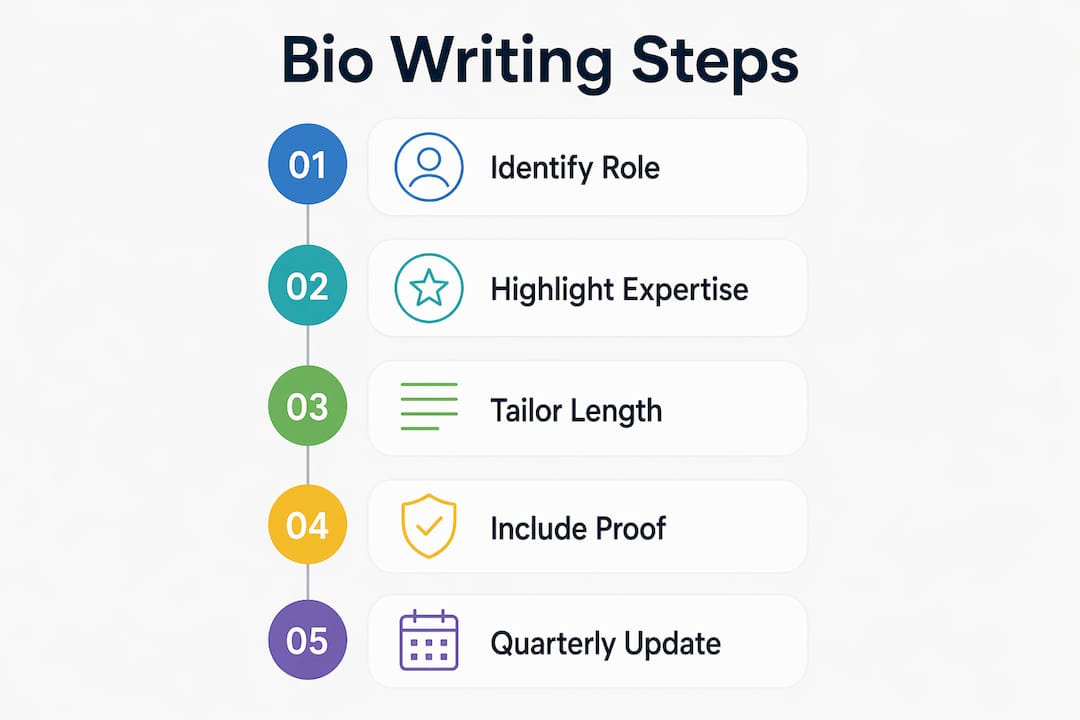
- Collect your credentials into a master document. List every role, achievement, publication, award, and client result you have earned. Include numbers wherever possible. This document becomes the source of truth for every bio version you create.
- Draft your positioning statement. Write one sentence that answers: who you are, what you do, and who you serve. “I help ecommerce founders build retention systems that reduce churn and grow lifetime value” is a positioning statement. “I am a marketing professional with 10 years of experience” is not.
- Apply a framework to structure the draft. The Who-What-For Whom framework works for most professional bios. State your role, describe your specialty, name your audience, cite your proof, and close with a call to action. Keep sentences under 20 words for maximum scannability.
- Produce platform-specific versions. Cut your 300-word bio down to 125 words by removing personal context and secondary achievements. Cut again to 50 words by keeping only your role, top credential, and CTA. The 25-word version is your headline: name, role, and one sharp differentiator.
- Schedule quarterly reviews. Regular quarterly updates keep your bio current and improve discoverability by both AI tools and human readers. Tie each review to a career milestone: a new client win, a promotion, a published piece, or a speaking engagement.
Pro Tip: After each quarterly review, run the competitor test on every version. If the language feels generic, swap one vague phrase for a specific result or credential. That single edit usually lifts the entire bio.
For ecommerce founders and brand operators, connecting your bio to your content strategy pays dividends. A bio that reflects your brand voice reinforces every piece of content you publish. Pairing your bio with a clear content framework for ecommerce creates a consistent brand signal across every channel.
Key Takeaways
A business bio works best when it leads with specific proof, adapts to each platform, and gets reviewed every quarter.
| Point | Details |
|---|---|
| Lead with specifics | Open with your role, specialty, and audience in the first 20 words. |
| Maintain four bio lengths | Keep 25, 50, 125, and 300-word versions ready for different platforms. |
| Use a master document | Draft one full bio first, then derive shorter versions from it. |
| Replace buzzwords with proof | Swap vague descriptors for specific metrics and named achievements. |
| Review every quarter | Update all bio versions at least four times a year to stay current. |
What I have learned from years of watching bios open and close doors
Most professionals underestimate how hard their bio works without them in the room. A journalist searching for a source, a conference organizer filling a panel, or a potential client vetting a vendor will read your bio before they ever contact you. That bio either earns the conversation or ends it.
The bios I have seen generate real results share one quality: they are specific to the point of being almost uncomfortable. They name the exact type of client served, the exact result delivered, and the exact credential that backs it up. Generic language feels safe, but it is actually the riskiest choice because it gives readers no reason to choose you over anyone else.
Authenticity matters, but it is not a substitute for proof. A personal note about your background or values adds warmth, but it cannot carry the bio alone. The best bios balance one human detail with two or three hard credentials. That ratio builds both trust and interest.
Voice consistency is the piece most professionals skip. Your LinkedIn bio, your website About page, and your speaker profile should all sound like the same person wrote them, because they should. Inconsistent tone across platforms creates a subtle but real sense of unreliability. Readers pick up on it even when they cannot name it.
Finally, treat your bio as a retention tool for your personal brand. Every time you update it with a new result or credential, you give your audience a reason to re-engage with your work. A bio that grows with your career compounds in value over time.
— Take
How Take-action helps brands build authority through content
A strong bio is the foundation of a personal brand, but it works best when it connects to a broader content and retention strategy. Take-action specializes in helping ecommerce brands and entrepreneurs build that connection. From email marketing and retention to campaign strategy and automation, Take-action aligns your brand voice with the systems that keep your audience engaged long after the first impression. If your bio is the door, Take-action helps you build what is behind it. Reach out to explore how a focused content and retention strategy can turn your professional credibility into measurable growth.
FAQ
What is a business bio?
A business bio is a short professional narrative that states who you are, what you do, and who you serve. It differs from a resume by emphasizing differentiation and value rather than chronological history.
How long should a professional bio be?
Best practice calls for four versions: 25 words for social profiles, 50 words for directories, 125 words for press materials, and 300 words for About pages and LinkedIn summaries.
Should a business bio be written in first or third person?
LinkedIn and personal website bios typically use first person for a direct tone. Press kits and speaker profiles use third person because journalists quote them without editing.
How often should you update your business bio?
Update all bio versions at least once per quarter. Tie each update to a new achievement, role change, or credential to keep the content current and credible.
What is the biggest mistake in bio writing for entrepreneurs?
The most common mistake is using vague buzzwords instead of specific results. Replacing phrases like “passionate leader” with a concrete metric, such as a revenue figure or client outcome, immediately improves credibility.