

Why invest in email marketing: proven ROI and retention power
TL;DR:
- Email offers a 36 to 45 dollar ROI per dollar spent, outperforming other channels.
- Automated flows like abandoned cart and post-purchase generate the majority of email revenue.
- Treating email as a growth asset through segmentation and automation boosts long-term sales.
Email marketing still surprises even seasoned e-commerce managers. While brands pour budget into paid social and search, email averages $36 to $45 back for every dollar spent, making it the highest-returning channel in e-commerce by a wide margin. The misconception that email is outdated persists, but modern platforms like Klaviyo have completely changed what automated email can do. This guide breaks down the real economics, the flows that drive results, and why treating email as a strategic asset rather than a broadcast tool is one of the smartest moves your brand can make.
Table of Contents
- Why email marketing delivers ROI others can’t match
- Core flows vs. campaigns: What actually drives revenue with Klaviyo
- The retention multiplier: Powering repeated sales and customer lifetime value
- Unlocking Klaviyo’s advantages: How segmentation, automation, and AI maximize impact
- What most brands miss about email: It’s a compounding asset, not a one-off campaign
- Ready to transform your retention with email?
- Frequently asked questions
Key Takeaways
| Point | Details |
|---|---|
| ROI leader | Email marketing delivers an average ROI of $36–$45 per dollar spent, outpacing paid ads and social. |
| Flows drive revenue | Automated flows like abandoned cart and welcome series produce 18x more revenue per recipient than campaigns. |
| Retention advantage | Email is 5x less expensive than customer acquisition and boosts customer lifetime value through repeat sales. |
| Klaviyo’s power | Klaviyo’s integrated, AI-powered platform unlocks advanced segmentation and automation for all ecommerce brands. |
| Ongoing value | Email is a compounding asset that grows in value with each new engaged subscriber and data-driven optimization. |
Why email marketing delivers ROI others can’t match
Paid social costs keep climbing. Organic reach keeps shrinking. Email, on the other hand, reaches an audience you own outright, with no algorithm standing between your message and your customer’s inbox. That ownership advantage is the foundation of email’s economics.
Email drives 20 to 40% of total e-commerce revenue for most brands, with optimized programs pushing that figure to 50% or more. Klaviyo users consistently land in the 25 to 45% range. Compare that to the fragmented returns from paid media, and the math becomes hard to ignore. Email marketing averages $36 to $45 ROI per dollar spent, a figure that reflects both the low cost of sending and the power of targeting people who already know your brand.
| Channel | Avg. ROI per $1 spent | Revenue share (ecommerce) | Audience control |
|---|---|---|---|
| Email marketing | $36 to $45 | 20 to 50% | Full (owned list) |
| Paid social | $2 to $4 | 5 to 15% | None (platform-dependent) |
| Paid search | $2 to $5 | 10 to 20% | None (auction-based) |
| Organic search | Variable | 15 to 30% | Partial (algorithm-dependent) |
“Email ROI is the highest in e-commerce, period. No other channel gives you this level of control over who sees your message, when, and at what cost.”
Here is why email consistently outperforms paid channels for e-commerce brands:
- Owned audience: Your list is yours. No platform can cut your reach overnight.
- Precise targeting: Segment by purchase history, browse behavior, location, and more.
- Low marginal cost: Sending to 10,000 vs. 100,000 subscribers costs a fraction of equivalent paid reach.
- Direct measurement: Every open, click, and purchase ties directly back to a specific send.
- Compounding returns: A well-maintained list grows more valuable over time, not less.
For a deeper look at how these numbers stack up, the email marketing benchmarks on our blog give you a real-world reference point across industries.
Core flows vs. campaigns: What actually drives revenue with Klaviyo
Most brands start with campaigns, the scheduled newsletters and promotional blasts that go to the whole list. Campaigns have their place, but they are not where the real money lives in Klaviyo.
Klaviyo flows generate 41% of email revenue from just 5.3% of total sends, with an 18x higher revenue per recipient than campaigns. The abandoned cart flow alone averages $3.07 revenue per recipient. That is not a rounding error. That is the difference between a passive newsletter and a revenue engine that runs while you sleep.
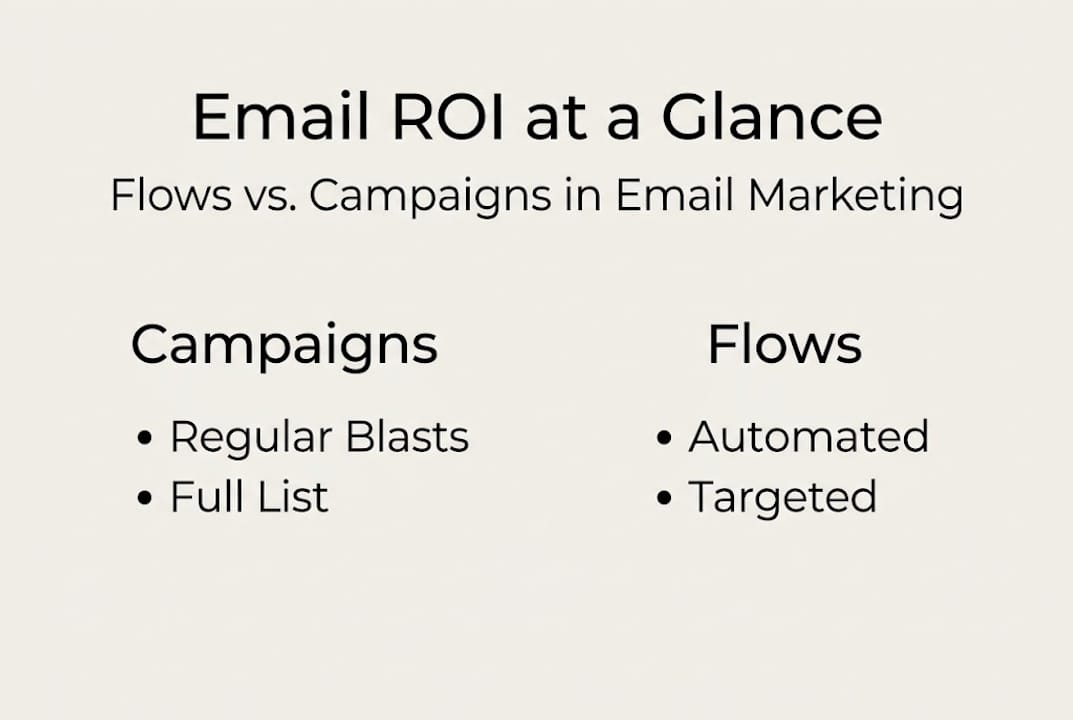
Flows trigger automatically based on what a shopper does, or does not do. An abandoned cart flow fires when someone leaves without buying. A welcome flow starts the moment someone joins your list. A post-purchase flow activates after a completed order to encourage a second purchase. Browse abandonment flows re-engage visitors who looked but did not add to cart. Flows also recover 5 to 15% of abandoned carts and can boost average order value by 28% through smart cross-sell sequences.
| Automated flows | Campaigns | |
|---|---|---|
| Trigger | Shopper behavior | Scheduled by marketer |
| Revenue per recipient | Up to 18x higher | Baseline |
| Send volume | Low (targeted) | High (broad) |
| Order rate | Significantly higher | Lower |
| Best use | Retention, recovery, onboarding | Promotions, launches, content |
Here is how to set up your first high-impact flows in priority order:
- Abandoned cart: The fastest win. Recover revenue from shoppers who were close to buying.
- Welcome series: Set the tone, introduce your brand, and drive a first purchase.
- Post-purchase: Thank buyers, request reviews, and plant the seed for a repeat order.
- Browse abandonment: Re-engage window shoppers before they forget you exist.
- Win-back: Bring lapsed customers back before they churn permanently.
Pro Tip: Build your abandoned cart flow first, every time. It targets the highest-intent shoppers on your list and delivers the fastest measurable lift. Get that running before you touch anything else.
For a practical look at how these work in practice, see our guide on effective automation flows and our breakdown of automation tool comparisons to understand where Klaviyo stands.
The retention multiplier: Powering repeated sales and customer lifetime value
Acquiring a new customer costs five times more than keeping an existing one. Email is the most cost-effective retention tool available to e-commerce brands, and the numbers back that up.

Email costs 5x less than acquisition while driving repeat purchases and increasing customer lifetime value over time. What makes this especially interesting is that 48% of flow revenue comes from new buyers, meaning flows like welcome, browse abandonment, and cart recovery are not just retention tools. They are also conversion tools for first-time customers who need a nudge.
Behavior triggers that maximize repeat purchases:
- Post-purchase follow-ups timed to the natural replenishment cycle of your product
- Loyalty milestone emails that reward customers after a set number of orders
- Product review requests that re-engage buyers and build social proof simultaneously
- Personalized product recommendations based on past purchase categories
- Re-engagement flows for subscribers who have gone quiet over 60 to 90 days
The compounding effect here is real. A customer who buys twice is far more likely to buy a third time. Email is the channel that makes that second purchase happen consistently, not by luck, but by design.
Pro Tip: Suppress disengaged subscribers from your main flows every 60 to 90 days. Sending to people who never open hurts your deliverability score, which affects whether your emails land in the inbox at all. A smaller, engaged list outperforms a bloated, unresponsive one every time.
For a broader look at how email fits into your overall strategy, our post on driving retention with email covers the full picture.
Unlocking Klaviyo’s advantages: How segmentation, automation, and AI maximize impact
Klaviyo is not just an email sender. It is a data platform built specifically for e-commerce, and that distinction matters enormously when you are trying to scale.
Klaviyo integrates directly with Shopify and other major platforms, automatically pulling in purchase data, browse behavior, and customer attributes for real-time segmentation. Its AI-powered recommendations have been shown to boost click rates to 3.75%, well above the standard 2 to 5% range. Top-performing brands hit open rates of 30 to 45%, with the top 10% of flows reaching $7.79 revenue per recipient.
What advanced segmentation and AI unlock for your program:
- Predictive analytics: Klaviyo forecasts when a customer is likely to buy again, so you can time your sends perfectly.
- Smart send time optimization: Emails go out when each individual subscriber is most likely to open.
- Dynamic content blocks: Show different products or offers to different segments within the same email.
- Real-time list updates: Segments refresh automatically as customer behavior changes, no manual exports needed.
- A/B testing at scale: Test subject lines, send times, and content variations with statistical confidence.
Pro Tip: Run a list hygiene audit every month. Remove hard bounces immediately, suppress chronic non-openers, and tag your most engaged subscribers for VIP segments. This single habit keeps your deliverability strong and your metrics meaningful.
For more on getting the most out of the platform, explore our advanced Klaviyo tips, our guide to Klaviyo personalization strategies, and our deep-dive into segmentation strategies.
What most brands miss about email: It’s a compounding asset, not a one-off campaign
Here is the uncomfortable truth most agencies will not tell you: the brands that treat email as a campaign calendar are leaving the majority of their potential revenue on the table. Email is not a broadcast tool. It is a compounding asset that grows more valuable the more intentionally you manage it.
The real ROI does not come from a single well-timed promotion. It comes from a nurtured, segmented list that receives the right message at the right moment, month after month. Campaigns account for 94.7% of sends but a fraction of revenue. Flows, by contrast, do the heavy lifting with a tiny fraction of the volume.
Deliverability and engagement are not set-and-forget. They require monthly attention, list hygiene, and strategic refinement. Brands that understand this build email programs that grow through automation and become more efficient over time, not less. The ones that treat email as a broadcast channel plateau quickly and wonder why their numbers are flat.
Ready to transform your retention with email?
A well-executed email program pays for itself many times over. The data is clear, the tools are available, and the brands winning on retention are the ones who treat email as a core revenue channel rather than an afterthought.
If you want to stop leaving revenue on the table and start building an automated email program that actually compounds, Take Action Email Marketing Agency is built exactly for this. We specialize in Klaviyo strategy, flow setup, and long-term retention partnerships for e-commerce brands ready to scale. Reach out to our team for expert retention support and find out what a properly structured email program can do for your numbers.
Frequently asked questions
How much revenue should email marketing drive for my ecommerce business?
Email should contribute 20 to 40% of online revenue for most brands, with optimized programs reaching 50% or more. If your email is below that range, there is likely untapped revenue sitting in your flows and segmentation.
Are automated flows really more effective than regular campaigns?
Absolutely. Klaviyo flows generate 18x higher revenue per recipient than campaigns and consistently outperform on order rates and click rates. The volume is lower, but the intent is far higher.
How does email help with customer retention?
Email flows like welcome, post-purchase, and abandoned cart nurture ongoing relationships and drive repeat sales. Email costs 5x less than acquisition, making it the most efficient retention channel available to e-commerce brands.
Is Klaviyo a good fit for small ecommerce brands?
Yes. Klaviyo automates core flows and provides segmentation and AI features that scale with your brand, whether you are sending to 500 subscribers or 500,000. The platform grows with you.
Recommended
- Take Action — Email Marketing & Retention Agency
- Take Action — Email Marketing & Retention Agency
- 7 Micro-Influencer Benefits for Ecommerce Retention | Take Action Blog | Take Action
- Online Marketing Strategy: Driving Ecommerce Retention | Take Action Blog | Take Action
- Nectar Blog | 7 Essential Ecommerce Retention Strategies List for Brands