

Why email marketing drives proven e-commerce growth
TL;DR:
- Email marketing delivers an industry average ROI of $36 to $42 per dollar, outperforming paid ads.
- Automated flows generate 41% of email revenue from just 5.3% of total sends.
- Building a qualified, engaged list is more valuable than large, cold audiences for sustained growth.
Every DTC brand chasing new customer acquisition through paid social is leaving money on the table. While marketing teams pour budgets into Facebook ads and TikTok campaigns, email consistently delivers an average return of $36 to $42 for every $1 spent, outperforming paid ads by a factor of 2:1. Email is not a legacy channel waiting to be replaced. It is the revenue backbone of the most profitable DTC brands operating today. This guide breaks down the real ROI data, the automations that drive the most revenue, and the strategies that turn a basic email list into a compounding growth engine.
Table of Contents
- The real ROI of email marketing for e-commerce
- How automation and flows drive most email revenue
- Personalization and segmentation: amplifying email impact
- Trust, first-party data, and the channel advantage
- A fresh take: What most DTC brands miss about email success
- Ready to unlock your brand’s email growth?
- Frequently asked questions
Key Takeaways
| Point | Details |
|---|---|
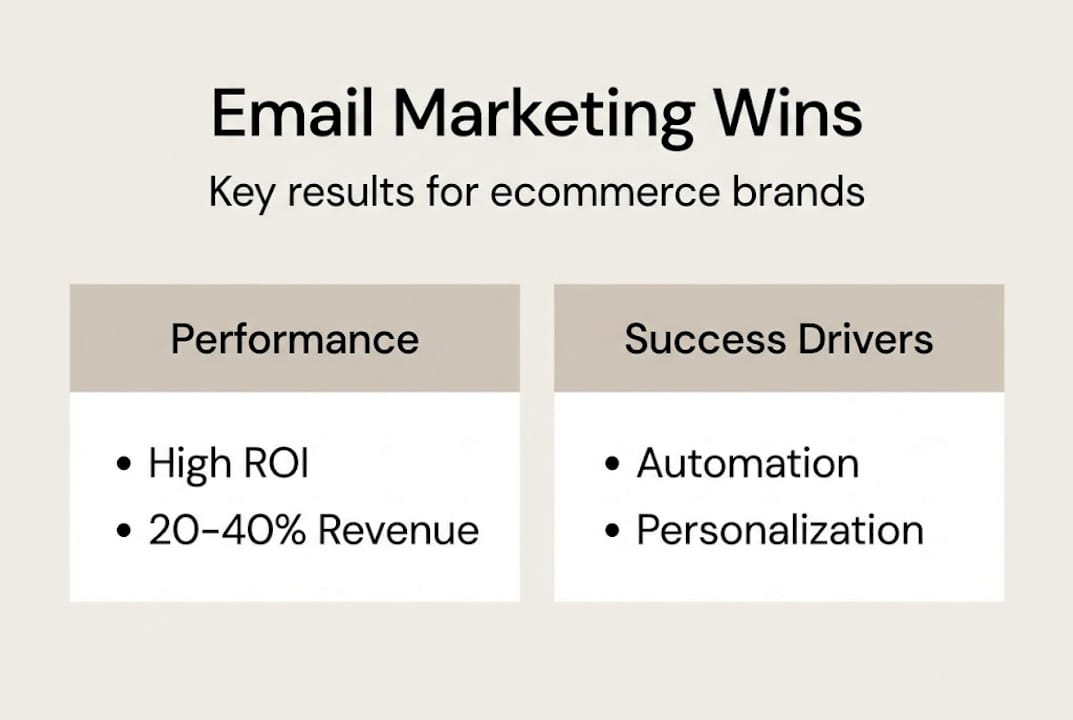
| Email drives results | Email marketing generates 20–40% of e-commerce revenue and the highest ROI among channels. |
| Automation multiplies impact | Automated flows like abandoned cart and post-purchase emails create outsized revenue from a small share of sends. |
| Personalization is essential | Segmentation and dynamic content dramatically increase conversions and retention for DTC brands. |
| Owned audience matters | Email gives you direct access to your audience and protects you from algorithm changes that can disrupt paid and social. |
The real ROI of email marketing for e-commerce
Now that you know email is not just alive but thriving, let’s look at the numbers that back it up.
The conversation around email ROI often gets watered down to open rates and click-through percentages. Those metrics feel good on a dashboard, but they rarely tell the full story. What actually matters is revenue per recipient, because that number captures what every send is worth to your bottom line. When you shift your lens to that metric, email’s dominance becomes impossible to ignore.
Email marketing delivers an average ROI of $36 to $42 for every dollar you spend. That is not a cherry-picked number from an outlier campaign. That is an industry average. Compare that to paid search, which typically returns $2 for every $1 spent, and the gap is staggering. The reason email compounds so effectively is that your list is a direct relationship with customers who already chose you.
Beyond the per-dollar return, email drives 20 to 40% of total e-commerce revenue for brands with well-managed programs. It also enhances repeat purchase rates above 30% and increases customer lifetime value by up to 33%. No other single channel moves those three metrics simultaneously. When you track revenue attribution properly in Klaviyo, you consistently see email punching above its cost weight.
Here is a straightforward comparison across channels:
| Channel | Average ROI | Revenue share | Retention lift |
|---|---|---|---|
| Email marketing | $36–$42 per $1 | 20–40% of revenue | CLV +33%, repeat rate 30%+ |
| Paid search (PPC) | ~$2 per $1 | Varies by brand | Low to moderate |
| Social media ads | ~$2.50 per $1 | 5–15% of revenue | Low |
| Influencer marketing | $5–$6 per $1 | Variable | Moderate |
The table makes one thing clear: email is not competing with these channels on a level playing field. It is operating in a different category entirely. You can learn more about how to benchmark your spend effectively in these email marketing ROI insights from our team.
One insight that often surprises DTC marketers is that a smaller, more engaged list consistently outperforms a large, cold one. Revenue per recipient is the signal. A 20,000-person list averaging $0.35 RPR per send generates $7,000 from every campaign. A bloated 100,000-person list averaging $0.04 RPR generates only $4,000, while also damaging deliverability. The brands that obsess over list quality grow faster than those chasing subscriber volume.
“The brands that win with email are not the ones sending the most. They are the ones sending the most relevant messages to the most qualified subscribers at the right moment in the customer journey.”
That shift in thinking, from volume to value, is what separates average email programs from exceptional ones.
How automation and flows drive most email revenue
Having seen the ROI potential, let’s dive into how email marketers get those massive returns, especially with automation.
If you are running campaigns but not investing heavily in automated flows, you are doing the equivalent of manually driving a car on cruise-control-friendly highway. Automated email flows do the heavy lifting so your team does not have to, and they do it better than any batch-and-blast campaign could.
The data here is striking. Automated flows drive 41% of total email revenue while accounting for just 5.3% of sends. That means automations generate a placed order rate 13 times higher than regular campaigns. You are getting exponentially more revenue from a fraction of the sends, simply because timing and relevance are built into the logic.

Here is how key flows compare to standard campaigns:
| Email type | Average open rate | Average CTR | Revenue per recipient |
|---|---|---|---|
| Welcome series | 45–55% | 8–12% | $0.40–$0.70 |
| Abandoned cart flow | 40–50% | 10–15% | $0.60–$1.20 |
| Post-purchase flow | 35–45% | 6–10% | $0.25–$0.50 |
| Win-back flow | 20–30% | 3–6% | $0.15–$0.40 |
| Standard campaigns | 18–25% | 2–4% | $0.05–$0.15 |
The gap is not subtle. Welcome emails capitalize on peak interest when someone first opts in. Abandoned cart flows recover revenue that would otherwise be lost, often converting 5 to 15% of abandoners when optimized well. Post-purchase flows build loyalty, encourage reviews, and plant the seed for the next purchase before the product even arrives. Win-back flows re-engage lapsing customers before they forget you exist entirely.
Here are the core reasons automations drive disproportionate revenue for DTC brands:
- Timing: Triggered emails reach customers at the exact moment they are most likely to act, not when your marketing calendar happens to align
- Relevance: Each flow is built around a specific customer action or lifecycle stage, making the message feel personal rather than broadcast
- Compounding returns: Once a flow is live and optimized, it generates revenue 24/7 without incremental effort from your team
- Zero fatigue: Subscribers only receive automation messages when they qualify, which prevents the list burnout common with heavy campaign schedules
- Data feedback loop: Flow performance in Klaviyo surfaces clear signals about where customers drop off, enabling smarter optimization
Pro Tip: Suppress subscribers who have not opened or clicked in 90 to 120 days before running major campaigns. This protects your sender reputation, keeps deliverability strong, and ensures your engagement metrics reflect your true active audience. Reactivate them with a dedicated win-back sequence first.
Pairing solid automations with smart email marketing tactics for your campaigns creates a system where every touchpoint is intentional. The flows handle lifecycle moments. The campaigns handle promotions, new launches, and seasonal pushes. Together, they cover the full customer relationship.
Personalization and segmentation: amplifying email impact
With automation powering delivery, advanced segmentation and personalization multiply the results.
Sending the same email to your entire list is the fastest way to train your subscribers to ignore you. It is also the fastest way to watch your unsubscribe rate creep up while your revenue per recipient drops. Segmentation fixes this by ensuring every message reaches the right people at the right stage, and the revenue impact is measurable.
One case study found that a DTC brand achieved 40% higher email revenue after implementing proper segmentation, with revenue per email jumping from $0.08 on batch sends to $0.33 on segmented sends. That is a 4x improvement in revenue efficiency from the same list, simply by targeting more precisely. Broader research shows that segmentation and personalization can lift email revenue anywhere from 14% to 760%, with behavioral targeting being especially powerful for retention-focused DTC brands.
The key is building segments that reflect real customer behavior and value, not just demographics. Here are the most impactful ways to segment a DTC email list:
- Purchase history: First-time buyers need different nurturing than three-time customers. Tailor cross-sell and upsell offers to what they already bought
- Lifecycle stage: Segment by recency, frequency, and monetary value (RFM). Treat high-value loyal customers very differently from at-risk lapsing ones
- Browse and click behavior: Someone who has visited your best-seller page three times this week is a far warmer lead than someone who opened one email two months ago
- VIP status: Your top 10 to 20% of customers by revenue deserve white-glove treatment, early access, exclusive offers, and personalized sequences that acknowledge their loyalty
- Category affinity: If someone only ever buys skincare from your brand, stop sending them apparel promotions. Serve what they actually want
Personalization strategies for Klaviyo-powered DTC programs go well beyond using someone’s first name. True personalization means the product block in the email reflects the subscriber’s actual browse history. It means the discount level in a win-back email is calibrated to the customer’s historical spend. It means milestone emails triggered by one-year purchase anniversaries arrive with a genuinely relevant offer.
Pro Tip: Milestone emails, triggered at 30, 60, or 365 days post-purchase, generate 3.4 times higher open rates than standard campaigns. VIP flows built for your highest-tier customers are proven to lift retention by 60 to 70%. If these are not live in your Klaviyo account today, they represent the fastest unactivated revenue in your program.
Understanding the full benefits of segmentation goes beyond open rate improvements. When subscribers receive emails that feel relevant to their actual needs, they stay subscribed longer, buy more often, and refer others. The math compounds over time in ways that raw campaign volume never will.
Trust, first-party data, and the channel advantage
Beyond numbers and tactics, email’s advantage is structural. Here’s why.
Every time an algorithm changes, brands relying on paid social or organic search feel the impact in their revenue. Ad costs rise unpredictably. Organic reach narrows. Audiences that took years to build on rented platforms can be made inaccessible overnight. Email does not work that way.
When someone joins your email list, they give direct, opted-in access to a first-party data relationship that no platform can take from you. Unlike social followers or search rankings, your email list is an asset you own. That changes the risk profile of your entire marketing operation.
Here are the structural advantages that make email the most defensible channel for DTC brands:
- Data ownership: Every subscriber profile, purchase history, and engagement record belongs to your business, not a platform
- Consent-based reach: Subscribers opted in because they want to hear from you, which means your messages arrive in a context of invitation rather than interruption
- No algorithmic gatekeeping: Your email lands in the inbox based on deliverability best practices, not an auction or a feed algorithm that deprioritizes your content
- High brand recall: Regular inbox presence keeps your brand top-of-mind between purchases without requiring continuous ad spend
- Trust signal: Email builds a different kind of relationship than a sponsored post. It feels personal, direct, and credible
“28% of consumers say email is their top purchase influence, compared to just 22% who cite social media ads. When it comes to converting intent into revenue, email wins.”
This structural advantage becomes even more important when you consider how most DTC brands are scaling. Paid acquisition costs keep rising while return on ad spend for many brands keeps falling. Email turns every acquisition into an owned relationship that you can monetize repeatedly over time. Each new subscriber does not just represent one purchase. They represent a lifetime of potential revenue that you control through first-party data and smart segmentation.
The brands building the most durable businesses right now are the ones treating email as infrastructure, not just a campaign channel. They invest in list growth because they understand that each addition to their owned audience is a permanent asset with compounding value.
A fresh take: What most DTC brands miss about email success
Taking all this into account, there is a crucial nuance e-commerce marketers need to understand.
Most brands that struggle with email have one thing in common: they treat it like a megaphone instead of a conversation. They focus on how often they send rather than how relevant each send is. They celebrate subscriber count while ignoring that their average revenue per recipient has been declining for 12 months straight.
Here is the uncomfortable truth. Sending less, to better segments, at the exact right lifecycle moment, generates more revenue than sending more to everyone. We have seen this play out across dozens of DTC programs. The brands that suppress cold subscribers, build out their automation examples, and obsess over RPR consistently outperform brands with three times the list size.
Vanity metrics are the trap. Opens feel rewarding. Unsubscribe counts feel scary. But neither tells you whether email is actually growing your business. Revenue per recipient is the metric that drives decisions worth making. When you combine smart automation with precise personalization, email stops being a cost center and starts functioning as your most reliable revenue channel.
Ready to unlock your brand’s email growth?
If you want guidance turning these tactics into growth, here’s how we can help.
The ROI data, automation strategies, and segmentation frameworks covered in this guide are not theoretical. They are the exact methods that separate high-performing DTC email programs from ones that stagnate at 15% open rates and flat revenue contribution.
At Take Action, we specialize in building and optimizing the email infrastructure that drives measurable, compounding growth for DTC brands. From full email marketing agency solutions including Klaviyo flow setup and campaign strategy, to long-term retention partnerships, we bring the expertise to implement exactly what your brand needs. If you are ready to see what expert email retention strategies look like in practice, let’s build something that works.
Frequently asked questions
What is a good ROI for email marketing in e-commerce?
A good ROI for e-commerce email marketing is between $36 and $42 for every $1 spent, with top-performing brands achieving even higher returns through strong segmentation and automation.
Which email automations generate the most revenue?
Welcome, abandoned cart, post-purchase, win-back, and VIP flows consistently drive the most revenue, with automated flows accounting for 41% of total email revenue from just 5.3% of sends.
How does email marketing improve retention?
By segmenting audiences and delivering personalized messages, email marketing boosts repeat purchase rates above 30% and increases customer lifetime value by up to 33% compared to non-email customers.
Is email better for e-commerce than social media ads?
Email generally delivers higher ROI and stronger retention outcomes, with email averaging $36 to $42 per $1 spent versus social ads at roughly $2.50. Both channels work best when used together, with email converting intent and social driving discovery.
Recommended
- Blog - Email Marketing Insights | Take Action | Take Action
- Boost ecommerce sales with top email marketing tips | Take Action Blog | Take Action
- 7 Service Business Marketing Ideas for Ecommerce Growth | Take Action Blog | Take Action
- Optimize ecommerce growth with a performance agency | Take Action Blog | Take Action