Klaviyo A/B Testing: A Practical Guide for Ecommerce
Klaviyo A/B testing is the process of sending two or more versions of an email to different segments of your audience to find out which one performs better. You change one element, whether that’s the subject line, the send time, or the body copy, and Klaviyo tracks the results against a metric you choose: open rate, click rate, or placed order rate. Once enough data comes in, Klaviyo automatically calculates statistical significance and routes the rest of your audience to the winning version. No guesswork, no gut-feel decisions.
What makes this worth doing consistently:
- Subject lines are the most commonly tested variable, covering tone, length, and format (statement vs. question)
- Email content tests cover copy, images, CTA placement, and button style
- Send timing tests identify the day and hour your audience is most likely to engage
- Design choices such as plain-text vs. HTML or discount vs. no discount reveal what your subscribers actually respond to
- Klaviyo tracks open rate, click rate, and placed order rate as your primary winning metrics
What is Klaviyo A/B testing and how do you run one?
Running a Klaviyo A/B test well comes down to discipline at each step. Here’s the process that actually produces usable data:
- Define your goal first. Pick one metric before you build anything. Open rate is right for subject line tests; click rate works for content tests; placed order rate fits when you’re testing conversion-focused elements.
- Create your variations. Build two versions of your email that differ by exactly one element. Testing one variable at a time is the only way to know what caused the difference in results.
- Set your audience split. A 50/50 split is the default and works for most tests. You can weight it differently if you want to protect more of your list from an unproven variation.
- Choose your test duration. Klaviyo recommends running open and click tests for several hours and revenue-based tests for at least a day to produce reliable data. A test that runs 2 hours on a small list tells you almost nothing.
- Launch and leave it alone. Once the test is live, don’t touch it. Klaviyo monitors for statistical significance and selects the winner automatically when the threshold is reached.
- Review the results. After the test completes, check which variation won and by how much. Document the outcome somewhere outside Klaviyo so you can build on it over time.
Key variables worth testing in your Klaviyo campaigns
Not every element deserves a test. Focus on the variables that move the metrics you care about most.
- Subject line style: A question (“Ready for your next order?”) often performs differently than a statement (“Your next order is waiting”). Test one format at a time to see which your audience prefers.
- Preview text: Frequently overlooked, preview text functions as a second subject line. A compelling preview can lift open rates without changing anything else.
- CTA copy and placement: “Shop now” vs. “See what’s new” can produce meaningfully different click rates. Button placement above or below the fold is another variable worth isolating.
- Images vs. plain text: Some audiences respond better to plain-text emails over image-heavy HTML, particularly in post-purchase flows where a personal tone lands better.
- Discount presence: Testing whether including a discount code changes conversion rate tells you how price-sensitive your segment actually is.
- Send day and time: Tuesday morning and Thursday afternoon are common high-engagement windows, but your audience may behave differently. Let the data tell you.
- Sender name: “Sarah from [Brand]” vs. the brand name alone can affect open rates, especially in welcome flows where trust is still forming.
Why A/B testing pays off for ecommerce marketers
The practical case for running split tests regularly is straightforward: you stop making decisions based on assumptions and start making them based on your actual audience’s behavior.
- Higher open and click rates come from knowing which subject lines and content formats your subscribers respond to, not from copying what worked for another brand.
- Better conversion rates follow when you test offers, CTAs, and product presentation before rolling them out to your full list.
- Reduced risk on big changes: if you’re redesigning your welcome flow or shifting your promotional strategy, test it on a segment first.
- Ongoing improvement compounds over time. Each test adds a data point to your understanding of your audience, and personalized content consistently outperforms generic sends.
- Automation handles the heavy lifting. Klaviyo selects and deploys the winning variation without manual intervention, so your best content reaches the most subscribers automatically.
How to run A/B tests inside Klaviyo flows
Flow A/B testing works differently from campaign testing, and the setup reflects that. Flows are triggered by behavior, so your test runs continuously as new subscribers enter the flow rather than all at once.
- Open the flow builder, click on the email you want to test, and select Create A/B test in the Email details panel.
- Klaviyo creates two copies of the email automatically. Edit each variation independently, changing only one element per test.
- Set the weight for each variation in the Test Settings section. Equal distribution is the default, but you can shift traffic toward a variation you want to protect or favor.
- Choose your winning metric. For flow emails, only open rate and click rate are available. Klaviyo recommends click rate because Apple Mail Privacy Protection can inflate open rate data.
- Configure automatic winner selection. By default, Klaviyo ends the test and routes all future recipients to the winner once statistical significance is reached.
- You can also set a date limit so the test ends automatically on a specific day regardless of significance.
Pro Tip: For flow tests, prioritize subject line and CTA copy before testing design elements. These variables tend to reach statistical significance faster in flows with moderate traffic, giving you usable results without waiting weeks.
One critical constraint: editing a live flow test requires ending the test first. If you modify the email template while the test is running, you invalidate the data. End the test, make your changes, then restart.
Using AI and a disciplined roadmap to get more from your tests
Most brands don’t have a testing problem. They have a testing discipline problem. Running tests without a prioritized plan means you spend time on low-impact variables while the highest-leverage elements go untested.
- Build a testing roadmap that ranks experiments by potential impact and feasibility. Subject lines, send times, and offers belong at the top. Font choices belong at the bottom.
- Track results outside Klaviyo in a centralized spreadsheet. Klaviyo’s results tab shows current data, but context matters. Knowing that a discount-free subject line outperformed a discount subject line in Q4 is only useful if you recorded it somewhere you’ll actually find it.
- Focus on click rate when your audience is small. You get more data points per recipient from clicks than from conversions, which means you reach statistical significance faster on smaller lists.
- Use Klaviyo’s AI-powered personalized campaigns for accounts with 400,000 or more profiles. Instead of sending the same winning variation to everyone, Klaviyo’s AI predicts which variation each recipient is most likely to engage with and sends accordingly. This moves beyond a single static winner to genuine 1:1 personalization at scale.
- For subject line generation, Klaviyo’s built-in subject line AI can produce multiple options you can test directly, removing the guesswork from variation creation. Pair this with Klaviyo personalization strategies to build tests that reflect your audience’s actual behavior patterns.
How to read your results and act on them
A completed test gives you more than a winner. It gives you a signal about your audience’s preferences that should inform your next test.
When Klaviyo declares a winner, check the margin. A variation that won by a fraction of a percentage point on a small sample is not a reliable signal. A variation that won by several points across a large, statistically significant sample is. Klaviyo displays win percentage estimates alongside the results so you can judge confidence at a glance.
Look at the losing variation too. If the losing subject line still generated a strong click rate, that tells you the content inside the email was doing work regardless of how subscribers got in. That’s a useful data point for your next content test.
Document the hypothesis you started with, the result, and what you’ll test next. Without that chain of reasoning, you’re running isolated experiments instead of building knowledge.
Common mistakes that undermine Klaviyo A/B tests
A few patterns consistently produce bad data and wasted effort.
Testing multiple variables at once is the most common error. If you change the subject line and the CTA in the same test, you can’t know which change drove the difference. One variable per test, every time.

Stopping tests early because one variation looks like it’s winning is another trap. Early results are often misleading. Let Klaviyo determine statistical significance before you draw any conclusions.
Choosing the wrong metric for your goal wastes the test. If you’re testing a subject line but tracking placed order rate, you’ll need a much larger audience and much longer duration to get a meaningful result. Match the metric to the variable. For email marketing mistakes that go beyond testing, the pattern is usually the same: decisions made without enough data.
Running tests on too-small segments produces noise, not insight. If your list has fewer than a few thousand subscribers, focus on the highest-engagement metrics like click rate and keep variations to two.
Best practices that make your tests worth running
A few habits separate teams that get consistent value from A/B testing and teams that run tests without learning much.
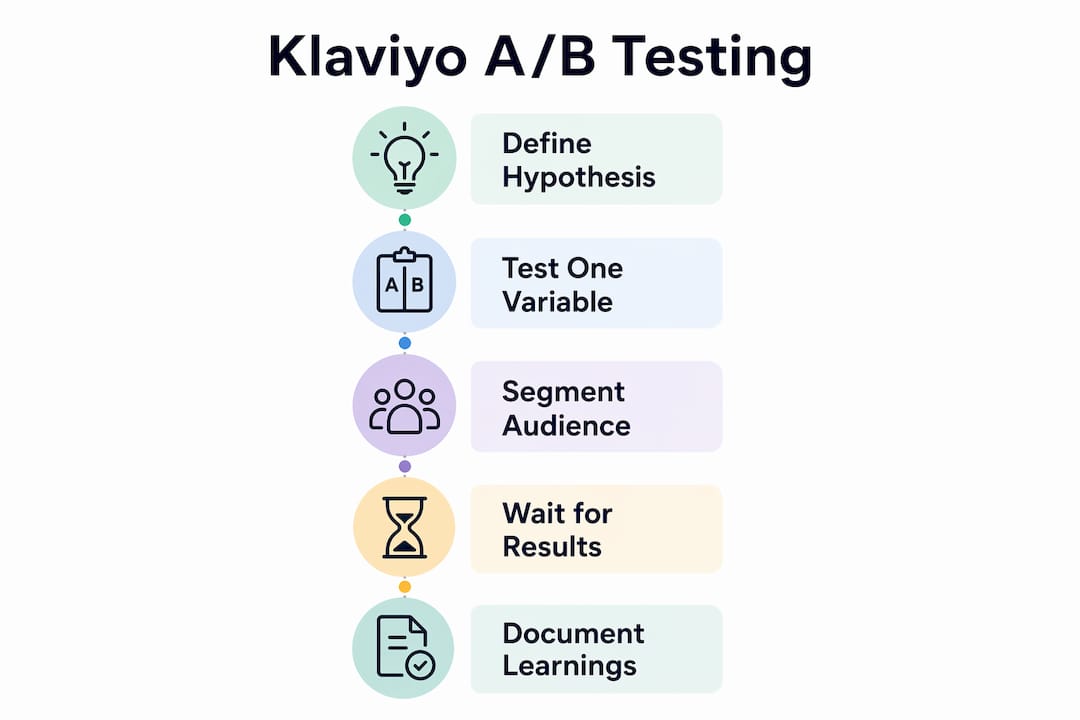
Always define your hypothesis before you build the test. “I think a question-format subject line will increase open rate because our audience responds to curiosity-based copy” is a testable hypothesis. “Let’s try something different” is not.
Keep your variations close enough to be comparable. Two subject lines that are wildly different in length, tone, and topic are testing too many things at once even if you only changed one labeled variable.
Run tests on your highest-traffic flows and campaigns first. A welcome series or an abandoned cart flow that sends hundreds of emails per week will reach statistical significance in days. A re-engagement flow that sends a few dozen emails per month may take months to produce reliable data.
Use list segmentation to make sure your test audience is homogeneous. Testing across wildly different customer segments in one shot can mask the real winner.
Real examples of A/B tests that produce results in Klaviyo
Subject line tests are the most common starting point, and for good reason. A question-format subject line (“Did you forget something?”) tested against a statement (“Your cart is waiting”) in an abandoned cart flow often reveals a clear preference within days on a moderately sized list.

Send time tests in campaign emails frequently surface surprising results. A brand that assumes its audience checks email in the morning may find that evening sends generate higher click rates, particularly for lifestyle or apparel products where browsing happens after work.
Plain-text vs. HTML tests in post-purchase flows often favor plain text. A simple, personal-sounding message from a founder or customer service rep can outperform a polished HTML template when the goal is building trust rather than driving a transaction.
Discount vs. no-discount tests in welcome flows help brands understand price sensitivity early. If the no-discount variation converts nearly as well, you’ve just protected margin on every future welcome send.
Key Takeaways
Klaviyo A/B testing produces reliable, compounding improvements when you test one variable at a time, wait for statistical significance, and document every result outside the platform.
| Point | Details |
|---|---|
| One variable per test | Changing multiple elements at once makes it impossible to know what drove the result. |
| Match metric to variable | Use open rate for subject line tests, click rate for content tests, and placed order rate for conversion-focused tests. |
| Minimum test duration | Run open and click tests for several hours and revenue-based tests for at least a day to produce reliable data. |
| Document results externally | A centralized spreadsheet outside Klaviyo preserves context that the platform’s results tab cannot. |
| AI personalization at scale | Accounts with 400,000+ profiles can use Klaviyo’s AI to send each recipient their predicted preferred variation instead of one static winner. |
Ready to turn your Klaviyo tests into a real growth system? Take-action builds and manages the full testing process for ecommerce brands, from flow setup to campaign optimization and ongoing performance tracking. Work with Take-action to build an email program that compounds.