

What Is an Email Engagement Funnel? 2026 Guide
TL;DR:
- An email engagement funnel is an automated system that guides subscribers based on their actions rather than a fixed schedule.
- It replaces broad broadcasts with targeted, stage-specific messages, improving open and conversion rates significantly.
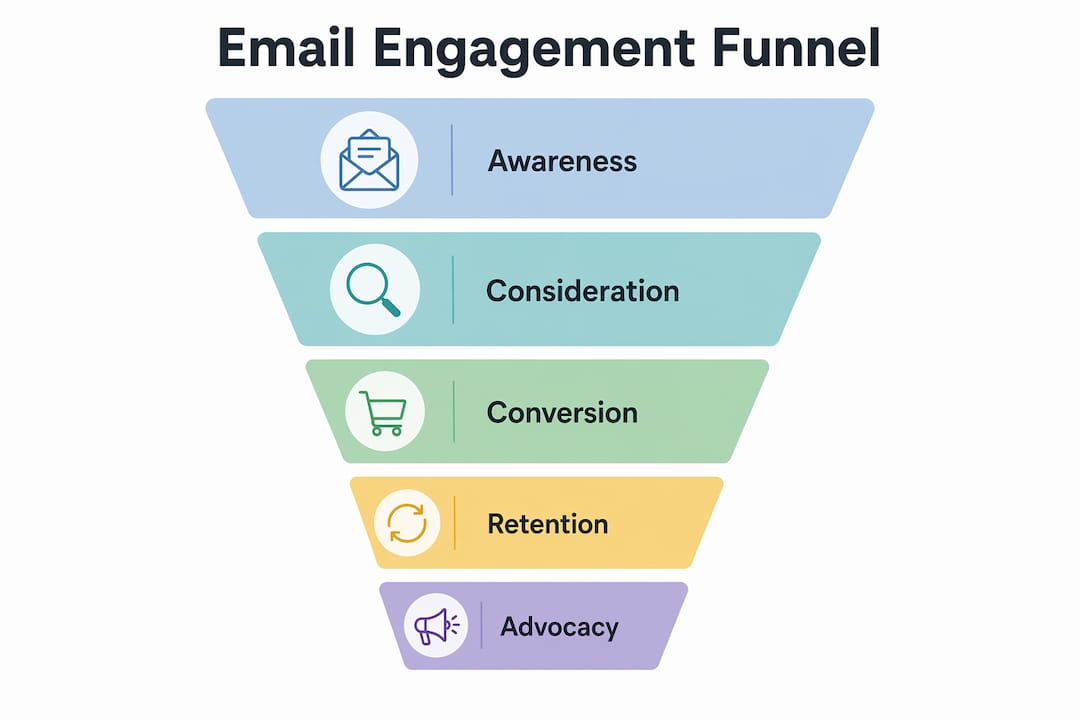
An email engagement funnel is an automated, behavior-driven sequence that guides subscribers through defined stages, from first contact to loyal customer, based on their actions rather than a fixed calendar. This system replaces generic broadcast campaigns with targeted emails triggered by real subscriber behavior. The five core stages are Awareness, Interest, Consideration, Conversion, and Retention. Welcome sequences alone achieve open rates between 50% and 80%, compared to roughly 20% for standard broadcast emails. That gap shows exactly why understanding email engagement at the funnel level is the difference between a list that costs money and one that generates it. Segmentation and automation are the two structural pillars that make the whole system work.
What is an email engagement funnel and how does it work?
An email engagement funnel is a structured, automated system that moves subscribers forward based on what they do, not just when they signed up. Each stage delivers content matched to the subscriber’s current level of trust and intent. A subscriber who just joined your list needs a different message than one who has browsed your product page three times without buying.

The funnel replaces the batch-and-blast model, which treats every subscriber identically regardless of behavior. Pitching too early damages trust, while never making a conversion ask leaves revenue on the table. The email marketing funnel solves both problems by timing messages to subscriber readiness.
Automation platforms like Klaviyo make this possible at scale. Behavioral triggers, such as a link click, a product page visit, or an abandoned cart, fire the right email at the right moment without manual intervention. The result is a system that runs continuously and improves as subscriber data accumulates.
What are the key stages of an email engagement funnel?
Each stage of the funnel has a distinct purpose, a different content style, and specific performance expectations. Skipping or rushing a stage is the most common reason funnels underperform.
-
Awareness. The subscriber has just joined your list. Your welcome sequence runs here. Its job is to introduce your brand, set expectations, and deliver immediate value. The welcome sequence is the highest-leverage stage and should establish brand voice, deliver value, and make a first offer quickly. A typical welcome sequence runs 3–5 emails over 5–7 days.
-
Interest. The subscriber is reading your emails but has not committed to a purchase. Nurture sequences run here, providing educational content, social proof, and brand storytelling. Nurture flows typically span 30–90 days and include 6–12 emails. The goal is building enough trust that the subscriber moves toward evaluation.
-
Consideration. The subscriber is actively comparing options. Emails at this stage highlight specific product benefits, address objections, and use testimonials or case studies. Timing becomes critical here. Sending a discount too early trains subscribers to wait for offers.
-
Conversion. The subscriber is ready to buy. Conversion sequences are short and direct, typically 3–5 emails over approximately 7 days. Clear calls to action, limited-time offers, and urgency copy all belong here. Abandoned cart flows are the most common conversion-stage automation for ecommerce brands.
-
Retention. The subscriber has purchased. Post-purchase flows convert at a 6.8% average and are the most overlooked stage in most email programs. These flows handle onboarding, cross-sell, upsell, and loyalty. Brands that skip this stage leave significant lifetime value unrealized.
How to segment your email list to power the funnel
Segmentation is the operational engine of a working email funnel. Without it, you send the same message to subscribers at completely different stages of readiness, and relevance collapses.
Behavioral segmentation outperforms demographic segmentation in every measurable way. Segmentation by behavioral tagging and stage transitions should be automatic, driven by subscriber actions rather than time on list. A subscriber who clicks a product link three times in a week has told you something far more useful than their zip code.
The most effective segmentation categories align directly with funnel stages:
- New subscribers. Entered via opt-in form or lead magnet. Trigger: list join event. Route to welcome sequence immediately.
- Engaged non-buyers. Opening emails and clicking links but not purchasing. Trigger: engagement score above threshold with zero purchase history. Route to consideration-stage content.
- Active buyers. Completed at least one purchase. Trigger: order confirmation event. Route to post-purchase flow and retention sequence.
- Lapsed subscribers. No opens or clicks in 60–90 days. Trigger: inactivity threshold. Route to re-engagement sequence before suppression.
- High-intent browsers. Visited product or pricing pages without converting. Trigger: site activity via tracking pixel. Route to conversion-stage sequence.
The critical mistake most brands make is building broad, static segments based on signup date or location. Without proper segmentation, brands send irrelevant content, which reduces open rates, increases spam complaints, and degrades sender reputation over time.
Pro Tip: Use Klaviyo’s profile properties and event-based flows to update segments in real time. A subscriber should move from the nurture segment to the conversion segment the moment they visit your pricing page, not at the end of a fixed time window.
Key email engagement metrics to track funnel performance in 2026
Tracking the right email engagement metrics separates brands that improve from brands that guess. Not all metrics carry equal weight, and some are now actively misleading.
Apple Mail Privacy Protection (MPP), introduced in 2021 and now widely adopted, pre-fetches emails and registers opens regardless of whether the subscriber actually read the message. Raw open rates are no longer a reliable signal of engagement for a significant portion of your list. CTR and revenue per email are better KPIs than raw open rates in the current environment.
The metrics that actually matter in 2026:
| Metric | What it measures | 2026 benchmark |
|---|---|---|
| Click-through rate (CTR) | Percentage of recipients who clicked a link | 1–3% |
| Click-to-open rate (CTOR) | Clicks as a percentage of openers | 10–15% for nurture flows |
| Reply rate | Direct replies to your email | 3–5% for cold outreach |
| Bounce rate | Undeliverable emails | Below 2% |
| Spam complaint rate | Subscribers marking email as spam | Below 0.1% |
| Revenue per email | Direct revenue attributed per send | Varies by industry |
ISPs track engagement signals including opens, clicks, replies, deletion without opening, and spam reports. Every one of these signals feeds your sender reputation score. A list full of unengaged subscribers will push your emails to spam regardless of how good the content is.
Pro Tip: Prioritize CTOR and revenue per email as your primary funnel health metrics. CTOR tells you whether your content is compelling once opened. Revenue per email tells you whether your funnel is actually converting. Both are immune to MPP inflation.
Best practices for building and improving each funnel stage
The structure of a funnel matters less than the quality of execution at each stage. These are the practices that separate high-performing funnels from average ones.
-
Welcome emails: send within minutes, not hours. Subscriber intent peaks at the moment of signup. A welcome email sent within 5 minutes of opt-in captures attention when it is highest. Use this email to confirm the value you promised, introduce your brand voice, and make a soft first offer.
-
Nurture stage: lead with value, not product. Subscribers in the interest stage are not ready to buy. Sending product-focused emails too early signals that you only care about the transaction. Educational content, brand stories, and customer results build the trust that makes conversion possible later.
-
Conversion stage: remove friction, add urgency. Every element of a conversion email should point toward one action. Multiple calls to action compete with each other and reduce click rates. Time-limited offers create urgency without feeling manipulative when the deadline is real.
-
Retention stage: treat buyers differently from prospects. A subscriber who has purchased deserves a different experience. Post-purchase flows should onboard the customer, educate them on product use, and introduce complementary products within the first 30 days.
-
Remove unengaged subscribers regularly. Keeping inactive subscribers on your list to inflate numbers is one of the most damaging things you can do to deliverability. Engagement drives deliverability in 2026. A smaller, engaged list consistently outperforms a large, disengaged one.
-
Use dynamic content and personalization. Emails that reference a subscriber’s specific behavior, such as the product they viewed or the category they browsed, outperform generic messages. Klaviyo’s dynamic blocks make this possible without building separate campaigns for every segment. Explore Klaviyo personalization strategies to see how ecommerce brands apply this at scale.
Key Takeaways
An email engagement funnel works because it matches message to behavior at every stage, replacing guesswork with a system that compounds over time.
| Point | Details |
|---|---|
| Funnel structure drives results | Five stages (Awareness through Retention) each require distinct content, timing, and calls to action. |
| Welcome sequences are highest leverage | Open rates of 50–80% make the welcome stage the single best opportunity to establish trust and make a first offer. |
| Behavioral segmentation is non-negotiable | Segments must update automatically based on subscriber actions, not static demographics or signup date. |
| Track CTOR and revenue per email | Apple MPP has made raw open rates unreliable; click-to-open rate and revenue per email reflect true funnel health. |
| Post-purchase flows are underused | A 6.8% average conversion rate makes retention-stage automation one of the highest-ROI investments in email. |
What most brands get wrong about email funnels
The brands I see struggling with email funnels almost always share one pattern: they invest heavily in acquisition and almost nothing in what happens after the first purchase. They build a welcome sequence, maybe an abandoned cart flow, and then stop. The post-purchase stage sits empty while they spend more on ads to replace customers they could have retained.
The second mistake is treating segmentation as a one-time setup task. Subscriber behavior changes constantly. A segment that was accurate in january is often wrong by march. Funnels built on static lists drift out of alignment with actual subscriber intent, and engagement drops quietly until deliverability becomes a crisis.
The third thing I see consistently is brands underestimating how much ISPs are watching. Engagement is the dominant deliverability signal in 2026. Sending to a disengaged list does not just waste budget. It actively damages your sender reputation and makes future emails less likely to reach anyone, including your best customers.
The fix is treating your email list as a live database, not a static asset. Subscribers move through stages. Your funnel should move with them.
— Take
How Take-action builds email funnels that drive real revenue
Take-action is a specialized email marketing and retention agency that builds the kind of funnels described in this article, from welcome sequences and abandoned cart flows to post-purchase automations and long-term retention programs.
The agency works primarily with Klaviyo and combines behavioral segmentation, dynamic content, and campaign strategy to turn email into a primary revenue channel. Every funnel is built around the client’s brand voice and subscriber data, not generic templates. If you are ready to build an email funnel that compounds over time, Take-action’s email marketing services are designed for exactly that. Brands looking to go deeper on automated email workflows can also explore the agency’s published resources.
FAQ
What is an email engagement funnel?
An email engagement funnel is an automated, behavior-driven sequence that guides subscribers from first contact through purchase and retention using targeted emails triggered by their actions. It replaces generic broadcast campaigns with stage-specific messaging tied to real subscriber behavior.
How many emails should an email funnel include?
Welcome sequences typically run 3–5 emails, nurture flows span 6–12 emails over 30–90 days, and conversion sequences use 3–5 emails over approximately 7 days. The right count depends on your audience’s buying cycle and the complexity of your offer.
What email engagement metrics matter most in 2026?
Click-through rate, click-to-open rate, reply rate, and revenue per email are the most reliable funnel health indicators. Raw open rates are distorted by Apple Mail Privacy Protection and should not be used as a primary performance signal.
How does segmentation improve email funnel performance?
Behavioral segmentation routes subscribers to the right stage-specific content based on their actions, such as clicks, page visits, and purchases. Treating email lists dynamically rather than as static groups is the core practice that separates high-performing funnels from average ones.
Why are post-purchase email flows important?
Post-purchase flows target customers immediately after a purchase, when brand trust is highest. With an average conversion rate of 6.8%, these flows generate repeat purchases and upsell revenue that most brands leave uncaptured by stopping their funnel at the first transaction.