

What Is a Teaser Email Campaign? A Marketer’s Guide
TL;DR:
- Teaser email campaigns build anticipation through curiosity and phased reveals, increasing engagement and conversions. They work best when sent to highly engaged subscribers within a 7-10 day window, with multi-channel coordination and outcome-focused messaging. Avoid excessive mystery, overpromising, and broad targeting to ensure trusted, effective launches.
A teaser email campaign is a series of curiosity-driven emails sent before a product launch, promotion, or announcement to build anticipation and prime your audience to act. The goal is not to reveal everything. The goal is to create enough intrigue that subscribers lean in, open the next email, and convert when the moment arrives. Phased teaser sequences that target engaged segments deliver a 30% uplift in conversion rates compared to uniform blasts. That number reflects a simple truth: the right message, sent to the right people, before the right moment, outperforms any single-send campaign. Teaser campaigns also rely on multi-channel synchronization across social media, site banners, and landing pages to prime audiences before the email even lands.
What is a teaser email campaign and how does it work?
A teaser email campaign works by exploiting a well-documented psychological principle called the Zeigarnik effect. The brain holds unresolved loops in active memory. When you give subscribers a hint of something coming without completing the picture, they keep thinking about it. That mental tension drives opens, clicks, and conversions.

The mechanics break down into three phases. First, you send a low-information signal that acknowledges something is coming. Second, you layer in slightly more detail with each follow-up email, building toward a reveal. Third, you send the launch email to an audience already primed to buy. Email reaches the warmest audiences in any teaser sequence and allows for this kind of progressive reveal that social media cannot replicate.
The balance between mystery and clarity is the hardest part to get right. Too much mystery and subscribers disengage because they cannot identify the value. Too much information and you kill the anticipation. The sweet spot is revealing the outcome your product delivers without revealing the product itself.
- Phase 1 (Day 1): Signal that something is coming. No product name, no price. Just a date and a hint of the benefit.
- Phase 2 (Day 4–6): Add one specific detail. A feature category, a problem it solves, or a social proof signal like “over 2,000 people already on the waitlist.”
- Phase 3 (Day 7–10): Send the launch email to the full engaged segment with full product details and a clear call to action.
Pro Tip: Send Phase 1 only to your most engaged subscribers. Their early opens and clicks signal to inbox providers that your campaign is worth delivering, which protects deliverability for the launch email.
What are best practices for creating effective teaser emails?
The structure of a teaser email is deceptively simple. The execution is where most marketers lose the thread.
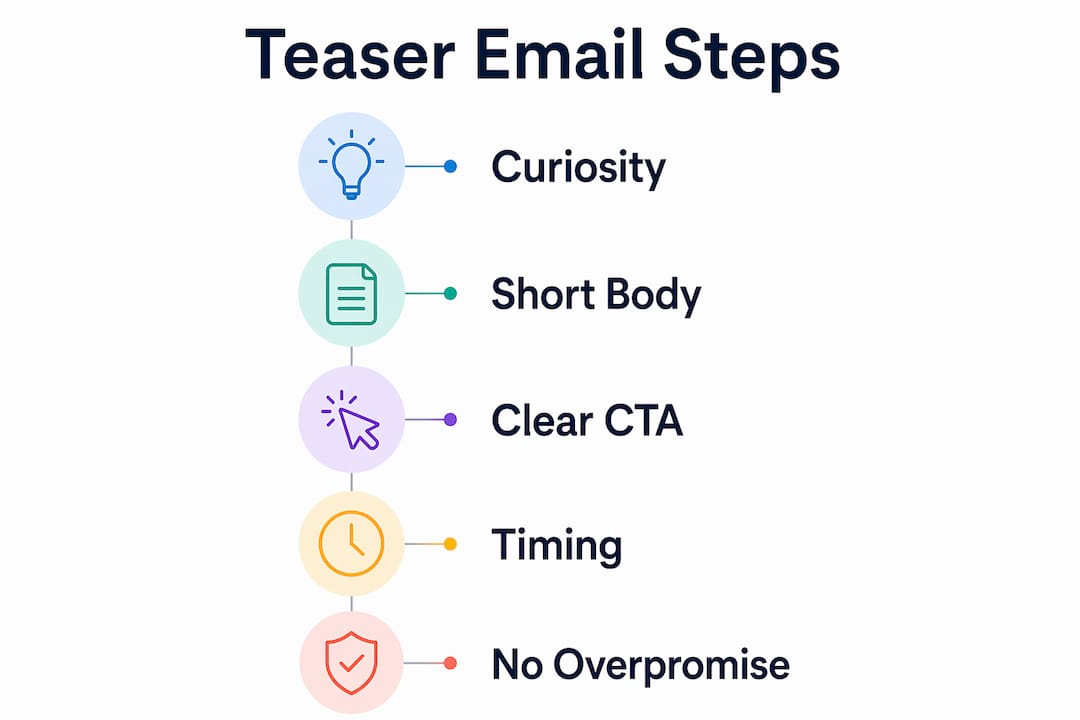
1. Write subject lines that spark curiosity without misleading. A subject line like “Something big is coming March 14” outperforms “You won’t believe what we’re launching” every time. The first sets a clear expectation. The second feels like clickbait. Effective teaser subject lines spark curiosity without being misleading, and always include a date or timeframe so subscribers know when the loop will close.
2. Keep the email body short and outcome-focused. A teaser email body should run 60–100 words maximum. Successful teaser sequences articulate one clear promise focused on outcome rather than features. “Save three hours a week on reporting” beats “New dashboard with 14 customizable widgets.” The outcome creates desire. The feature list can wait for the launch email.
3. Use a single, low-friction call to action. “Join the waitlist” or “Save the date” converts better than “Shop now” in a teaser context. You are asking for a micro-commitment, not a purchase. That micro-commitment, a waitlist signup or a calendar save, dramatically increases the probability of conversion at launch because the subscriber has already said yes once.
4. Time your sequence 7–10 days before launch. Starting earlier than 10 days risks audience fatigue. Starting later than 7 days leaves too little time to build momentum. The 7–10 day window is the proven range for phased teaser campaigns that generate meaningful conversion lifts.
5. Never overpromise. Restraint in teaser messaging is not optional. If your teaser implies a transformation and your product delivers an incremental improvement, you will lose the subscriber’s trust permanently. Credibility is the asset teaser campaigns spend. Spend it carefully.
Pro Tip: Write the launch email first. Then write the teaser emails backward from that reveal. This forces every teaser to point toward a real, specific promise rather than vague hype.
How to use segmentation and cross-channel coordination in teaser campaigns?
Segmentation is the variable that separates teaser campaigns that generate buzz from those that generate unsubscribes.
Behavioral segmentation means sending teaser emails only to subscribers who have opened or clicked within the last 60–90 days. These are the people most likely to engage, share, and convert. Sending teasers to cold or inactive contacts wastes the campaign’s momentum and drags down your open rate metrics. Sending teasers only to highly engaged segments maximizes anticipation and protects your sender reputation. For a deeper look at how segmentation drives email revenue, the Take-action guide on email segmentation strategies covers the mechanics in detail.
For less engaged contacts, use a different message. Instead of a curiosity-driven teaser, send a re-engagement email that frames the upcoming launch as a reason to reconnect. This approach keeps your inactive segment warm without polluting your teaser metrics.
Cross-channel coordination amplifies everything. Multi-channel teaser campaigns combine email, social media, site banners, and creator partnerships to reach audiences across multiple touchpoints. The coordination is not about repeating the same message everywhere. It is about using low-fidelity signals on social and site banners to prime recognition before the email arrives.
Here is how the channels work together:
| Channel | Role in the teaser sequence | Timing |
|---|---|---|
| Primary conversion driver; progressive reveal sequence | Days 1, 5, and 10 before launch | |
| Social media | Low-fidelity signal; builds visual recognition | Ongoing from Day 14 |
| Site banners | Captures existing traffic; directs to waitlist page | Days 7–10 before launch |
| Creator partnerships | Extends reach to new audiences; adds social proof | Days 5–7 before launch |
Coordinating low-fidelity signals before teaser emails land primes audiences to recognize and open the email. When a subscriber has already seen a cryptic social post and a site banner, the teaser email feels like the next chapter of a story they are already following. That context significantly increases open rates and click-through rates. AI-driven personalization tools, including those covered in this generative AI for ecommerce overview, can further refine which segments receive which channel signals at which moment.
What common pitfalls should marketers avoid in teaser campaigns?
Most teaser campaigns fail for one of five predictable reasons.
- Excessive mystery. Over-mysterious teasers lower click-through rates because subscribers cannot identify the value or the action they should take. Mystery is a tool, not a strategy. Every teaser must answer the implicit question: “Why should I care?”
- Overpromising. A teaser that implies a product will change everything sets an expectation the launch email must meet. When it does not, you lose trust and future open rates suffer. Align every teaser promise with what the product actually delivers.
- Sending to unsegmented lists. Cold contacts and inactive subscribers do not have the context or the relationship to respond to a teaser. Sending to your full list dilutes results and risks spam complaints.
- Too many emails. Three teaser emails in a 7–10 day window is the practical ceiling for most audiences. More than that creates fatigue and trains subscribers to ignore your sends.
- No clear reveal timeline. Subscribers need to know when the loop will close. A teaser without a date feels like a dead end. Always state when the reveal happens.
Pro Tip: After every teaser campaign, pull the click-to-open rate for each email in the sequence. A drop between Email 1 and Email 2 usually signals that the first email overpromised or the second added no new information. Fix the sequence before the next launch.
Key Takeaways
A teaser email campaign works because it creates a psychological loop that subscribers want to close, and the brands that close it with a real, well-timed promise convert at significantly higher rates.
| Point | Details |
|---|---|
| Phased timing drives conversions | Start teaser sequences 7–10 days before launch for the strongest conversion lift. |
| Segmentation protects results | Send teasers only to engaged subscribers to maximize open rates and protect deliverability. |
| Outcome messaging beats features | Focus every teaser on the result the product delivers, not its specifications. |
| Cross-channel priming amplifies email | Use social posts and site banners before the email lands to increase recognition and open rates. |
| Mystery requires a clear payoff | Every teaser must hint at real value and include a date so subscribers know when the reveal arrives. |
What I have learned running teaser campaigns for ecommerce brands
Teaser campaigns are a frequency game. The brands that treat a teaser as a single clever email almost always underperform. The brands that build a coordinated sequence across email, social, and their own site consistently outperform their own launch benchmarks.
The insight that took me the longest to internalize is this: the teaser is not about the product. It is about the subscriber’s relationship with your brand. When someone opens your teaser email, they are not just curious about what you are launching. They are deciding whether they trust you enough to pay attention. That trust is built over every previous email you have sent, every promise you have kept, and every time you have not wasted their time.
Segmentation is where I see the biggest gap between brands that run good teaser campaigns and brands that run great ones. Sending a teaser to your full list feels efficient. Sending it only to your most engaged 20% feels like leaving money on the table. The data says the opposite. A tight, engaged segment generates more waitlist signups, more social shares, and more launch-day revenue than a broad send to a mixed list. The benefits of segmentation for email revenue are not theoretical. They show up in every campaign metric.
The final thing I would tell any marketer building their first teaser sequence: write the reveal email first. Know exactly what you are promising before you write a single word of the teaser. The teaser’s job is to make the reveal feel inevitable and exciting. You cannot do that if you do not know what the reveal is.
— Take
How Take-action helps brands build teaser campaigns that convert
Take-action specializes in the kind of email marketing that teaser campaigns demand: precise segmentation, phased automation, and messaging that earns trust before it asks for a purchase.
The team at Take-action builds teaser sequences inside Klaviyo, using behavioral segmentation to identify the right audience for each phase and automations that trigger based on real subscriber activity. If you are planning a product launch, a seasonal promotion, or a brand announcement and want a teaser campaign built to convert, Take-action’s email marketing services are built for exactly that. The agency works as a long-term partner, not a one-off vendor, which means your teaser strategy connects to your full retention and revenue program.
FAQ
What is a teaser email campaign?
A teaser email campaign is a series of pre-launch emails designed to build curiosity and anticipation before a product, promotion, or announcement goes live. It uses progressive reveals and behavioral segmentation to maximize engagement and conversion at launch.
How many emails should a teaser campaign include?
Three emails in a 7–10 day window before launch is the standard structure for most teaser campaigns. More than three risks audience fatigue; fewer than two leaves insufficient time to build anticipation.
When should I send teaser emails before a launch?
Start your teaser sequence 7–10 days before the launch date. This window builds enough momentum without fatiguing your audience or losing the urgency that drives launch-day conversions.
Who should receive teaser emails?
Send teaser emails to your most engaged subscribers, typically those who have opened or clicked within the last 60–90 days. Highly engaged segments generate stronger open rates and protect your sender reputation.
What is the biggest mistake in teaser email campaigns?
Excessive mystery is the most common failure point. Over-mysterious teasers lower click-through rates because subscribers cannot identify the value or the action they should take. Always balance intrigue with a clear hint of the outcome.