

What Is a Klaviyo Segment? Ecommerce Guide 2026
TL;DR:
- Klaviyo segments are dynamic groups that update automatically based on contact data changes. They enable highly personalized marketing by targeting groups defined by behavior, demographics, or purchase history. Proper use of segments increases email revenue and customer engagement significantly.
A Klaviyo segment is a dynamic, automatically updating group of contacts defined by specific behavioral, demographic, or purchase criteria. Unlike a static email list, a segment continuously re-evaluates your entire database and adds or removes contacts the moment their data changes. That real-time accuracy is what makes segments the foundation of personalized ecommerce email marketing. Highly segmented campaigns can yield over three times the revenue per recipient compared to unsegmented ones. If you are still sending the same email to your entire list, you are leaving serious money on the table.

What is a Klaviyo segment and how does it work?
A Klaviyo segment is a filter, not a folder. It does not store contacts permanently. Instead, it runs a continuous query against your full database and includes every contact whose profile data matches the conditions you set.
You can build a segment around almost any data point Klaviyo tracks: purchase history, email engagement, predicted lifetime value, geographic location, or custom properties you pass in from your store. A contact enters the segment the moment they meet the criteria. They exit automatically when they no longer qualify. That fluid membership is what separates segments from lists.
Segments update in near real-time and scan your entire database, not just a single list. That means a contact who has never opted into any list can still appear in a segment if their profile data matches the rules. This is a critical detail for compliance: always verify that the contacts in a segment are actually mailable before you send.
Pro Tip: New segments need time to populate historical data. Wait until the member count stabilizes before sending a campaign. Sending too early risks reaching an incomplete audience and skewing your results.
Sending before full population is one of the most common mistakes new Klaviyo users make. The segment may show 200 contacts when it will eventually hold 2,000. Give it at least a few hours after creation before you hit send.
What segmentation strategies work best in Klaviyo?
The most effective Klaviyo segmentation strategies for ecommerce are built around RFM analysis and customer lifecycle stages. RFM stands for Recency, Frequency, and Monetary value. It groups customers by how recently they bought, how often they buy, and how much they spend. Those three dimensions tell you more about a customer’s relationship with your brand than almost any other data set.
RFM segmentation and its benefits
RFM segments help you tailor engagement strategies to each customer tier. Brands using RFM segmentation report up to 31% increased engagement when reactivating inactive customers. That lift comes from sending the right message to the right person at the right time, not from sending more email.
A Champion segment contains your best customers: recent buyers who purchase often and spend the most. A Needs Attention segment holds customers who used to buy regularly but have gone quiet. A Churn Risk segment captures contacts who have not purchased in a defined window and are trending toward lapsing entirely. Each group needs a completely different message.
Lifecycle segments that drive revenue
Beyond RFM, lifecycle segmentation groups contacts by where they sit in their relationship with your brand. Common lifecycle segments for ecommerce include:
- New subscribers who have not yet purchased, needing a welcome series with social proof and a first-order incentive
- First-time buyers who need a post-purchase flow that builds loyalty and encourages a second purchase
- VIP customers who deserve early access to new products or exclusive events rather than generic discount codes
- At-risk customers who respond well to a targeted win-back campaign with a time-sensitive offer
- Lapsed customers who need a final re-engagement attempt before being suppressed to protect deliverability
Predictive analytics combined with segmentation helps identify customers likely to churn before they actually do. Klaviyo’s predictive data properties, like predicted next order date and churn risk score, feed directly into segment conditions so you can act proactively.
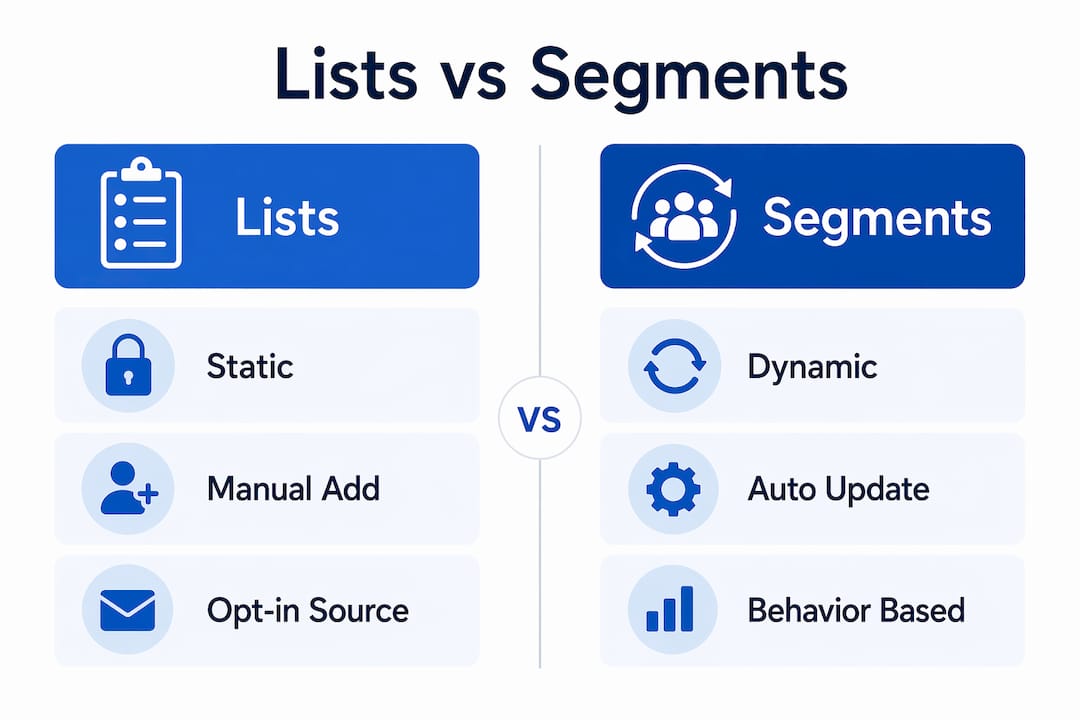
How are Klaviyo segments different from lists?
Lists and segments solve different problems. Confusing them leads to poor targeting and wasted sends. The table below shows the core differences.
| Feature | Lists | Segments |
|---|---|---|
| Membership | Static, manually added or via opt-in form | Dynamic, automatically updated by criteria |
| Update frequency | Only changes when someone subscribes or unsubscribes | Updates continuously as contact data changes |
| Based on | Opt-in action | Behavior, purchase history, demographics, and more |
| Manual additions | Yes, you can add contacts directly | No, you must change profile data to match rules |
| Use in flows | Trigger flows when someone joins a list | Used in conditional splits to personalize flow paths |
You cannot manually add a contact to a segment without changing their underlying profile data or behavior to match the segment rules. That is by design. Segments are meant to reflect reality, not override it.
Lists are best for capturing opt-ins, organizing subscribers by signup source, and triggering welcome flows. Segments are best for campaigns, re-engagement, and conditional logic inside automated flows. For a deeper look at how lists function alongside segments, the Klaviyo list guide from Take-action covers the distinction in full.
Segments enable conditional splits inside automated flows based on real-time user behavior. A conditional split is a branch in a flow that sends contacts down different paths depending on whether they meet a condition. For example, a post-purchase flow can split VIP customers toward an exclusive upsell email while routing first-time buyers toward a loyalty program invite. That kind of personalization is only possible with dynamic segments.
Klaviyo segment best practices for ecommerce marketers
Getting the most from Klaviyo segmentation comes down to a handful of practices that separate high-performing stores from average ones.
- Wait for full population. Always let a new segment finish building before you send. Check the member count twice, an hour apart, and confirm it has stabilized.
- Protect your Champions. Over-discounting loyal customers erodes your margins and trains them to wait for sales. Offer VIP customers early access, exclusive products, or event invites instead of percentage-off codes.
- Tailor offers by segment status. Different content and offers should go to Champion customers versus Needs Attention groups. A 20% discount that reactivates a lapsed buyer would be wasted on someone who buys every two weeks at full price.
- Verify mailable contacts. Segments scan the entire database and can include contacts who have not opted in. Always filter for consent status before sending to a segment to stay compliant and protect deliverability.
- Combine segments with automation. The real power of segmentation shows up when you connect it to Klaviyo automation flows. A churn risk segment feeding a win-back flow runs 24 hours a day without manual effort.
Pro Tip: Build a suppression segment for your most engaged VIP customers and exclude them from promotional discount campaigns. This protects your margins while you still reward them through non-discount channels.
For ecommerce brands looking to put these practices into a full retention system, the email segmentation strategies guide from Take-action walks through how to structure segments for long-term growth.
Key Takeaways
Klaviyo segments are dynamic filters that update automatically, and using them with RFM analysis and lifecycle logic is the most direct path to higher email revenue and stronger customer retention.
| Point | Details |
|---|---|
| Segments update automatically | Contacts enter and exit based on live data, so your audience is always accurate. |
| RFM drives personalization | Recency, frequency, and monetary tiers let you send the right offer to the right customer. |
| Lists and segments serve different roles | Use lists for opt-ins and triggers; use segments for campaigns and flow conditional splits. |
| Wait before sending | New segments need time to populate fully before you send a campaign. |
| Protect loyal customers | Avoid discounting Champions; use early access and exclusive perks to reward them instead. |
Why I think most brands are using segments wrong
After working with ecommerce brands on Klaviyo strategy, the pattern I see most often is this: marketers build a handful of segments, send a few campaigns, and then stop experimenting. They treat segmentation as a setup task rather than an ongoing practice.
The shift from batch-and-blast to dynamic segment-driven email is the single most effective change a brand can make for long-term customer value. But it only works if you keep refining the criteria. A churn risk window that works for a brand selling consumables every 30 days will be completely wrong for a brand selling furniture. You have to calibrate to your own purchase cycle.
The other mistake I see constantly is treating all loyal customers the same. Your top 10% of buyers by revenue are not the same as your top 10% by order count. RFM separates those groups clearly. A customer who orders frequently at low values needs a different message than one who orders rarely but spends $500 each time. Sending them the same email is a missed opportunity every single time.
Segmentation is not a feature you turn on. It is a discipline you build over time. The brands that win with email are the ones that treat every segment as a distinct audience with distinct needs, and then test relentlessly until the data tells them what works.
— Take
Take-action helps ecommerce brands get more from Klaviyo
Knowing how segments work is one thing. Building a full segmentation system that runs automatically and drives consistent revenue is another.
Take-action is a Klaviyo-focused email marketing and retention agency that builds segmentation strategies, automated flows, and campaign programs for ecommerce brands. From RFM-based win-back sequences to VIP loyalty flows, Take-action handles the setup and ongoing management so your email channel grows without adding to your workload. If your Klaviyo account is underperforming, the team at Take-action can audit your current setup and show you exactly where revenue is being left behind.
FAQ
What is a Klaviyo segment in simple terms?
A Klaviyo segment is a dynamic group of contacts that updates automatically based on rules you define, such as purchase behavior, email engagement, or location. Unlike a static list, contacts enter and exit the segment on their own as their data changes.
How do I create a Klaviyo segment?
Go to the Audience tab in Klaviyo, select Segments, and click Create Segment. Define your conditions using Klaviyo’s condition builder, then save and wait for the segment to fully populate before using it in a campaign.
What segments can I create in Klaviyo?
You can create segments based on purchase history, email engagement, predicted lifetime value, geographic data, RFM tiers, churn risk, and custom profile properties. Common examples include VIP buyers, lapsed customers, first-time buyers, and high-engagement non-purchasers.
What is the difference between a Klaviyo list and a segment?
A list is a static collection built through opt-in actions, while a segment is a dynamic filter that continuously evaluates your entire database. You can manually add contacts to a list, but segment membership is determined entirely by whether a contact’s data matches the defined criteria.
How does a conditional split use Klaviyo segments?
A conditional split is a branch inside a Klaviyo flow that routes contacts down different paths based on whether they belong to a segment. For example, a post-purchase flow can send VIP customers toward an exclusive upsell while routing new buyers toward a loyalty program invite.