

What Is a Klaviyo Flow? Guide for Ecommerce Marketers
TL;DR:
- A Klaviyo flow is an automated, behavior-triggered messaging sequence that operates across multiple channels. It responds in real time to customer actions, enabling personalized, continuous communication without manual effort. Flows are essential for ecommerce retention strategies, unlike scheduled campaigns which are one-time broadcasts.
A Klaviyo flow is an automated sequence of messages triggered by a specific customer action, delivering personalized communication across email, SMS, push notifications, and WhatsApp without any manual scheduling. Unlike a one-time campaign blast, flows run continuously in the background, responding to individual customer behaviors in real time. For ecommerce marketers, this distinction is the foundation of modern retention strategy. Understanding what is Klaviyo flow automation means understanding how to turn customer data into revenue on autopilot.
How do Klaviyo flows differ from email campaigns?
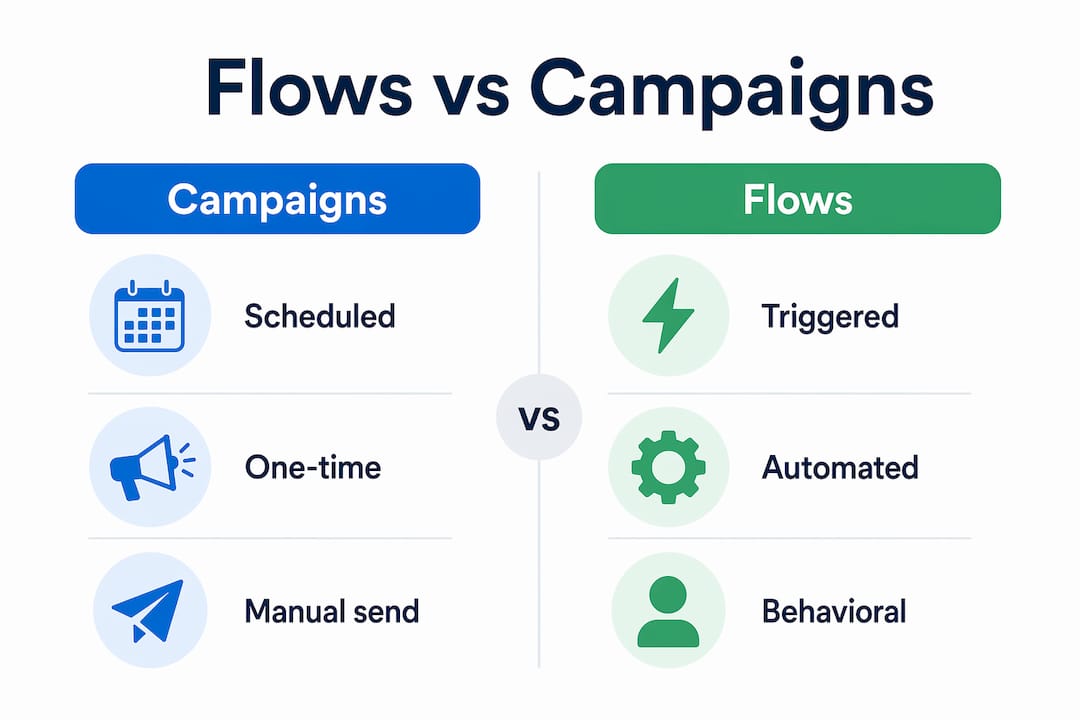
The clearest way to separate flows from campaigns is this: calendar-driven sends are campaigns; behavior-triggered sends are flows. That mental model shapes every decision you make in Klaviyo.
Campaigns are scheduled, one-time messages you create and send manually. A Black Friday promotion, a product launch announcement, or a seasonal sale email are all campaigns. You write them, set a send time, and they go out to a defined list. After that, they are done.
Flows work differently. A flow activates the moment a customer takes a specific action, such as signing up for your list, abandoning a cart, or completing a purchase. Flows run continuously, triggered by individual behaviors, so every new customer who meets the trigger conditions enters the sequence automatically. No manual effort required after setup.
The strategic implication is significant. Using campaigns for lifecycle tasks like welcome sequences or post-purchase follow-ups creates unnecessary manual overhead and reduces targeting precision. Flows handle those tasks automatically, freeing your team to focus on higher-level strategy.
| Feature | Campaigns | Klaviyo flows |
|---|---|---|
| Trigger type | Scheduled by marketer | Customer behavior |
| Frequency | One-time send | Continuous, always on |
| Personalization | Segment-level | Individual-level |
| Manual effort | High | Low after setup |
| Best use case | Promotions, announcements | Retention, lifecycle nurture |
Use campaigns for timely announcements. Use flows for automated retention and conversion strategies triggered by customer behavior. That division of labor is what makes Klaviyo powerful for ecommerce brands.
What are the main components and triggers of a Klaviyo flow?
Every Klaviyo flow is built from four core elements: a trigger, actions, filters, and timing delays. Understanding each one lets you build sequences that feel personal rather than mechanical.
Triggers are the starting point. Flows trigger messages based on customer milestones like signups, purchases, browsing behavior, or cart abandonment. Common ecommerce triggers include:
- List or segment trigger: A customer joins your email list or enters a specific segment, such as VIP buyers.
- Metric trigger: A customer completes an action tracked by Klaviyo, such as placing an order or viewing a product page.
- Date trigger: A message sends based on a date property, such as a birthday or subscription anniversary.
Actions are what happens after the trigger fires. Actions include sending an email, sending an SMS, adding a delay, or applying a conditional split to route customers down different paths based on their behavior or profile data.
Filters refine who enters or continues through a flow. You can exclude customers who have already purchased, limit entry to first-time subscribers, or split paths based on purchase history. This is where segmentation turns a generic sequence into a targeted experience.

Pro Tip: Start your abandoned cart flow with a one-hour delay before the first email. Customers who abandon carts often return on their own within 60 minutes. Sending too early wastes a message and can feel intrusive.
Klaviyo’s drag-and-drop builder lets marketers without technical expertise create and customize complex flows easily. For those who want to move even faster, Flows AI allows paid users with over 250 active profiles to describe their goal in plain language and receive a complete flow structure automatically. That feature alone removes the biggest barrier most ecommerce teams face when getting started.
How do Klaviyo flows enable multi-channel marketing automation?
Klaviyo’s real advantage is data unification. Klaviyo unifies customer data from multiple channels, allowing marketers to orchestrate email, SMS, WhatsApp, and push notifications inside a single automated flow. That means one trigger can set off a coordinated sequence across every channel a customer uses.
Consider a post-purchase flow for a skincare brand. The sequence might look like this:
- Day 0: Send a transactional email confirming the order with product care tips.
- Day 3: Send an SMS with a link to a how-to video for the purchased product.
- Day 14: Send an email asking for a review, with a discount for the next purchase.
- Day 30: Send a push notification reminding the customer to reorder before they run out.
Each message arrives on the channel most likely to reach that specific customer. Klaviyo’s data layer tracks which channels each customer engages with, so the flow can route messages accordingly.
“Flows’ power lies in unifying data and orchestrating multi-channel messaging, allowing you to reach customers at the optimal moment on their preferred channel.” — Klaviyo
Klaviyo supports over 350 integrations and flexible APIs, centralizing data from ecommerce platforms, customer service tools, and marketing channels. That data depth is what makes behavior-based orchestration accurate rather than approximate. For ecommerce brands running on Shopify, BigCommerce, or WooCommerce, the integration is direct and the data flows in automatically.
What are practical Klaviyo flow examples for ecommerce?
Ecommerce marketers use flows for welcome series, abandoned cart recovery, post-purchase sequences, and product recommendations to improve engagement and revenue. Each of these serves a distinct stage of the customer lifecycle.
Welcome series
A welcome series is the first automated impression your brand makes. It typically runs three to five emails over seven to ten days, introducing your brand story, bestsellers, and a first-purchase incentive. The trigger is a new list signup. A strong welcome series sets purchase intent early and filters out low-engagement subscribers before they hurt your deliverability.
Abandoned cart recovery
Abandoned cart flows are the highest-ROI sequence most ecommerce brands can build. The trigger fires when a customer adds items to their cart but does not complete checkout. A three-email sequence, sent at one hour, 24 hours, and 72 hours after abandonment, consistently recovers a meaningful share of lost revenue. For stores selling products with competitive pricing, pairing the third email with a time-limited discount or a tool like PriceLows to surface price comparisons can push hesitant buyers over the line.
Post-purchase nurture
Post-purchase flows turn one-time buyers into repeat customers. The sequence starts immediately after an order is placed and continues for 30 to 60 days. Content includes order confirmation, shipping updates, product usage tips, review requests, and cross-sell recommendations. Klaviyo flows deliver personalized experiences without increasing manual effort, which means your post-purchase sequence runs for every customer regardless of order volume.
Product recommendation flows
Recommendation flows use purchase history and browsing data to suggest relevant products. They are particularly effective for brands with large catalogs. A customer who bought running shoes gets a flow featuring socks, insoles, and running gear. The trigger is a completed purchase, and Klaviyo’s dynamic product blocks pull in personalized recommendations automatically.
Pro Tip: Measure each flow’s revenue per recipient, not just open rate. Revenue per recipient tells you whether the sequence is actually converting, not just getting clicks.
| Flow type | Primary trigger | Key goal |
|---|---|---|
| Welcome series | List signup | Brand introduction, first purchase |
| Abandoned cart | Cart abandonment | Recover lost revenue |
| Post-purchase | Order placed | Retention, repeat purchase |
| Product recommendation | Purchase history | Cross-sell, upsell |
| Win-back | Long inactivity period | Re-engage lapsed customers |
For deeper strategy on automated workflows for ecommerce, the specific sequencing and timing decisions matter as much as the flow type itself. Customizing delays, split paths, and message content to your audience’s behavior is what separates a functional flow from a high-performing one. You can also explore Klaviyo personalization strategies to sharpen how each message speaks to individual customers.
Key Takeaways
Klaviyo flows are the most direct path from customer behavior to automated, personalized revenue for ecommerce brands.
| Point | Details |
|---|---|
| Flows vs. campaigns | Flows are behavior-triggered and always on; campaigns are scheduled one-time sends. |
| Core components | Every flow needs a trigger, actions, filters, and timing delays to function effectively. |
| Multi-channel reach | One Klaviyo flow can coordinate email, SMS, push, and WhatsApp in a single sequence. |
| Top flow types | Welcome series, abandoned cart, post-purchase, and product recommendation flows drive the most ecommerce revenue. |
| AI-assisted setup | Flows AI lets paid users build complete flow structures from a plain-language description. |
Why most ecommerce brands underuse their flows
Most brands I work with at Take-action have the right flows in place. Welcome series, abandoned cart, post-purchase. The basics are there. What they are missing is optimization after launch.
A flow set up in 2024 and never touched since is not a working asset. It is a static sequence sending the same messages to a customer base that has changed. Buying patterns shift. Product catalogs grow. Seasonal behavior creates new segments. Flows need to be reviewed quarterly, at minimum, with fresh eyes on subject lines, timing delays, and conditional splits.
The second thing I see consistently is brands treating flows as a set-it-and-forget-it channel while pouring budget into paid ads. The math rarely works in their favor. A well-optimized abandoned cart flow recovers revenue from customers who already showed purchase intent. That is a fundamentally different economics than acquiring a cold click from a paid channel.
The third misconception is that more flows equal better results. That is wrong. Five flows with strong segmentation and tested copy outperform fifteen flows built quickly and never refined. Start with the highest-impact sequences, measure revenue per recipient, and iterate before expanding.
Flows AI is genuinely useful for getting a first draft structure in place fast. But the strategic decisions, what to say, when to say it, and to whom, still require human judgment. The brands winning with Klaviyo are the ones combining the platform’s automation capabilities with deliberate, data-informed decisions at every step.
— Take
Ready to build flows that actually convert?
Take-action specializes in Klaviyo flow setup, segmentation strategy, and ongoing optimization for ecommerce brands. Whether you are starting from scratch or refining an existing automation setup, the team at Take-action builds sequences grounded in your customer data and brand voice. From welcome series to post-purchase nurture, every flow is built to generate measurable revenue, not just activity metrics. If you want email to become a primary growth channel rather than a secondary one, visit Take-action to see how the agency approaches Klaviyo automation for scaling ecommerce brands.
FAQ
What is a Klaviyo flow in simple terms?
A Klaviyo flow is an automated sequence of emails or messages that sends automatically when a customer takes a specific action, such as signing up or abandoning a cart. It runs continuously without manual scheduling.
How many emails should a Klaviyo flow have?
The number depends on the flow type. Abandoned cart flows typically use three emails; welcome series use three to five; post-purchase flows can run five or more over 30 to 60 days.
Can Klaviyo flows send SMS as well as email?
Yes. Klaviyo flows support email, SMS, push notifications, and WhatsApp within a single automated sequence, allowing you to reach customers on their preferred channel.
How do I start creating Klaviyo flows?
Use Klaviyo’s drag-and-drop flow builder to select a trigger, add actions and delays, and set filters. Paid users with over 250 active profiles can also use Flows AI to generate a complete flow structure from a plain-language description.
What is the difference between a Klaviyo flow and a campaign?
A campaign is a one-time scheduled send to a list. A flow is a behavior-triggered sequence that runs automatically for every customer who meets the trigger conditions, making flows better suited for lifecycle and retention marketing.
Recommended
- How to Attract Online Leads with Klaviyo Email Automation | Take Action Blog | Take Action
- Turn email leads into revenue with Klaviyo flows | Take Action Blog | Take Action
- Maximize email revenue with Klaviyo mail marketing | Take Action Blog | Take Action
- Remarketing best practices: boost ecommerce revenue with Klaviyo | Take Action Blog | Take Action