

The Role of Data in Email Marketing That Drives Revenue
TL;DR:
- Data forms the core of high-performing email marketing, replacing guesswork with precise targeting.
- It improves personalization, segmentation, automation, and ultimately boosts revenue and deliverability.
Data is the foundation of every high-performing email marketing program. Without it, you are sending the same message to everyone and hoping for the best. The role of data in email marketing is to replace that guesswork with precision: knowing who to contact, what to say, and when to send it. Platforms like Klaviyo and AI tools like Phrasee have made data-driven email campaigns accessible to brands of every size. AI-powered email programs generate 41% more revenue than manual ones. Email already returns $36 for every $1 spent. Data is what turns that average into an outlier.
What types of data impact email marketing performance?
Not all data carries equal weight in a campaign. The type of data you collect determines what you can personalize, how accurately you can segment, and how reliably your automations will fire.
First-party data is the most reliable and legally compliant source available. It comes directly from your subscribers through signup forms, purchase histories, and on-site behavior. Personalization fails without first-party data collected through these direct channels. This is the data you own outright, and it forms the backbone of every effective campaign.
Behavioral data tracks what subscribers actually do: which emails they open, which links they click, and which product pages they visit. This data powers trigger-based automations, such as abandoned cart sequences and browse-abandonment flows. Trigger-based emails generate 8x higher transaction rates than standard broadcast campaigns. That gap exists because behavioral data lets you send a message at the exact moment a subscriber signals intent.
Purchase history is the clearest signal of future buying behavior. It fuels cross-sell recommendations, replenishment reminders, and post-purchase sequences. A customer who bought a coffee grinder three months ago is a natural candidate for a coffee subscription offer today.
Zero-party data is information subscribers give you voluntarily, such as quiz answers, preference surveys, or product interests selected at signup. It is the most consent-forward data type and produces highly relevant content without requiring behavioral inference.
Here is a quick breakdown of the four core data types and their primary use cases:
- First-party data: Signup forms, purchase records, on-site tracking. Used for segmentation and compliance.
- Behavioral data: Opens, clicks, browse activity. Used for triggers and dynamic content.
- Purchase history: Order data and product categories. Used for cross-sell and replenishment flows.
- Zero-party data: Surveys, quizzes, preference centers. Used for personalized content without inference.
Pro Tip: Run a data audit before building any new automation. Map every data point you currently collect, identify gaps, and fix collection errors before you build segments on top of unreliable inputs.
How does data segmentation improve email open and click rates?
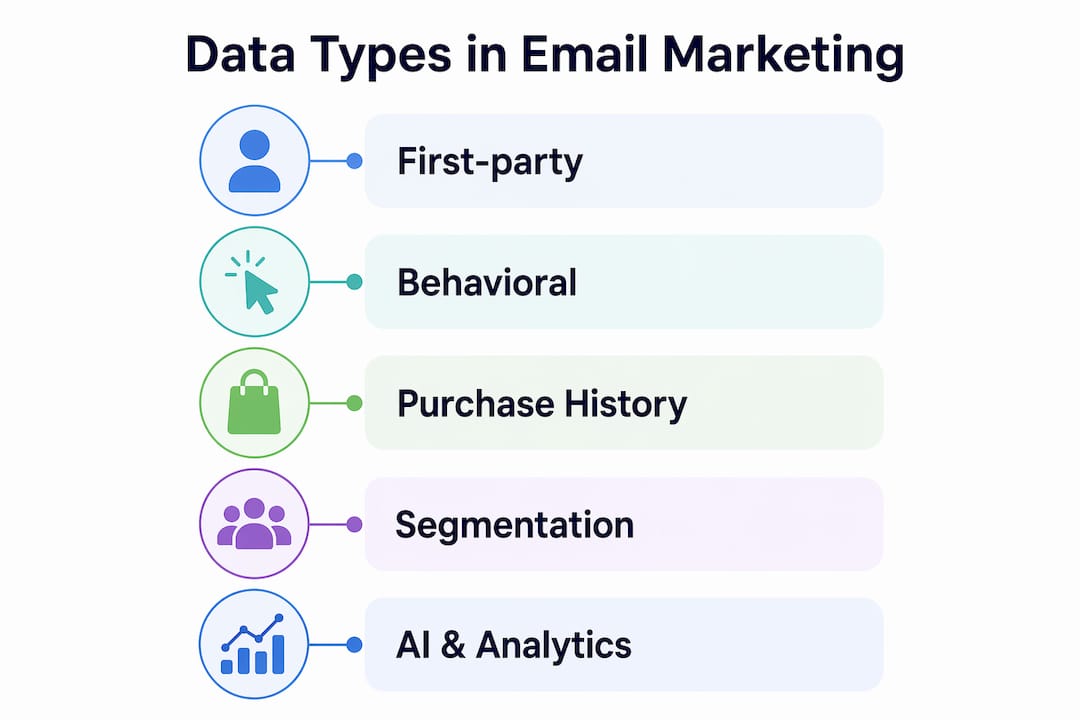
Static broadcast emails treat a new subscriber the same as a loyal customer who has purchased five times. That approach produces weak results. Data segmentation strategies divide your list into groups based on shared characteristics, so each group receives content that matches their relationship with your brand.
The difference between static and dynamic segmentation is significant. Static segments are defined once and rarely updated. Dynamic segments, powered by platforms like Klaviyo and ActiveCampaign, update automatically as subscriber behavior changes. A customer who was “at risk of churning” last month may move into the “re-engaged” segment after opening two emails this week. Dynamic segmentation reflects reality in real time.

Common segmentation criteria include lifecycle stage, purchase frequency, geographic location, and predicted lifetime value. Each criterion narrows the audience for a given message, which increases its relevance. Dynamic personalization yields up to 29% higher open rates and 41% higher click-through rates compared to static email. Those numbers represent real revenue, not just vanity metrics.
| Segment type | Data source | Primary use case |
|---|---|---|
| New subscribers | Signup date, source | Welcome series, brand introduction |
| High-value customers | Purchase frequency, order value | VIP offers, early access campaigns |
| At-risk subscribers | Last open date, purchase recency | Win-back sequences, re-engagement flows |
| Category browsers | On-site behavior, click history | Product-specific campaigns, cross-sell |
Dynamic content blocks take segmentation one step further. A single email template can display different product images, offers, or copy blocks depending on which segment receives it. This approach scales personalization without multiplying your workload.
Pro Tip: Start with three segments: new subscribers, active buyers, and lapsed customers. Master those before adding complexity. Most brands that struggle with segmentation have too many segments, not too few.
How do analytics and AI sharpen send timing and subject lines?
Email marketing analytics do more than report what happened. They feed predictive models that determine what should happen next. Two of the highest-impact applications are send-time optimization and subject line generation.
AI send-time optimization analyzes each subscriber’s individual engagement history to predict the window when they are most likely to open an email. AI send-time optimization improves open rates by 18–22%, but it requires at least 90 days of engagement history per subscriber to work reliably. Sending to a brand-new list with no history produces no meaningful optimization.
Subject line tools like Phrasee and Persado use natural language generation trained on performance data to write and test subject lines at scale. These tools deliver 20–50% uplift over human-written controls. That uplift compounds across every send, making subject line optimization one of the fastest ways to lift revenue from an existing list.
Three practical steps for implementing AI-driven optimization:
- Build your data threshold first. AI email tools need at least 1,000 active contacts to generate reliable predictions. Below that threshold, results are inconsistent.
- Run multivariate tests, not just A/B tests. Traditional A/B testing compares two variables. Multivariate AI testing evaluates dozens of combinations simultaneously, producing faster and more statistically sound conclusions.
- Feed clean data into the model. Sparse or inaccurate engagement data produces poor predictions. Scrub inactive contacts and correct data errors before activating AI features.
Stat to know: AI-generated subject lines increase open rates by 26% compared to human-written ones. At scale, that difference compounds into meaningful revenue.
You can see how AI in ecommerce is reshaping not just subject lines but the entire personalization stack for online brands.
What technical data factors affect email deliverability?
Deliverability is where data-driven strategy meets technical execution. A perfectly segmented, beautifully written email that lands in the spam folder generates zero revenue. Three technical content factors now directly influence whether your email reaches the inbox.
HTTPS links versus HTTP links are the first signal inbox providers evaluate. HTTPS links improve deliverability rates to 98.1%, while HTTP links reduce delivery. Every link in your template should use HTTPS. This is a non-negotiable baseline, not an advanced tactic.
Image alt text is the second critical factor. AI inbox classifiers use alt text as a primary content signal to evaluate whether an email is relevant and safe. Emails with missing alt text perform worst in engagement and AI classification. A single large hero image with no fallback text is a reliable path to poor inbox placement.
Template file size is the third factor most marketers overlook. Emails exceeding 100KB risk being clipped by Gmail and other clients, which strips out tracking pixels and unsubscribe links. Industry best practice keeps templates under 60KB. A clipped email loses both compliance data and engagement tracking, which corrupts the analytics you depend on for future decisions.
Content hygiene checklist for every send:
- All links use HTTPS, not HTTP
- Every image has descriptive alt text
- Template file size stays under 60KB
- No single large hero image without supporting text
- Unsubscribe link is present and functional
For more on how technical content standards affect inbox placement, the Take-action guide on content for ecommerce email covers practical template decisions that protect deliverability.
Key Takeaways
Data-driven email marketing outperforms broadcast campaigns on every measurable metric, from open rates to revenue per send, when built on accurate first-party data and maintained with consistent technical hygiene.
| Point | Details |
|---|---|
| First-party data is the foundation | Collect data directly from subscribers before building any segmentation or automation. |
| Dynamic segmentation beats static lists | Behavioral and purchase data enable real-time segments that lift open rates by up to 29%. |
| AI tools need data thresholds | Require at least 1,000 active contacts and 90 days of history before activating AI optimization. |
| Content hygiene affects deliverability | Use HTTPS links, add alt text to images, and keep templates under 60KB to protect inbox placement. |
| Subject line AI delivers measurable lift | Tools like Phrasee and Persado produce 20–50% uplift over human-written subject lines. |
Why most brands get data-driven email wrong
The brands I see struggle with email marketing share one pattern: they invest in tools before they invest in data quality. They install Klaviyo, activate every AI feature on day one, and then wonder why their personalization feels generic. The answer is always the same. The data feeding those tools is incomplete, inconsistent, or simply wrong.
The fix is unglamorous but effective. Audit your data collection before you touch your automations. Check that your signup forms capture the fields your segments actually need. Verify that your behavioral tracking fires correctly on your product pages. Clean your list of contacts who have not engaged in over a year. None of that is exciting, but it is what separates brands that see real lifts from brands that just have expensive software.
The second mistake is ignoring content hygiene. Marketers spend hours on subject lines and zero minutes checking whether their template is 120KB and full of HTTP links. That template is quietly destroying deliverability every time it sends. Fix the technical foundation first, then layer in AI optimization.
My honest recommendation: spend the first 60 days on data infrastructure. Build clean segments, fix your tracking, and establish a content hygiene checklist. After that foundation is solid, AI tools like Phrasee and Klaviyo’s predictive analytics will actually perform as advertised. The brands that see strong email ROI are not the ones with the most sophisticated tools. They are the ones with the cleanest data.
— Take
How Take-action turns your data into email revenue
Take-action is a specialized email marketing and retention agency that builds data-driven campaigns using Klaviyo. The team handles everything from data segmentation and flow setup to AI-assisted campaign strategy and ongoing performance analysis. If your email program is running on broadcast sends and incomplete data, Take-action rebuilds it from the foundation up. That means welcome sequences, abandoned cart flows, post-purchase automations, and the segmentation logic that makes each one relevant. Brands that want email to function as a primary revenue channel, not a secondary afterthought, can explore the full service offering at Take-action’s agency page.
FAQ
What is the role of data in email marketing?
Data powers every decision in email marketing, from who receives a message to what it says and when it arrives. Without accurate subscriber data, personalization and segmentation are impossible.
How much data do you need before using AI email tools?
AI email tools require at least 1,000 active contacts and 90 days of engagement history to generate reliable predictions. Below those thresholds, AI personalization produces inconsistent results.
What is zero-party data and why does it matter?
Zero-party data is information subscribers share voluntarily, such as quiz answers or preference selections. It produces highly relevant personalization without requiring behavioral inference or third-party tracking.
How does email template size affect deliverability?
Templates over 100KB risk being clipped by Gmail, which removes tracking pixels and unsubscribe links. Keeping templates under 60KB protects both inbox placement and compliance data.
Which segmentation criteria produce the highest engagement lifts?
Behavioral and purchase-based segments consistently outperform demographic-only segments. Dynamic personalization based on behavior produces up to 41% higher click-through rates compared to static email campaigns.