

The Role of Abandoned Checkout Emails in 2026
TL;DR:
- Abandoned checkout emails recover a significant share of lost sales by reconnecting with buyers during peak purchase intent. Proper sequencing, segmentation, multi-channel coordination, and legal compliance are essential to maximize their effectiveness.
Abandoned checkout emails are automated messages sent to shoppers who added items to their cart but left without buying. Their core purpose is revenue recovery: reconnecting with buyers at the exact moment purchase intent is highest. Cart abandonment rates consistently exceed 70% across ecommerce, meaning most stores lose the majority of potential sales at the final step. A well-built recovery program changes that math significantly. Understanding the role of abandoned checkout emails, how to sequence them, what to say, and how to stay legally compliant, is one of the highest-return investments an ecommerce marketer can make.
How abandoned checkout emails drive revenue recovery
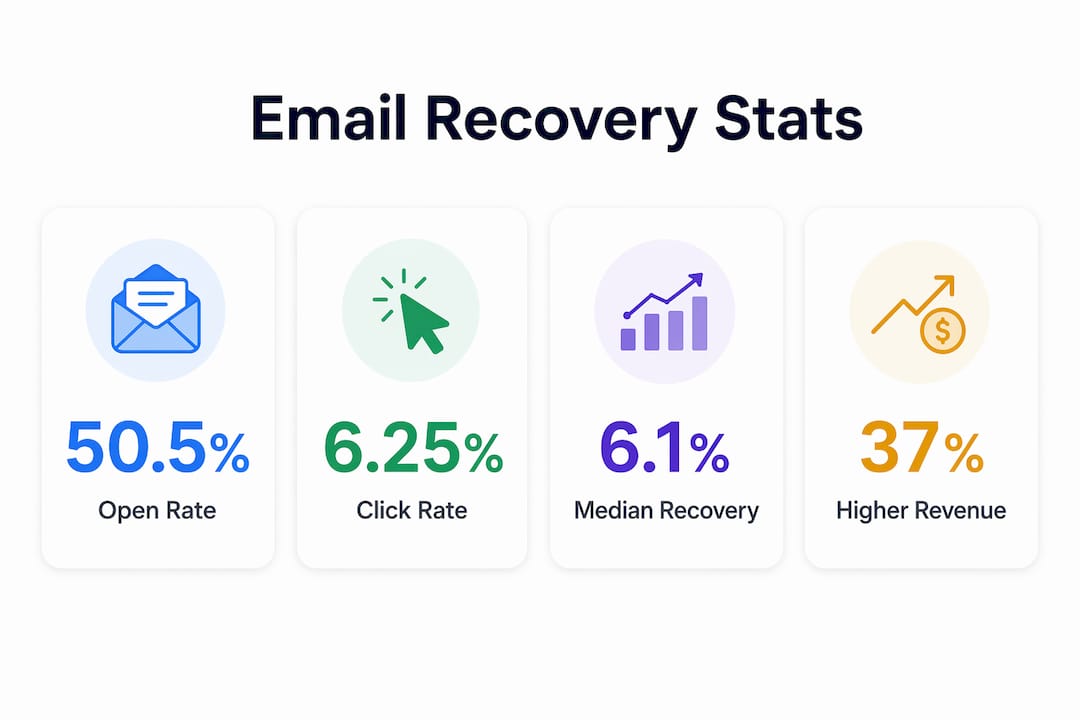
Cart recovery emails are the highest-yielding automated flow in ecommerce, generating 37% more revenue per recipient than welcome series emails. That gap exists because the shopper has already shown buying intent. The email is not creating desire. It is removing friction.
The numbers back this up. Well-optimized programs recover 5–15% of abandoned carts, with a median recovery rate of 6.1% and top-decile performers exceeding 18.4%. For a store doing $500,000 in monthly revenue with a 70% abandonment rate, even a 6% recovery rate represents tens of thousands of dollars in recaptured sales every month.
Engagement benchmarks are equally strong. Abandoned checkout emails carry an average open rate of 50.5% in 2026, far above the 20–25% typical of standard promotional campaigns. Average click rates land around 6.25%, with top performers reaching 13.33%. These figures reflect the relevance advantage: the email arrives when the shopper is already thinking about the product.
The cost efficiency is striking. Sending a recovery email costs as little as $0.08–$0.15 per send while delivering ROI up to 700:1 based on average cart value. No paid channel comes close to that ratio.
Pro Tip: Track net recovery revenue, not just open or click rates. A high open rate with no purchases means your subject line works but your email body or checkout experience does not.
| Metric | Benchmark |
|---|---|
| Average open rate | 50.5% in 2026 |
| Average click rate | 6.25%, top performers at 13.33% |
| Median cart recovery rate | 6.1% of abandoned carts |
| Top-decile recovery rate | 18.4% or higher |
| Cost per email sent | $0.08–$0.15 |
What is the best timing and sequence for recovery emails?
The standard approach is a three-email sequence sent at 1 hour, 24 hours, and 72 hours after abandonment. This structure follows the natural decay curve of purchase intent. The sooner you reach the shopper, the higher the conversion probability.
Conversion rates by send time confirm this pattern clearly:
- Email 1 (1 hour after abandonment): Converts at approximately 20.3%. Keep this email simple. Show the cart, include a clear return link, and skip the discount. The shopper may have just gotten distracted.
- Email 2 (24 hours after abandonment): Converts at approximately 12.2%. Add social proof here: reviews, ratings, or a “X people are looking at this item” message. Introduce a soft incentive like free shipping if your margins allow.
- Email 3 (72 hours after abandonment): Converts at approximately 8.1%. This is your last-chance email. Use urgency (“Only 3 left in stock”), a stronger incentive, and reason-to-believe content like quality guarantees or manufacturing details.
Content strategy matters as much as timing. Top-performing stores use reason-to-believe content in later emails rather than defaulting to percentage discounts. Quality assurances, origin stories, and customer testimonials lift conversion beyond what a 10% off code achieves.
On incentives specifically: free shipping or free gifts convert 28% higher than percentage discounts while protecting margins. A free gift feels like a bonus. A percentage discount trains shoppers to wait for a deal.

Segmentation sharpens all of this. High-cart-value abandoners deserve a different message than first-time visitors who left a $15 item. Top performers tailor incentives based on cart value tiers, using urgency and social proof strategically rather than applying blanket discounts across every segment.
Pro Tip: Personalization beyond product images, including the customer’s name, browsing history, and segment-specific copy, markedly increases recovery rates. Build at least two flows: one for new visitors and one for returning customers.
A few common mistakes to avoid:
- Sending only one email and calling it a recovery program
- Offering a discount in the first email, which conditions shoppers to abandon carts on purpose
- Using generic subject lines like “You left something behind” without personalizing to the product
- Ignoring mobile rendering, since most recovery emails are opened on a phone
How does multi-channel coordination improve cart recovery?
Email alone recovers a meaningful share of abandoned carts. Pairing it with SMS and paid retargeting recovers significantly more, but only when the channels are coordinated. Uncoordinated multi-channel outreach creates message fatigue and, worse, trains shoppers to abandon carts expecting a discount from at least one channel.
SMS brings speed. SMS open rates reach 98% compared to email’s 50%, and most SMS messages are read within three minutes of delivery. That makes SMS the right tool for the first-hour touch when purchase intent is at its peak. Email then provides the detailed context, product imagery, and objection-handling copy that a 160-character SMS cannot.
The coordination rules that separate high-performing programs from average ones:
- Suppress shoppers from paid retargeting ads once they enter your email or SMS recovery flow. Failing to suppress users from paid ads doubles acquisition costs and erodes margin.
- Set channel priority so SMS fires first, email follows, and ads only activate for non-responders after 48 hours.
- Cap total touchpoints across all channels at five within a 72-hour window to avoid irritating the shopper.
The impact of cart abandonment emails multiplies when they work in concert with retargeting rather than competing with it. The goal is a single coordinated recovery experience, not three separate campaigns running in parallel.
Pro Tip: Build suppression lists into every paid ad campaign. If a shopper converts via email, they should exit the retargeting audience within hours, not days. This alone can cut wasted ad spend by a measurable amount.
What are the legal requirements for checkout recovery emails?
Legal compliance is not optional, and the rules vary by geography. Under GDPR and similar laws, abandoned checkout emails require either legitimate interest or explicit consent, plus a clear unsubscribe option in every message. Non-compliance carries fines up to €20 million or 4% of annual global turnover, whichever is higher.
The key obligations by regulation:
- GDPR (EU/UK): Requires a lawful basis for processing. Legitimate interest applies when the shopper initiated a transaction. You must still provide opt-out access and honor it promptly.
- CAN-SPAM Act (US): Requires a physical mailing address, a clear unsubscribe mechanism, and no deceptive subject lines. Abandoned cart emails qualify as commercial messages under CAN-SPAM.
- CCPA/CPRA (California): Grants consumers the right to opt out of data sale and requires disclosure of data use. If you share behavioral data with ad platforms, your privacy policy must reflect that.
Practical compliance steps every ecommerce marketer should follow:
- Display a clear opt-out link in every recovery email, not buried in fine print
- Avoid dark patterns like pre-checked consent boxes at checkout
- Document your lawful basis for sending before you launch any recovery flow
- Honor unsubscribe requests within 10 business days under CAN-SPAM, or immediately under GDPR best practice
Understanding email marketing compliance from the start protects your sender reputation and your brand. A single spam complaint spike can damage deliverability across your entire email program, not just your recovery flow.
Key Takeaways
Abandoned checkout emails are the highest-ROI automated flow in ecommerce, and their effectiveness depends on disciplined sequencing, segmentation, multi-channel coordination, and legal compliance.
| Point | Details |
|---|---|
| Recovery rates vary widely | Median programs recover 6.1% of carts; top performers exceed 18.4% with proper sequencing. |
| Three-email sequence wins | Send at 1 hour, 24 hours, and 72 hours to follow the purchase-intent decay curve. |
| Free shipping beats discounts | Non-percentage incentives convert 28% higher and protect your margins from discount conditioning. |
| Multi-channel requires suppression | Suppress email and SMS converters from paid ads immediately to avoid wasted spend. |
| Compliance is non-negotiable | GDPR, CAN-SPAM, and CCPA each impose specific obligations; document your lawful basis before sending. |
What I’ve learned from building recovery flows that actually convert
Most ecommerce brands set up a single cart abandonment email, add a 10% discount code, and consider the job done. That approach leaves the majority of recoverable revenue on the table.
The brands that consistently hit 15%+ recovery rates treat this as a system, not a campaign. They test subject lines, incentive types, and send times with the same rigor they apply to paid ads. They segment by cart value, buyer history, and abandonment reason. They check whether the checkout experience itself is causing abandonment, because no email sequence fixes a slow-loading checkout page or a surprise shipping fee at the final step.
The discount trap is real. When you offer a discount in your first recovery email, you teach your best customers to abandon carts on purpose. I have seen brands inadvertently train their most loyal buyers to wait for the email. The fix is simple: hold the discount for email three, and only for segments where margin supports it.
The metric that matters most is net recovery revenue, not open rate. A 60% open rate means nothing if the checkout experience fails after the click. Test your checkout flow from the recovery email link the same way you test the email itself. Prefilled carts, fast load times, and visible payment options all affect whether the click becomes a purchase.
Recovery email is not a set-and-forget automation. The brands winning in 2026 review their flows quarterly, update product imagery, refresh copy, and adjust incentive thresholds based on margin data. That discipline is what separates a 6% recovery rate from an 18% one.
— Take
How Take-action builds recovery systems that perform
Take-action specializes in building and refining abandoned cart recovery flows for ecommerce brands using Klaviyo. The work goes beyond a basic three-email setup. Take-action designs segmented flows by cart value and buyer type, integrates suppression logic across email, SMS, and paid channels, and ensures every flow meets GDPR, CAN-SPAM, and CCPA requirements from day one.
Brands working with Take-action gain a recovery system built on real ecommerce automation workflows and tested against current benchmarks. The agency handles strategy, copywriting, flow architecture, and ongoing performance review so your team focuses on growth rather than maintenance. If your current recovery rate is below 10%, there is measurable revenue waiting to be recaptured. Take-action is the partner that builds the system to get it.
FAQ
What is the average recovery rate for abandoned checkout emails?
The median recovery rate is 6.1% of abandoned carts. Top-performing programs using segmented, three-email sequences exceed 18.4%.
When should the first abandoned cart email be sent?
Send the first email within one hour of abandonment. Emails sent at the one-hour mark convert at approximately 20.3%, the highest rate in the sequence.
How many emails should a cart recovery sequence include?
Three emails is the proven standard: sent at 1 hour, 24 hours, and 72 hours after abandonment. Each email should serve a distinct purpose, from a simple reminder to social proof to a final urgency message.
Are abandoned checkout emails legal under GDPR?
Yes, when sent under a legitimate interest basis for shoppers who initiated a transaction. Every email must include a clear unsubscribe option, and you must honor opt-out requests promptly.
Should every recovery email include a discount?
No. Discounts in the first email train shoppers to abandon carts deliberately. Reserve incentives for the second or third email, and favor free shipping or free gifts over percentage discounts to protect margins.