

How Customer Feedback Drives Retention and Reduces Churn
Customer feedback is the most direct lever you have for reducing churn, because it tells you exactly why customers leave before they actually do. Bain & Company research aggregated across mid-market SaaS and CX programs shows that feedback programs that consistently close the loop can reduce churn by 10–15%. That’s not a marginal improvement. For most subscription or repeat-purchase businesses, it’s the difference between a growing customer base and a leaking one.
The mechanics are straightforward:
- Churn driver detection: Feedback surfaces the friction points customers experience but rarely mention before canceling.
- Targeted fixes: Prioritizing the issues that correlate with churn lets teams fix what actually matters, not what’s loudest.
- Personalization: Segmented feedback reveals which customer groups need different experiences, enabling tailored retention plays.
- Service recovery: A resolved complaint, communicated back to the customer, often produces stronger loyalty than a flawless experience ever would.
The sections below cover how each mechanism works, where to collect feedback, how to analyze and prioritize it, how to design a repeatable loop, and how to measure whether it’s actually moving the retention needle.
Key Takeaways
Customer feedback reduces churn only when the loop closes — collecting and analyzing without communicating changes back to customers produces no measurable retention benefit.
| Point | Details |
|---|---|
| Close the loop within 72 hours | Triggered feedback at onboarding and renewal requires a response within 72 hours to prevent churn at the highest-risk moments. |
| Prioritize by impact × frequency ÷ effort | Score every identified issue on retention impact, frequency, and fix effort before assigning ownership. |
| 10–15% churn reduction is achievable | Bain & Company research shows consistent closed-loop programs reduce churn by 10–15% across mid-market programs. |
| Email is the primary closing channel | Personalized, triggered email flows tied to CSAT and NPS scores produce measurable reactivation and renewal lift. |
| Take-action builds the flows | Take-action designs Klaviyo-based retention flows mapped to your feedback signals, from post-support recovery to renewal outreach. |
Table of Contents
- What customer feedback is — and how it differs from market research
- How customer feedback actually improves retention
- Where and how to collect feedback that’s actually useful for retention
- How to analyze and prioritize feedback so it actually reduces churn
- Designing the feedback loop that actually reduces churn
- Why email is the highest-leverage channel for closing the loop
- Measuring whether your feedback program is actually reducing churn
- Common pitfalls that turn feedback programs into churn accelerators
- What to do in the first 30, 90, and 180 days
- Sources
What customer feedback is — and how it differs from market research
Customer feedback is the stream of voice-of-customer (VoC) signals generated by real transactions, support interactions, product usage, reviews, and in-product prompts. It’s operational by nature: it reflects what a specific customer experienced at a specific moment, and it’s most useful when it reaches the right team fast enough to act on.
Market research is different in almost every dimension that matters for retention work.
| Dimension | Customer feedback | Market research |
|---|---|---|
| Collection cadence | Continuous or triggered | Periodic (quarterly, annual) |
| Sample | Actual customers at real touchpoints | Recruited panels or surveyed segments |
| Speed to action | Hours to days | Weeks to months |
| Primary use case | Fix churn drivers, close the loop | Segment sizing, brand positioning, product strategy |
| Bias risk | Recency and response bias | Selection and recall bias |
The distinction matters for retention teams because the expectations around speed and follow-through are completely different. A customer who fills out a post-support CSAT survey expects a response within 48 hours, not a quarterly report. An NPS survey sent at renewal is a retention signal, not a research exercise. Treating operational feedback with the cadence of market research is one of the fastest ways to accelerate churn rather than prevent it.
A four-stage feedback loop — collect, analyze, apply, and close — only works when the “close” step happens at the speed the customer’s context demands. That’s the operational reality market research timelines simply can’t match.
How customer feedback actually improves retention
Feedback doesn’t improve retention by existing. It improves retention through specific causal mechanisms, each of which requires a different response from your team.
Churn driver detection is the most direct mechanism. Customers who are about to leave rarely announce it — but they do signal it through low CSAT scores, negative reviews, or support tickets that go unresolved. Capturing and tagging these signals before the cancellation event gives you a window to intervene. A SaaS company that identifies onboarding friction through in-product micro-surveys, for example, can fix the flow and measurably reduce early-stage churn within a single sprint cycle.

Prioritizing fixes that increase perceived value is where feedback becomes a product and operations tool, not just a CX metric. When you know which pain points correlate with churn events, you can stop guessing about the roadmap. Forbes research on feedback-driven product strategy notes that treating customers as partners reduces the risk of building features nobody wanted — a direct retention benefit, since customers who see their input reflected in the product stay longer.
Personalization and segmentation work because not all customers churn for the same reason. A power user who churns after a pricing change needs a different retention play than a new customer who never completed onboarding. Segmented feedback lets you build targeted retention flows rather than one-size-fits-all campaigns.
Service recovery is where the psychological impact of feedback is most visible. HubSpot reports that about 83% of customers feel more loyal to brands that respond to and resolve complaints. Service recovery often produces stronger loyalty than a flawless experience, because customers value being heard and seeing a visible fix. That’s not a soft benefit — it’s a measurable retention outcome.
Product-market fit alignment is the long game. Continuous feedback loops, distributed across product, support, and marketing teams, keep the product evolving in the direction customers actually need. Brands that let this drift — building features based on internal assumptions rather than customer signals — tend to see gradual churn acceleration that’s hard to diagnose until it’s expensive to reverse.
Where and how to collect feedback that’s actually useful for retention
The channel you use to collect feedback shapes what you learn. A post-purchase email survey captures a different signal than an in-app prompt after a failed transaction, and both are different from a support transcript. Matching the channel to the retention goal is what separates a useful feedback program from a survey graveyard.
| Channel | Best retention use case | Typical cadence | Key bias to watch |
|---|---|---|---|
| NPS survey | Relationship health at renewal | Quarterly or at renewal | Promoters over-respond |
| CSAT survey | Post-support or post-purchase | Triggered after event | Recency effect |
| CES survey | Onboarding, checkout friction | Triggered after task | Task-specific, not holistic |
| In-product micro-survey | Feature adoption, onboarding drop-off | Triggered by behavior | Self-selection |
| Review monitoring | Brand reputation, product gaps | Continuous | Extreme sentiment bias |
| Social listening | Emerging issues, unfiltered sentiment | Continuous | Volume skews to vocal minority |
| Support transcripts | Root-cause analysis, recurring issues | Weekly review | Agent framing effects |
Salesforce guidance on multi-touch collection emphasizes tracking feedback across all of these simultaneously, because customers rarely report problems directly — they just leave. The signals you need are often in the channels you’re not watching.
Triggered feedback at high-stakes moments is where most retention programs get the highest signal-to-noise ratio. The moments that matter most: onboarding completion (or abandonment), the first renewal window, a failed transaction, and the first 30 days after a pricing change. These are the points where churn risk is highest and where a single piece of feedback can unlock a fix that affects an entire cohort.
For practical implementation, here are copy-ready question templates:
- NPS (relationship): “On a scale of 0–10, how likely are you to recommend [Brand] to a colleague? What’s the main reason for your score?”
- CSAT (post-support): “How satisfied were you with the resolution of your issue today? (1–5) What could we have done better?”
- In-product micro-survey (onboarding): “Did you find what you were looking for? Yes / No / I need help.” (Follow with one open field if “No.”)
Keep surveys short. A single question with one optional follow-up consistently outperforms five-question forms on response rate and data quality. For retail ecommerce touchpoints, the timing of the trigger matters as much as the question itself.
How to analyze and prioritize feedback so it actually reduces churn
Raw feedback volume is not an asset. Unanalyzed feedback sitting in a spreadsheet is noise. The goal is a repeatable workflow that converts signals into prioritized retention initiatives.
The prioritization framework that works in practice scores each identified issue on three dimensions: impact on retention (how strongly does this correlate with churn events?), frequency (how many customers are affected?), and effort to fix (engineering days, policy changes, or content updates required?). A high-frequency, high-impact, low-effort issue is your first fix. A low-frequency, low-impact, high-effort issue goes to the backlog.
The workflow itself runs in five steps: collect and tag incoming feedback by theme and customer segment, perform root-cause analysis on the top themes (ask “why” three times before accepting the surface complaint as the real issue), quantify the potential retention impact by correlating the theme with churn cohort data, score using the framework above, and assign ownership with a deadline.
Tagging and thematic analysis work best when you combine automated AI-assisted tagging with a weekly human-led review. Auto-tagging catches volume and surfaces patterns; human review catches nuance, context, and the edge cases that matter most for high-value customers. Zendesk’s documentation on VoC programs notes that organizations able to act quickly on feedback — including during high-disruption periods — improved retention outcomes, which is exactly what a tight tagging-to-action workflow enables.
To test whether a specific issue actually drives churn, run a cohort analysis: compare the 90-day retention rate of customers who reported the issue against those who didn’t. If the gap is statistically meaningful, the issue belongs at the top of your priority list regardless of how loud or quiet the feedback volume is.
Designing the feedback loop that actually reduces churn
A feedback loop that stops at “collect and analyze” is just a reporting exercise. The step that converts feedback into retained revenue is closing the loop — communicating back to customers that their input led to a real change. Qualtrics guidance on closing the loop is explicit: visible remediation is what turns a negative experience into a loyalty outcome.
The operational loop runs in four stages:
- Collect — Trigger surveys and monitor channels at the moments defined in your collection plan. Set a weekly cadence for pulling support transcripts and review data.
- Analyze — Tag and score incoming feedback within 48 hours of collection. Run the prioritization framework weekly.
- Act — Assign the top-priority issue to an owner with a deadline. For service recovery cases (individual complaints), the SLA is 24–72 hours. For product fixes, use your standard sprint cycle.
- Close the loop — Communicate the action back to the customer or customer segment that raised the issue.
Close-the-loop email template (individual service recovery) is a critical part of communicating your changes effectively to customers, much like a retail display upgrade without renovation communicates physical improvements to shoppers.
Subject: We heard you — here’s what we changed
Hi [First Name],
Thank you for letting us know about [specific issue]. We’ve [specific action taken — e.g., updated the billing page / escalated your case to our senior support team / fixed the onboarding step you mentioned].
If you have a moment, we’d love to know if this resolved things for you: [one-click survey link].
[Name], [Team]
Internal ticket template for turning feedback into work:
Issue: [Theme — e.g., “Onboarding step 3 confusion”] Source: [Channel + date range] Affected segment: [Cohort or customer tier] Retention impact score: [From prioritization matrix] Owner: [Name] Deadline: [Date] Close-the-loop message: [Draft or link to template]
Automation checklist for routing feedback:
- Route NPS detractors (score 0–6) to a CRM task with a 48-hour follow-up SLA
- Tag CSAT scores below 3 as high-priority and assign to a human agent, not a bot
- Push thematic tags from support transcripts into your project management tool weekly
- Trigger a close-the-loop email automatically when a fix is deployed (link to the change log or release note)
Pro Tip: Automate the routing and tagging, but write the service recovery messages by hand for high-value customers. A personalized email from a real person after a bad experience converts at a measurably higher rate than a templated response — and it’s the kind of detail customers remember and mention in reviews.
Why email is the highest-leverage channel for closing the loop
Email is uniquely effective for closing the loop because it’s direct, measurable, and tied to the customer’s lifecycle context in a way that social or in-app messages rarely are. You can see who opened the close-the-loop message, who clicked the follow-up survey, and who renewed after receiving it. That traceability is what makes email the channel where retention programs produce measurable revenue outcomes.
Three flows that consistently move retention metrics:
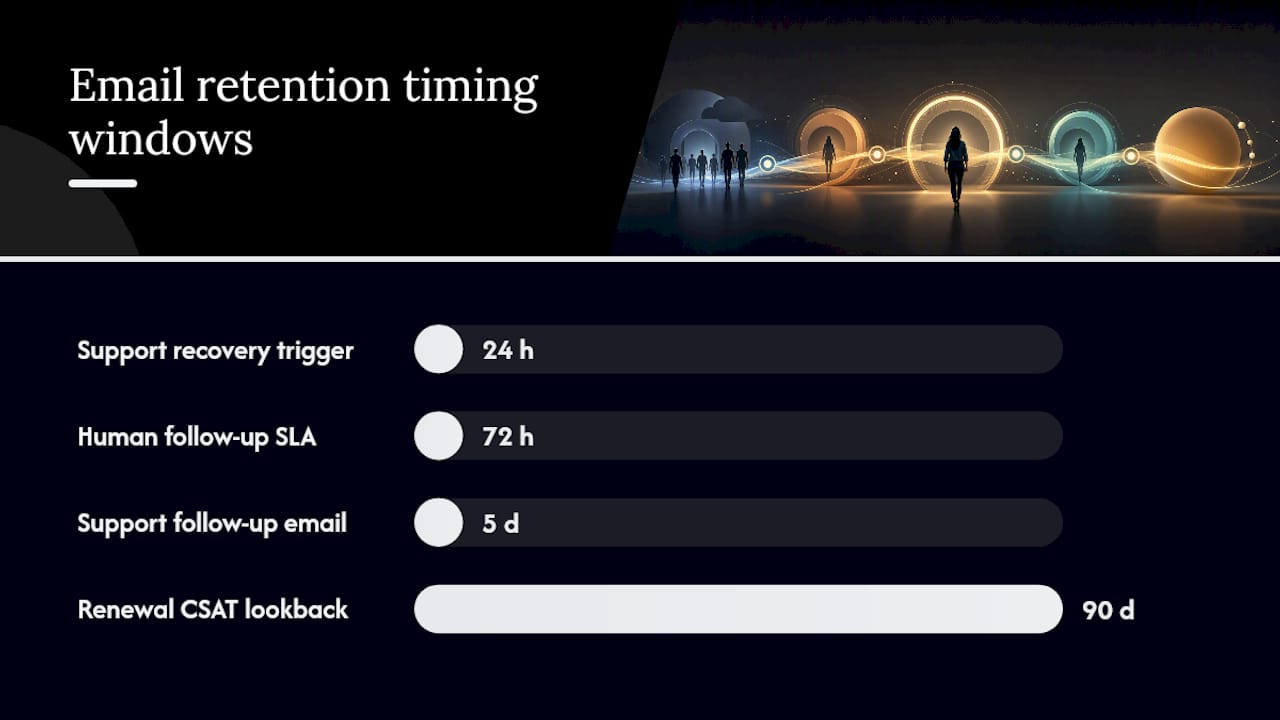
1. Post-support recovery flow Triggered 24 hours after a support ticket closes with a CSAT score below 3. The first email acknowledges the issue and confirms the fix or escalation. The second, sent 5 days later, checks whether the resolution held and invites the customer to share any remaining friction. This flow alone tends to recover a meaningful share of at-risk customers who would otherwise churn silently.
2. Feature announcement + preview invite based on feedback When a product change is directly traceable to customer feedback, email the segment that raised the issue first. Subject line: “You asked for this — it’s here.” Give them early access or a walkthrough. This closes the loop publicly and creates a loyalty moment that generic release notes never achieve.
3. Renewal outreach after poor CSAT Customers approaching renewal with a CSAT score below 3 in the prior 90 days are high churn risk. A personalized email from a senior team member — not an automated campaign — that acknowledges the experience and offers a concrete resolution (a call, a credit, a dedicated onboarding session) changes the renewal conversation entirely.
Email automation checklist for feedback-driven retention:
- Segment by NPS score, CSAT score, and last purchase date before sending any retention email
- Use dynamic content blocks to reference the specific issue the customer reported
- Set a 72-hour SLA for human follow-up on any negative feedback routed through email
- Track open rate, click rate, and 90-day retention rate by cohort for every close-the-loop campaign
Metrics to watch for email-driven retention:
- Response rate on close-the-loop emails (benchmark: 15–25% for triggered, personalized sends)
- Reactivation rate for detractors who received a recovery email vs. those who didn’t
- Renewal lift for customers who received a pre-renewal CSAT recovery email
For Klaviyo-based ecommerce flows, segmentation by feedback score is a straightforward property to add to existing lifecycle flows — it doesn’t require a separate tool stack.
Measuring whether your feedback program is actually reducing churn
Measuring the impact of a feedback program requires more than tracking NPS over time. You need experiment designs that isolate the effect of feedback-driven actions from everything else happening in the business.
Primary KPIs and suggested benchmarks:
- Churn rate by cohort — Compare cohorts that received close-the-loop outreach against those that didn’t. A 10–15% churn reduction is achievable with a consistent closed-loop program, per Bain & Company research.
- Retention rate at 90 and 180 days — Segment by NPS score at onboarding. Promoters should retain at a materially higher rate than detractors.
- Customer lifetime value (CLV) — Track CLV by feedback response segment over 6–12 months.
- NPS trend — A rising NPS trend that correlates with specific product or service changes is evidence that feedback is driving improvement.
- CSAT trend by touchpoint — Flat or declining CSAT at renewal is an early warning signal, not a lagging indicator.
- Response rate — Low survey response rates (below 10% for email surveys) indicate a collection problem, not a feedback problem.
Experiment design checklist for proving causality:
- Define the intervention (e.g., close-the-loop email to detractors within 48 hours)
- Randomly assign eligible customers to treatment and holdout groups
- Set a measurement window (90 days minimum for churn; 180 days for CLV)
- Confirm sample size is large enough to detect a meaningful difference (consult a statistician or use a standard power calculator)
- Track both the primary metric (churn rate) and secondary metrics (CSAT, CLV) for the full window
- Document confounders (pricing changes, product launches) that could explain the difference
Timeline for expected impact:
| Window | Expected outcomes | Minimum tooling |
|---|---|---|
| 0–30 days | Baseline established, top churn drivers identified | Survey tool, tagging system |
| 30–90 days | First fixes deployed, early retention signal visible | CRM, email automation |
| 90–180 days | Cohort retention lift measurable, CLV trend emerging | Analytics, A/B testing |
| 180+ days | Scaled automation, compounding retention gains | Full VoC stack |
At a high level, the CLV calculation is straightforward: if a feedback-driven intervention retains X% more customers per month, multiply that by average monthly revenue per customer and project over 12 months. Even a 1% improvement in monthly retention compounds significantly over a year for most subscription or repeat-purchase businesses.
Common pitfalls that turn feedback programs into churn accelerators
Most feedback programs fail not because the data is bad, but because the loop never closes. Here are the pitfalls that consistently accelerate churn rather than prevent it, and the fixes that work.
-
The survey graveyard: You collect feedback, tag it, and file it. Nothing changes. Customers who took the time to respond notice — and they churn faster than customers who never responded at all. Fix: assign every feedback theme an owner and a deadline before the next collection cycle runs.
-
Annual NPS as the only signal: A single annual NPS survey misses every churn event that happens between cycles. Fix: add triggered NPS at renewal and triggered CSAT at every high-stakes touchpoint. Annual NPS is a trend indicator, not a retention tool.
-
Ignoring sample bias: Customers who respond to surveys are not a random sample. Detractors and promoters over-respond; the silent middle — often the largest churn risk — rarely responds at all. Fix: supplement surveys with passive signals (support transcripts, review monitoring, behavioral data) to capture the customers who don’t raise their hand.
-
Automating without personalization: Routing every negative CSAT score to a templated “we’re sorry” email trains customers to ignore your outreach. Fix: use automation for routing and triage, but write personalized messages for high-value or high-risk customers. The psychological impact of a genuine response on loyalty is measurable — a form letter is not the same thing.
-
Not closing the loop visibly: Asking for feedback and then making changes without telling customers you made them is the single most common program failure. Customers don’t check your release notes. Fix: send a close-the-loop message to the segment that raised the issue every time a fix ships.
Pro Tip: Track “sentiment drift” — the change in average CSAT or NPS score for a specific cohort over 60–90 days. A cohort whose sentiment is declining is a churn cohort in formation. Catching it at the drift stage, rather than at cancellation, is where feedback programs pay for themselves.
What to do in the first 30, 90, and 180 days
This checklist is designed for a team launching or rebuilding a retention-focused feedback program. Assign an owner to each item before the first week ends.
Days 1–30: Baseline and signal capture
- Audit existing feedback channels (surveys, reviews, support tickets) and identify gaps in coverage at high-stakes touchpoints.
- Deploy triggered CSAT at post-support and triggered NPS at renewal (or the equivalent for your business model).
- Set up basic tagging in your CRM or support tool — five to eight themes is enough to start.
- Run a weekly 30-minute insight review with one representative from product, support, and marketing.
- Identify the top three churn drivers from existing data (support ticket themes, cancellation reasons, review sentiment).
Days 30–90: First fixes and early retention wins
- Prioritize the top churn driver using the impact × frequency ÷ effort framework and assign an owner.
- Deploy a close-the-loop email to the segment that raised the top issue once the fix ships.
- Build a post-support recovery email flow for CSAT scores below 3.
- Measure 30-day retention rate for customers who received a close-the-loop message vs. those who didn’t.
- Add social listening and review monitoring to the weekly insight review.
Days 90–180: Scaled automation and cohort measurement
- Automate feedback routing from survey tools into your CRM and project management tool.
- Build the renewal outreach flow for customers with poor CSAT in the prior 90 days.
- Run a 90-day cohort analysis comparing retention rates for customers who received close-the-loop outreach vs. holdout.
- Expand tagging to include sentiment scoring and customer tier segmentation.
- Present a CLV impact estimate to leadership using the cohort data from step 3.
Minimum tooling for each window: a survey tool (Typeform, Delighted, or a native CRM survey), an email automation platform, and a tagging system. You don’t need a dedicated VoC platform to get meaningful results in the first 90 days — you need a consistent process and clear ownership.
What actually works in practice — and what takes longer than you’d expect
The programs that move the retention needle fastest share one characteristic: they close the loop within 72 hours at the touchpoints that matter most. Onboarding and renewal are the two moments where a single piece of feedback, acted on and communicated back, can change a customer’s trajectory. Everything else — annual NPS tracking, quarterly insight reports, product roadmap alignment — matters, but it compounds over months, not weeks.
What takes longer than most teams expect is the cultural shift. Getting product, support, and marketing to treat feedback as a shared operational input rather than a CX team’s reporting exercise usually requires a few visible wins before the weekly insight review becomes a meeting people actually want to attend. The first close-the-loop email that generates a positive reply from a customer who was about to cancel tends to be the moment that changes the room.
One tip worth applying immediately: prioritize triggered feedback at renewal and onboarding, and commit to a 72-hour close-the-loop SLA for those touchpoints specifically. That’s a narrow scope, but it’s where the churn risk is highest and where a fast, personalized response has the most measurable impact on retention.
How Take-action helps brands close the loop and retain more customers
Closing the feedback loop at scale requires email flows that are personalized, triggered by the right behavioral signals, and built to measure retention outcomes — not just open rates. Take-action builds exactly these flows for ecommerce brands using Klaviyo: post-support recovery sequences, renewal outreach for at-risk customers, and feature announcement emails that communicate changes back to the segments that asked for them.
The value is specific: instead of a generic retention email strategy, you get flows mapped to your actual feedback signals — NPS scores, CSAT thresholds, and purchase behavior — with segmentation and copy that reflects what your customers actually said. This is a paid service, and the right fit is a brand that already has feedback data and needs the email infrastructure to act on it at scale.
If you want to see what a feedback-driven retention program looks like in practice for your business, book a strategy call with Take-action to review your current flows and identify where closing the loop can move your retention metrics.
Sources
- Bain & Company
- Koji — Customer feedback loop guide (2026)
- IBM — How to build a successful customer retention strategy
- HubSpot — The benefits of customer feedback