

Boost Customer Retention with Personal Branding in Email
TL;DR:
- Personal branding builds trust, loyalty, and humanizes email marketing for ecommerce brands.
- Segmentation and authentic voice significantly increase open and click rates, driving revenue.
- Strong reputation and substance are essential, as AI cannot replace genuine human experience.
Personalized emails boost open rates by 26%, click-through rates by 101%, and revenue by up to 40%. Yet most ecommerce brands still treat email as a broadcast tool, blasting the same generic message to everyone on their list. The real missed opportunity is not the lack of personalization tech. It is the absence of a recognizable, trusted brand voice behind every email. Personal branding is not just for influencers or solopreneurs. For service providers and ecommerce marketing teams, it is the invisible engine that makes segmentation work, builds loyalty faster, and turns one-time buyers into repeat customers. This article gives you the frameworks, benchmarks, and tactics to make it happen.
Table of Contents
- Why personal branding matters for service providers
- The power of personalization: Segmentation & authentic voice in email
- Building email content pillars: Humanizing through value-first engagement
- Advanced nuances: Introvert advantage, AI balance, and product-led exceptions
- Our perspective: Reputation, trust, and the future of service branding
- Enhance your retention strategy with Take Action
- Frequently asked questions
Key Takeaways
| Point | Details |
|---|---|
| Branding boosts retention | Personal branding turns email marketing into a trust-building channel, significantly improving customer retention rates. |
| Segmentation drives results | Behavioral and demographic segmentation in emails multiplies engagement and revenue for service providers. |
| Human connection wins | Combining AI efficiency with genuine human interaction helps brands stand out and build lasting loyalty. |
| Content pillars matter | Value-first content, education, and community engagement are essential for effective email branding. |
| Reputation precedes branding | Build competence and trust before amplifying your personal brand for sustainable customer retention. |
Why personal branding matters for service providers
Most marketers think personal branding is about a polished headshot and a catchy tagline. It is actually much more functional than that. Personal branding is the combination of your positioning, your reputation, and how consistently you show up for your audience. When that combination is strong, every email you send carries more weight because readers already know who is behind it and why they should care.
For service providers in ecommerce, this matters at a mechanical level. Defining your micro-niche, auditing your unique strengths, and building an SEO-optimized visual identity are foundational steps that make everything downstream, including email, more effective. Without that foundation, even a perfectly segmented list will underperform because the content lacks a point of view worth following.
Here is what strong personal branding actually does for your email program:
- Humanizes your content so readers feel like they are hearing from a person, not a corporation
- Creates emotional hooks that generic brand accounts cannot replicate
- Builds anticipation so your open rates climb organically over time
- Reduces unsubscribes because readers identify with the voice, not just the product
- Strengthens referrals since people share emails that feel personal and relevant
AI tools have made content production faster than ever, but they have not replaced empathy. The brands winning on email right now are using AI as a co-pilot for consistency while leaning into genuine human perspective for differentiation. You can explore practical digital branding tips to see how this plays out in real ecommerce contexts.
The most overlooked truth in personal branding? Aesthetics without substance creates what experts call signal inversion: your brand looks polished but communicates nothing of value. That erodes trust faster than a bad design ever would. Focus on what you actually know and believe before you worry about how it looks.
Pro Tip: Audit your last five email campaigns. If you removed your logo, would a loyal customer still recognize your voice? If the answer is no, substance-building should come before any visual refresh.
If you want a deeper look at actionable service business marketing ideas that integrate with email, that resource is a strong next step. With the groundwork set, let us dive deeper into how personal branding integrates with email marketing strategy.
The power of personalization: Segmentation & authentic voice in email
Segmentation is the operational arm of personal branding. It lets you match the right voice to the right person at the right moment. Without it, even the most compelling brand voice gets diluted by irrelevance.
Personalized email drives 29% higher open rates, 41% higher click rates, 71% greater loyalty, and a 2% lift in repeat purchases that can translate to over $20,000 on a $1 million revenue base. Those are not marginal gains. They are the difference between email being a cost center and being your top revenue channel.
Here is a quick comparison of generic versus personalized email performance:
| Metric | Generic email | Personalized email |
|---|---|---|
| Open rate | ~18% | ~29% |
| Click-through rate | ~2.5% | ~5% |
| Customer retention lift | Baseline | Up to 71% more loyalty |
| Revenue per $1 spent | ~$20 | Up to $42 |
The segmentation benefits go beyond demographics. Behavioral segmentation, based on purchase history, browsing patterns, and email engagement, lets you send messages that feel almost telepathic. That is where personal branding and personalization intersect most powerfully.
Here is a numbered process you can implement right now:
- Segment by behavior first. Group customers by what they have bought, what they have browsed, and how recently they engaged.
- Define your brand voice in writing. One paragraph describing your tone, values, and what you stand for. Every email writer on your team should have this.
- Map voice to segment. A new subscriber needs warmth and clarity. A lapsed customer needs a re-engagement hook that feels personal, not promotional.
- Build sequenced flows. Welcome, nurture, and re-engagement sequences compound retention over time. A single campaign will not do it.
- Test and refine the voice. A/B test subject lines written in your personal voice against generic ones. The data will tell you fast.
For a deeper look at list segmentation tactics built for ecommerce, that resource breaks down the technical side in practical terms. Armed with knowledge about branding’s importance, here is how personalization transforms email engagement.
Building email content pillars: Humanizing through value-first engagement
Content pillars are the categories that give your email program structure without making it feel formulaic. For personal branding in email, three content pillars power the most effective programs: educational value, relationship-building, and community engagement.

Educational content positions you as the expert your subscribers chose to hear from. It answers the questions they are already asking. Think tutorials, frameworks, industry insights, and behind-the-scenes breakdowns of decisions you made and why.
Relationship-building content is where your personality shows up most directly. Stories, opinions, and honest takes on industry trends build the emotional connection that keeps subscribers reading month after month.
Community engagement content closes the loop. It invites replies, surfaces subscriber stories, and makes your email feel like a two-way conversation rather than a broadcast.
Here is what makes the difference between a content pillar strategy that works and one that stalls:
- Empathy in the opening line. Address the specific frustration or desire your segment is experiencing right now.
- Specificity over vague encouragement. Concrete examples outperform motivational language every time.
- AI for drafting, humans for editing. Use tools like Klaviyo personalization strategies to automate timing and triggers. Write the actual content yourself.
- Reply to every comment and email response. This is not optional. Community is loyalty’s engine, and the signal you send by responding is irreplaceable.
“Personal branding amplifies your marketing, but no AI can replicate your specific niche human experiences. That is your differentiation.”
Pro Tip: Set a weekly 30-minute block to personally reply to subscriber responses. The customers who email back are your highest-value segment. Treat them accordingly.
For newsletter retention strategies built around these pillars, there is a full breakdown tailored to ecommerce brands. The personal branding mechanics behind these pillars are consistent across industries, but how you apply them in email is specific to your audience and offer. Now that segmentation is clear, let us construct emails that truly humanize your service brand and sustain retention.
Advanced nuances: Introvert advantage, AI balance, and product-led exceptions
Not everyone is a natural performer. That is actually good news for email marketers. Introverts often produce the most compelling email content because they naturally gravitate toward depth over spectacle. Platforms that reward thoughtful long-form content like Medium, or documentation-heavy communities like GitHub, show that introverts excel via depth over performative posting. That same advantage transfers directly to email.
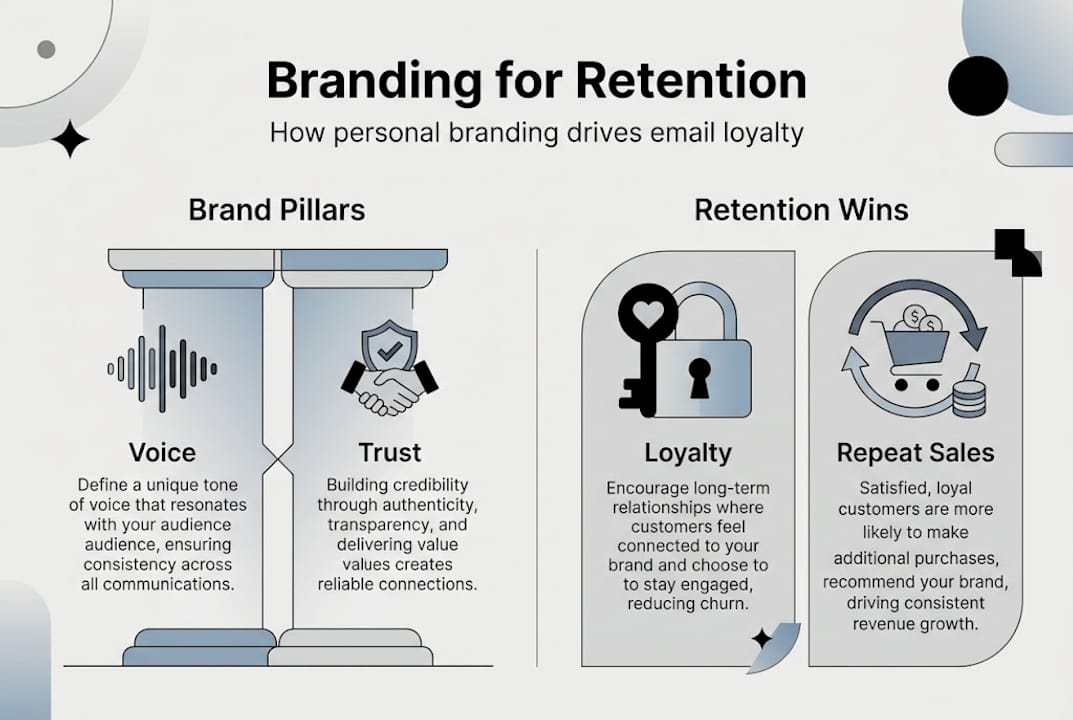
The AI balance question comes up constantly. Here is the honest answer: AI is excellent for scale, consistency, and testing. It is poor at building trust, navigating nuance, and making your audience feel genuinely seen. In the AI era, crystal-clear brand discovery becomes more critical, not less, because AI-generated content is everywhere and human specificity is the differentiator.
Key nuances worth building into your strategy:
- Signal inversion is real. A highly aesthetic brand with no clear point of view will lose to a plainly designed brand with a sharp perspective. Substance wins.
- Introverts, lean into writing. Long-form emails, detailed case studies, and analytical breakdowns build authority faster than short-form social content ever will.
- Not every brand needs a personal face. Product-led brands like Buck Mason, which grew to $150M through product excellence rather than founder-led branding, prove that the strategy is contextual.
- Service providers are different. When the product is expertise and relationship, personal branding is not optional. It is the product.
“AI commoditizes expertise at scale. Your specific niche human experiences are the only thing it cannot replicate. That is where your brand lives.”
For service-based ecommerce brands, the Klaviyo brand automation approach lets you maintain human voice at scale, automating the mechanics while keeping the content genuinely personal. Having outlined the main pillars, here is how these nuances surface in today’s marketing landscape and what they mean for your retention strategy.
Our perspective: Reputation, trust, and the future of service branding
Here is what most brands get wrong: they try to amplify before they have anything worth amplifying. Personal branding in email does not start with a great template or a clever subject line formula. It starts with building reputation first before any amplification begins. Without that, all the segmentation and automation in the world will not generate lasting loyalty.
The brands we see sustaining genuine retention are not the loudest ones. They are the most consistent and most trustworthy ones. AI will keep improving at content production. It will not improve at building the kind of trust that makes a customer choose you over a cheaper competitor.
“Reputation precedes branding. Without it, amplification just accelerates collapse.”
Invest in segmentation importance as a foundational discipline, but pair it with a relentless commitment to showing up with a real perspective. That combination is what separates email programs that plateau from ones that compound.
Pro Tip: Before your next campaign, ask: does this email reflect what we actually believe, or just what we think will convert? Belief-driven content converts better and retains longer.
Enhance your retention strategy with Take Action
Personal branding and email marketing are not separate disciplines. When they work together, the results compound. If you are ready to build an email program that reflects your brand’s real voice, segments your audience intelligently, and automates retention without losing the human touch, that is exactly what we build at Take Action.
As a specialized email marketing agency, we combine personal branding strategy with Klaviyo automation to create programs that retain customers and grow revenue predictably. From content pillar development to behavioral segmentation and flow setup, our team handles the full stack. Visit Take Action to explore how we can build a retention engine tailored to your brand’s voice and goals.
Frequently asked questions
What is personal branding for service providers in ecommerce?
Personal branding for service providers means defining your micro-niche, articulating your unique strengths, and humanizing your marketing to build lasting customer relationships in ecommerce.
How does personal branding enhance email marketing retention?
By using segmentation and an authentic personal voice, personal branding transforms emails into trust-building content. Segmentation and personalized sequences boost retention and revenue significantly compared to generic broadcasts.
Can product-led brands succeed without personal branding?
Yes. Buck Mason reached $150M through product-led strategies rather than founder branding. But service providers, where the expertise is the product, gain the most from a strong personal brand and reputation.
What are the three content pillars for personal branding emails?
Educational value, relationship-building content, and community engagement are the three core pillars. Value-first posting and thoughtful community engagement are what sustain subscriber loyalty over time.
How can introverts build personal brands authentically online?
Introverts excel through depth in writing and niche platforms rather than high-visibility performative content. Reputation and clarity of perspective are far more effective than volume or spectacle.
Recommended
- Master branding with Klaviyo email automation for growth | Take Action Blog | Take Action
- 7 Innovative Ecommerce Newsletter Ideas for Higher Retention | Take Action Blog | Take Action
- Essential digital branding tips for ecommerce growth | Take Action Blog | Take Action
- Content Creation Agencies: Driving Retention Growth | Take Action Blog | Take Action