

Overcoming email marketing roadblocks to optimize growth
TL;DR:
- Email marketing is often underperforming due to strategy and execution issues rather than content.
- Key roadblocks include deliverability problems, low engagement, poor segmentation, and lack of automation.
- Focusing on fixing deliverability, building automation, and using behavioral segmentation can significantly boost revenue and retention.
Email marketing should be your most reliable revenue channel, yet most e-commerce brands watch it underperform while paid ads drain their budgets. You set up flows, write campaigns, and still see low open rates, bouncing emails, and flat retention numbers. The frustration is real, and it costs you compounding revenue every week. Flows outperform campaigns by 18 to 75 times in revenue per recipient, driving 30 to 50% of total email revenue despite low send volume. That gap between where you are and where you could be is not a content problem. It is a strategy and execution problem. This guide gives you the exact framework to identify, fix, and scale past the most common email marketing roadblocks.
Table of Contents
- Recognizing common email marketing roadblocks
- Preparing to overcome roadblocks: Tools, segmentation, and benchmarks
- How to execute: Fixing deliverability, engagement, and automation
- Verifying results: Measuring improvement and optimizing further
- The hard truths most marketers miss about overcoming email marketing roadblocks
- Take action: Accelerate your retention growth with expert guidance
- Frequently asked questions
Key Takeaways
| Point | Details |
|---|---|
| Flows outperform campaigns | Automated flows can generate 18 to 75 times more revenue per recipient than standard campaigns. |
| Fix deliverability first | Ensuring your emails reach the inbox is essential before improving segmentation or content. |
| Segment for maximum retention | Behavior-based segmentation and RFM triggers drive much higher engagement and revenue growth. |
| Monitor and optimize continuously | Regularly check key metrics and optimize flows to stay ahead of marketing roadblocks. |
Recognizing common email marketing roadblocks
Before you can fix anything, you need to name it. Most e-commerce brands dealing with stalled email performance are fighting one or more of the same core issues. Understanding each one clearly is the first step toward solving it.
Deliverability problems are often invisible until they become catastrophic. Your emails land in spam, bounce back, or simply never reach the inbox. Common roadblocks include deliverability issues where bounce rates exceed 1%, low engagement, poor segmentation, weak list hygiene, and difficulty setting up automation. These are not isolated technical glitches. They are symptoms of a system that was never properly built.
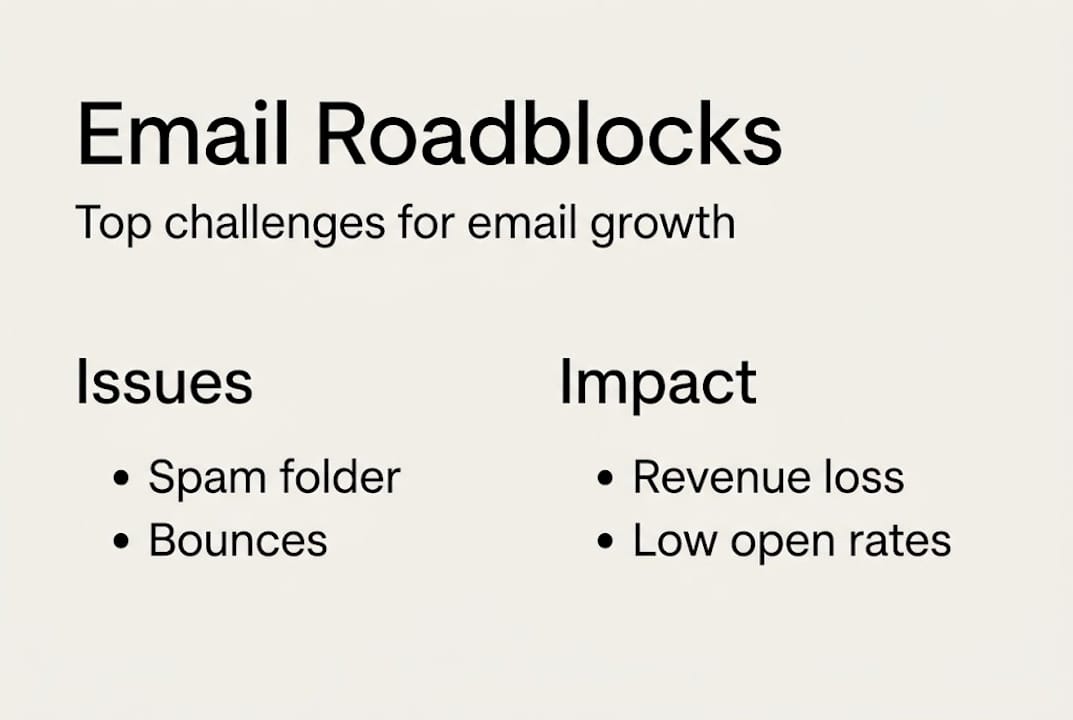
Low engagement is the next major culprit. If your open rates sit below 20% or your click rates are under 0.5%, your audience is telling you something. Either your subject lines are missing the mark, your content is not relevant, or you are sending to the wrong people at the wrong time. You can read more about avoiding email marketing mistakes that quietly kill engagement before you even notice the trend.
Here is a quick breakdown of the most common roadblocks and their downstream effects:
| Roadblock | Root cause | Revenue impact |
|---|---|---|
| High bounce rate | Dirty list, no authentication | Inbox placement drops |
| Low open rate | Weak subject lines, bad timing | Fewer conversions |
| Poor segmentation | One-size-fits-all sends | Irrelevant content, unsubscribes |
| No automation | Manual sending only | Missed revenue moments |
| Compliance gaps | No preference center | Legal risk, trust erosion |
List health is another area that quietly destroys performance. Sending to unengaged or invalid contacts signals to inbox providers like Gmail and Outlook that your emails are not wanted. Over time, this tanks your sender reputation and makes it harder to reach even your best customers.
Key warning signs to watch for:
- Bounce rate above 1% on any campaign
- Open rates declining month over month
- Spam complaint rate above 0.08%
- No segmentation beyond basic demographics
- Zero automated flows running in the background
Many brands also struggle with email marketing challenges around automation setup. Building flows feels technical and time-consuming, so it gets deprioritized. But that delay means you are leaving your highest-ROI channel on the table every single day. Strategies for improving open rates start with fixing these foundational issues first.
Preparing to overcome roadblocks: Tools, segmentation, and benchmarks
With the roadblocks identified, let’s gear up with what works today. You cannot solve a performance problem without first knowing what good looks like. Setting realistic benchmarks and choosing the right tools gives you a baseline to measure against.
For 2026, email performance benchmarks show that campaigns achieve open rates of 31 to 49% and click rates of 0.5 to 1.7%. Flows, however, open at 39% and click at 2.7 to 5.6%, with conversion rates 13 times higher than standard campaigns. If your numbers fall short of these, you have a clear optimization target.
Here is a reference table to guide your goal-setting:
| Metric | Campaign benchmark | Flow benchmark |
|---|---|---|
| Open rate | 31 to 49% | 39%+ |
| Click rate | 0.5 to 1.7% | 2.7 to 5.6% |
| Conversion rate | Baseline | 13x higher |
| Revenue per recipient | Lower | 18 to 75x higher |
The right tools make execution possible. Klaviyo remains the top platform for e-commerce email automation because it connects directly to your store data, enabling behavior-based triggers and real-time segmentation. Pair it with a deliverability monitoring tool and you have the core stack you need. You can explore a detailed email automation tools comparison to find what fits your current setup.
Segmentation is where most brands leave the biggest money on the table. Move beyond basic demographics and use behavioral data:
- Purchase frequency: How often does a customer buy?
- Recency: When did they last purchase?
- Monetary value: What is their average order value?
- Browse behavior: What products have they viewed but not bought?
- Engagement tier: Are they opening emails or going cold?
This RFM model (Recency, Frequency, Monetary) is the gold standard for e-commerce segmentation. The 2026 retention playbook reinforces that brands using RFM-based segmentation consistently outperform those using static lists.
Pro Tip: Start with just three segments: active buyers (purchased in the last 90 days), at-risk customers (no purchase in 91 to 180 days), and lapsed contacts (180 days or more). Even this simple split will immediately improve your relevance and reduce unsubscribes. Building a strong foundation also means building your email list with quality contacts from the start.
How to execute: Fixing deliverability, engagement, and automation
Armed with tools and targets, it is time to apply practical fixes. This is where most brands stall because the to-do list feels overwhelming. Break it into three focused areas: deliverability, engagement, and automation.

Fixing deliverability starts with authentication. Authenticate your sending domain using SPF, DKIM, and DMARC records. These protocols tell inbox providers that your emails are legitimate. Without them, even great content ends up in spam. This is a one-time technical setup with lasting impact.
Next, clean your list. Remove hard bounces immediately and suppress anyone who has not opened an email in 180 days or more. Yes, your list will shrink. But a smaller, engaged list will always outperform a bloated, unresponsive one.
Here are the steps to execute a full deliverability fix:
- Set up SPF, DKIM, and DMARC on your sending domain
- Remove all hard bounces from your list immediately
- Run a re-engagement campaign for contacts inactive 90 to 180 days
- Suppress non-openers beyond 180 days
- Add a preference center so subscribers control their email frequency
“A preference center is not just a compliance tool. It is a trust signal that reduces unsubscribes and keeps your most engaged contacts happy.”
Fixing engagement means testing relentlessly. Test subject lines using A/B splits on every major campaign. Test send times across your top segments. Optimize every email for mobile since over 60% of emails are opened on a phone. You can find practical sales-boosting email tips that cover both design and copy improvements.
Building automation is the highest-leverage fix you can make. Start with these three flows:
- Abandoned cart: Recover lost revenue from shoppers who left without buying
- Win-back: Re-engage lapsed customers before they are gone for good
- Post-purchase: Build loyalty and encourage repeat purchases immediately after a sale
These flows run 24/7 without manual effort. You can study workflow examples to see exactly how top e-commerce brands structure each sequence. Pair these with retention strategies that go beyond the inbox for a full-funnel approach. Ongoing managing email retention ensures these flows keep performing as your brand scales.
Pro Tip: Set your abandoned cart flow to trigger within 30 minutes of abandonment. The first email in the sequence consistently generates the highest conversion rate because intent is still fresh.
Verifying results: Measuring improvement and optimizing further
Once you have made changes, how do you know they are actually working? Measurement is not optional. It is the mechanism that turns one-time fixes into compounding growth.
Start by comparing pre and post metrics across four core areas:
- Open rate: Are more people reading your emails?
- Click rate: Are readers engaging with your content?
- Revenue per recipient (RPR): Is each send generating more revenue?
- ROI: What is your return for every dollar spent on email?
Email ROI benchmarks show $36 to $42 returned per $1 spent on average. The best programs using AI and automation reach up to $76 per $1 spent. If your current ROI sits below $36, you have clear room to grow.
Here is a simple optimization tracker to use monthly:
| Area | Metric to track | Action if declining |
|---|---|---|
| Deliverability | Bounce rate, spam rate | Re-authenticate, clean list |
| Engagement | Open rate, click rate | Test subject lines, timing |
| Automation | Flow revenue, RPR | Audit triggers, update copy |
| Retention | Repeat purchase rate | Strengthen post-purchase flow |
Monitor each segment separately. A win-back flow for lapsed customers will perform very differently than a welcome series for new subscribers. Treating them the same way hides what is actually working. You can also look at repurposing content for email to keep your flows fresh without starting from scratch every quarter.
AI and personalization are the next layer of optimization. Platforms like Klaviyo use predictive analytics to recommend send times, product suggestions, and churn risk scores. Brands that layer these features onto a clean, segmented list see the biggest performance jumps. Checking Klaviyo benchmarks regularly keeps your targets calibrated to what top performers are achieving.
Document every win. When a subject line test lifts open rates by 8%, write down what you tested and why it worked. When a new flow segment outperforms your baseline, record the logic. These documented wins become your repeatable playbook. They also help you increase productivity by reducing the time you spend reinventing strategies that already work.
The hard truths most marketers miss about overcoming email marketing roadblocks
Most guides will tell you to send more emails, add more flows, and test more subject lines. That advice is not wrong, but it misses the actual problem. The brands that consistently struggle with email roadblocks are not failing because of tactics. They are failing because they treat roadblocks as one-time problems to fix rather than ongoing systems to manage.
Deliverability does not stay fixed. Engagement does not stay high. Segmentation does not stay accurate. Your audience changes, your product catalog evolves, and inbox algorithms shift. The brands winning at email in 2026 are the ones that built a culture of continuous testing and iteration, not just a solid initial setup.
The other truth is that segmentation and automation return disproportionate revenue relative to effort. Most brands spend 80% of their time on campaigns and 20% on flows, when the revenue split should be the opposite. Shifting that ratio, even partially, is the single highest-leverage move you can make. Deeper email strategies that focus on automation over volume consistently outperform brands chasing open rates with more sends.
Proactive testing always beats reactive fixing. Build a monthly review cadence before problems appear, not after your deliverability tanks.
Take action: Accelerate your retention growth with expert guidance
Breaking through email marketing roadblocks takes more than knowing the right steps. It takes consistent execution, ongoing testing, and the kind of platform expertise that turns strategy into measurable revenue. Most brands hit a ceiling not because they lack ideas, but because implementation takes time and precision they do not have.
The email marketing experts at Take Action specialize in exactly this work. From Klaviyo flow setup and list segmentation to full campaign strategy and deliverability audits, the team builds systems that grow with your brand. Whether you are starting from scratch or optimizing an underperforming setup, the retention services for e-commerce are designed to accelerate results without the trial-and-error cost. Start with a free audit and see exactly where your biggest opportunities are hiding.
Frequently asked questions
What is the biggest email marketing roadblock for e-commerce brands?
Deliverability and segmentation are the most common roadblocks e-commerce brands face, often causing revenue loss long before marketers realize the problem exists.
How can I increase customer retention with email?
Automated flows like abandoned cart, post-purchase, and win-back campaigns significantly boost customer retention by engaging shoppers at the exact right moment in their journey.
What email metrics should I track for overcoming roadblocks?
Track open rates, click rates, revenue per recipient, ROI, and segment performance. Klaviyo benchmarks give you a reliable standard to measure your progress against.
How do I fix high bounce rates in my email campaigns?
Authenticate your sending domain with SPF, DKIM, and DMARC, then clean your list regularly and stop sending to contacts who have not engaged in 180 days or more.
Are automation and AI actually worth it for small brands?
Absolutely. AI-driven programs can achieve up to $76 ROI per $1 spent, making automation one of the highest-return investments available to brands at any size.
Recommended
- Avoid Common Email Marketing Mistakes for Higher ROI | Take Action Blog | Take Action
- Optimize ecommerce growth with a performance agency | Take Action Blog | Take Action
- Email Marketing Mistakes That Hurt Ecommerce Growth | Take Action Blog | Take Action
- Take Action — Email Marketing & Retention Agency
- Email Marketing Workflow Drives 494% More Orders for CPG Brands – Reddog Consulting Group