

Optimize ecommerce growth with a performance agency
Most ecommerce brands leave significant revenue on the table by treating email marketing as a broadcast channel rather than a strategic growth engine. Traditional platforms often cap your ability to segment audiences, test variations, or automate sophisticated customer journeys. A performance based marketing agency specializing in Klaviyo automation changes this equation entirely. By combining advanced segmentation, behavioral triggers, and continuous optimization, these agencies transform email into a primary revenue driver. This article reveals how partnering with a specialized agency unlocks measurable growth through proven automation strategies that adapt to your customers’ unique behaviors and preferences.
Table of Contents
- Why Ecommerce Brands Struggle With Email Marketing Growth
- How Advanced Email Automation Drives Revenue Growth
- Why Partner With A Performance Based Marketing Agency For Klaviyo
- Key Metrics And Strategies To Optimize With Your Agency
- Partner With A Performance Based Marketing Agency To Grow Your Ecommerce Business
- Frequently Asked Questions
Key takeaways
| Point | Details |
|---|---|
| Automated flows drive substantial revenue | Properly configured email flows can generate over 27% of total revenue for ecommerce brands. |
| Platform choice impacts scalability | Switching to Klaviyo enables advanced segmentation and testing that less robust platforms cannot support at scale. |
| Performance agencies align with your goals | Agencies compensated on measurable outcomes focus relentlessly on revenue growth and customer retention metrics. |
| Volume and engagement can coexist | Strategic automation allows brands to increase sending frequency while maintaining high open rates through better targeting. |
Why ecommerce brands struggle with email marketing growth
Many ecommerce marketing managers hit a ceiling with their email programs, not because their products lack appeal, but because their platforms impose artificial constraints. You might recognize these symptoms: campaigns require manual setup every time, segmentation options feel limited to basic demographics, and A/B testing applies only to subject lines. These limitations prevent you from delivering the personalized, timely messages that modern customers expect.
Less advanced platforms create three core bottlenecks:
- Manual workflow creation that consumes hours of team time for routine campaigns
- Shallow segmentation that groups customers by purchase history alone, ignoring behavioral signals
- Testing restrictions that prevent you from optimizing send times, content variations, or audience splits simultaneously
These constraints force brands to choose between scale and personalization. When Hohem, a gimbal and camera stabilizer brand, faced these exact challenges on their previous platform, they struggled to expand their email program without sacrificing engagement. Transitioning from a less advanced platform to Klaviyo allowed them to overcome limitations in testing, automation, and segmentation, leading to improved performance across every metric.
“The switch to Klaviyo wasn’t just about features. It fundamentally changed how we could communicate with customers at different lifecycle stages, turning email from a cost center into a profit driver.”
Understanding these pain points reveals why platform selection matters as much as strategy. Without the technical foundation to execute sophisticated automation, even brilliant campaign ideas remain theoretical. The gap between what you know works and what your current tools allow creates frustration and missed revenue opportunities. Recognizing this limitation is the first step toward implementing customer engagement Klaviyo automation that scales with your business.
How advanced email automation drives revenue growth
Automated email flows operate as always-on revenue generators by targeting customers at precise moments in their journey. Unlike campaigns that broadcast the same message to your entire list, flows respond to individual behaviors: browsing specific products, abandoning carts, making first purchases, or reaching VIP status. This behavioral targeting creates relevance that generic campaigns cannot match.
Klaviyo’s automation capabilities enable three revenue-driving strategies:
- Lifecycle flows that nurture customers from first visit through repeat purchases, adapting messaging based on engagement patterns
- Behavioral triggers that respond to cart abandonment, browse abandonment, and post-purchase opportunities within hours of customer actions
- Predictive segmentation that identifies high-value customers before they churn, enabling proactive retention campaigns
The revenue impact of these strategies becomes clear in real-world results. When Hohem implemented comprehensive automation, 27% of their revenue came from automated flows alone. Even more impressive, 32% of total revenue originated from emails, demonstrating how the channel evolved from a supplementary tactic to a primary growth driver.

| Automation Type | Revenue Contribution | Implementation Complexity | Optimization Frequency |
|---|---|---|---|
| Welcome series | 8-12% of email revenue | Low | Quarterly |
| Abandoned cart | 15-20% of email revenue | Medium | Monthly |
| Post-purchase | 5-8% of email revenue | Medium | Quarterly |
| Browse abandonment | 3-5% of email revenue | High | Monthly |
| Win-back campaigns | 4-7% of email revenue | Medium | Quarterly |
Segmentation transforms these automated flows from good to exceptional. Rather than sending the same abandoned cart email to every customer, you can vary messaging based on cart value, product category, previous purchase history, and engagement level. A first-time browser receives different messaging than a loyal customer who suddenly abandons a high-value cart.
A/B testing amplifies these gains by continuously improving every element. You might test whether cart abandonment emails perform better at 1 hour or 3 hours post-abandonment, whether urgency language or product benefits drive more clicks, or whether single-product showcases outperform multi-product emails. These incremental improvements compound over time.
Pro Tip: Start with your highest-volume flows when implementing testing. A 5% improvement to abandoned cart emails that reach 1,000 customers monthly delivers more revenue than a 20% improvement to a VIP flow reaching 50 customers. Focus optimization efforts where volume and value intersect.
The combination of automation, segmentation, and testing creates a system that improves continuously. Each customer interaction generates data that refines future messaging, creating a feedback loop that becomes more effective over time. This systematic approach to automated workflows for ecommerce brands explains why sophisticated email programs generate disproportionate returns compared to basic broadcast campaigns. The key lies in treating email as a dynamic system rather than a static channel, using email segmentation strategies that evolve with customer behavior.
Why partner with a performance based marketing agency for Klaviyo
Building sophisticated email automation in-house requires specialized expertise that most ecommerce teams lack. You need technical knowledge of Klaviyo’s platform, copywriting skills for conversion-focused messaging, design capabilities for on-brand templates, and analytical expertise to interpret performance data. Hiring and retaining this talent internally costs significantly more than agency partnerships, especially when you factor in the learning curve and ongoing training.
Performance based marketing agencies bring immediate value through:
- Deep platform expertise accumulated across dozens of client implementations, revealing what actually works versus theoretical best practices
- Established frameworks for segmentation, flow design, and testing that compress months of trial and error into weeks of proven execution
- Cross-industry insights that identify opportunities your competitors haven’t discovered yet
- Continuous optimization that treats your email program as a living system requiring constant refinement
The performance based model aligns agency incentives directly with your revenue goals. Unlike retainer arrangements where agencies get paid regardless of results, performance compensation ties agency earnings to measurable outcomes: revenue growth, customer retention rates, or email-attributed conversions. This structure ensures your agency partner obsesses over the same metrics that keep you awake at night.
Hohem’s experience illustrates this partnership value. After implementing advanced email automation with agency support, they achieved a 23% increase in total store revenue. This growth didn’t come from a single campaign or tactic, but from systematic improvements across their entire email ecosystem: smarter segmentation, better-timed flows, and continuous testing that compounded small wins into substantial revenue gains.
Agencies also overcome the resource constraints that plague in-house teams. Your marketing manager already juggles paid ads, social media, content creation, and a dozen other priorities. Email automation requires focused attention to design flows, write sequences, analyze performance, and iterate based on results. An agency provides dedicated resources without the overhead of full-time employees.
Pro Tip: When evaluating agencies, request case studies from brands in your industry and revenue range. An agency that grew a $50 million retailer may lack relevant experience for a $2 million startup, and vice versa. Look for proven results with businesses facing similar challenges to yours.
The technical hurdles alone justify agency partnerships for many brands. Klaviyo offers powerful capabilities, but unlocking them requires understanding API integrations, custom properties, conditional logic, and liquid templating. Agencies handle this complexity so you can focus on strategy rather than technical implementation.
Beyond initial setup, agencies provide ongoing optimization that in-house teams struggle to maintain. They monitor performance weekly, identify underperforming segments, test new approaches, and refine messaging based on emerging customer behaviors. This continuous improvement approach to managing business growth through email retention ensures your email program evolves with your business rather than becoming stagnant. The combination of specialized expertise, aligned incentives, and dedicated resources explains why brands increasingly view agency partnerships as investments rather than expenses, especially when seeking to boost ecommerce growth through SEO and Klaviyo automation simultaneously.
Key metrics and strategies to optimize with your agency
Tracking the right metrics transforms email marketing from guesswork into a predictable revenue channel. Your agency should obsess over three core indicators: open rates that measure subject line effectiveness and list health, click-through rates that reveal content relevance and offer appeal, and revenue per email that connects activity to actual business outcomes. These metrics tell different parts of your email story and require distinct optimization approaches.
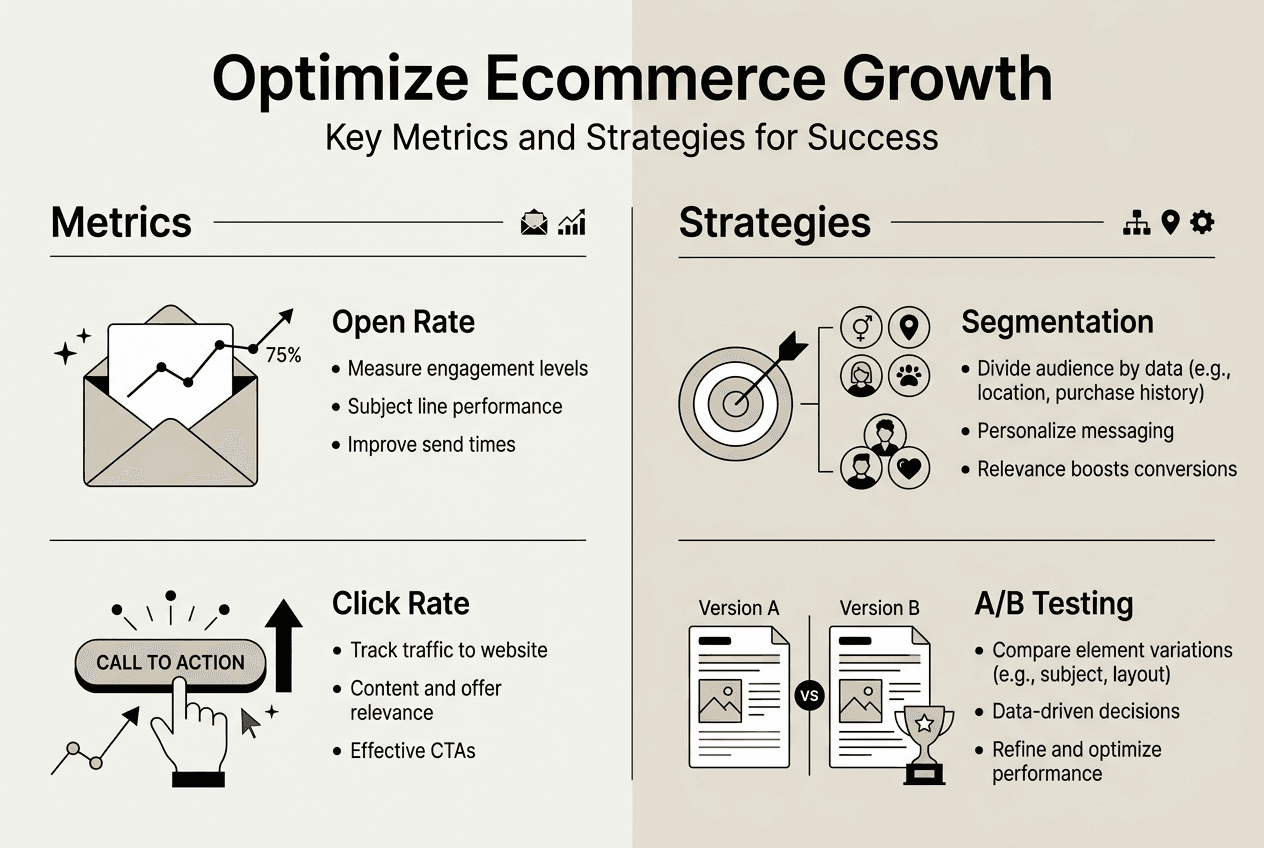
Open rates signal whether your emails reach engaged subscribers who want to hear from you. When Hohem maintained a 57% open rate despite increasing sending volume 5x, they proved that volume and engagement aren’t mutually exclusive. The key lies in segmentation that ensures every email reaches recipients likely to find it relevant. A 40% open rate to a highly targeted segment of 500 customers drives more revenue than a 25% open rate to your entire list of 10,000.
Click-through rates measure whether your email content motivates action. Low clicks despite high opens suggest your subject lines promise more than your content delivers, or your calls to action lack clarity. High clicks with low conversions point to landing page issues rather than email problems. This diagnostic capability helps you identify exactly where to focus optimization efforts.
| Metric | Benchmark Range | Optimization Focus | Measurement Frequency |
|---|---|---|---|
| Open rate | 35-50% | Subject lines, send times, list hygiene | Weekly |
| Click-through rate | 2-5% | Content relevance, CTA placement, offer strength | Weekly |
| Conversion rate | 1-3% | Landing page alignment, offer match, urgency | Weekly |
| Revenue per email | $0.10-$0.50 | Segmentation, product selection, pricing strategy | Monthly |
| List growth rate | 2-5% monthly | Lead magnets, signup forms, value proposition | Monthly |
Revenue per email connects activity to outcomes, revealing which campaigns and flows actually drive business results. This metric exposes the difference between engagement theater and revenue generation. An email with a 60% open rate but $0.05 revenue per send underperforms one with a 40% open rate generating $0.30 per send.
Optimizing these metrics requires a systematic approach:
- Establish baseline performance for all active flows and campaign types to identify improvement opportunities
- Prioritize optimization efforts based on volume and current performance, focusing on high-traffic, underperforming areas first
- Implement single-variable tests that isolate what actually drives improvement versus what feels like it should work
- Analyze results within 7-14 days to gather statistically significant data without waiting unnecessarily
- Scale winning variations across similar emails and flows to compound improvements systematically
- Document learnings in a shared knowledge base so insights inform future campaigns and prevent repeated mistakes
Your agency should track automation flow performance separately from campaign metrics. Flows typically achieve higher open rates and revenue per email because they target specific behaviors rather than broadcasting to entire lists. Understanding this distinction helps you allocate resources appropriately between evergreen automation and timely campaigns.
Pro Tip: Monitor the relationship between sending frequency and engagement metrics monthly. If open rates decline as you increase volume, you’re hitting saturation. The solution isn’t necessarily sending less, but segmenting more precisely so each subscriber receives only highly relevant emails.
Advanced list segmentation for ecommerce email enables you to send more emails to engaged segments while reducing frequency to less responsive subscribers. This surgical approach maintains overall volume while improving per-email performance. The goal isn’t maximum emails sent, but maximum revenue per subscriber over their lifetime.
Your agency partnership should include monthly reporting that connects these metrics to business outcomes. Revenue growth matters more than open rates, customer lifetime value trumps click-through rates, and retention rates reveal more than any single campaign metric. By focusing on outcomes rather than vanity metrics, you ensure optimization efforts actually move your business forward. This outcome orientation explains why brands increasingly seek to boost open rates with Klaviyo in 2026 as part of broader revenue growth strategies rather than as isolated tactics.
Partner with a performance based marketing agency to grow your ecommerce business
Transforming email from a supplementary channel into your primary growth engine requires expertise, technology, and relentless optimization. You’ve seen how advanced automation drives measurable revenue, why platform capabilities matter, and which metrics actually predict business outcomes. The question now is whether you’ll implement these strategies through trial and error over months, or accelerate results by partnering with specialists who’ve already solved these challenges.
A performance based marketing agency brings immediate value through proven frameworks tailored to your brand, customer base, and revenue goals. You gain access to Klaviyo experts who design sophisticated flows, segment audiences with surgical precision, and optimize continuously based on your actual performance data. The performance based model ensures your agency partner succeeds only when you do, aligning incentives around the metrics that matter most to your business.
Whether you’re struggling with platform limitations, lacking internal resources, or simply want to accelerate growth, an email marketing and retention agency provides the expertise and execution capability to transform your email program. The brands achieving exceptional results aren’t necessarily spending more on email. They’re leveraging specialized knowledge, advanced automation, and continuous optimization to extract maximum value from every subscriber.
Frequently asked questions
What is a performance based marketing agency?
A performance based marketing agency earns compensation tied directly to measurable business outcomes rather than fixed retainers. These agencies focus on metrics like revenue growth, customer acquisition cost, and retention rates because their earnings depend on delivering results. This model aligns agency incentives with client goals, ensuring both parties prioritize the same success indicators. Performance based structures work particularly well for email marketing where revenue attribution is clear and measurable.
How does Klaviyo automation increase ecommerce revenue?
Klaviyo automation increases revenue by sending targeted emails triggered by specific customer behaviors at optimal moments in the buying journey. When someone abandons a cart, browses specific products, or reaches a purchase milestone, automated flows respond immediately with relevant messaging. This behavioral targeting creates personalization at scale that manual campaigns cannot match. The combination of perfect timing, relevant content, and behavioral triggers converts significantly better than generic broadcast emails.
Why is segmentation important in email marketing?
Segmentation enables you to send highly relevant content to specific customer groups rather than generic messages to everyone. A first-time buyer needs different messaging than a loyal customer, just as a high-value cart abandoner requires different incentives than someone who browsed a single product. Segmentation increases open rates by ensuring recipients see subject lines relevant to their interests, boosts click-through rates by matching content to customer intent, and drives more revenue by aligning offers with customer value and behavior patterns.
Can a performance based marketing agency help small ecommerce businesses?
Many performance based agencies scale their services to fit businesses of all sizes, from startups to established brands. The performance model actually benefits smaller businesses because you pay for results rather than expensive retainers regardless of outcomes. Agencies bring expertise that small teams cannot afford to hire internally, providing access to sophisticated strategies without full-time employee costs. Their focus on measurable ROI ensures every dollar invested drives proportional returns, making them particularly valuable for businesses with limited marketing budgets.
How long does it take to see results from email automation?
Most brands see initial results from email automation within 30 to 60 days of implementation. Welcome series and abandoned cart flows typically generate revenue immediately once activated, while more sophisticated flows like browse abandonment and win-back campaigns require time to gather behavioral data. The full impact of comprehensive automation becomes clear after 90 days when you have enough data to optimize based on actual performance. Continuous improvement means results compound over time, with mature programs significantly outperforming initial implementations.
Recommended
- SEO Marketing Agency: Driving Ecommerce Growth Online | Take Action Blog | Take Action
- Google SEO Agency: Impact on Ecommerce Growth | Take Action Blog | Take Action
- SEO Digital Marketing Agency: Impact on Ecommerce | Take Action Blog | Take Action
- Digital Media Buying Agency Impact on Ecommerce | Take Action Blog | Take Action