

Monitor digital marketing ROI with Klaviyo: 41% revenue
TL;DR:
- Flows generate 41% of revenue with significantly higher ROI than broadcasts.
- Accurate email ROI measurement relies on linear multi-touch attribution and key metrics like RPR and click rate.
- Focusing on automation and segmentation improves ROI more than increasing campaign volume.
Email marketing ROI is not the mystery most ecommerce brands make it out to be. The real problem is not measurement itself but relying on the wrong methods and metrics. Flows outperform campaigns in ROI by a staggering margin, yet most brands still pour their energy into broadcast campaigns and wonder why results feel inconsistent. Klaviyo changes the game by making attribution transparent, benchmarks accessible, and automation measurable in real time. This article walks you through the frameworks, formulas, and strategies you need to track and improve your digital marketing ROI with confidence.
Table of Contents
- Why ROI measurement matters for ecommerce email marketing
- Key metrics and formulas to monitor digital marketing ROI
- Automation vs campaign: Which drives stronger ROI?
- Advanced strategies: Benchmarks, segmentation, and attribution tips
- Our take: What most email marketers get wrong about ROI
- Boost your ROI with expert email automation
- Frequently asked questions
Key Takeaways
| Point | Details |
|---|---|
| Multi-touch attribution matters | Using linear multi-touch tracking ensures you accurately measure email’s impact beyond last-click models. |
| Flows drive higher ROI | Automated flows outperform campaigns by targeting relevance and timing, with revenue per recipient up to 18x greater. |
| Benchmark for ongoing improvement | Trust benchmarks after 6 months or 25 sends and use weekly comparisons to refine your email strategies. |
| Prioritize actionable metrics | Track RPR, conversion rate, placed order rate, and click rates for the clearest view of marketing ROI. |
Why ROI measurement matters for ecommerce email marketing
Tracking email marketing ROI is not just a reporting exercise. It is the foundation of every smart decision you make about budget, content, and growth. Without it, you are guessing. With it, you can scale what works and cut what does not.
Many ecommerce brands fall into the same traps. They celebrate high open rates while ignoring revenue per recipient (RPR). They over-credit a single campaign that happened to coincide with a sale. Or they default to last-click attribution, which gives all the credit to the final email a customer opened before buying. This approach distorts reality and leads to bad strategy.
Klaviyo solves this with omnichannel linear multi-touch attribution, which distributes credit equally across every touchpoint in the customer journey. If a customer received a welcome flow email, clicked an abandoned cart reminder, and then converted after a campaign, each touchpoint gets a share of that revenue. This gives you a truer picture of what is actually driving results.
For target audience research and email ROI, understanding which segments respond to which flows is just as important as the attribution model itself. And for brands integrating other channels, pairing SEO with Klaviyo automation creates a compounding effect that pure campaign sends cannot replicate.
Here is what you should be tracking on a consistent basis:
- Revenue per recipient (RPR): How much revenue each email generates per send
- Open rate: Engagement signal, though Apple Mail Privacy Protection (MPP) adds noise
- Click rate: A cleaner engagement indicator post-MPP
- Conversion rate: The percentage of email recipients who complete a purchase
- Placed order rate: Orders generated directly from an email send
Klaviyo’s benchmarks for core metrics give you industry comparisons across verticals so you know whether your numbers are competitive or need attention. Without benchmarks, a 2% click rate sounds fine until you realize your category average is 4%.
“You cannot improve what you do not measure” is a cliché for a reason. In email marketing, not measuring the right things is just as damaging as not measuring at all.
When you connect precise ROI measurement to your scaling decisions, you stop treating email as a cost center and start treating it as the revenue engine it actually is.
Key metrics and formulas to monitor digital marketing ROI
Knowing that measurement matters is one thing. Knowing exactly which numbers to pull and how to calculate them is another. Let’s get specific.
The core formula for email ROI is straightforward:
Email ROI = [(Revenue from Email – Cost of Email) / Cost of Email] x 100
If you generated $50,000 from email and your platform and labor costs totaled $5,000, your ROI is 900%. That is not unusual for well-optimized Klaviyo accounts. The ROI formula and Klaviyo’s calculator use inputs like active profiles, average order value (AOV), and purchase frequency to estimate potential returns before you even launch a flow.
Here is a quick reference for the metrics that matter most:
| Metric | What it measures | Why it matters |
|---|---|---|
| RPR | Revenue per email sent | Efficiency of each send |
| Placed order rate | Orders per email sent | Direct revenue signal |
| Click rate | Link clicks per email sent | Engagement quality |
| Conversion rate | Purchases from email traffic | Bottom-line impact |
| List growth rate | Net new subscribers gained | Pipeline health |
Klaviyo aggregates benchmark data from 183,000+ customers to give you a live comparison against peers. Flow click rates average 5.58% while campaign click rates average 1.69%. That gap is not random. It reflects the power of relevance and timing.
Here is a simple process to start tracking accurately:
- Set your attribution window in Klaviyo (5-day click, 1-day open is standard for ecommerce)
- Exclude transactional emails from marketing ROI reports
- Pull RPR by flow and by campaign separately
- Compare your numbers against Klaviyo’s vertical benchmarks monthly
- Calculate your email ROI quarterly using the formula above
Pro Tip: Do not trust your benchmarks until you have at least 25 sends or 6 months of data. Early data is noisy and can lead you to optimize for outliers instead of trends. For more email marketing tips on structuring your reporting cadence, a consistent review rhythm matters as much as the metrics themselves.
Automation vs campaign: Which drives stronger ROI?
This is the strategic question every ecommerce brand eventually faces. Should you prioritize sending more campaigns or investing in building better flows? The data makes the answer clear.
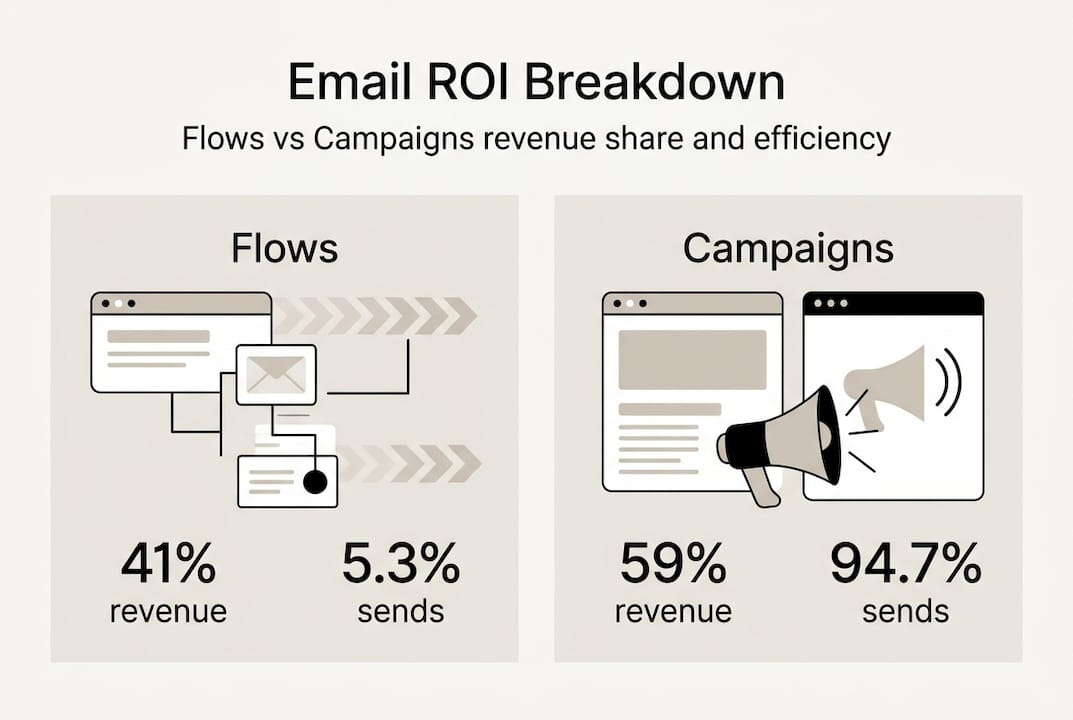
Flows drive 41% of revenue from just 5.3% of total sends, and their RPR is 18 times higher than campaigns. Read that again. Nearly half your email revenue comes from a tiny fraction of sends, simply because those sends are triggered by behavior and timed to relevance.

Here is how flows and campaigns compare head to head:
| Factor | Flows (automation) | Campaigns (broadcast) |
|---|---|---|
| Revenue share | 41% of email revenue | 59% from 94.7% of sends |
| RPR | 18x higher | Baseline |
| Click rate | 5.58% average | 1.69% average |
| Personalization | High (behavior-triggered) | Low to medium |
| Effort after setup | Minimal | Ongoing per send |
The reason flows win so consistently comes down to relevance and timing. A welcome series hits a new subscriber at peak interest. An abandoned cart flow reaches a shopper when purchase intent is still warm. A replenishment flow lands exactly when a customer is likely running out of product. Campaigns, by contrast, go to everyone on a schedule that has nothing to do with individual behavior.
Brands that get this right see extraordinary results. Fishwife achieved 67x ROI, Smile Brilliant 39x, and Coffee Beanery 65x using Klaviyo-powered automation strategies. These are not outliers. They reflect what happens when you match the right message to the right moment.
For a deeper look at the tools that power this kind of performance, email automation tools for retailers break down the options across platforms. And if retention is your focus, email retention strategies tie automation directly to long-term customer value.
Pro Tip: Start with a replenishment or post-purchase flow if you only have time to build one automation this quarter. It requires minimal content and consistently delivers high RPR because it catches customers at a natural re-engagement moment.
Advanced strategies: Benchmarks, segmentation, and attribution tips
Once you have your core flows live and your metrics tracked, the next level is optimization. This is where most brands leave serious revenue on the table.
Segmentation is the sharpest tool in your kit. Prioritizing RFM segmentation and A/B testing alongside peer benchmarks is consistently ranked as a top driver of email ROI improvement. RFM stands for Recency, Frequency, and Monetary value, and it lets you build segments that reflect actual customer behavior rather than broad demographics.
Here is how to apply advanced tactics practically:
- Engagement segmentation: Separate your 90-day engaged contacts from your cold list and send different content to each group
- RFM tiers: Build separate flows for VIP customers, at-risk customers, and lapsed buyers
- Fatigue management: Cap send frequency for contacts who have not clicked in 60 days
- Weekly benchmarking: Pull your key metrics every Monday and compare week-over-week trends, not just monthly snapshots
- Cross-channel view: Consolidate email, SMS, and paid data into a single dashboard for full journey visibility
Attribution nuance matters too. Linear multi-touch gives a fuller picture than last-click, but it is not perfect. Excluding bot clicks and Apple MPP-inflated opens from your ROI calculations keeps your numbers honest. Apple MPP pre-loads email images, which artificially inflates open rates for Apple Mail users. If open rates are your primary engagement metric, you are working with distorted data.
Shift your primary engagement signal from open rate to click rate and placed order rate. These metrics survive Apple MPP intact and give you a cleaner read on real intent.
For brands working with a performance agency for ecommerce, having a unified view of all attribution signals is part of what separates amateur email programs from systems that scale reliably.
Pro Tip: Consolidate your data sources quarterly. Pull Klaviyo’s email data alongside your ad platform reports and website analytics. When you can see the full customer journey, attribution gaps become obvious and fixable.
Our take: What most email marketers get wrong about ROI
Here is the uncomfortable truth most agencies will not tell you: campaign volume is often a vanity metric dressed up as strategy. Sending more emails feels productive. It rarely is.
We see brands obsess over weekly campaign calendars while their abandoned cart flow has a typo in the subject line and a broken link in the body. The flow runs 24/7 and touches every high-intent shopper. The campaign runs once and is forgotten by Thursday.
Linear multi-touch attribution consistently reveals that automation drives a disproportionate share of email revenue once you strip away the noise of over-attribution from last-click models. Brands that switch attribution models often discover that campaigns they thought were high performers were actually coasting on the momentum built by flows earlier in the journey.
Engagement segmentation is the other underused lever. Sending to your full list because “it does not cost extra” is how you train your best customers to ignore you. The brands we see winning on Klaviyo social media integration and cross-channel revenue are not sending more. They are sending smarter, to smaller, more intentional segments.
Weekly benchmarking is the habit that separates reactive email programs from proactive ones. If you only review metrics monthly, you are always a month behind the problem.
Boost your ROI with expert email automation
Understanding the frameworks is the first step. Executing them consistently while running a growing ecommerce brand is a different challenge entirely.
At Take Action, we specialize in building and optimizing Klaviyo email programs that deliver measurable ROI for ecommerce brands. From flow architecture and segmentation setup to weekly benchmarking and campaign design, we handle the full system so you can focus on your product and customers. Whether you are starting from scratch or looking to audit and improve what you already have, our email marketing consultants bring the strategy, data, and execution to turn your email channel into a reliable revenue driver. Let’s build something that compounds over time.
Frequently asked questions
What is the most accurate way to attribute email marketing revenue?
Linear multi-touch attribution, as used by Klaviyo, gives a balanced view by crediting all touchpoints equally across the customer journey rather than rewarding only the last email opened.
How long should I track email benchmarks before trusting the data?
Wait for at least 25 sends or 6 months of data to ensure your benchmarks reflect true performance patterns rather than short-term noise.
How does Apple Mail Privacy Protection (MPP) affect email ROI tracking?
Apple MPP distorts open rates by pre-loading email images, so you should exclude bot clicks and shift focus to click rate and placed order rate for accurate ROI measurement.
Why do automation flows outperform broadcast campaigns in ROI?
Flows are behavior-triggered and timed to individual intent, which is why they drive 41% of revenue from only 5.3% of sends and carry an RPR 18 times higher than campaigns.
Can Klaviyo’s ROI calculator help with strategy planning?
Yes, Klaviyo’s calculator uses active profiles, AOV, and frequency to estimate potential returns, making it a practical starting point for setting realistic goals before you build out your flow architecture.
Recommended
- Marketing Budget: 25% to Klaviyo = 45% Revenue Boost | Take Action Blog | Take Action
- Klaviyo Integration: 30x Revenue Boost from Social Media | Take Action Blog | Take Action
- Master Target Audience Research for Higher Email ROI | Take Action Blog | Take Action
- Engage Customers with Klaviyo: Boost Open Rates 40% in 2026 | Take Action Blog | Take Action
- Performance Marketing Team | Multi‑Channel Paid Ads