

Klaviyo SMS Marketing: What Ecommerce Brands Need to Know
TL;DR:
- Klaviyo SMS marketing uses behavior-triggered, personalized messages integrated with ecommerce data to boost sales. It should start with transactional messages and follow a channel-shifting approach to minimize subscriber fatigue. Proper consent collection and strategic timing are essential for legal compliance and campaign effectiveness.
Klaviyo SMS marketing is the practice of sending personalized, behavior-triggered text messages through Klaviyo’s unified B2C CRM platform to engage customers and drive ecommerce sales. Unlike standalone SMS tools, Klaviyo connects text messaging directly to purchase history, browsing behavior, and email engagement data. That connection is what makes it genuinely useful. 86% of consumers have made two or more purchases via SMS, and 65% report buying earlier than planned because of text urgency. Those numbers show SMS is not a supplementary channel. For ecommerce marketers, it is a direct line to the purchase decision.
What is Klaviyo SMS marketing and how does it work?
Klaviyo SMS marketing is a native channel inside Klaviyo’s platform, not a third-party add-on. That distinction matters because it means every text message you send draws from the same customer data powering your email flows, segments, and automations.

When a customer abandons a cart, browses a product category, or makes a first purchase, Klaviyo logs that event in a unified customer profile. You can then trigger an SMS based on that exact behavior, at the right moment, with content that reflects what that specific customer did. This is what separates Klaviyo from generic bulk SMS tools. The personalization is driven by real behavioral data, not guesswork.
Klaviyo supports two message types: standard SMS and MMS. SMS is plain text. MMS includes images, GIFs, or short video clips. Both serve different purposes. SMS works well for flash sale alerts and shipping updates. MMS is better for product launches or visual promotions where the image carries the message. Understanding which format to use affects both your results and your costs.
Key Klaviyo SMS features and pricing
Klaviyo’s SMS feature set covers four core areas: automation, personalization, segmentation, and compliance tools.
Automation runs through Klaviyo’s flow builder. You set behavioral triggers, such as a cart abandonment or a post-purchase event, and Klaviyo sends the SMS at the right moment without manual intervention. Flows can include both email and SMS steps in the same sequence, which is where the channel integration becomes powerful.
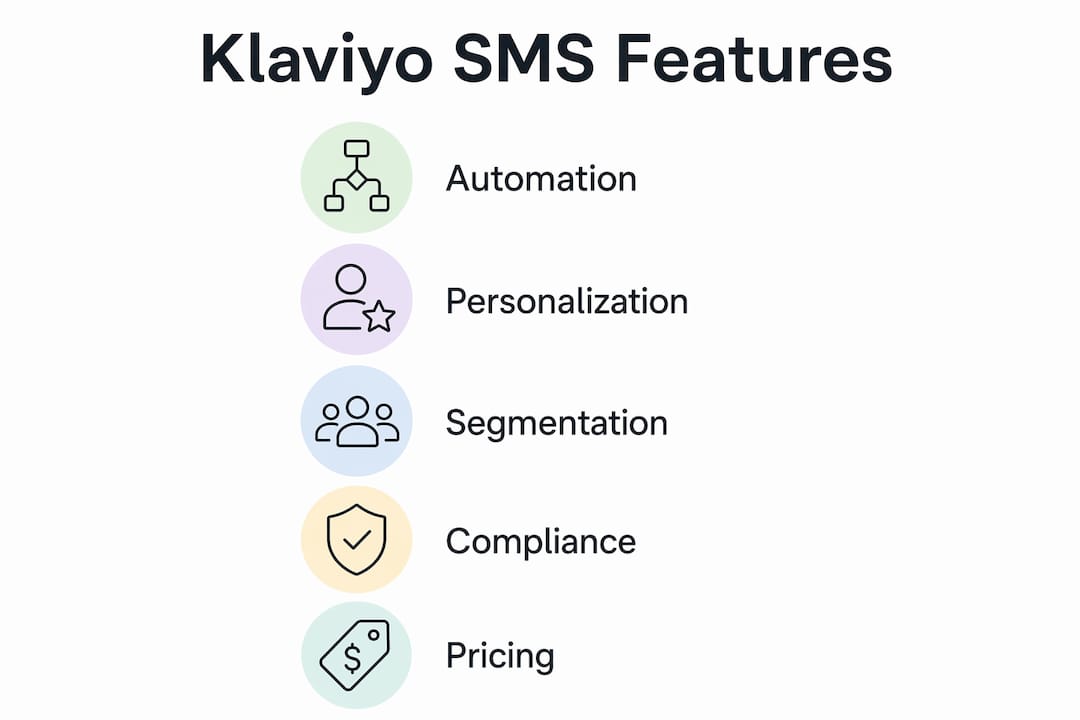
Personalization pulls from unified customer profiles. Every message can include the customer’s name, the specific product they viewed, or a discount tied to their purchase history. Klaviyo’s AI-driven segmentation groups customers by behavior, spend level, or engagement frequency, so you send the right message to the right group.
Message types and credit costs work as follows:
- Standard SMS: 1 credit per message, approximately $0.01 per credit for US sends
- MMS: 3 or more credits per message, depending on file size and carrier
- Credits are consumed per send and unused credits do not roll over to the next billing period
Pricing starts at $35 per month for up to 500 contacts, with SMS credits included at that tier. Beyond the included credits, billing scales by usage and contact volume. There is no flat rate for unlimited sends. Budget planning requires tracking both your contact count and your average monthly send volume.
Pro Tip: Run a 30-day send volume estimate before committing to a tier. MMS messages consume credits three times faster than SMS, so a campaign heavy on images can exhaust your monthly credits faster than expected.
Setup requires enabling SMS inside your Klaviyo account, acquiring a toll-free number or branded sender ID, and configuring consent separately from email consent. Klaviyo manages sender numbers and compliance settings on a country-by-country basis.
How does Klaviyo SMS integrate with email and ecommerce data?
The role of SMS in Klaviyo is to act as a fast, high-attention layer on top of your existing email strategy. Email builds the relationship over time. SMS closes the gap when timing is critical.
Klaviyo’s B2C CRM stores a single customer profile that captures every interaction across channels. When a customer opens an email, clicks a product link, or completes a purchase on Shopify, BigCommerce, or WooCommerce, that event updates their profile in real time. Klaviyo’s ecommerce integrations make this data immediately available for SMS triggers, which means your text messages reflect what the customer just did, not what they did last week.
The most effective cross-channel flows follow a clear logic:
- Send an email first for any non-urgent communication
- Wait a defined period, typically 4–8 hours, to check if the email was opened
- If the email remains unopened, trigger an SMS with a shorter, more direct message
- Reserve MMS for high-value moments like product launches or loyalty rewards
This approach, called channel-shifting, reduces the risk of over-messaging. Customers who already engaged with your email do not receive a redundant text. Customers who missed the email get a second chance through a channel with much higher open rates.
Flash sales are the clearest example of SMS doing what email cannot. A flash sale running for 6 hours cannot wait for a 24-hour email open window. An SMS sent at the moment the sale starts reaches the customer immediately. Pair that with a remarketing strategy that retargets non-purchasers after the sale, and you have a complete campaign structure.
Pro Tip: Build your SMS flows inside the same Klaviyo flow as your email steps. Using a single flow with conditional splits for channel preference keeps your logic clean and your reporting unified.
Compliance and consent requirements for Klaviyo SMS
SMS compliance is not optional. Sending texts without explicit, verifiable consent exposes your brand to legal liability and carrier filtering that can block your messages entirely.
Klaviyo requires SMS consent to be collected separately from email consent. A customer who opted into your email list has not consented to receive texts. You need a dedicated opt-in mechanism, such as a keyword opt-in via text, a checkout checkbox specifically for SMS, or a sign-up form with a clearly labeled SMS consent field.
Key compliance requirements include:
- Explicit opt-in before any marketing SMS is sent
- Clear disclosure of message frequency at the point of opt-in
- A working opt-out keyword, typically STOP, included in every message
- Country-specific sender number setup managed inside Klaviyo’s settings
- Separate consent records for email and SMS stored in the customer profile
Subscriber fatigue is the most common compliance-adjacent problem ecommerce marketers face. Sending SMS only when email fails to engage is the most practical way to keep opt-out rates low. Practitioners recommend treating SMS as a high-value, low-frequency channel. 72% of consumers are willing to receive weekly brand texts, but that ceiling drops fast if the messages feel irrelevant or repetitive.
Pro Tip: Audit your SMS opt-out rate monthly. A rate above 2% signals that your message frequency or content relevance needs adjustment before you scale send volume.
Effective Klaviyo SMS campaign types and practical tips
The most effective Klaviyo SMS campaigns share one quality: they arrive at the exact moment the customer needs them.
Transactional messages, such as order confirmations, shipping updates, and delivery notifications, are the best starting point for any ecommerce brand new to SMS. They are expected, welcomed, and non-intrusive. They also build the trust that makes promotional messages more effective later. A customer who received accurate shipping updates from you is far more likely to open your next flash sale text.
Beyond transactional messages, the highest-performing SMS use cases for ecommerce are:
- Abandoned cart recovery: A short, direct text with a link to the cart, sent 4–8 hours after email, recovers customers who missed the email
- Flash sales and limited-time offers: Time-sensitive promotions where SMS urgency directly accelerates purchase decisions
- Back-in-stock alerts: Customers who requested a notification expect an immediate text, not a delayed email
- Personalized product recommendations: AI-driven suggestions based on past purchases, sent after a defined post-purchase window
- Loyalty and VIP rewards: Exclusive offers sent to high-spend segments reinforce retention without discounting broadly
“SMS marketing’s strength lies in transactional messages that build trust before promotional outreach.” — Rob Hand, Klaviyo
Message length discipline matters. SMS character limits are real constraints. A message that wraps into two texts doubles your credit cost and often reads as disjointed. Write every SMS to land the key point in one message. Lead with the offer or update, follow with the link, and end with the opt-out reminder. That structure fits within a single SMS credit and respects the customer’s attention.
Monitor click-through rate, conversion rate, and opt-out rate for every SMS campaign. If click-through is low, the message content or timing is off. If conversion is low but click-through is high, the landing page or offer needs work. Opt-out rate tells you whether your frequency is sustainable. Use these three metrics to guide every optimization decision.
Key Takeaways
Klaviyo SMS marketing works best when it is treated as a precision channel, not a broadcast tool, and integrated directly with email flows and ecommerce behavioral data.
| Point | Details |
|---|---|
| SMS drives purchase urgency | 65% of consumers buy earlier than planned due to SMS urgency, making it a direct conversion tool. |
| Credits determine your budget | Standard SMS costs 1 credit; MMS costs 3 or more. Plan send volume before choosing a pricing tier. |
| Consent must be separate | SMS opt-in is legally distinct from email opt-in. Collect and store both independently in Klaviyo. |
| Channel-shifting reduces fatigue | Send SMS only after email goes unopened for 4–8 hours to protect opt-out rates and subscriber trust. |
| Transactional messages build trust first | Start with order and shipping updates before adding promotional SMS to your flow sequence. |
SMS and email together: what I’ve learned running Klaviyo for ecommerce brands
Most ecommerce marketers add SMS to Klaviyo and immediately start sending promotional blasts. That is the wrong move. The brands that see the strongest results from Klaviyo SMS email plus SMS integration start with transactional messages and earn the right to send promotions later.
The channel-shifting approach is where I see the biggest gap between brands that get SMS right and those that burn their lists. Sending a text to every subscriber every time you run a sale is a fast path to high opt-out rates and carrier filtering. Sending a text only to subscribers who did not open your email, at the right moment, is a completely different experience for the customer.
The compliance setup is also consistently underestimated. I have seen brands spend weeks building SMS flows only to discover their consent capture was not legally compliant for their primary market. Getting the SMS consent configuration right before you build anything else saves significant rework.
The future of Klaviyo SMS is deeper AI personalization at the individual message level. Klaviyo’s platform already uses behavioral data to time and target messages. The next step is dynamic message content that adapts to each customer’s current context, not just their historical behavior. Brands that build clean, well-segmented SMS lists now will be positioned to use those capabilities as they roll out.
— Take
How Take-action helps ecommerce brands get Klaviyo SMS right
Setting up Klaviyo SMS correctly from the start, including consent capture, flow architecture, and credit budgeting, requires more than reading documentation.
Take-action is a Klaviyo-focused email and retention agency that builds the full system for ecommerce brands: SMS and email flow setup, abandoned cart recovery, post-purchase sequences, and campaign strategy. The work is grounded in behavioral data and built to generate measurable revenue, not just send volume. If your brand is ready to add SMS as a real revenue channel alongside email, Take-action builds and manages that system for you.
FAQ
What is Klaviyo SMS marketing?
Klaviyo SMS marketing is the practice of sending personalized, behavior-triggered text messages through Klaviyo’s B2C CRM platform. It connects SMS directly to ecommerce data, including purchase history and browsing behavior, to automate timely, relevant messages.
How much does Klaviyo SMS cost?
Klaviyo SMS pricing starts at $35 per month for up to 500 contacts, with SMS credits included. Standard SMS costs approximately $0.01 per credit, and MMS messages consume 3 or more credits each.
Does Klaviyo SMS require separate consent from email?
Yes. SMS consent must be collected separately from email consent. A customer who opted into your email list has not given permission to receive text messages, and sending without explicit SMS opt-in violates carrier and legal requirements.
What are the best use cases for Klaviyo SMS campaigns?
The highest-performing use cases are abandoned cart recovery, flash sale alerts, back-in-stock notifications, shipping updates, and personalized loyalty offers. Transactional messages are the best starting point for brands new to SMS.
How does Klaviyo SMS work with email marketing?
Klaviyo SMS and email share a unified customer profile, so both channels draw from the same behavioral data. The most effective strategy sends email first and triggers SMS only if the email goes unopened, reducing subscriber fatigue and keeping opt-out rates low.