

How to Tell a Brand Story: A Practical Playbook
Tell a brand story by putting the customer first: name their problem clearly, show how you guide them to a specific outcome, and prove it with real customer evidence. That’s the whole method. Everything else is execution.
HubSpot recommends building a single core narrative your entire team can repeat consistently, organized around four pillars: People, Places, Purpose, and Plot. Before you write a word, run this checklist to confirm your draft has the right bones:
- Customer as hero: The story centers on your customer’s transformation, not your company’s achievements.
- Clear conflict: You’ve named at least one external obstacle (the practical problem), one internal struggle (how it makes them feel), and one philosophical tension (why it’s wrong that this problem exists).
- Brand as guide: You show empathy first, then authority. You don’t describe your product until you’ve earned the guide role.
- A simple plan: You offer a clear, believable path from problem to resolution, in three steps or fewer.
- Proof: At least one specific customer outcome, number, or quote backs the resolution.
- One-breath test: A stranger can repeat the story in a single breath after hearing it once.
Pro Tip: Interview at least ten current customers before writing anything. A meaningful number of customer interviews is needed to surface reliable language patterns — the words they use, not the words you’d choose — and those patterns become the raw material for every story element above.
Table of Contents
- How to tell a brand story: a step-by-step framework
- How to collect customer interviews that actually build your story
- What are the core elements every brand story needs?
- Five brand story examples worth learning from
- How do you use your brand story across different channels?
- What mistakes make brand stories fall flat?
- What does a one-paragraph brand story template look like?
- Key Takeaways
- The part of brand storytelling most agencies skip
- Your brand story belongs in your email flows, not just your About page
- Useful sources
How to tell a brand story: a step-by-step framework
This six-step process moves from discovery to deployment. Each step has a clear deliverable so the work stays concrete.
Step 1: Audit what you’re already saying
Most brands are already telling a story unintentionally. Before inventing a new narrative, audit your existing customer-facing assets — homepage copy, email sequences, social bios, sales decks, packaging. Look for the story that’s already there, even if it’s muddled or brand-centered. Note recurring themes, the language customers use in reviews, and any tension that surfaces naturally.
Deliverable: A one-page summary of your current story, its protagonist (you or your customer?), and the gaps.
Step 2: Run customer interviews
Interview a minimum of ten current customers. Record the calls. Transcribe them. You’re listening for three things: what life looked like before your product, the emotional weight of the problem, and the specific language they use to describe the change. This is your story’s raw material, not your marketing team’s brainstorm.
Deliverable: Ten transcripts tagged by problem, emotion, and outcome.
Step 3: Identify the conflict layers
From the transcripts, extract the three conflict layers. The external conflict is the practical obstacle. The internal conflict is how that obstacle made the customer feel. The philosophical conflict is the broader injustice — why this problem shouldn’t exist in the first place. Most brand stories stop at the external layer and wonder why they feel flat.
Deliverable: One sentence per conflict layer.
Step 4: Draft the one-paragraph story
Write a single paragraph using the fill-in-the-blank template in Section 8. Cast the customer as the hero. Position your brand as the guide. Include the plan and the resolution. Keep it under 100 words.
Deliverable: A draft one-paragraph story.
Step 5: Run the Casting Test and the one-breath test
Strip all brand and founder names from the draft. Read it aloud. If the protagonist that emerges is your company rather than your customer, the story is miscast. Rewrite until the customer is clearly the hero. Then read the paragraph to five people who have no connection to your company — not employees, not friends, not investors. If they can’t repeat the core idea back in their own words, simplify.
Deliverable: A validated one-paragraph story that passes both tests.
Step 6: Build modular assets and deploy
HubSpot calls this a “story arsenal” — a set of modular assets (one-liners, testimonial clips, micro-stories, subject lines, taglines) that can be recombined across channels without losing the core narrative. Assign each asset to a channel and a funnel stage.
Deliverable: A story arsenal of at least six assets across three channels.
Rollout checklist for cross-team alignment:
- Sales team has the one-liner and three customer proof points.
- Product team knows the philosophical conflict the brand is solving.
- Customer experience team uses the guide language (empathy first, authority second) in every touchpoint.
- Email and retention flows reflect the story’s resolution and proof.
- All new campaign copy is checked against the one-paragraph story before launch.
How to collect customer interviews that actually build your story
The research method is where most brand stories either earn their credibility or lose it. A story built from a whiteboard session sounds like it came from a whiteboard session. One built from customer transcripts sounds like the customer wrote it.
Sampling: why ten interviews is the floor
Experts recommend a minimum of ten customer interviews to surface reliable language patterns. Below that number, you’re likely hearing individual quirks rather than shared experiences. Ten interviews give you enough repetition to spot the phrases that appear across multiple customers — those repeated phrases are your messaging pillars.
Choose customers who have been with you long enough to describe a before-and-after transformation. Avoid brand evangelists who only praise you; you need people who can articulate the struggle.
Interview questions that reveal the story
Ask open-ended questions that pull out emotional language and stakes:
- “What was happening in your life or business right before you found us?”
- “What had you already tried, and why didn’t it work?”
- “What was the moment you realized something needed to change?”
- “How did the problem make you feel day-to-day?”
- “What does life or work look like now, compared to then?”
- “How would you describe what we do to a friend who’s never heard of us?”
Question 6 is the most valuable. The customer’s answer is often the clearest version of your brand story you’ll ever hear.
Recording, tagging, and synthesizing
Record every interview with the customer’s permission. Use a transcription tool like Otter.ai or Rev to generate text quickly. Then tag each excerpt with one of three labels: Problem, Emotion, or Outcome. After ten interviews, sort the tags. The phrases that appear most often across the Problem and Emotion columns become your conflict language. The Outcome column gives you your proof points.
| Raw excerpt | Tag | Evidence strength |
|---|---|---|
| “I was spending hours every week on this and still felt behind.” | Problem / Emotion | High (specific + emotional) |
| “Nothing I tried before actually stuck.” | Problem | Medium (common, needs specificity) |
| “Within two months, I stopped worrying about it entirely.” | Outcome | High (time-bound, emotional) |
| “It felt like finally having someone in my corner.” | Emotion | High (vivid, repeatable metaphor) |
| “I’d describe it as a system that just works.” | Outcome | Medium (vague, needs a number) |
Pro Tip: After synthesizing your transcripts, read the top five phrases aloud to someone outside your company. Ask them to describe the brand in one sentence. If their description matches your intended story, your language is working. If it doesn’t, the gap between what you think you’re saying and what customers hear is your first rewrite.
What are the core elements every brand story needs?
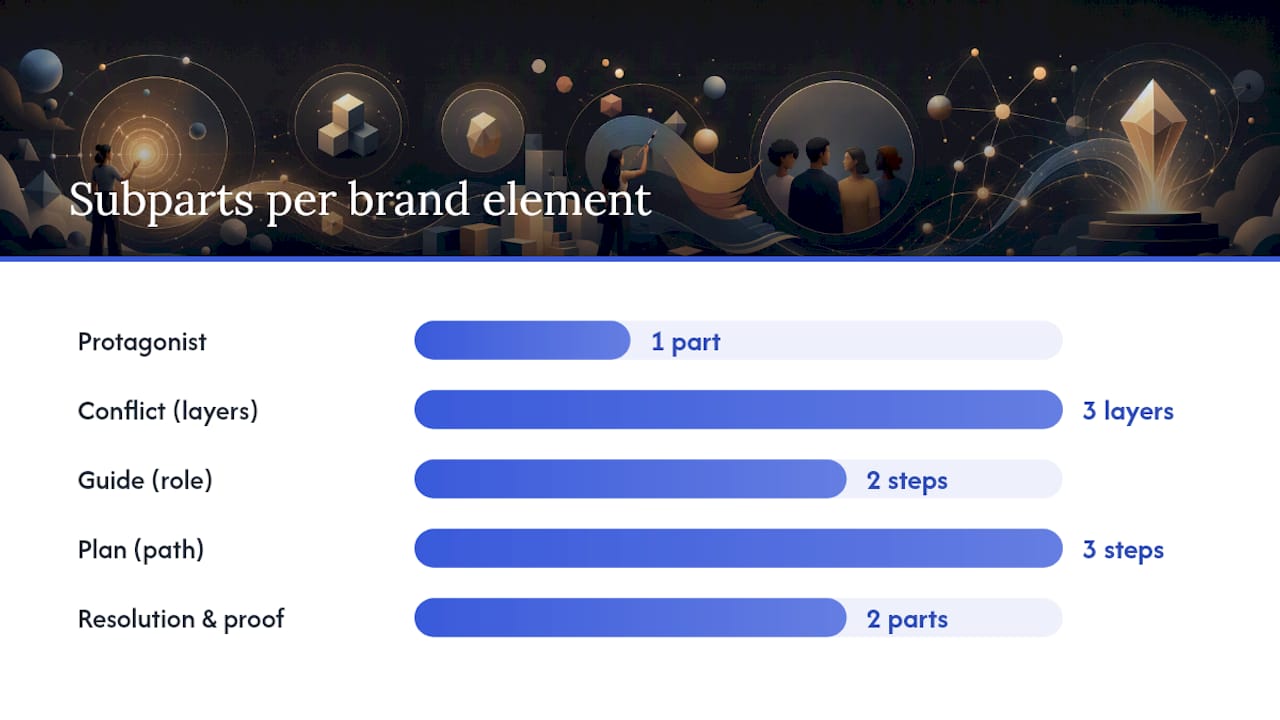
The StoryBrand framework identifies five structural elements that every effective brand story shares. Miss one and the narrative loses either clarity or emotional pull.
- The protagonist (your customer): The story is about their life, their goal, their transformation. Not your founding story. Not your product features. The customer’s journey is the plot.
- The conflict (three layers): External conflict is the practical obstacle — the thing blocking the goal. Internal conflict is the emotional weight it carries. Philosophical conflict is the broader injustice — why this problem shouldn’t exist. Addressing all three is what separates a story that resonates from one that merely informs.
- The guide (your brand): You enter the story not as the hero but as the mentor. Show empathy first — prove you understand the struggle. Then show authority — demonstrate you’ve helped others through it. Don’t describe your product until you’ve earned this role.
- The plan: A simple, believable path from problem to resolution. Three steps or fewer. Complexity here kills trust.
- The resolution and proof: What does success look like for the customer? State it specifically, then back it with evidence. A real brand story pairs aspiration with proof — customer numbers, testimonials, or concrete outcomes that make the resolution credible.
Pro Tip: Run the Casting Test before any story goes public: remove your brand name and founder name from the draft. Read it aloud. If the protagonist that emerges is your company, rewrite. The customer must be the clear center of gravity.
Five brand story examples worth learning from
Each example below follows the same five-element structure. The analysis focuses on which element is strongest and what you can copy directly.
1. The outdoor gear brand that leads with the philosophical conflict
A mid-size outdoor apparel company built its story around a single idea: “The wild shouldn’t be a luxury.” Their customer is the person who grew up without access to outdoor spaces and now wants to reclaim that connection. The external conflict is cost and access. The internal conflict is feeling like outdoor culture isn’t for people like them. The philosophical conflict — that nature should be accessible to everyone — is what makes the story stick.
What works: The philosophical layer does the heavy lifting. It turns a gear purchase into a values statement. What to copy: Write your philosophical conflict as a one-sentence injustice (“It’s wrong that X”). Post it on your About page before any product description.
2. The B2B software company that leads with the emotional layer
A project management platform’s story centers on a marketing manager who spends her Sundays catching up on work that should have been done Friday. The external conflict is disorganized workflows. The internal conflict is the guilt and anxiety of feeling perpetually behind. The brand positions itself as the guide that gives her Sundays back.
What works: The emotional layer (Sunday guilt) is more specific and memorable than “save time.” What to copy: Name the exact moment your customer feels the problem most acutely. That moment is your emotional hook.
3. The DTC skincare brand that leads with proof
A direct-to-consumer skincare brand built its story around a founder who couldn’t find products that worked for her skin type. The story is hers, but the resolution belongs to the customer: “Many customers saw a visible difference within about a month.” The proof point is front and center on the homepage, not buried in a product page.
What works: Aspiration paired with a specific, time-bound outcome earns trust faster than any claim alone. What to copy: Find your single strongest outcome metric and put it in the resolution sentence of your one-paragraph story.
4. The local service business that leads with the external conflict
A home renovation contractor built its story around one specific frustration: contractors who don’t show up when they say they will. The external conflict is unreliability. The internal conflict is the stress of planning around someone else’s schedule. The philosophical conflict is that homeowners deserve to be treated like adults. The plan is three steps: one call, one fixed date, one completed job.
What works: Naming a competitor’s failure (without naming the competitor) positions the brand as the obvious alternative. What to copy: Identify the most common complaint about your category, not just your brand, and make it the external conflict.
5. The nonprofit that leads with the resolution
A literacy nonprofit opens every piece of communication with the outcome, not the problem: “A child who reads by third grade is four times more likely to graduate high school.” The story works backward from that resolution to the conflict (early reading gaps) and the guide role (trained volunteers). Donors see the destination before they’re asked to fund the journey.
What works: Leading with the resolution creates urgency without manipulation. What to copy: Write your resolution sentence first. If it’s compelling on its own, your story has a strong anchor.
| Example | Dominant element | Conflict layer | Proof type |
|---|---|---|---|
| Outdoor apparel | Philosophical conflict | All three layers | Values alignment |
| B2B software | Internal/emotional | Emotional + external | Specific moment |
| DTC skincare | Proof/resolution | External + internal | Outcome metric |
| Local contractor | External conflict | External + philosophical | Process clarity |
| Nonprofit | Resolution first | External | Statistical outcome |
For more deconstructed examples across retail and fashion contexts, this breakdown of storytelling techniques is worth a read.
How do you use your brand story across different channels?
The one-paragraph story is your source document. Every channel gets a version adapted to its job — attention, proof, conversion, or retention — but the core conflict, guide role, and resolution never change.
Channel checklist:
- Homepage hero: Lead with the customer’s conflict and the resolution. The guide role lives in the subheadline or supporting copy. Keep it to two sentences.
- About page: This is where the full one-paragraph story lives, plus the founder’s empathy story (why they understood the problem) and two or three proof points.
- Email welcome sequence: The first email introduces the guide role. The second email names the conflict in the customer’s own language. The third email delivers the first proof point.
- Paid ads: One conflict layer per ad. Test external vs. internal vs. philosophical to see which resonates with your audience segment.
- Sales decks: Open with the customer’s problem, not your company overview. The guide role and plan come after the conflict is established.
- Packaging and post-purchase: Reinforce the resolution. The customer just made a decision — remind them what success looks like.
Three email copy snippets that carry the story
These translate the one-paragraph story into email-specific formats. Adapt the bracketed placeholders to your brand.
-
Welcome email subject line: “You’ve been dealing with [external conflict] long enough.” Preview text: “Here’s what changes from here.” Body (first two sentences): “We know [internal conflict — how it feels]. That’s exactly why we built [brand] the way we did — and why [specific customer outcome] is what we measure our work by.”
-
Abandoned cart subject line: “Still thinking it over? Here’s what [customer name] said.” Preview text: “Real words from someone who was exactly where you are.” Body: One customer quote that names the before-state, the decision, and the after-state. Three sentences maximum.
-
Post-purchase email subject line: “You made the right call. Here’s proof.” Preview text: “[Outcome metric] — and counting.” Body: Restate the resolution in one sentence. Add one proof point. Set the expectation for what comes next.
Pro Tip: Tag your email campaigns by story theme (conflict, guide, proof, resolution) in your analytics platform. After 90 days, you’ll see which narrative layer drives the highest open and click rates for your specific audience. That data tells you where to lean harder in future campaigns. HubSpot recommends mapping narrative themes to funnel KPIs for exactly this kind of ongoing optimization.
Building a brand content strategy that retains customers means keeping the story consistent across every touchpoint, not just the launch moment.
What mistakes make brand stories fall flat?
Most brand story failures come down to one of five patterns. Each one has a two-step fix.
-
Brand-as-hero: The story centers on the company’s journey, achievements, or values rather than the customer’s transformation. Fix: Run the Casting Test. Rewrite every “we” sentence as a “you” sentence until the customer is the protagonist.
-
No emotional layer: The story names the external problem but skips the internal and philosophical conflicts, leaving it feeling informational rather than resonant. Fix: Add one sentence per conflict layer. Ask: “How does this problem make the customer feel?” and “Why is it wrong that this problem exists?”
-
No proof: The resolution is aspirational but unsubstantiated. Readers don’t believe it. Fix: Add one specific customer outcome — a number, a time frame, or a direct quote — to the resolution sentence.
-
Too complex to repeat: The story has too many characters, too many steps, or too many ideas. A stranger can’t retell it. Fix: Apply the five-person external test. If fewer than four of five listeners can repeat the core idea, cut until they can.
-
Inconsistent deployment: The story lives on the About page but disappears from email, ads, and sales conversations. Each channel tells a slightly different version. Fix: Build the story arsenal (one-liners, proof snippets, taglines) and distribute it to every team with a one-page brief before launch.
Red-flag checklist before rollout:
- Does the draft pass the Casting Test (customer is the protagonist)?
- Are all three conflict layers present?
- Is there at least one specific proof point in the resolution?
- Can a stranger repeat the core idea in one breath?
- Does every channel version trace back to the same one-paragraph source document?
- Has the story been reviewed by someone outside the marketing team?
If any answer is no, the story isn’t ready.
What does a one-paragraph brand story template look like?
Here’s the fill-in-the-blank template. Each placeholder has a one-line instruction.
The one-paragraph template:
“[Customer description] wants [specific goal], but [external conflict]. Worse, [internal conflict — how it makes them feel]. It shouldn’t be this way — [philosophical conflict]. That’s why [brand name] [guide role: empathy + authority]. With [simple 2–3 step plan], [customer description] can [resolution: specific outcome]. And [proof: customer quote, metric, or time frame].”
Instructions for each placeholder:
- Customer description: Use the exact language from your interview transcripts. Not “busy professionals” — “marketing managers who run campaigns without a dedicated team.”
- Specific goal: The outcome they want, not the product they need.
- External conflict: The practical obstacle blocking the goal.
- Internal conflict: The emotional weight of that obstacle.
- Philosophical conflict: The one-sentence injustice.
- Guide role: One sentence showing empathy, one showing authority.
- Simple plan: Two or three steps, named simply.
- Resolution: The specific, believable outcome.
- Proof: One real data point or customer quote.
Three tagline formulas tied to story goals
- Awareness: “[Philosophical conflict, reframed as a belief] — [brand name].” Example: “Everyone deserves a Sunday. [Brand].”
- Trust: “We’ve helped [number] [customer type] [achieve outcome]. You’re next.” Example: “We’ve helped 400 founders stop losing sleep over their books. You’re next.”
- Conversion: “[External conflict]? [Simple plan in one phrase] — [brand name].” Example: “Still chasing abandoned carts? Three flows, one system — [Brand].”
Two completed sample paragraphs
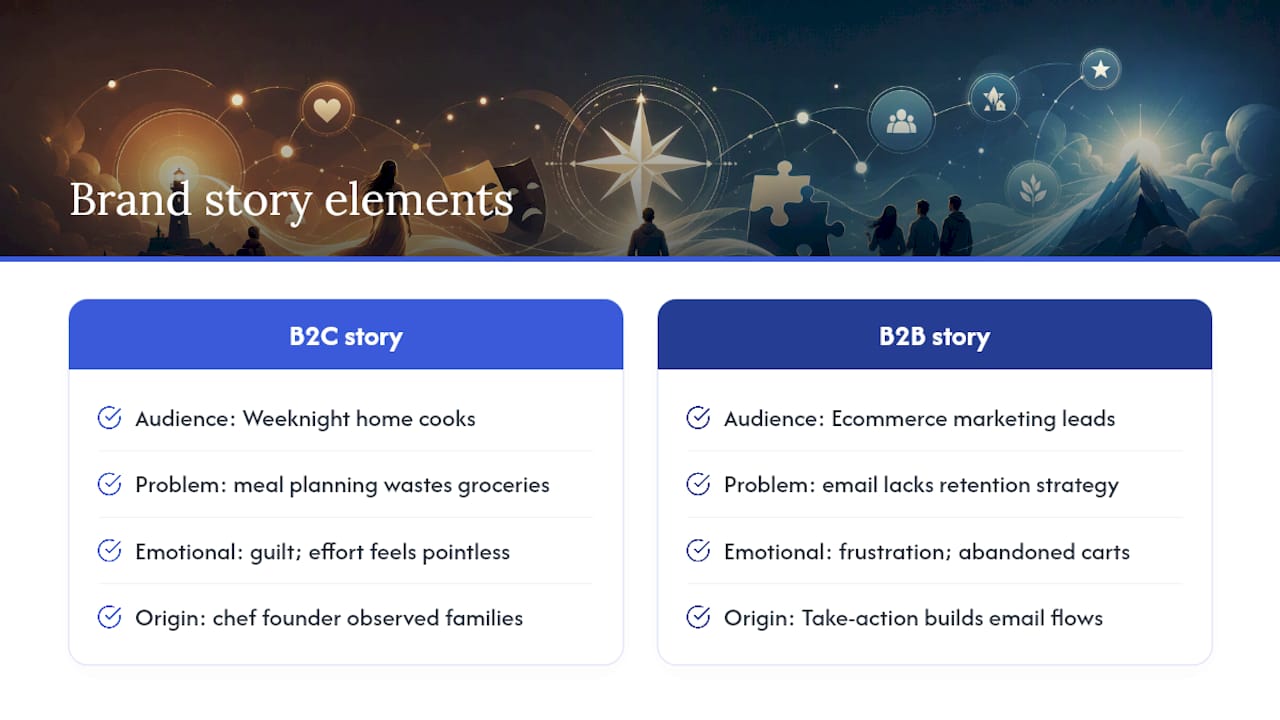
B2C example: “Home cooks who want to eat well on weeknights struggle to plan meals without wasting half the groceries they buy. Worse, the guilt of throwing out food makes the whole effort feel pointless. It shouldn’t be this hard to cook at home. That’s why [Brand] was built by a chef who spent years watching families give up on cooking — and then figured out why. With a weekly plan, a smart shopping list, and 30-minute recipes, home cooks can eat well every night without the waste. Customers report cutting their grocery bill by a third within the first month.”
B2B example: “Marketing leads at growing ecommerce brands want email to drive real revenue, but most are running campaigns without a clear retention strategy. The frustration of watching open rates drop and carts go abandoned makes the channel feel like a dead end. Email shouldn’t be an afterthought. That’s why Take-action works with brands to build automated flows that carry the brand story from the first welcome email through post-purchase. With audience segmentation, story-led copy, and Klaviyo automation, brands recover abandoned revenue and build the kind of customer relationships that don’t depend on the next ad spend.”
Pro Tip: Once the one-paragraph story is finalized, print it and put it at the top of every creative brief. Every piece of content your team produces should be traceable back to at least one element of that paragraph. If it isn’t, it probably doesn’t need to exist.
Key Takeaways
A brand story works when the customer is the hero, the conflict has three layers, and the resolution is backed by real proof — everything else is decoration.
| Point | Details |
|---|---|
| Customer is the hero | Run the Casting Test: strip brand names and confirm the customer is the protagonist before publishing. |
| Interview at least ten customers | Ten interviews surface reliable language patterns; fewer risks building a story on individual quirks. |
| Name all three conflict layers | External, internal, and philosophical conflicts together create emotional depth that a single-layer story can’t match. |
| Proof anchors the resolution | Pair every resolution claim with a specific customer outcome, metric, or direct quote to earn trust. |
| Take-action translates story into email | Take-action builds Klaviyo flows and retention sequences that carry the brand story from welcome through post-purchase. |
The part of brand storytelling most agencies skip
Most brand storytelling advice stops at the one-paragraph template and calls it done. The harder, more valuable work is what happens after: getting that story into the hands of every team, in a format they can actually use, and then measuring whether it’s working.
At Take-action, the approach starts with the research. Before any email flow is built or any campaign goes live, the story has to be grounded in customer language — not the language the brand wishes its customers used, but the words that actually appear in transcripts and reviews. That’s the only version of a story that holds up across channels without constant revision.
The philosophical conflict layer is where most brands underinvest. It’s also the layer that drives the deepest retention. When a customer believes your brand stands for something beyond the product, they don’t just buy again — they tell other people. That word-of-mouth loop is what makes a brand story a long-term asset rather than a campaign device.
The measurable outcomes Take-action targets when implementing story-driven email programs: higher open rates on conflict-led subject lines, improved click rates on proof-based body copy, and recovered abandoned cart revenue from flows that speak to the emotional layer of the purchase decision.
Your brand story belongs in your email flows, not just your About page
Most brands spend weeks crafting a brand story and then let it sit on the About page while their email sequences read like generic promotional blasts. The story you just built deserves better distribution than that.
Take-action specializes in translating a brand’s core narrative into Klaviyo email flows and retention sequences that actually carry the story: welcome emails that establish the guide role, abandoned cart flows that speak to the emotional conflict, and post-purchase sequences that reinforce the resolution with proof. The result is an email channel that feels like a conversation with a brand customers trust, not a broadcast from a company they barely remember signing up for.
If you want help turning your one-paragraph story into email flows that drive open rates, click rates, and recovered revenue, book a discovery call with Take-action and we’ll show you exactly where your current sequences are leaving the story behind.
Useful sources
These are the primary references behind this playbook. Each one contributes something specific.
- Storytelling in Branding: How To Craft a Story That Sells | Shopify — Practical guidance on pairing aspiration with proof points and founder story integration.
- What Is a Brand Story? | HBS Online — Academic framing of brand storytelling as a strategy for identity, values, and emotional connection.
- Best Storytelling Examples for Marketers | Corrado Manenti — Curated examples and empathetic narrative techniques across retail and fashion contexts.
- How to Enhance Brand Storytelling for Lasting Impact | Corrado Manenti — Tactical suggestions for elevating storytelling execution in retail and brand contexts.
- Customer Testimonials for Ecommerce Brands | Take-action — Practical guidance on collecting and deploying customer proof points in brand-led marketing.
- Branding and Positioning: The Ecommerce Retention Edge | Take-action — How consistent brand voice drives retention and why positioning matters beyond acquisition.