

How to Choose a Brand Positioning Agency That Wins
TL;DR:
- Brand positioning is a strategic process of defining where a brand competes and who it serves, not just storytelling. Effective agency work begins with research, leadership alignment, and clear trade-offs, ensuring lasting market differentiation. Premature focus on visual identity or superficial changes often undermines true positioning efforts and wastes resources.
Most businesses assume a brand positioning agency is hired to craft a compelling story. That’s a costly misunderstanding. Brand positioning is not storytelling. It is the strategic decision of where your brand competes, who it serves, and who it deliberately excludes. Global brand values exceed $3.6 trillion as of 2026, which tells you that the commercial stakes of getting positioning right are enormous. This guide breaks down exactly how brand positioning agencies operate, what to look for when selecting one, and how to extract real, measurable value from the engagement.
Table of Contents
- Key Takeaways
- What a Brand Positioning Agency Actually Does
- How to select the right agency
- The agency engagement process, from start to finish
- Pitfalls that waste budget and erode results
- My honest take on what agency positioning work really requires
- Take-action can help you put strategy into motion
- FAQ
Key Takeaways
| Point | Details |
|---|---|
| Positioning is strategic, not cosmetic | A brand positioning agency defines market trade-offs before any visual or messaging work begins. |
| Discovery drives everything | Agencies spend 30 to 60 days in research before producing a single strategic output. |
| Leadership alignment is non-negotiable | Internal consensus on positioning decisions determines whether agency work actually gets implemented. |
| Activation tools extend the investment | Great agencies leave behind frameworks your team uses independently long after the engagement ends. |
| Repositioning requires managing legacy equity | You cannot discard prior brand assets carelessly without destroying the trust you’ve already built in market. |
What a Brand Positioning Agency Actually Does
There is a distinction that separates effective positioning work from expensive decoration. Brand strategy consulting focuses on positioning, target audiences, value proposition, and growth. Visual identity follows that foundation. Strategy provides the blueprint. Identity is the building. Confusing the two is how brands end up with a gorgeous logo and no clear reason for customers to choose them over a competitor.
A brand positioning agency takes you through a structured process. It starts with discovery, where the agency conducts stakeholder interviews, customer research, and competitive brand analysis to understand where you currently sit in the market. Then comes leadership alignment, a phase many companies skip and later regret deeply. After alignment is achieved, the agency develops a positioning framework, message architecture, and the tools needed to translate strategy into execution across channels.
Pro Tip: Before signing any contract, ask the agency to walk you through their discovery process in detail. If they skip directly to creative concepts, that is a signal they are a brand identity services shop, not a brand strategy firm.
Why does leadership alignment matter so much at this early stage? Because the most common reason positioning work fails is not weak strategy. It is internal disagreement about direction that surfaces after the agency has already delivered the work. Getting leaders into alignment before development begins prevents this expensive pattern.
How to select the right agency
Not every brand positioning agency is the right fit for every business. Here is what you should be evaluating before you sign anything.
- Strategic depth. Does the agency lead with research and competitive brand analysis, or do they lead with portfolio samples? The best branding agencies build recommendations on evidence, not aesthetics.
- Sector experience. A branding strategy consultant who has worked in your category understands your competitive context without weeks of catch-up. That experience compresses timelines and sharpens insight.
- Facilitation skills. This one is underappreciated. A neutral facilitator uses data to shift leadership conversations from subjective opinions to evidence-based decisions. If an agency cannot manage a room full of opinionated executives, their strategy will never be adopted.
- Boutique vs. large firm. Boutique agencies provide partner-led focus, while large firms offer scalability. If you need speed and direct senior attention, a boutique specialist typically delivers both. If you are managing a global repositioning with dozens of markets and stakeholders, a larger brand development agency has the infrastructure.
- Deliverable clarity. Ask specifically what you will receive at the end of the engagement. Message frameworks, positioning statements, decision criteria, sales enablement materials. Vague deliverables produce vague results.
Pro Tip: Request two or three references from past clients who operated in categories similar to yours. Ask those references specifically about the agency’s facilitation and whether leadership alignment was achieved. Creative awards are not a proxy for strategic effectiveness.
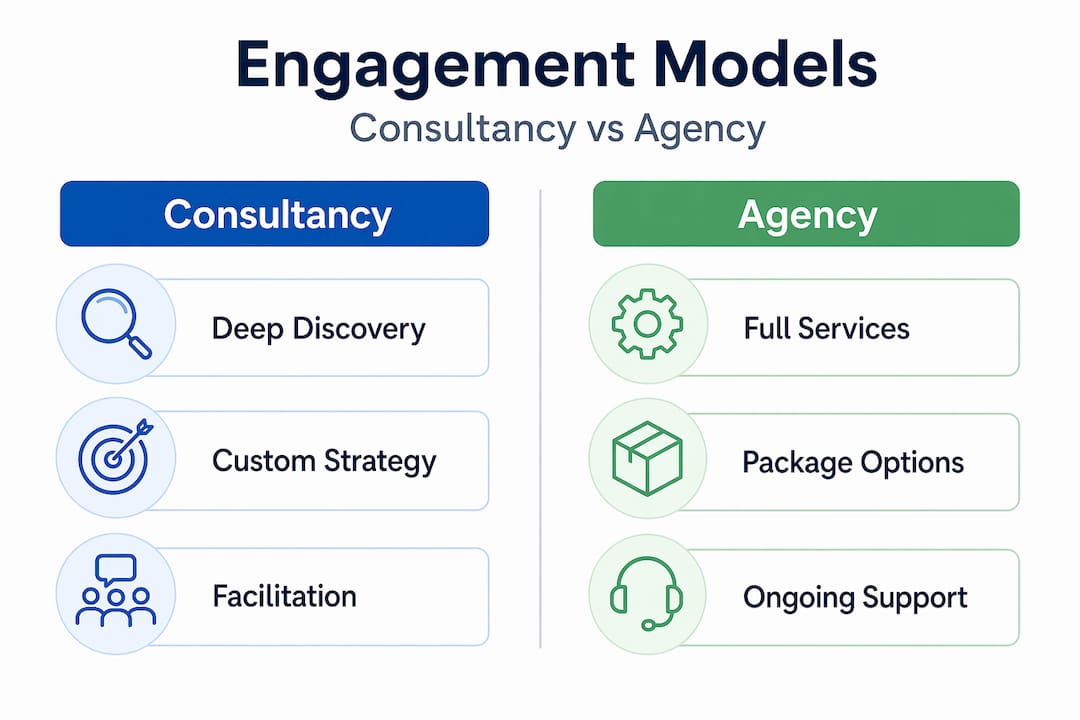
The consultancy vs. full-service agency distinction is also worth thinking through carefully. A consultancy specializing in brand positioning will often stop at strategy and hand execution to your internal team or a separate creative partner. A full-service brand development agency handles both. Each model has merit depending on your internal capabilities and budget.

The agency engagement process, from start to finish
Understanding what you are actually buying helps you hold an agency accountable and prepare your own team for what the engagement demands.
Discovery and research
Most agencies spend 30 to 60 days on immersion before delivering a strategic roadmap. During this phase, expect stakeholder interviews across leadership and front-line staff, customer surveys and qualitative conversations, and a thorough competitive brand analysis of both direct competitors and adjacent categories. Skipping strategic foundation leads to tactical, ineffective work. This phase is not billable padding. It is the most critical investment of the entire engagement.
Leadership alignment workshops
This is where the agency earns its fee. A skilled branding strategy consultant presents research findings and guides leadership through structured decisions about market focus. Who is the brand for? Who is it not for? What do you own in the category today versus where you need to compete tomorrow? These workshops convert opinion-based debates into decisions backed by market evidence.
Positioning framework development
After alignment is achieved, the agency builds the actual positioning framework. This typically includes a formal positioning statement, a value proposition hierarchy, message architecture organized by audience segment, and a competitive differentiation map. These outputs become the operating system for every piece of communication your brand produces going forward.
The table below shows how the two most common engagement models compare.
| Stage | Consultancy model | Full-service agency model |
|---|---|---|
| Discovery and research | Deep stakeholder interviews and data analysis | Same, often with larger research team |
| Strategy development | Positioning framework, message architecture | Same, plus creative brief integration |
| Creative execution | Handed to client or third party | Handled internally by agency |
| Activation tools | Messaging guidelines, decision frameworks | Full brand identity services and templates |
| Post-engagement support | Advisory retainer optional | Often included in broader retainer |
Activation tools and handoff
Activation tools empower brand teams to consistently apply positioning frameworks long after the agency relationship ends. These include decision criteria for content and campaign approvals, sales enablement materials that translate positioning into prospect conversations, and messaging playbooks that new hires can use to get up to speed quickly. The agencies that skip this step leave clients dependent on them for every subsequent decision. The ones that invest in it multiply the return on the original engagement many times over.
Pitfalls that waste budget and erode results
Even with the right agency, there are patterns that reliably undermine positioning work. Avoid these.
- Starting with visual identity. Hiring an agency for brand identity services before the strategic foundation is set produces beautiful assets with no coherent positioning behind them. Design should follow strategy, not precede it.
- Focusing on the tagline. Cosmetic changes alone fail to produce growth. A repositioning that only touches the tagline and logo without changing product, service, or customer experience is not a repositioning. It is a rebrand. These are not the same thing.
- Trying to appeal to everyone. Trying to appeal to everyone results in a diluted brand that lacks distinctiveness. Effective positioning is as much about what you say no to as what you say yes to. If your positioning statement could describe three of your competitors, it is not a position.
- Discarding legacy equity carelessly. Balancing what to keep and what to change is fundamental in repositioning. Brand equity is accumulated trust. Abandoning recognizable assets without a deliberate transition plan destroys that trust faster than poor marketing ever could.
- No measurement framework. Before the agency engagement concludes, agree on how you will measure the positioning’s effectiveness. Category share of voice, net promoter score movement, revenue from target segments. Position strategy without a measurement plan is untraceable and therefore indefensible in budget reviews.
Pro Tip: Demand a “what we are not” statement as part of your positioning framework. If the agency resists making explicit trade-offs, they are optimizing for client comfort rather than competitive clarity. The best brand positioning frameworks make uncomfortable choices on paper so you don’t make expensive ones in market.
My honest take on what agency positioning work really requires
I’ve watched businesses spend significant money on brand positioning work and walk away with a beautifully bound strategy document that collects dust. And I’ve seen the opposite too, where a well-run engagement reshapes how a company makes every subsequent decision. The difference rarely comes down to the agency’s creative talent.
What I’ve found consistently is that the business’s own leadership readiness is the primary variable. When a leadership team enters the engagement with unresolved disagreements about direction, those disagreements don’t disappear because a smart agency presents compelling research. They surface again, usually at the implementation stage, and derail everything.
The other thing I’ve come to believe strongly is that brand positioning is about clear choices on market segments, not storytelling craft. An agency that makes you feel inspired but avoids the hard specificity of who you serve and who you don’t is doing creative consulting, not positioning strategy. The discomfort of making explicit trade-offs is precisely where the value lives.
If you are evaluating agencies, look for the ones willing to tell you what your brand should stop doing. That is a harder conversation to have than any brand workshop exercise. It is also the one that produces lasting differentiation.
— Take
Take-action can help you put strategy into motion
Defining your positioning is only half the work. The other half is activating it consistently across every customer touchpoint, and that is exactly where many brands stall after the agency engagement ends.
At Take-action, we work with ecommerce brands to turn positioning strategy into revenue-generating customer journeys. Our email marketing and retention programs are built around your brand voice and positioning, using Klaviyo automation to deliver the right message to the right segment at every stage of the customer lifecycle. Whether you are launching a repositioned brand or scaling a defined identity, we help you build brand consistency through retention channels that compound over time. If you want to explore how your positioning can drive measurable retention growth, our agency team is ready to talk through your specific situation.
FAQ
What does a brand positioning agency actually deliver?
A brand positioning agency delivers a strategic positioning framework including a positioning statement, message architecture, competitive differentiation map, and activation tools your team uses post-engagement. Design and creative outputs follow this strategic foundation.
How long does a brand positioning engagement typically take?
Most agencies spend 30 to 60 days in the discovery and research phase alone, with full engagements typically running three to six months depending on organizational complexity and the scope of deliverables.
What is the difference between brand positioning and brand identity?
Brand positioning defines where and how you compete in the market, who you serve, and what makes you distinctly different. Brand identity services translate that strategy into visual and verbal expressions like logos, colors, and tone of voice.
How do I know if I need a brand positioning agency or a branding strategy consultant?
If your challenge is internal alignment and market strategy, a branding strategy consultant focused on research and facilitation is likely the right fit. If you also need full creative execution, a brand development agency that handles both strategy and identity is the stronger choice.
What is the biggest mistake companies make with positioning agencies?
Starting with visual identity before establishing a strategic foundation is the most common and expensive mistake. Effective positioning requires a research-backed strategy first. Creative execution without that foundation produces attractive assets that fail to differentiate.