

Grow your audience with content and email automation
TL;DR:
- Most ecommerce brands struggle with high costs and low conversion rates, but combining content marketing with disciplined email automation can build a valuable owned audience. Establishing clear audience segmentation and aligning content objectives with email flows ensures relevant messaging, while automation amplifies distribution and engagement efforts efficiently. Consistent measurement and integrated messaging across channels are key to optimizing growth and turning prospects into loyal customers.
Every ecommerce brand faces the same brutal reality: getting traffic is expensive, keeping attention is harder, and converting browsers into loyal buyers feels like an uphill battle. Paid ads deliver diminishing returns the moment you pause your budget, and social algorithms punish you for existing. The brands that consistently grow their audience do something different. They combine strategic content marketing with disciplined email automation to build an owned audience that compounds over time. This guide breaks down exactly how to do that, step by step, using proven frameworks that align content creation with email distribution and retention.
Table of Contents
- Laying the groundwork for content-driven audience growth
- Crafting content that attracts and educates your audience
- Amplifying reach: Distributing and promoting content via email automation
- Measuring impact and optimizing your approach
- Why most content strategies fall short and what actually works
- Accelerate your audience growth with proven email strategies
- Frequently asked questions
Key Takeaways
| Point | Details |
|---|---|
| Build a strong content foundation | Audience research and clear objectives set the stage for successful content-driven audience growth. |
| Integrate email automation early | Using email to distribute and promote content boosts engagement and retention. |
| Measure and optimize | Tracking KPIs and iterating your approach ensure sustained audience growth. |
| Avoid fragmented messaging | Coordinated content and email strategies yield stronger results than siloed efforts. |
Laying the groundwork for content-driven audience growth
Before you publish a single blog post or send a single email, you need a foundation. Without it, even the best content disappears into the void. The brands that win at audience growth spend time upfront defining who they are talking to, what those people actually care about, and how content and email will work together from day one.
Start with audience segmentation. Not all of your potential customers are the same. A first-time visitor researching a product needs very different content than a repeat buyer who already trusts your brand. Segmenting your audience by behavior, purchase history, and intent allows you to deliver the right message at the right moment. This is not a nice-to-have. It is the difference between content that converts and content that just takes up server space.
Content marketing fundamentals confirm that strong online content improves search rankings, drives brand awareness, and builds long-term loyalty when it is tied to clear objectives. Those objectives typically follow four stages: attract new visitors, educate them about your product or category, engage them with relevant value, and delight existing customers to turn them into advocates.
| Content objective | Audience stage | Primary format | Email role |
|---|---|---|---|
| Attract | Cold, unaware | SEO blogs, social content | Lead magnet sequences |
| Educate | Aware, researching | Guides, comparison posts | Welcome flows |
| Engage | Considering | Newsletters, case studies | Segmented campaigns |
| Delight | Loyal customers | Exclusive content, VIP offers | Post-purchase flows |
Use this table as a planning tool, not a rigid checklist. The point is to match your content type to where a person is in their relationship with your brand, and then use email to deepen that relationship automatically.
The actions to take right now:
- Define two to three primary audience segments based on behavioral data
- Map each segment to a content objective (attract, educate, engage, or delight)
- Identify which email flows support each stage
- Set measurable goals: list growth rate, open rate benchmarks, and content traffic targets
- Audit existing content to see what gaps exist
If you are just starting building your email list, integrate that effort with your content plan from the start. Every piece of content should have a clear path that pulls readers toward your email list.
Pro Tip: Pair your content calendar with your email flow schedule so that every piece of content has a corresponding email touchpoint. This creates a reinforcing loop where content generates subscribers, and email nurtures them into buyers.
Strong brand awareness strategies also depend on consistent messaging across both content and email. When the voice and offer in your blog matches what lands in someone’s inbox, trust compounds quickly.
Crafting content that attracts and educates your audience
With your foundation set, the next step is making your content work harder for you. Most ecommerce brands produce content inconsistently, without a clear process, and then wonder why results are flat. Great content is not about volume. It is about relevance, timing, and clarity.
Start with ideation grounded in data. Look at your support tickets, product reviews, and search queries to find the questions your audience is already asking. These are your best content ideas because they reflect real intent. A brand selling skincare products might find that customers consistently ask about ingredient compatibility. That insight alone could fuel a series of educational blog posts, an email course, and a comparison guide.
Content should be planned, created, distributed, and promoted across channels, with email treated as a central distribution strategy rather than a last-minute addition. This is where most brands drop the ball. They create content and then hope people find it organically. Instead, build email directly into your distribution plan before you publish anything.
| Content type | Best for | Pitfall to avoid |
|---|---|---|
| SEO blog post | Attracting cold organic traffic | Being too generic or keyword-stuffed |
| Email newsletter | Nurturing existing subscribers | Talking about your brand instead of adding value |
| Product guide | Educating mid-funnel readers | Focusing on features instead of outcomes |
| Case study | Building trust and credibility | Making it too long or hard to skim |
| Welcome email series | Onboarding new subscribers | Overwhelming readers with too many messages too fast |
Here is a step-by-step process for creating content that actually performs:
- Research your audience’s real questions using review data, customer support logs, and keyword research tools
- Pick one clear objective per piece (attract, educate, engage, or delight) so the content has direction
- Write for the human first, the search engine second. Tone, clarity, and usefulness outperform optimization every time
- Add a content-to-email bridge in every piece, meaning a clear call to action that pulls readers onto your email list
- Review for specificity: generic advice gets ignored, but specific examples build credibility and trust
- Repurpose before you publish: plan how each piece will live in an email, a social post, and a segmented campaign
Tying your content to email segmentation strategies makes it significantly more effective. When a subscriber reads a guide about a specific product category, tagging them in your email platform and following up with targeted content closes the gap between interest and purchase.
Pro Tip: Your best-performing email subject lines are a goldmine for content ideas. If a particular topic drives high open rates in email, that same topic will likely perform well as a blog post or newsletter feature.
For inspiration on formats that retain subscribers long term, explore newsletter ideas for retention. The formats you choose matter as much as the content itself.
Amplifying reach: Distributing and promoting content via email automation
Once your content is ready, it is time to get it seen and acted upon. Creating great content and waiting for people to find it is not a strategy. Distribution is where most of the leverage lives, and email automation is your most reliable distribution engine.
Email and social content promotion are vital to any sustainable audience growth plan. Content should not be an afterthought but integrated into your overall marketing system from the start. That means building automated email flows that distribute content based on subscriber behavior, purchase stage, and engagement history.
“The brands growing the fastest are not necessarily producing the most content. They are the ones with the most disciplined distribution systems. Email automation is the backbone of that system.”
Here is how to build a content distribution engine using email automation:
- Welcome sequences: Deliver your best educational content automatically to every new subscriber within the first seven days. This sets expectations and drives immediate engagement
- Behavioral triggers: Tag subscribers based on what content they read or which emails they click, then serve them follow-up content that matches their interest
- Re-engagement campaigns: Use automated flows to revive subscribers who have gone quiet, using content as the hook rather than a discount offer
- Content digest emails: Send weekly or biweekly roundups that surface your best articles, guides, and resources based on segment
- Post-purchase content flows: After a customer buys, deliver educational content that helps them get more value from their purchase. This drives loyalty and reduces churn
Strategically repurposing content for email multiplies the value of everything you create. A single in-depth blog post can become three email campaigns, a social series, and a follow-up flow. You do not need to produce more content. You need to extract more value from what you already have.
Social channels amplify what email anchors. Share content across your organic social profiles to drive new subscribers to your list, then let email automation take over the nurturing process. The two channels work best together when they reinforce the same message at different touchpoints.

For tactical advice on using email content to directly lift revenue, the email marketing sales tips on our blog cover proven frameworks that bridge content and conversion.
Measuring impact and optimizing your approach
Promoting content is only as effective as your ability to measure results and adapt. Too many ecommerce brands run content and email campaigns on gut instinct, with no systematic tracking. That is how you end up six months into a content strategy with nothing to show for it.
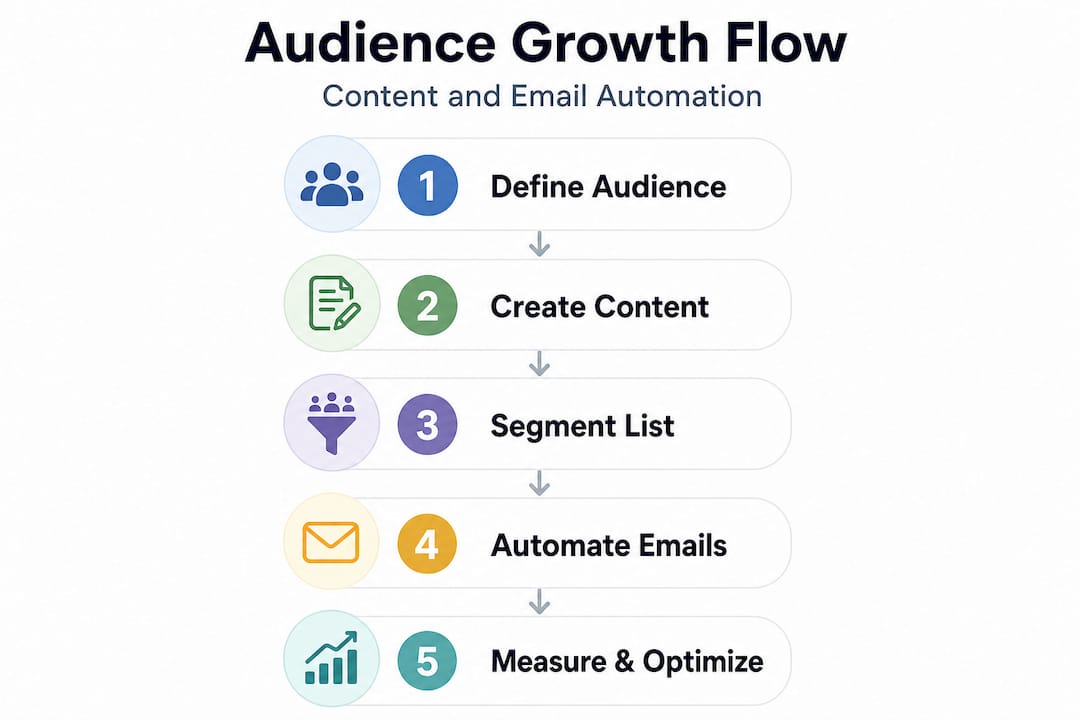
Content marketing goals include sales, engagement, and loyalty, and performance must be tracked and iterated continuously for the strategy to compound over time. Measurement is not a one-time audit. It is an ongoing discipline.
The core metrics you need to track consistently:
- Email open rate: Measures how effective your subject lines and send timing are. Industry benchmarks for ecommerce typically sit between 20% and 35%, but your own trend over time matters more than any benchmark
- Click-through rate (CTR): Indicates how compelling your content and calls to action are within the email itself
- Conversion rate from email: Tracks how many readers take a meaningful action, whether that is a purchase, a content download, or a list sign-up
- List growth rate: Measures how effectively your content attracts new subscribers month over month
- Content engagement rate: Time on page, scroll depth, and social shares for blog and guide content
- Revenue attributed to email: Tracks the direct sales impact of your email campaigns and flows
Once you have data, look for patterns rather than reacting to individual data points. A single email with a low open rate might be a fluke. A consistent downward trend means your subject line strategy needs work or your list needs re-segmentation.
Pro Tip: Run A/B tests on subject lines for at least four sends before drawing conclusions. One test tells you almost nothing. Four tests reveal patterns you can act on with confidence.
Common pitfalls to watch for:
- Measuring opens alone without tracking conversions means you are optimizing for vanity, not revenue
- Ignoring unsubscribe rates can signal that your content frequency or relevance is off
- Sending the same content to every segment wastes the power of your email platform
Resources on email newsletters and retention outline exactly why consistent measurement is what separates brands that plateau from brands that scale.
Why most content strategies fall short and what actually works
After mastering measurement, it is essential to step back and rethink how you approach strategy itself. Here is the uncomfortable truth: most ecommerce content strategies fail not because the content is bad, but because the strategy is fragmented.
Brands treat content and email as separate workstreams managed by different people with different goals. The content team wants traffic. The email team wants conversions. Neither is thinking about the full journey a subscriber takes from first touchpoint to loyal buyer. This fragmentation creates a leaky funnel where great content attracts visitors who never get nurtured, and great email flows never get the right subscribers.
The conventional wisdom says to produce more content, post more often, and send more emails. That is the wrong lesson. The right move is to produce fewer pieces with higher intent, and then build automated systems that ensure every piece of content finds the right person at the right time.
We have seen brands cut their content output by 40% and double their email-generated revenue simply by tightening the connection between what they publish and how they follow up. The magic is in the integration, not the volume.
The single biggest mistake is fragmented messaging. When your blog says one thing, your email says something slightly different, and your social says something else entirely, the audience gets confused and disengages. Consistency of message across every channel builds the kind of trust that turns subscribers into customers and customers into advocates.
Building advanced email segmentation into your content distribution system is the lever that makes everything else more effective. When you know what a subscriber has read, clicked on, and purchased, you can deliver content that feels personal rather than broadcast.
The brands winning at audience growth right now treat content as the fuel and email automation as the engine. Neither works as well without the other.
Accelerate your audience growth with proven email strategies
Growing an audience through content and email is not a guessing game when you have the right systems and expertise behind you. The strategies in this article work, but building and optimizing them takes time, testing, and deep knowledge of how automation platforms actually behave in practice.
Take Action specializes in helping ecommerce brands turn email into their most reliable growth channel. From flow architecture to campaign strategy, we build audience growth solutions that connect your content directly to revenue. Whether you are starting from scratch or looking to scale what you already have, our email automation expertise covers every stage of the subscriber journey. We combine human strategy with data-driven execution so your audience grows on autopilot while you focus on building your brand.
Frequently asked questions
What types of content are most effective for ecommerce audience growth?
Educational blogs, interactive emails, and actionable newsletters drive the most engagement and growth for ecommerce brands, as content planned across formats including blogs and newsletters consistently outperforms single-channel approaches.
How can email automation help grow my ecommerce audience?
Email automation enables targeted, timely delivery of content that drives repeat engagement and customer loyalty, which is why brand awareness and loyalty improve most dramatically when automation handles distribution at scale.
What KPIs should I track to measure content and audience growth?
Monitor open rates, click rates, and conversions from both email and web content, since content marketing goals span sales, engagement, and loyalty and require ongoing iteration to sustain growth.
Is social promotion important for ecommerce content marketing?
Social promotion is essential for amplifying reach and should be integrated with email for maximum effectiveness, since both channels are vital to a sustainable audience growth strategy.
Recommended
- Managing Business Growth with Automated Email Retention | Take Action Blog | Take Action
- Email content that drives engagement and retention | Take Action Blog | Take Action
- Email automation for course creators: engage and retain | Take Action Blog | Take Action
- Content Creation in Marketing: Driving Email Engagement | Take Action Blog | Take Action