

Finding Your Business Niche: A 2026 Entrepreneur’s Guide
TL;DR:
- Choosing a specific market segment with an urgent, recurring problem is essential before building a brand. Entrepreneurs must pass filters for knowledge, market spending, and sustainability to find viable niches. Starting with a good-enough niche and refining it through execution allows faster growth than waiting for perfect certainty.
A business niche is defined as a specific market segment where a clearly identified group of people has a painful, recurring problem they are willing to pay to solve. Finding your business niche is the single most important decision you make before building a brand, writing a word of content, or spending a dollar on ads. Entrepreneurs who skip this step build businesses that speak to everyone and convert no one. The good news: niche selection is a skill, not a talent. You can learn it, test it, and refine it over time.
What are the key factors for finding your business niche?
A viable niche passes three filters before you commit a single resource to it. First, you need genuine knowledge or experience to help customers solve their problem. Second, you need evidence of existing spenders in that market. Third, you need to sustain interest and produce content for at least 12 months without burning out. Skip any one of these, and you are building on sand.
Search volume is the most objective early signal of niche demand. Viable niches show between 500 and 10,000 monthly searches for their core terms. That range indicates real demand without the crushing competition that buries new entrants in high-volume markets. A niche with 200 monthly searches is likely too thin to monetize. One with 500,000 monthly searches is likely dominated by established players with years of authority.
Two common pitfalls trap entrepreneurs early. The first is choosing a niche so narrow that the audience cannot support a business. The second is choosing a niche so broad that differentiation becomes impossible. “Fitness” is a category, not a niche. “Strength training for women over 50 with joint pain” is a niche. The difference is specificity, and specificity is what builds credibility faster with a targeted segment.
- Knowledge filter: Can you answer the top 30 questions in this space without researching every answer?
- Spending filter: Are there existing products, courses, or services people already pay for in this space?
- Sustainability filter: Can you produce content, offers, and conversations around this topic for a full year?
- Demand filter: Does keyword research show 500–10,000 monthly searches for core terms?
- Competition filter: Are the top search results dominated by low-authority sites or outdated content?
Pro Tip: Run a quick Google search for your niche topic. If the first page shows forums, Reddit threads, and blogs from 2019, that is a green light. Fresh, authoritative content is missing, and you can fill that gap.
How can you research and validate your niche ideas?
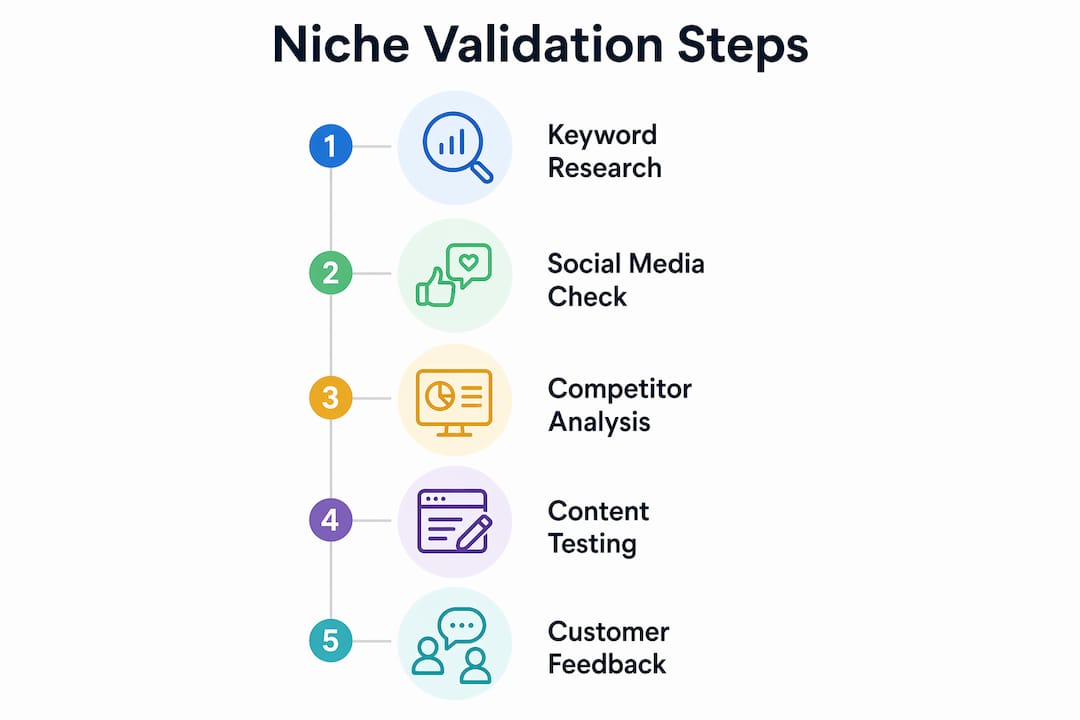
Validation separates a good idea from a good business. The goal is to confirm that real people are actively searching for solutions, spending money on answers, and gathering in communities where their questions go unanswered.

Start with keyword research tools to measure demand. Google Keyword Planner, Ahrefs, and Semrush all show monthly search volume and keyword difficulty scores. You are looking for terms in the 500–10,000 monthly search range with difficulty scores low enough for a new site to rank. High volume with low competition is rare. Moderate volume with moderate competition is the realistic sweet spot for most new entrepreneurs.
Social media and community platforms are underrated validation tools. Active question-heavy groups with unanswered or poorly answered questions signal a real audience with unmet needs. Search Facebook Groups, Reddit subreddits, and Quora threads for your niche topic. If people are asking the same questions repeatedly and the answers are thin or contradictory, you have found a gap worth filling.
Competitor analysis is the third pillar of validation. Forums, outdated blogs, and low-authority competitors in top search results signal lower competition and real niche openings. When the top-ranking pages for your target keyword are three years old and written by generalist sites, a focused new entrant can outrank them within months.
The micro-niche layering method
Broad ideas become viable niches through a process called micro-niche layering. Start with a general category, then add three layers of specificity: audience, problem, and context. The layering method generates at least 5–10 micro-niches before you make a final choice.
- Start with a broad category: “technology.”
- Add an audience layer: “technology for seniors.”
- Add a problem layer: “technology for seniors who struggle with smartphones.”
- Add a context layer: “affordable Android phones for seniors with vision impairment.”
- Generate 5–10 variations at this specificity level before comparing them.
- Run each variation through keyword research and community checks.
- Score each micro-niche on demand, competition, and your personal expertise.
| Validation Method | What It Reveals | Time Required |
|---|---|---|
| Keyword research | Monthly demand and competition level | 2–4 hours |
| Community analysis | Unmet needs and audience engagement | 3–5 hours |
| Competitor audit | Content gaps and authority levels | 2–3 hours |
| 90-day content test | Topic depth and personal sustainability | 90 days |
The 90-day content test is the most underused validation method. If you cannot brainstorm 30 distinct topics relevant to your niche in a single sitting, the niche is either too narrow or you lack the expertise to serve it. This test costs nothing and saves months of wasted effort.
Pro Tip: Open a blank document and set a 20-minute timer. Write as many content titles as you can for your niche. If you hit 30 before the timer ends, you have a niche with real depth. If you stall at 12, keep refining.
What steps should entrepreneurs take to select and commit to a niche?
Selecting a niche is a decision, not a discovery. Most entrepreneurs treat it like a treasure hunt, waiting for the perfect answer to reveal itself. The better approach is to set a deadline, make the best call with available information, and start building.
Limit your niche decision to 48 hours once you have completed basic research. This constraint sounds arbitrary, but it works. Overthinking produces analysis paralysis, not better decisions. The information you need to make a good niche choice is available within a few hours of research. Everything beyond that is delay disguised as diligence.
Starting with an imperfect niche beats waiting for a perfect one. The practical insights you gain from your first 90 days of execution are worth more than six months of additional planning. You learn what your audience actually asks, what they pay for, and where your expertise genuinely helps. None of that information is available before you start.
- Set a 48-hour decision window after completing your keyword, community, and competitor research.
- Test with a minimal viable offer before building a full product or service. A short workshop, a free guide, or a consultation call reveals real demand faster than any research tool.
- Track what resonates in the first 30 days. Which content gets shares? Which offers get clicks? Let the data guide your refinement.
- Expect your niche to shift. The niche you define in month one is rarely identical to the one you operate in month twelve. That evolution is refinement, not failure.
- Build trust through focused messaging. Targeted messages to specific segments increase repeat business and customer loyalty faster than broad, general positioning.
A focused niche also makes your ecommerce retention strategy more effective. When you know exactly who you serve, every email, every offer, and every follow-up sequence speaks directly to that person’s situation. Retention improves because relevance improves.
What are common myths about choosing the right niche?
The biggest myth in niche selection is that narrowing your focus means losing customers. The opposite is true. A specific niche attracts the right customers more efficiently and converts them at higher rates. Broad positioning attracts browsers. Specific positioning attracts buyers.
“Niching is not about exclusion. It is about sharpening your marketing focus so that the right people recognize themselves in your message immediately. That recognition builds trust faster than any ad campaign ever could.”
The second myth is that passion alone qualifies a niche. Passion matters for sustainability, but it does not validate demand. Plenty of passionate entrepreneurs have built businesses around topics nobody pays for. The three-filter test (knowledge, spending evidence, sustainability) is more reliable than passion as a primary guide.
Entrepreneurs also confuse niche topic with niche audience. A niche topic is a subject area. A niche audience is a specific group of people with a specific problem. “Personal finance” is a topic. “Personal finance for freelance designers earning under $80,000 a year” is an audience. The audience definition is what makes your marketing specific enough to convert.
Patience is the final underrated factor. Niche authority builds over months, not weeks. The entrepreneurs who succeed are the ones who retain customers through consistent, relevant communication while their niche reputation compounds. Expecting fast results from a new niche leads to premature pivots that reset the clock every time.
Key Takeaways
Finding your business niche requires passing a three-filter test of knowledge, market spending, and 12-month sustainability before committing any significant resources.
| Point | Details |
|---|---|
| Three-filter test | Confirm knowledge, existing spenders, and 12-month sustainability before committing. |
| Search volume range | Target niches with 500–10,000 monthly searches to balance demand and competition. |
| Micro-niche layering | Generate 5–10 specific micro-niches before making a final selection. |
| 48-hour decision rule | Set a firm deadline after research to avoid analysis paralysis and start executing. |
| Niches evolve | Expect your niche to refine itself over the first 12 months. That is normal progress. |
Why starting imperfectly beats waiting for certainty
The entrepreneurs I watch succeed fastest are not the ones with the most research. They are the ones who start with a good-enough niche and let execution teach them the rest. I have seen founders spend four months building spreadsheets comparing 40 niche ideas. I have also seen founders pick a niche in a weekend, launch a simple offer, and have paying customers within three weeks. The second group learns faster every time.
The paralysis comes from treating niche selection as a permanent, irreversible decision. It is not. Niches evolve naturally during the first year, and adjustment is expected. What you are really committing to is a direction, not a destination. You can correct course once you are moving. You cannot correct course while standing still.
The practical lesson I keep coming back to is this: focus beats breadth at every stage of early growth. A focused niche means focused content, focused offers, and focused online marketing strategy that compounds over time. Broad positioning spreads effort thin and produces weak signals. Narrow positioning concentrates effort and produces clear feedback. Start narrow, learn fast, and refine from there.
— Take
How Take-action supports niche-focused growth
Once you have identified your niche, the next challenge is converting that focus into consistent revenue. That is where email marketing and retention become the growth engine.
Take-action is a specialized email marketing and retention agency that helps ecommerce brands turn a defined niche audience into a loyal, high-value customer base. Using Klaviyo automation, segmentation, and targeted campaign strategy, Take-action builds the flows that keep niche customers engaged long after their first purchase. Welcome sequences, abandoned cart recovery, and post-purchase automations all perform better when your niche is sharp and your messaging is specific. If you are ready to put your niche focus to work, explore Take-action’s services and see how retention-focused email marketing drives measurable growth.
FAQ
What is a business niche, exactly?
A business niche is a specific market segment defined by a particular audience with a shared, recurring problem they are willing to pay to solve. It combines audience identity, problem specificity, and monetization potential.
How do I know if my niche is too narrow?
If you cannot generate 30 distinct content topics for your niche in a single brainstorming session, the niche is likely too narrow or your expertise in it is too limited to sustain a business.
How long does it take to find the right niche?
Basic niche research takes 2–3 days. Full validation through the 90-day content test and initial audience feedback takes three months. Expect the niche to continue refining through the first year of operation.
Do I need to be passionate about my niche?
Passion helps with sustainability but does not validate demand. A niche must pass the three-filter test of knowledge, existing market spending, and 12-month sustainability regardless of how passionate you feel about the topic.
What search volume should I target when selecting a niche?
Target niches where core keywords show between 500 and 10,000 monthly searches. That range signals real demand while keeping competition at a level where a new entrant can realistically rank and grow.