

Digital Marketing Company: What It Is and What It Does
TL;DR:
- A digital marketing company is an external team of specialists who plan, execute, and optimize marketing across online channels to increase visibility, leads, and revenue. They manage strategies like SEO, paid media, content, and email campaigns, acting as growth partners rather than mere vendors. These agencies rely on real-time data and iterative testing to tailor campaigns, ensuring measurable results and sustainable business growth.
If you’ve ever Googled “digital marketing company what is it” expecting a simple answer, you already know the results rarely satisfy. Most explanations are either too vague or too technical. The real answer sits somewhere more useful: a digital marketing company, also called a digital marketing agency, is an external team of specialists who plan, execute, and optimize your marketing across every relevant online channel. It’s not just ads. It’s not just social posts. It’s a coordinated effort designed to drive visibility, leads, and revenue for your business online.
Table of Contents
- Key Takeaways
- What a digital marketing company actually is
- How digital marketing companies use strategy and data to drive results
- Types of digital marketing agencies compared
- Real benefits of hiring a digital marketing company
- My honest take on what separates good agencies from the rest
- Grow your revenue with Take-action’s email expertise
- FAQ
Key Takeaways
| Point | Details |
|---|---|
| More than ads | Digital marketing companies manage full-channel strategies across SEO, email, content, and paid media. |
| External growth partner | They function like an outsourced marketing department, not just a task-based vendor. |
| Data drives decisions | Ongoing analytics and real-time measurement guide every campaign adjustment and creative update. |
| Agency types vary | Full-service, SEO-focused, and inbound agencies each serve different business needs and goals. |
| Email drives retention | Retention-focused services like email automation convert one-time buyers into loyal customers. |
What a digital marketing company actually is
A digital marketing company is an organization of specialists hired to manage and grow your brand’s presence across online channels. The formal industry term is “digital marketing agency,” and understanding both helps you search smarter and ask better questions when vetting partners.
What does a digital marketing company do, concretely? It promotes brands online by planning, executing, and optimizing marketing across channels like search engines, social media platforms, email, paid advertising, and your website. Each of those channels requires distinct expertise. SEO specialists think in keywords and backlinks. Paid media managers think in cost per click and return on ad spend. Email strategists think in segmentation and automations. A full-service agency brings all of those people under one roof and coordinates their work toward your business goals.
Here’s what separates a good agency from a vendor who just completes tasks. A vendor runs your Facebook ads. An agency asks why your conversion rate is flat even though traffic is growing, then investigates every touchpoint from ad copy to landing page to post-purchase email. They act as growth partners or external marketing departments rather than standalone contractors.
The services of digital marketing companies typically include:
- Search engine optimization (SEO): Getting your website to rank for terms your customers search
- Pay-per-click advertising (PPC): Managing paid campaigns on Google, Meta, and similar platforms
- Content marketing: Creating articles, videos, and guides that attract and educate your audience
- Social media management: Building and engaging your community across social platforms
- Email marketing: Running campaigns and automated flows that convert and retain customers
- Website optimization: Improving user experience and conversion rates on your existing site
Pro Tip: Ask any agency you evaluate to show you how their individual services connect to each other. If they can’t explain how their SEO work feeds into their email strategy, they’re running siloed tactics, not a unified growth plan.
How digital marketing companies use strategy and data to drive results
Most business owners imagine the daily work inside an agency as a team writing blog posts or scheduling tweets. The reality is more sophisticated. Agencies run marketing work in overlapping loops of creative updates, campaign management, and analytics reviews, all happening simultaneously and informing each other in real time.
Here’s a simplified version of how that operational cycle looks in practice:
- Audience research: Before any campaign launches, specialists study who you’re trying to reach, what platforms they use, what language they respond to, and what competitors are already doing. This is the foundation everything else builds on.
- Strategy development: Using research findings, the agency maps out which channels to prioritize, what content types to produce, and what benchmarks define success for your specific business.
- Execution: Campaigns go live. Content gets published. Automated email flows get configured. Ads start running. This is where most people think the work ends. It doesn’t.
- Measurement and analysis: Digital marketing teams handle strategy, execution, and data analysis using real-time tools to track exactly what’s working and what isn’t. Open rates, click-through rates, cost per acquisition, revenue per email, all of it gets monitored.
- Optimization: Based on what the data shows, the team adjusts. Ad creative gets swapped. Email subject lines get tested. Landing page copy gets rewritten. This loop never stops.
The reason this loop matters is simple. No single formula exists for online marketing. What works for a fashion brand will not work for a B2B software company. Agencies tailor strategies based on audience research, continuously testing and scaling what performs. That adaptability is the core of what you’re actually paying for, not the deliverables themselves.
You can see this in action when you look at how digital marketing ROI gets tracked through tools like Klaviyo. The ability to tie a specific email flow to a measurable revenue number changes how you make decisions. Instead of guessing which channels to invest in, you know.
Pro Tip: When you review an agency’s monthly report, pay more attention to revenue-tied metrics than traffic numbers. Traffic without conversion is a vanity metric. If they can’t show you what a campaign actually generated in revenue or qualified leads, you need a different reporting structure.
Types of digital marketing agencies compared
Not every agency looks the same. Understanding the differences helps you choose the right partner for where your business is right now.
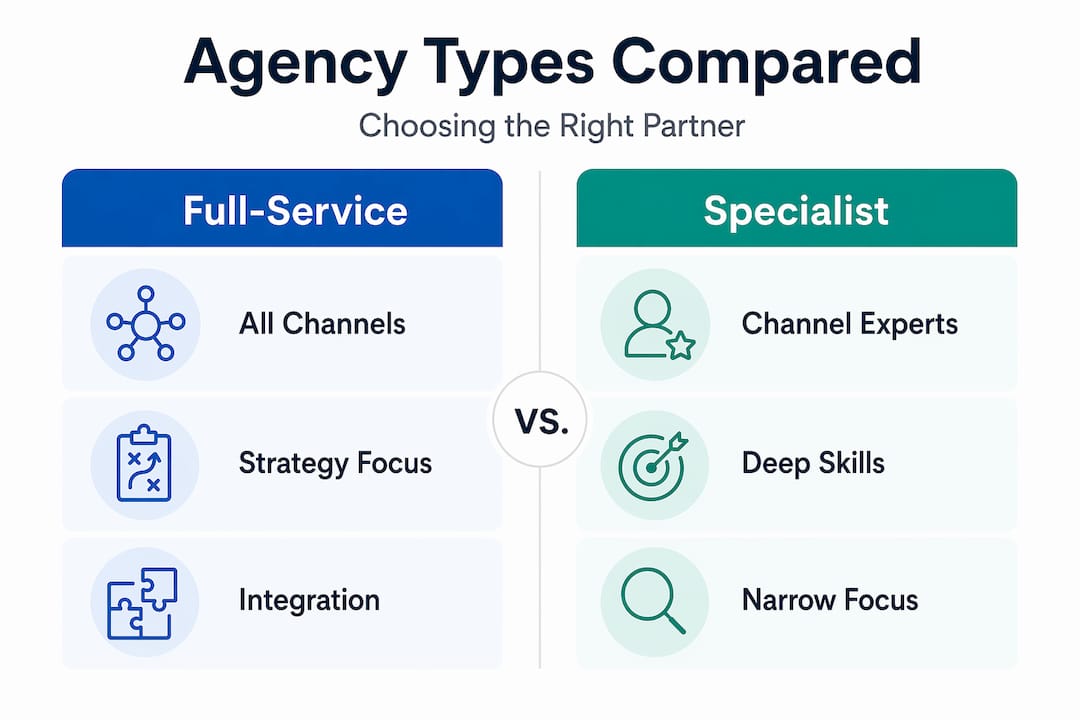
Different digital marketing agency types include full-service firms, SEO-focused agencies, and inbound marketing specialists. Here’s how they compare:
| Agency Type | Core Focus | Best For | Trade-off |
|---|---|---|---|
| Full-service agency | All digital channels: SEO, PPC, email, social, content | Businesses that want one partner managing everything | Higher cost; can spread thin across channels |
| SEO-focused agency | Organic search rankings and technical site health | Brands with longer sales cycles where organic traffic converts well | Slower results; may not support paid or email channels |
| Inbound marketing agency | Content, lead nurturing, and organic attraction strategies | B2B companies building long-term audience relationships | Requires patience; results compound over months |
| Email and retention agency | Automated flows, segmentation, lifecycle campaigns | Ecommerce brands focused on customer lifetime value | Narrow scope; needs other channels for top-of-funnel traffic |
Choosing between these comes down to your current biggest gap. If you have traffic but your digital marketing for ecommerce isn’t converting that traffic into repeat buyers, a retention-focused agency will move the needle faster than a full-service firm trying to fix everything at once. If you have zero online presence, a full-service agency gives you the broadest starting point.
The defining question to ask yourself: what is the single metric that would most change your business this year if it improved? Let that guide which type of agency you pursue.
Real benefits of hiring a digital marketing company
Business owners often ask whether the investment is actually worth it. Here’s what working with a digital marketing company practically delivers:
- Increased website traffic: Through SEO, paid media, and content, agencies attract more of the right visitors to your site, people actively looking for what you sell.
- Higher conversion rates: Digital marketing connects brands to audiences online by coordinating multiple channels toward a single goal, getting more visitors to take action.
- Cost efficiency: Digital marketing is generally less expensive than traditional marketing and allows precise targeting. You’re not paying for billboard views from people who will never buy from you.
- Customer retention: Beyond driving new traffic, agencies build brand presence and improve ongoing customer relationships. Email automations, retargeting campaigns, and loyalty-focused content keep existing customers coming back.
- Scalability: Your business can grow without needing to hire a full internal marketing team. The agency scales its effort as your needs expand.
- Access to specialist expertise: You get a strategist, a copywriter, an analyst, and a technical SEO expert without hiring each as a full-time employee.
The often-overlooked benefit is speed. An experienced agency has already tested hundreds of strategies across dozens of clients. They know what typically fails in your industry before running a single experiment with your budget. That saved testing time has real dollar value.
Effective digital marketing is judged on conversion and retention progress, not just traffic growth. The best agencies understand this and measure their own success accordingly. When you’re evaluating a partner, that distinction tells you a lot about their maturity.

My honest take on what separates good agencies from the rest
I’ve seen a pattern across businesses that hire digital marketing companies and end up disappointed. It almost never comes down to the agency lacking skill. It comes down to the agency treating the relationship like a service contract instead of a growth partnership.
What I’ve learned is that the best agencies proactively bring you problems before you notice them. They flag a drop in email open rates before your monthly review. They tell you a competitor just started outranking you for your primary keyword. They ask whether your Q4 promotion aligns with your retention goals. That kind of transparency is rare, and it’s the thing worth paying for.
The other pattern I’ve noticed: clients judge success too early and on the wrong metrics. When someone tells me an agency “didn’t work,” the first thing I ask is what they were measuring. If the answer is website traffic or social followers, that’s the problem. Meeting customers where they spend time online and converting them into buyers takes longer than most expect, especially in the organic channels.
My honest advice: choose an agency that pushes back on your assumptions, not just one that executes your instructions. If they agree with everything you say, they’re not doing their job.
— Take
Grow your revenue with Take-action’s email expertise
If what you need most isn’t more traffic but more revenue from the customers you already have, email marketing is the highest-leverage place to start. Take-action specializes in exactly that.
At Take-action, we help ecommerce brands turn email into a primary revenue channel using Klaviyo automation, advanced segmentation, and campaign strategies built around your brand’s voice. That means welcome flows that convert new subscribers, abandoned cart sequences that recover lost sales, and post-purchase automations that build loyalty on autopilot. If you’re currently relying on paid ads as your main growth channel, we’ll help you build something more sustainable alongside it. Reach out and let’s talk about what a focused retention strategy could do for your numbers.
FAQ
What is a digital marketing company?
A digital marketing company, also called a digital marketing agency, is a team of specialists hired to plan and manage a brand’s marketing across online channels like search engines, social media, email, and paid advertising. They act as an external marketing department focused on generating measurable business results.
What services do digital marketing companies offer?
Services of digital marketing companies typically include SEO, pay-per-click advertising, content marketing, social media management, email marketing, and website conversion optimization. Full-service agencies handle all of these, while specialized firms focus on one or two areas.
How is a digital marketing company different from a traditional ad agency?
A digital marketing company focuses exclusively on online channels and uses real-time data to measure and adjust campaigns continuously. Traditional ad agencies typically manage TV, radio, and print campaigns where performance measurement is slower and less precise.
How do I choose a digital marketing agency?
Start by identifying your biggest growth gap, whether that’s traffic, conversions, or retention, and find an agency that specializes in solving that specific problem. Ask to see case studies from businesses similar to yours and ask how they measure and report on success beyond basic traffic metrics.
Is hiring a digital marketing company cost-effective for small businesses?
Yes. Digital marketing is generally less expensive than traditional channels and allows precise audience targeting, which means smaller budgets go further. Many agencies also offer tiered pricing or project-based work that makes professional marketing accessible at different budget levels.