

Create Your Brand Online with Klaviyo + Shopify
A flow-first email program, specifically a welcome series, abandoned checkout flow, and customer winback, paired with 4–6 revenue-focused segments, is the fastest way to build a recognizable online brand and start generating retention revenue. You don’t need a massive list. You need the right three flows live before anything else.
Here’s what to do in the next 24–72 hours:
- Connect Shopify to Klaviyo and verify that checkout, order, and browse events are firing correctly.
- Activate the welcome series using a Klaviyo flow template as your starting point and then customize the copy to match your brand voice.
- Enable the abandoned checkout flow — this is your single highest-RPR (revenue per recipient) automation.
- Create a winback path for buyers who haven’t purchased in 90–180 days.
- Pick 4–6 segments (first-time buyers, repeat buyers, VIPs, at-risk, lapsed, engaged non-buyers) and map each to a flow.
Pro Tip: Don’t wait until your flows are “perfect” to launch. A live welcome series with placeholder copy outperforms a polished one that hasn’t shipped. Optimize after you have data.
Every brand goal — recognition, trust, loyalty — depends on showing up at the right moment with the right message. Flows are how you do that at scale.
Key Takeaways
Automated flows plus a short list of high-impact segments are the fastest path to building a recognizable online brand and driving consistent retention revenue through email.
| Point | Details |
|---|---|
| Launch flows in order | Welcome series and abandoned checkout first; together they can drive 40–60% of total flow revenue. |
| Start with 4–6 segments | VIPs, recent purchasers, engaged non-buyers, at-risk, and lapsed map directly to your core flows. |
| Measure by RPR | Revenue per recipient outperforms open rate for prioritizing which flows and segments to optimize. |
| Authenticate before sending | SPF, DKIM, and DMARC must pass before your first send to protect deliverability and brand reputation. |
| Take-action for faster execution | Take-action builds the full Klaviyo retention stack — flows, segments, and measurement — for ecommerce brands that need results in 30 days. |
Table of Contents
- What does a 90-day email brand launch look like?
- Which flows should you build first?
- How do you segment for maximum revenue impact?
- How do you personalize flows without breaking them?
- Why is Klaviyo + Shopify the pragmatic default for DTC brands?
- How do you measure whether your flows are working?
- What does implementation actually cost, and when should you hire an agency?
- How do you scale without damaging your sender reputation?
- Take-action builds this for you, start to finish
- What we’ve learned building retention programs at Take-action
- Sources
What does a 90-day email brand launch look like?
A reliable build follows three phases. Skip ahead and you’ll hit deliverability problems or launch flows with no audience to receive them.
Week 1 essentials
- Connect Shopify to Klaviyo and confirm native sync is active.
- Authenticate your sending domain: SPF, DKIM, and DMARC records all need to pass.
- Build the welcome series skeleton (subject lines, send timing, brand voice notes).
- Validate that checkout started, order placed, and product viewed events are firing.
Month 1 priorities
- Ship the abandoned checkout flow (3 emails minimum, with an optional SMS branch).
- Set up basic segments: first-time buyers, repeat buyers, VIPs, and at-risk (no purchase in 60–90 days).
- Launch a post-purchase onboarding flow covering education, review request, and a cross-sell prompt.
- Run a product feed check to confirm dynamic content blocks pull the right SKUs.
Month 2 additions
- Add browse abandonment and replenishment or subscription flows.
- Set up an A/B testing framework: one variable per test, minimum viable sample size defined before launch.
- Document segment logic (entry criteria, exit criteria, suppression rules).
- Build a 30/60/90-day measurement plan: track RPR, flow conversion rate, and repeat purchase rate per cohort.
| Checkpoint | What to validate |
|---|---|
| Event tracking | Checkout started, order placed, product viewed all firing |
| Product feed | Dynamic blocks pulling correct SKUs and images |
| List hygiene | Suppression list active; hard bounces removed |
| Domain auth | SPF, DKIM, DMARC passing in Klaviyo’s domain check |
| Segment logic | Entry/exit rules documented; no overlapping suppression gaps |
Which flows should you build first?
The Klaviyo retention playbook is clear: welcome and abandoned checkout flows come first. Together, those two alone can drive a large share of total flow revenue when properly built and optimized.
Welcome series
Build 4–6 emails plus an optional SMS touchpoint. The first email delivers the offer or brand story immediately. Emails 2–4 cover product education, social proof, and a secondary offer. Emails 5–6 handle objection resolution and a final urgency nudge. Timing: send email 1 within 5 minutes of signup, then space subsequent emails 1–2 days apart. This sequence shapes how a subscriber perceives your brand before they’ve ever bought anything.
Abandoned checkout vs. abandoned cart
These are different triggers. Abandoned checkout fires when someone reaches the checkout page but doesn’t complete the purchase. Abandoned cart fires earlier, when items are added to the cart. Build checkout abandonment first — it targets buyers who are closer to converting and typically shows higher RPR. A three-email sequence (immediate, 4 hours, 24 hours) with a conditional split for first-time vs. repeat buyers covers most scenarios.
Customer winback and sunset flows
Trigger a winback sequence when a buyer hasn’t purchased in 90–180 days, depending on your average purchase cycle. Three to four emails work well: a re-engagement offer, a product highlight, and a final “last chance” message. If they don’t engage, move them into a sunset flow and suppress from promotional sends. This protects deliverability and keeps your list healthy.
Automated flows generate roughly 41% of email revenue from only ~5.3% of sends — a disproportionate return that makes flow investment the clearest ROI lever in email marketing.
Next-wave flows
Once the core three are live, add these in order: post-purchase (education + cross-sell + review request), browse abandonment (1–2 emails within 24 hours of a product view with no purchase), and cross-sell or replenishment flows tied to product category and reorder timing.
Use Klaviyo’s flow library templates as structural starting points. Customize subject lines, dynamic product blocks, and incentive logic — but don’t rebuild the trigger architecture from scratch.
How do you segment for maximum revenue impact?
Shopify’s segmentation guidance recommends starting with purchase behavior, lifecycle stage, engagement, category affinity, VIP status, and churn risk. That’s the right list. The mistake most brands make is trying to build all of them at once.
Start with 5–8 segments that map directly to your live flows. A practical starting architecture:
- VIPs (top 10–15% by LTV): suppress from discounts, prioritize for early access.
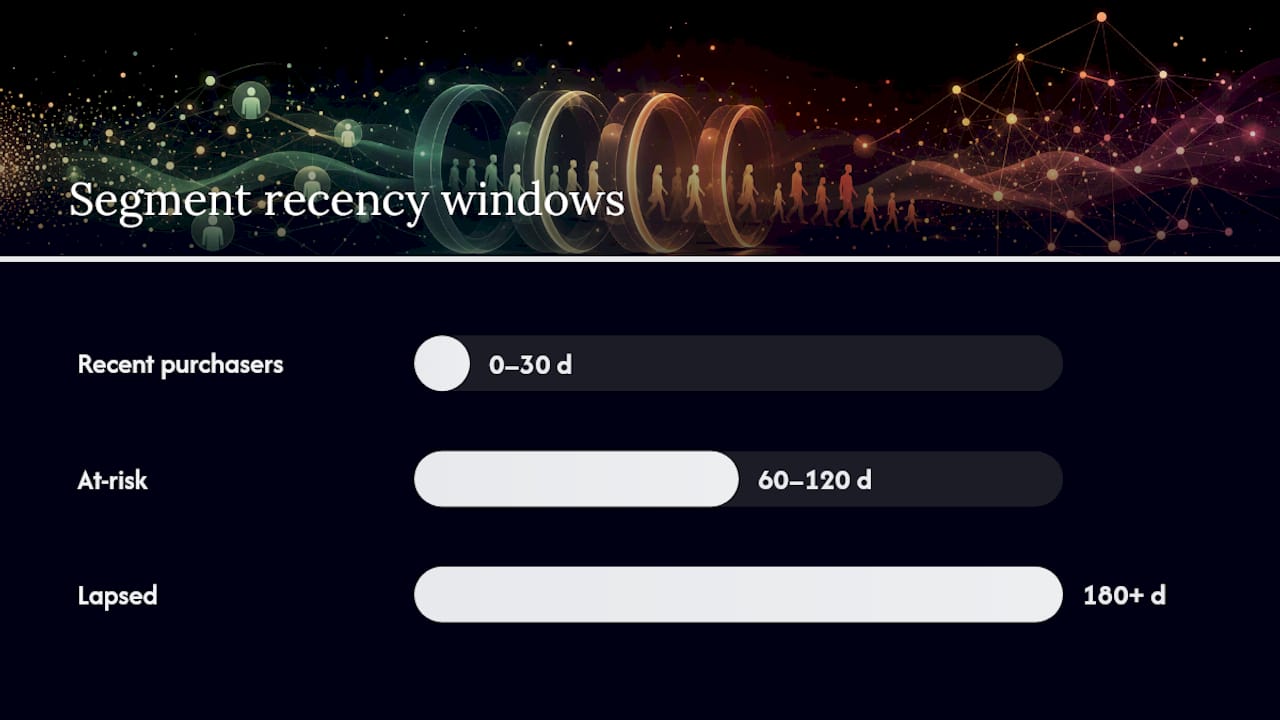
- Recent purchasers (0–30 days): feed into post-purchase flow.
- Engaged non-buyers: feed into welcome series or a dedicated nurture track.
- At-risk (60–120 days, no purchase): feed into winback flow.
- Lapsed (180+ days): sunset candidates; test a re-engagement offer first.
Prioritize segments using four criteria: revenue impact, automation readiness, data availability, and send-frequency control. A segment with high revenue impact but missing event data isn’t ready to automate yet. Score each candidate on those four dimensions and pick the top 4–6 to build first.
Operational rules matter as much as the segment definitions. Set a minimum segment size (typically 500+ profiles) before activating an automated flow. Define clear exit criteria so profiles don’t stay in a flow after they’ve converted. And keep your segment taxonomy documented — aim for no more than 20 active segments total to keep governance manageable.
How do you personalize flows without breaking them?
Personalization in Klaviyo runs on two mechanics: trigger splits and conditional splits. A trigger split routes subscribers into different flow paths based on what action they took (e.g., signed up via a pop-up vs. a checkout opt-in). A conditional split branches within a flow based on profile properties or behavior (e.g., has purchased before vs. hasn’t).
For abandoned checkout, a useful conditional split branches on whether the subscriber is a first-time buyer. First-timers get social proof and a welcome offer. Repeat buyers get a simpler reminder with a loyalty nudge.
Dynamic content blocks pull product recommendations directly from your Shopify catalog. Always set a fallback product or category for cases where the recommended product goes out of stock. Inventory-aware blocks prevent the embarrassing scenario of emailing someone about an item you can’t ship.
- Use profile properties (like
predicted_gender,total_clv, or custom tags) to adjust tone and offer level. - Keep VIP messaging discount-free by default — they respond better to exclusivity than price cuts.
- Modular block design (header, product block, copy block, CTA block) lets you swap one element per A/B test without rebuilding the whole email.
See personalized email examples for practical dynamic content patterns that preserve brand voice across segments.
Why is Klaviyo + Shopify the pragmatic default for DTC brands?
Klaviyo’s ecommerce email platform is built around the exact data model DTC brands need: native Shopify sync, real-time event tracking, product feed support for dynamic blocks, and a flow builder that handles conditional logic without custom code.
Evaluation checklist before committing to any platform:
- Native Shopify integration (not a third-party connector)
- Real-time event support: product viewed, checkout started, order placed, order fulfilled
- Dynamic product feed for personalized blocks
- Segmentation builder that supports RFM-style logic
- SMS capability within the same platform
- Flow templates and a pre-built library to accelerate setup
- Predictive analytics (CLV, churn risk scores)
Klaviyo passes all of these.
For a detailed comparison of email automation tools and integration notes, that resource covers the platform decision in more depth.
How do you measure whether your flows are working?
Track four primary KPIs per flow: revenue per recipient (RPR), conversion rate per flow entry, incremental repeat-purchase rate, and flow-attributed revenue as a percentage of total email revenue.
RPR beats open rate as a prioritization metric because open rates are inflated by Apple Mail Privacy Protection and don’t correlate with actual purchases.
A/B testing framework:
- Test one variable at a time: subject line, send timing, offer amount, or CTA copy.
- Define minimum sample size before launch (typically 500+ recipients per variant for statistical confidence).
- Run a control group (10–15% of flow entries) to measure incremental lift vs. no email.
- Use conditional splits to test timing variants without duplicating flow architecture.
In the first 14–30 days after launch, monitor: flow entry rates (are subscribers entering as expected?), RPR trending (is it stable or declining?), and deliverability signals (bounce rate, spam complaint rate). When AOV skews benchmarks, normalize RPR by AOV band rather than comparing across product categories directly.
What does implementation actually cost, and when should you hire an agency?
The 90-day operational path breaks into three phases with distinct resource requirements.
In-house cost drivers: Klaviyo pricing scales with list size; staff time for strategy, copywriting, and QA typically runs 15–25 hours per week during the build phase. Total tooling plus staff time for a 90-day build often lands in the $8,000–$20,000 range depending on team seniority and list size.
Agency engagement: Setup fees vary by scope; ongoing retainers for a full-service Klaviyo agency typically cover flow management, segmentation updates, campaign sends, and reporting.
Hire vs. DIY decision criteria:
- Hire if you lack internal Klaviyo expertise, need flows live in under 30 days, or are managing server-side tracking and subscription dunning.
- Build in-house if you have a dedicated email marketer, a 60–90 day runway, and straightforward Shopify data.
- Red flags in agency proposals: vague deliverables, no RPR-based reporting, and no mention of domain authentication or list hygiene.
For niche ecommerce brands evaluating a full setup, this online store setup guide illustrates how the same flow-first principles apply even in specialized retail contexts.
How do you scale without damaging your sender reputation?
Deliverability is a brand asset. Once your reputation drops, recovering it takes weeks.
Core hardening steps:
- Authenticate SPF, DKIM, and DMARC on every sending domain before your first send.
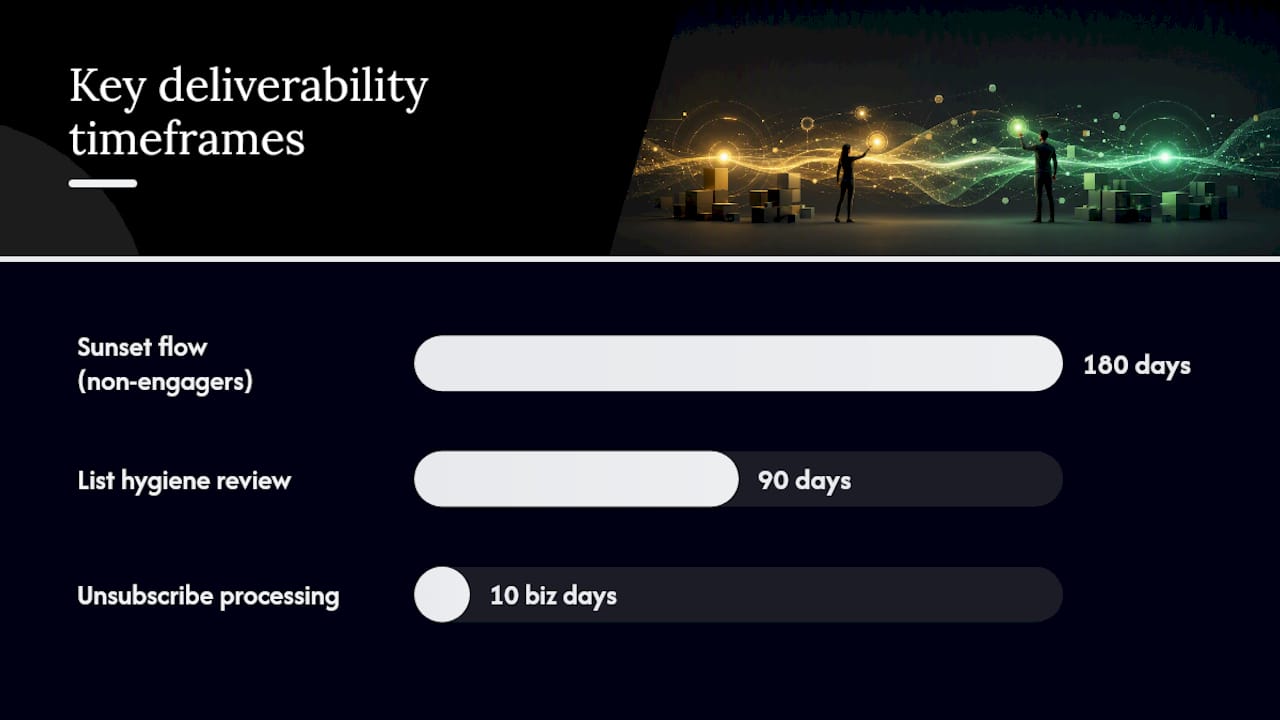
- Run a sunset flow for 180-day non-engagers: one re-engagement email, then suppress.
- Monitor inbox placement monthly using a tool like GlockApps or Mail-Tester.
- Deduplicate profiles and validate email-match rates between Klaviyo and Shopify quarterly.
- Set suppression rules so high-risk segments (lapsed 180+ days) don’t receive promotional campaigns until they re-engage.
US compliance basics: CAN-SPAM requires a physical mailing address in every commercial email, a clear unsubscribe mechanism that processes within 10 business days, accurate from addresses, and non-deceptive subject lines. Build these into your flow templates as non-negotiable defaults, not afterthoughts. This is general operational guidance, not legal advice — confirm current requirements with a qualified professional or the FTC’s CAN-SPAM guidance directly.
Governance rules to document:
- Assign a named owner for each segment and flow.
- Schedule quarterly audits: review segment sizes, entry/exit logic, and suppression lists.
- Cap active segments at roughly 20 to keep the taxonomy manageable.
Pro Tip: Set a calendar reminder for a 90-day list hygiene review from day one. Brands that skip this end up with inflated lists, declining deliverability, and no clean baseline to measure against.
Take-action builds this for you, start to finish
Most ecommerce teams know what they need to build. The gap is bandwidth and Klaviyo expertise to build it fast and build it right.
Take-action is a Klaviyo-focused retention agency that handles the full build: domain authentication, welcome series, abandoned checkout flow, post-purchase sequence, segmentation architecture, and ongoing measurement. The difference from a generalist agency is specificity. Every deliverable maps to RPR improvement, not vanity metrics. Every flow ships with documented segment logic, suppression rules, and a 30-day performance baseline.
If you’re an ecommerce brand that needs flows live in 30 days or less, or you want a second opinion on what your current setup is leaving on the table, schedule a discovery call with Take-action to get a flow and segment audit.
What we’ve learned building retention programs at Take-action
The brands that grow fastest through email share one habit: they measure by revenue per recipient from day one and ignore open rate as a primary signal. That single shift changes which flows get prioritized, which segments get built first, and how copy decisions get made.
Flow-first, RPR-first, product-feed-aware personalization. That’s the operating model. Brand voice and creative matter, but they’re multipliers on a working retention architecture, not substitutes for one.
The teams that struggle are usually the ones who spend month one perfecting creative and month two realizing their events aren’t firing correctly. Authentication and event validation first. Everything else second.
Sources
- Best practices for flows · Klaviyo Academy
- Klaviyo Lifecycle Email Flows for Ecommerce in 2026 · DigitalApplied
- Email list segmentation strategies for high-volume ecommerce stores · Shopify
- The Klaviyo Retention Playbook for D2C Brands (2026 Edition) · Pixeltree