

Content Marketing in Digital Marketing: 2026 Guide
TL;DR:
- Content marketing in digital marketing involves strategically creating and distributing valuable content to attract and convert audiences without interruptive ads. It is interdependent with channels like SEO and paid media, supporting each stage of the buyer’s journey and focusing on quality over volume. Measurement in 2026 emphasizes revenue impact, AI visibility, and customer experience, with brands leveraging AI for efficiency while maintaining authentic, human-centered content.
Content marketing in digital marketing is defined as the strategic planning, creation, and distribution of valuable, relevant content to attract, engage, and convert specific audiences without relying on interruptive advertising. Salesforce describes this as a multi-stage process spanning research, production, distribution, and refinement. Unlike paid ads that interrupt, content marketing earns attention by solving real problems for real people. Platforms like HubSpot, Salesforce, and AI-driven creation tools have made this approach more scalable and measurable than ever. The result is a discipline that now sits at the center of how brands build trust, generate demand, and retain customers across every digital channel.
How does content marketing fit within the digital marketing ecosystem?
Content marketing is one core pillar of digital marketing, sitting alongside paid advertising, SEO, email, and conversion rate optimization. WordStream describes the flow as attract, engage, nurture, and convert. Each stage depends on content doing a specific job. Without it, paid ads have nowhere to send traffic worth converting, and SEO has nothing to rank.
The relationship between content and other channels is not parallel. It is interdependent. A well-written blog post fuels organic search rankings, gives paid campaigns a landing page worth clicking, and feeds email sequences with material subscribers actually want to read. Content is the connective tissue that makes every other channel perform better.
What does content marketing include in practice? The scope is wide:
- Blog posts and articles that target search intent and build topical authority
- Email newsletters and nurture sequences that move leads through the funnel
- Case studies and white papers that support sales conversations
- Short-form video for social platforms like Instagram, TikTok, and YouTube Shorts
- Webinars and podcasts that build community and demonstrate expertise
- Landing pages and product content that convert traffic into customers
Quality consistently outperforms volume. A single well-researched article that ranks for a high-intent keyword delivers more pipeline than ten thin posts that no one reads past the headline.
Pro Tip: Before adding a new content format to your mix, audit what you already have. Most brands have underperforming assets that a single update or repurpose could turn into top performers.
What is the best way to map content across the buyer’s journey?
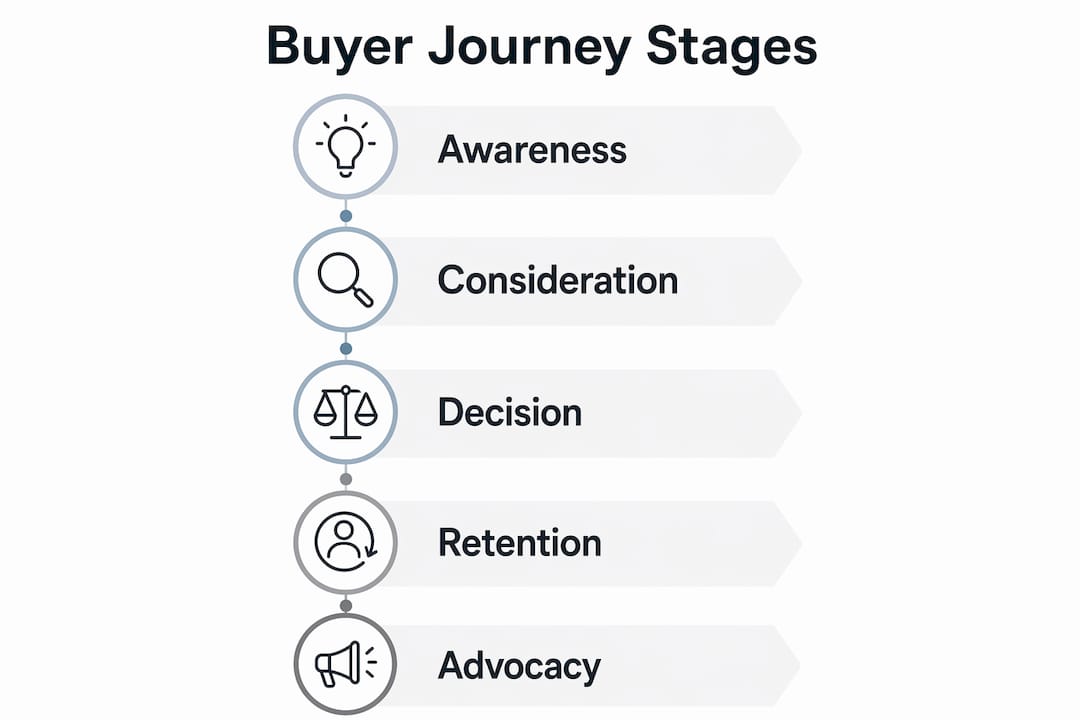
HubSpot’s full-funnel model organizes content marketing around three stages: awareness, consideration, and decision. Each stage reflects a different mindset, a different question the buyer is asking, and a different type of content that answers it well. Skipping stages is one of the most common and costly mistakes brands make.
Creating content by buyer journey stage, rather than by channel or topic alone, ensures your messaging aligns with where the audience actually is in their decision process. A prospect who just discovered your brand needs education, not a pricing page. A prospect comparing vendors needs proof, not another blog post about industry trends.
| Funnel stage | Content types | Primary goal |
|---|---|---|
| Awareness | Blog posts, social content, short-form video, podcasts | Build visibility and earn trust |
| Consideration | Case studies, comparison guides, webinars, email sequences | Demonstrate fit and differentiate |
| Decision | Product demos, testimonials, free trials, ROI calculators | Remove friction and drive conversion |
The mistake most teams make is overproducing awareness content while neglecting the middle and bottom of the funnel. Consideration-stage content, things like detailed comparison guides or customer success stories, directly influences whether a lead converts or walks away to a competitor.
HubSpot recommends assigning each content asset an explicit cognitive job and a logical next step. That means every piece of content should answer one question clearly and then point the reader toward the next piece that answers the question they will naturally ask next. This prevents funnel gaps that silently kill conversion rates.
Pro Tip: Map your existing content library against the three funnel stages. Most brands discover they have 70% or more of their assets sitting at the awareness stage. Fill the gaps at consideration and decision first. That is where revenue lives.
How are marketers measuring content marketing success in 2026?
The Content Marketing Institute is direct: measurement must shift from vanity counts to metrics tied to revenue impact, AI-driven visibility, customer experience, and operational efficiency. Page views and social shares do not satisfy a CFO. Pipeline influence, customer lifetime value, and retention rates do.
“Executives want to see content marketing connected to business outcomes, not content activity. The question is no longer ‘how much did we publish?’ It is ‘what did publishing that generate?’” — Content Marketing Institute
The metrics that matter most in 2026 fall into four categories:
- Revenue impact: Pipeline influenced, closed deals attributed to content, customer lifetime value growth
- AI visibility: Brand mentions in ChatGPT, Perplexity, and Google AI Overviews responses
- Customer experience: Time to conversion, support ticket deflection, onboarding completion rates
- Operational efficiency: Content reuse rate, cost per lead from organic content, production cost per asset
HubSpot’s 2026 survey of 1,500+ marketers found that 33% of marketers cite measuring marketing ROI as their top challenge. That number signals a structural problem: most teams are still building measurement frameworks after the content is already live, rather than defining KPIs before a single word is written.
The fix is to treat content marketing as a publishing and measurement system from day one. Define your attribution model, set up customer journey tracking, and align your KPIs with what leadership actually reports on before scaling production. Integrated attribution planning built into strategy development is what separates teams that prove ROI from teams that guess at it.
What are the top 2026 trends shaping digital content strategy?
The biggest shift in digital content strategy right now is the collision between AI-driven production and the growing demand for authentic, human-centered content. These two forces are not opposites. They are a tension that the best content teams are learning to manage deliberately.

AI tools are now used for content creation by 42.5% of marketers, media production by 37.2%, and automation by 35.6%. That adoption rate means AI is no longer a competitive advantage. It is table stakes. The differentiation now comes from what you do with the time AI saves you, specifically investing it in original research, genuine expertise, and brand voice that cannot be replicated by a prompt.
Key trends every content marketer needs to track:
- Answer engine optimization (AEO): Half of all Google searches now include AI overviews. Brands are rewriting content to be cited by generative AI tools, not just ranked in traditional search results.
- Short-form video dominance: Platforms like TikTok, Instagram Reels, and YouTube Shorts reward frequency and authenticity over production value. Brands that repurpose long-form content into short clips are compounding their reach without compounding their workload.
- Hyper-personalization at scale: AI enables content experiences tailored to industry, behavior, and funnel stage. Static, one-size-fits-all content pages are losing ground to dynamic, segmented experiences.
- Content repurposing as strategy: The most efficient content teams treat every long-form asset as a source file. One research report becomes a blog post, an email sequence, a LinkedIn series, and a short-form video script.
The brands winning in 2026 are not publishing more. They are publishing smarter, measuring faster, and building content ecosystems where each asset reinforces the others. For ecommerce brands specifically, understanding how content drives retail growth through digital channels is the foundation for sustainable acquisition and retention.
Key takeaways
Effective content marketing in digital marketing requires funnel-mapped assets, revenue-tied measurement, and a clear system for connecting content output to business outcomes.
| Point | Details |
|---|---|
| Content marketing is strategic, not tactical | Plan content around funnel stages and business goals, not just topics or channels. |
| Funnel gaps kill conversions | Most brands over-index on awareness content. Fill consideration and decision stages first. |
| Measurement must tie to revenue | Track pipeline influence, customer lifetime value, and AI visibility, not just traffic. |
| AI is table stakes, not an edge | Use AI to save time, then invest that time in original expertise and authentic brand voice. |
| Every asset needs a job and a next step | Assign each piece of content a clear cognitive role and a logical path to the next stage. |
Why most content strategies stall before they scale
From working with ecommerce brands on retention and email strategy, the pattern I see most often is this: a team invests heavily in content production, publishes consistently for three to six months, and then hits a wall when leadership asks what it is actually generating. The content exists. The measurement framework does not.
The uncomfortable truth is that most content strategies are built backward. Teams decide what to publish, then figure out how to measure it. The smarter sequence is to define what success looks like for your business, map that to funnel stages, and then build content that fills the gaps in your attribution model. That is not a creative constraint. It is what makes content a revenue argument instead of a cost center.
I have also seen brands treat AI adoption as a volume play. More content, faster, cheaper. That almost always backfires. Audiences notice when content lacks a point of view. The content marketing for e-commerce brands that perform best are the ones using AI to handle research, formatting, and distribution logistics while keeping human judgment at the center of every editorial decision.
The other gap I see consistently is the absence of middle and bottom funnel content. Awareness content is easy to justify because it generates traffic. Consideration and decision content is harder to produce and harder to attribute, but it is where the actual conversion happens. If your content strategy does not include detailed comparison guides, customer success stories, and objection-handling assets, you are handing warm leads to competitors who do.
Build the measurement system first. Fill the funnel from the bottom up. Use AI for efficiency, not as a substitute for expertise. That sequence works.
— Take
How Take Action supports your content marketing results
Content strategy without a distribution and retention system leaves revenue on the table. At Take Action, we work with ecommerce brands to turn content-driven traffic into measurable revenue through email marketing, automated retention flows, and Klaviyo-powered segmentation. If your content is attracting the right audience but your email channel is not converting or retaining them, that is a fixable problem. Explore how Take Action’s email marketing services connect your content efforts to the revenue metrics your leadership team actually cares about. For a deeper look at how content strategy fits into 2026 priorities, the 2026 content marketing strategy guide on our blog is worth your time.
FAQ
What is content marketing in digital marketing?
Content marketing in digital marketing is the strategic creation and distribution of valuable, relevant content to attract, engage, and convert specific audiences. Salesforce defines it as a multi-stage process that spans research, production, distribution, and ongoing refinement.
What does content marketing include?
Content marketing includes blog posts, email newsletters, case studies, short-form video, webinars, podcasts, and landing pages. Each format serves a different stage of the buyer’s journey and a different audience intent.
How does content marketing support SEO?
Content marketing and SEO are directly linked. Well-structured content targeting specific search queries builds topical authority, earns backlinks, and signals relevance to search engines, including AI-powered answer engines that now surface results in Google AI Overviews.
How do you measure content marketing ROI?
The Content Marketing Institute recommends measuring pipeline influence, customer lifetime value, and retention rates rather than traffic or social engagement alone. Attribution models built before content production begins produce the most accurate ROI data.
How is AI changing content marketing in 2026?
AI tools are used by 42.5% of marketers for content creation, but human authenticity remains the primary differentiator. Brands are also adapting content for AI-powered search discovery, a practice known as answer engine optimization.
Recommended
- What Comes Under Content Marketing: a 2026 Guide | Take Action Blog | Take Action
- Content Marketing Campaign: Your 2026 Strategy Guide | Take Action Blog | Take Action
- What Is the Content Marketing Strategy in 2026 | Take Action Blog | Take Action
- Content creation in digital marketing: A growth guide | Take Action Blog | Take Action