

Content Marketing Campaign: Your 2026 Strategy Guide
TL;DR:
- Most effective content marketing campaigns cost significantly less than traditional advertising, focusing on strategy, personalization, and measurement.
- Building audience trust through authentic storytelling and targeted content is essential for long-term brand authority and customer retention.
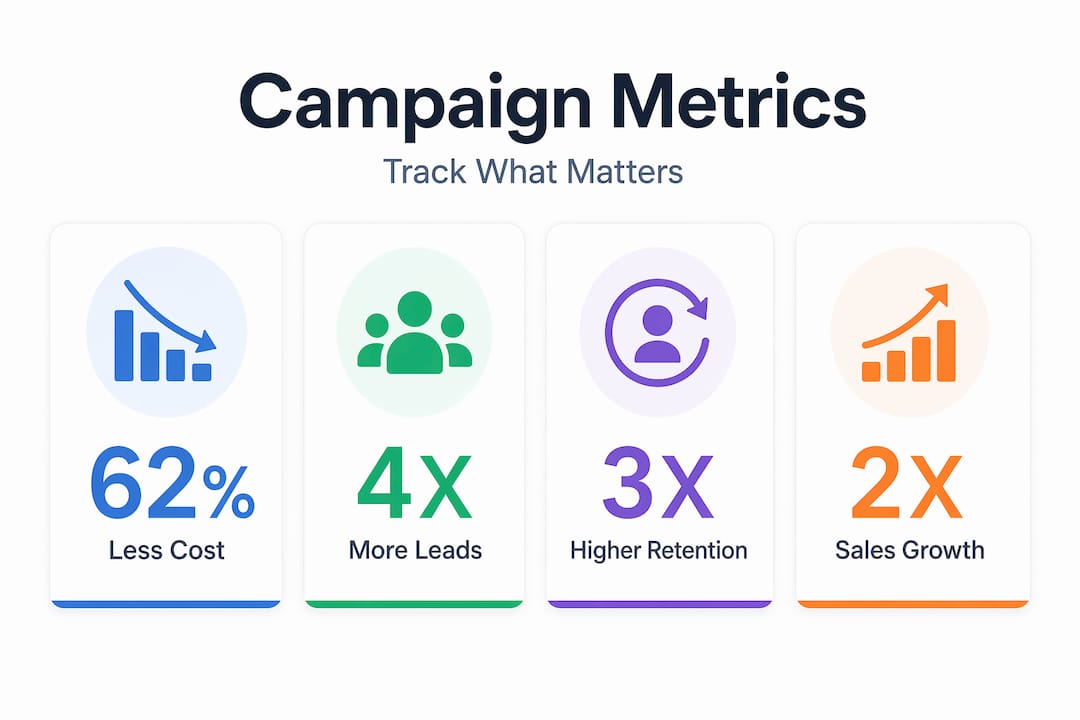
Most marketing professionals assume a serious content marketing campaign requires a budget to match. That assumption is costing them. Content marketing campaigns cost 62% less than traditional campaigns on average, while consistently outperforming them on engagement and long-term brand authority. The gap between brands that get results and those that spin their wheels rarely comes down to budget. It comes down to strategy, personalization, and measurement discipline. This guide gives you a practical, data-backed framework to plan, execute, and optimize campaigns that actually convert.
Table of Contents
- Key takeaways
- What makes a content marketing campaign actually work
- Using AI and data to personalize your campaign
- Planning and executing across multiple channels
- Measuring what matters in your campaign
- Building authority through storytelling and community
- My honest take on what most campaigns get wrong
- Ready to turn your content into a retention engine?
- FAQ
Key takeaways
| Point | Details |
|---|---|
| Cost efficiency is real | Content campaigns cost 62% less than traditional marketing while delivering stronger long-term ROI. |
| Quality beats frequency | Over 70% of marketers now prioritize content relevance over publishing volume. |
| AI needs human balance | AI-driven personalization works best when paired with expert-led strategy and human judgment. |
| Roadmap and calendar are different | Your strategic roadmap and tactical content calendar serve distinct purposes and both require active management. |
| Measurement closes the loop | Structured feedback between sales and marketing teams sharpens content performance over time. |
What makes a content marketing campaign actually work
Before you can run an effective campaign, you need clarity on what one actually is. A content marketing campaign is a coordinated effort to create and distribute valuable, relevant content to a defined audience over a set period, tied to a specific business goal. That is content marketing 101. What separates a campaign from random publishing is intention, structure, and accountability.
The foundation starts with your audience. Vague personas produce vague content. The brands winning in 2026 build detailed customer profiles that go beyond demographics. They map pain points by buyer stage, identify the specific questions prospects ask before purchasing, and segment their audience based on behavior, not just profile attributes. That level of specificity directly shapes what content you create, where you publish it, and how you measure success.
Goal setting is where most campaigns quietly fail. “Drive more traffic” is not a goal. “Generate 200 marketing-qualified leads in Q3 at a cost per lead under $40” is a goal. Every piece of content in a well-built campaign connects back to a measurable outcome. That connection is what separates a marketing content plan from a content calendar.
Here is what the core components of an effective campaign look like in practice:
- Audience segmentation: Group prospects by behavioral signals, not just firmographics or demographics.
- Content relevance: quality and relevance matter more to over 70% of marketers than posting frequency.
- Goal alignment: Each campaign asset should map directly to a stage in your funnel, whether awareness, consideration, or decision.
- Consistency: A predictable publishing cadence builds trust with both your audience and search algorithms.
Pro Tip: Build a one-page campaign brief before creating a single piece of content. Include your audience segment, the core problem you are solving, the business goal, success metrics, and the primary channel. This brief becomes the filter for every decision you make during execution.
Traditional content approaches treated channels as silos. A blog post was a blog post. Modern integrated campaigns treat every asset as part of an interconnected system. A single research report becomes a blog series, a LinkedIn post, an email nurture sequence, and a webinar topic. The content works harder because the distribution is deliberate.
Using AI and data to personalize your campaign
Personalization used to mean inserting a first name into an email subject line. That bar is long gone. The brands running the most effective campaigns today use AI to predict which content a specific audience segment needs at a specific stage, and deliver it automatically.
The results are concrete. The Project Athena campaign achieved a 3.8x return on ad spend with a $150,000 budget by combining AI-driven personalization with integrated multi-channel tactics. That is a B2B SaaS company, not a consumer brand with a massive following. The mechanism was predictive audience segmentation, personalized content delivery, and tight coordination across channels.
Here is what AI-powered content personalization looks like in practice:
- Predictive segmentation: AI tools analyze behavioral signals to group prospects by their likelihood to convert, not just their demographic profile.
- Dynamic content delivery: Personalized landing pages and email sequences that adapt based on how a user has previously engaged with your brand.
- Content scoring: Algorithms identify which pieces of content correlate most strongly with conversion, so you invest production budget in what works.
- Interactive utility tools: Embedding ROI calculators or assessment widgets on landing pages significantly improves lead quality, because prospects who complete them are signaling genuine intent.
The challenge is balance. AI automation paired with human expertise consistently outperforms pure automation on content authority and lead quality. AI handles pattern recognition and personalization at scale. Humans bring the editorial judgment, brand voice, and subject matter depth that algorithms cannot replicate. One without the other produces either generic content at scale or brilliant content that never reaches the right person.
Pro Tip: Align content formats with your team’s actual strengths. Subject matter experts often write far more authoritative content than they produce on video. Forcing video production on a team built for writing produces low-quality video and average writing. Match format to skill, then optimize distribution.
Top content marketers now operate as integrated system builders, combining AI-assisted production with entity-based SEO and deliberate video strategy. The shift is from inspiration-driven publishing to systematic, workflow-driven output.
Planning and executing across multiple channels
Strategy without a plan is just intention. Running a content marketing campaign at scale requires two distinct management tools: a strategic roadmap and a tactical content calendar. Most teams confuse them or skip one entirely.

The roadmap versus calendar distinction matters more than most teams realize. Your roadmap is a multi-quarter strategic document. It answers questions like: What campaigns are we running this quarter? What business goals do they serve? What resources do we need? Your calendar is the daily and weekly execution layer. It answers: What is publishing on Tuesday? Who is writing it? Where is it in the approval process?
Here is a practical process for building campaign infrastructure that holds up under execution pressure:
- Define your campaign theme and goal first. Before touching a content calendar, lock in the audience segment, the core message, and the measurable outcome you are chasing.
- Map content to funnel stages. Identify what awareness content, consideration content, and decision-stage content you need to support the full buyer journey.
- Select your primary and secondary channels. Choose channels based on where your specific audience actually spends time, not where it is fashionable to publish. If your prospects live on LinkedIn and email, go deep there before spreading thin.
- Build the calendar with publishing slots, formats, and owners. Every piece needs a deadline, a responsible person, and a distribution plan. Content without a distribution plan is a tree falling in an empty forest.
- Layer in retargeting and nurture sequences. Prospects who engage with awareness content but do not convert need a structured follow-up path. Retargeting ads and email sequences keep your brand visible without requiring new content production.
Pro Tip: Plan your content calendar in six-week sprints rather than full quarters. Six weeks gives you enough time to see performance data and adjust before you have locked in 12 more weeks of content that might be heading in the wrong direction.
For ecommerce brands specifically, the content marketing for ecommerce space has matured considerably. The brands seeing the best results coordinate organic content, email nurture, and paid retargeting as a single system rather than separate initiatives managed by separate teams.
Measuring what matters in your campaign
A content marketing campaign without measurement is a guess with extra steps. Most teams track the wrong metrics, or track the right ones without a feedback loop that actually changes behavior.
The metrics worth watching fall into four categories:
- Engagement: Time on page, scroll depth, video completion rate, social shares. These tell you whether your content is holding attention.
- Lead quality: Marketing-qualified leads generated, lead-to-opportunity conversion rate, cost per lead. Volume without quality is vanity.
- Revenue impact: Pipeline attributed to content, customer acquisition cost, return on ad spend. These are the numbers your CFO cares about.
- Content efficiency: Which formats and topics drive the most qualified leads per dollar spent. This informs your next campaign’s production budget.
| Metric | What it tells you | When to act |
|---|---|---|
| Cost per lead (CPL) | Efficiency of content in driving qualified prospects | CPL rising 20%+ over baseline |
| Lead-to-close rate | Content quality and audience targeting accuracy | Drop below historical average |
| ROAS | Revenue generated per dollar of campaign spend | Below campaign-specific target |
| Engagement rate | Audience relevance and content quality | Consistent decline across multiple assets |
Structured feedback loops between sales and marketing are where most organizations leave performance on the table. Sales reps know which content prospects actually find useful. Marketing rarely asks. A biweekly 30-minute sync between sales and content teams, focused specifically on what assets prospects are engaging with and what questions are not being answered, produces faster iteration than any A/B testing framework alone.
Pro Tip: Do not wait until a campaign ends to review performance. Set a 30-day check-in for every campaign. Look at early engagement signals and CPL trends. Campaigns typically need 2 to 4 months before showing significant results, but early data points tell you whether you are on track or drifting.
Building authority through storytelling and community
The most technically sophisticated content marketing strategy in the world fails if your audience does not trust you. Authority and trust are not built through production quality alone. They are built through authenticity, consistent expertise, and giving your audience a genuine voice.
Content marketing and storytelling are inseparable in 2026. The brands with the deepest audience loyalty are not necessarily publishing the most content. They are publishing the most credible content, content that features real user voices, expert perspectives, and radical transparency about how their products work and where they fall short.
Dove’s approach proves the point. By building a campaign around unfiltered Reddit reviews, the brand surpassed 1 billion impressions without manufactured testimonials or scripted praise. The content was credible precisely because it was not controlled.
The tactical moves that build authority over time:
- Expert-led content: Feature subject matter experts as named authors or contributors. Bylined expertise builds trust faster than brand voice alone.
- Community co-creation: User-generated content, customer case studies, and community forums give your audience ownership in the brand story.
- Authority-driven publishing: In an AI-saturated content world, durable growth depends on differentiated, credible content that aligns with how AI-driven search surfaces information.
- Editorial partnerships: High-quality editorial partnerships boost referral traffic, domain authority, and brand credibility simultaneously.
“62% of consumers find traditional promotional content disruptive.” Research confirms that audiences are not rejecting content. They are rejecting content that feels like an ad wearing a blog post costume. Authentic storytelling is not a soft strategy. It is the most defensible competitive advantage available.
To build a brand that retains customers through content, the approach must consistently prioritize trust over promotion. You can explore brand content strategies that have proven effective for ecommerce and online brands at different growth stages.
My honest take on what most campaigns get wrong
I’ve worked alongside enough marketing teams to spot the pattern quickly. The teams that struggle with content marketing campaigns almost always have the same problem: they are optimizing for output instead of outcome.
They measure success by how many blog posts went live, how many social posts were scheduled, how many pieces of content the team produced this quarter. Meanwhile, no one in leadership can answer the question: “Did any of this actually move the needle on revenue?”
What I’ve learned is that volume is a hiding place. When a campaign is not converting, producing more content feels productive. It rarely is. The better move is to stop, audit what you have, identify where prospects are dropping off the funnel, and fix that specific gap with one well-crafted piece of content rather than ten mediocre ones.
The other mistake I see constantly is treating AI as a replacement for strategy rather than an accelerant. AI tools are genuinely powerful for personalization, content scoring, and predictive segmentation. But they require human-set objectives, human-curated inputs, and human judgment on outputs. A campaign built entirely on AI-generated content with no editorial oversight produces content that feels like it was written by someone who has never spoken to a real customer. Because it was.
The brands I’ve seen get consistent results from content treat it like a product. They have a roadmap, a feedback loop, and a willingness to kill content that is not working. They also play the long game. Patience is not passive. It is staying disciplined to your strategy while iterating on execution.
— Take
Ready to turn your content into a retention engine?
If you have read this far, you already know that a great content marketing campaign is not about publishing more. It is about publishing smarter, distributing deliberately, and measuring what actually connects to revenue. That is exactly where Take-action specializes.
Take-action helps ecommerce brands and online businesses build the kind of campaign infrastructure that converts attention into customers and customers into loyal repeat buyers. From strategic planning and email flow architecture to Klaviyo automation and performance optimization, the team at Take-action brings the data-driven discipline that makes content work as a genuine growth channel. If you are ready to stop guessing and start scaling, Take-action is built for that conversation.
FAQ
What is a content marketing campaign?
A content marketing campaign is a structured, goal-oriented effort to create and distribute valuable content to a defined audience over a specific period. It differs from general content publishing because every asset connects to a measurable business outcome.
How long does a content campaign take to show results?
Most campaigns require a ramp-up period of 2 to 4 months before producing significant results. Early engagement signals can indicate whether the strategy is on track, but patience and iterative optimization are necessary for meaningful performance data.
How do I measure the success of a content campaign?
Track four metric categories: engagement (time on page, scroll depth), lead quality (cost per lead, MQL volume), revenue impact (ROAS, pipeline attribution), and content efficiency (leads per dollar by format and topic).
Does content marketing work for small budgets?
Yes. Content campaigns cost 62% less on average than traditional marketing, making them particularly effective for brands that cannot compete on paid media spend. The key is targeting a narrow, well-defined audience with highly relevant content rather than broadcasting broadly.
How does storytelling fit into a content campaign?
Content marketing storytelling is the mechanism that builds trust at scale. Authentic stories, whether from customers, experts, or internal voices, create the emotional connection that converts an audience into buyers. Dove’s use of unfiltered consumer voices to surpass 1 billion impressions is a concrete example of storytelling as a campaign strategy.
Recommended
- Content Marketing Strategy Examples That Actually Drive Growth | Take Action Blog | Take Action
- Best SEO Digital Marketing Strategies for 2026 | Take Action Blog | Take Action
- Content creation in digital marketing: A growth guide | Take Action Blog | Take Action
- UGC Strategy for Ecommerce Brands: 2026 Guide | Take Action Blog | Take Action