

Building an Email List for Ecommerce Growth in 2026
TL;DR:
- Building an email list is the most controllable asset for ecommerce growth because it cannot be affected by algorithm changes.
- Setting up proper technical infrastructure, including authentication and compliance, is essential to ensure delivery and maintain reputation.
- Effective lead magnets and strategic placement tactics are key to attracting and converting visitors into engaged subscribers.
Building an email list is the single most controllable growth asset an ecommerce brand can own. Unlike paid ads or social media reach, your list belongs to you. No algorithm change can cut your access to subscribers overnight. With the right setup, a focused lead magnet, and consistent acquisition tactics, reaching 1,000 subscribers in 90 days is a realistic baseline. This article covers the technical prerequisites, proven acquisition strategies, list health practices, and the most common mistakes that stall growth before it starts.
What tools do you need before building an email list?
The foundation of a healthy email list is not your signup form. It is your technical infrastructure. Skipping this step is the most expensive mistake ecommerce marketers make, because even a perfectly designed form cannot save emails that land in spam.
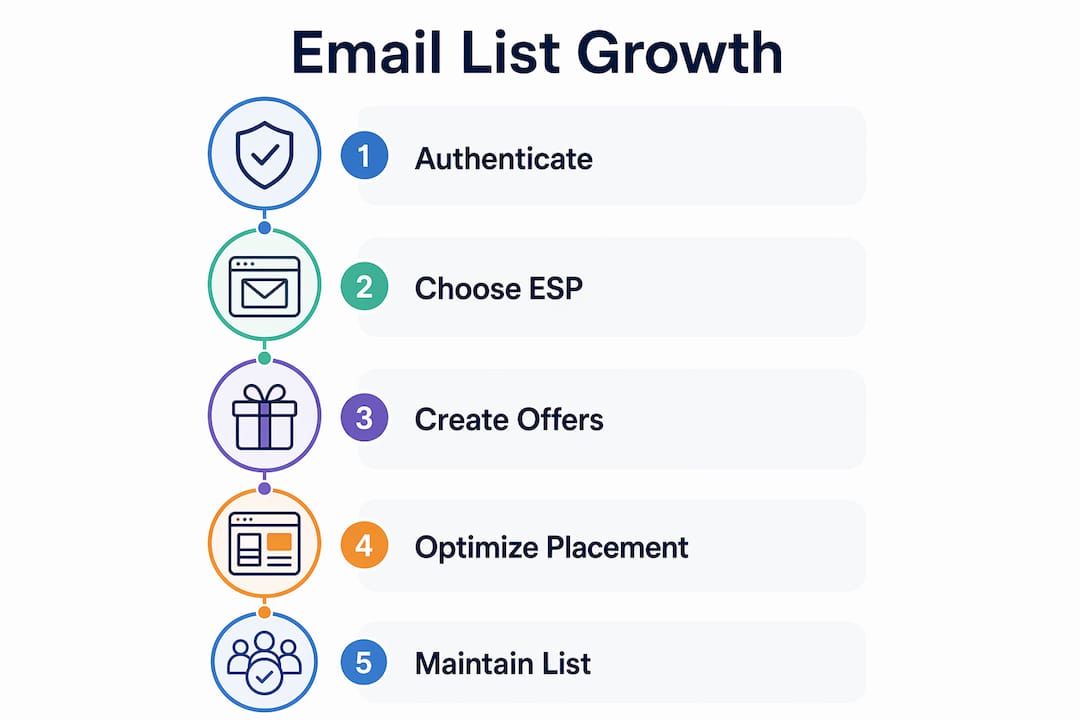
Choose the right email service provider
An email service provider (ESP) is the platform that stores your subscribers, sends your campaigns, and tracks engagement. For ecommerce brands, the right ESP supports automation flows, segmentation by purchase behavior, and integration with your store. Klaviyo is the leading choice for Shopify and BigCommerce brands because it connects directly to order data and enables precise behavioral triggers.
Set up authentication before your first send
Authenticated sending with SPF, DKIM, and DMARC is not optional in 2026. These three DNS records tell inbox providers that your domain is a legitimate sender. Without them, your emails go to junk. SPF specifies which servers can send on your domain’s behalf. DKIM adds a cryptographic signature to each message. DMARC tells receiving servers what to do when either check fails.
Pro Tip: Set your DMARC policy to “p=quarantine” initially, then move to “p=reject” once you confirm your sending sources are all authenticated. This protects your domain reputation without blocking legitimate mail.
Before collecting a single address, confirm these records are active:
- SPF record: Added to your domain’s DNS as a TXT record
- DKIM record: Generated inside your ESP and added to DNS
- DMARC record: A TXT record at
_dmarc.yourdomain.comwith your chosen policy - Custom sending domain: Route email through your own domain, not a shared ESP subdomain
- CAN-SPAM and GDPR compliance: Every signup form needs a clear opt-in statement, and every email needs an unsubscribe link
Compliance is not just legal protection. A clear opt-in statement also sets subscriber expectations, which reduces spam complaints and improves long-term engagement.
How do you attract and convert visitors into email subscribers?
The mechanics of growing email subscribers come down to two variables: the offer and the placement. Most ecommerce brands underperform on both.

Lead magnets that actually convert
A generic “Sign up for our newsletter” call to action converts poorly. Lead magnets like email templates, calculators, mini-courses, and exclusive first-order discounts convert significantly better. The reason is specificity. A visitor who sees “Get 15% off your first order” understands exactly what they receive. A visitor who sees “Join our community” does not. Specific value propositions convert 3–5 times better than generic CTAs. That gap compounds fast when you are running paid traffic.
Understanding what makes a lead magnet effective goes beyond just picking the right format. The offer must match the intent of the traffic arriving at that page.
Placement tactics that maximize signups
Where you place your form matters as much as what it says. The highest-performing placements for ecommerce sites are:
- Exit-intent popups: Triggered when a visitor moves their cursor toward the browser tab. These catch abandoning visitors without interrupting active browsing.
- Inline forms within blog content: Placed after the first or second section of a post, where readers have already demonstrated interest.
- Sticky header or footer bars: Always visible without blocking content, ideal for low-friction offers like a discount code.
- Checkout page opt-in: A single checkbox during purchase captures buyers at peak intent with minimal friction.
Cold traffic converts at 1–3% on standard signup forms. Engaged traffic, such as readers arriving from SEO-optimized blog posts, converts at 5–15%. That difference explains why content marketing and lead generation tactics compound over time. Each piece of content you publish becomes a permanent acquisition asset.
Pro Tip: Reduce your signup form to two fields maximum: email address and first name. Every additional field cuts conversion rates. You can collect more data later through post-signup surveys or purchase behavior.
Targeting a defined audience segment with a specific value proposition is the single biggest lever for improving list quality. Broad offers attract low-intent subscribers who never open an email.
How do you maintain subscriber quality and list health over time?
Growing a list is only half the job. A list that does not stay clean and engaged becomes a deliverability liability. Inbox providers watch your engagement rates closely. A list full of inactive addresses signals that your content is not worth reading, and your sender reputation drops accordingly.
Double opt-in vs. single opt-in
Double opt-in requires new subscribers to confirm their address via a follow-up email before they are added to your list. Single opt-in adds them immediately. Double opt-in produces a smaller but cleaner list. It filters out typos, disposable addresses, and low-intent signups. The result is higher open rates, fewer spam complaints, and better inbox placement. For ecommerce brands focused on long-term retention, double opt-in is the better default.
Keeping your list healthy month after month
Follow these steps to maintain a list that stays responsive:
- Remove hard bounces immediately. A hard bounce means the address does not exist. Sending to bounced addresses damages your sender score fast.
- Flag subscribers inactive for 90 days. Run a re-engagement campaign with a clear subject line like “Still want to hear from us?” before removing them.
- Suppress non-openers after 180 days. If a re-engagement campaign fails, suppress the address rather than delete it. You can reactivate them later if they purchase.
- Monitor your unsubscribe rate per campaign. A rate above 0.5% on a single send signals a relevance problem, not just a list problem.
- Replenish continuously. Annual churn runs 25–30% across most email lists. That means you lose roughly one in four subscribers every year just through natural attrition.
A net monthly growth rate of 2.5–5% is the minimum needed to offset that churn and actually grow your audience. Anything below that and your list is shrinking, even if your signup form is running. Consistent newsletter content keeps subscribers engaged between purchases and reduces passive churn.
Pro Tip: Segment your list by engagement tier: active, at-risk, and lapsed. Send your most promotional campaigns only to active subscribers. This protects your sender reputation while you work to re-engage the rest.
What mistakes should ecommerce marketers avoid when building their list?
Most list-building failures trace back to a small set of repeatable errors. Recognizing them early saves months of wasted effort.
Obsessing over signup form aesthetics without configuring SPF, DKIM, and DMARC first is the fastest way to build a list that never reaches the inbox. Technical infrastructure is not optional. It is the prerequisite for everything else.
The most common mistakes include:
- Skipping authentication setup. Neglecting domain authentication leads directly to spam folder placement. No amount of great content fixes that.
- Buying or scraping email lists. Purchased lists contain addresses that never opted in to hear from you. Sending to them triggers spam complaints, destroys your sender reputation, and violates CAN-SPAM and GDPR.
- Measuring success by list size alone. A list of 50,000 disengaged subscribers performs worse than a list of 5,000 people who open every email. Engagement rate is the metric that predicts revenue.
- Offering no clear value at signup. Vague CTAs produce vague subscribers. If you cannot explain in one sentence what someone gets by signing up, rewrite the offer before running traffic to it.
- Sending without a frequency commitment. Subscribers who do not know how often to expect emails are more likely to mark your first message as spam when it arrives unexpectedly.
Key Takeaways
Building an email list delivers sustainable ecommerce growth only when technical setup, targeted acquisition, and consistent list hygiene work together from the start.
| Point | Details |
|---|---|
| Authenticate before acquiring | Configure SPF, DKIM, and DMARC before collecting a single subscriber to protect inbox delivery. |
| Use specific lead magnets | Targeted offers like discounts or templates convert 3–5x better than generic newsletter CTAs. |
| Plan for annual churn | Losing 25–30% of subscribers yearly means a net monthly growth rate of 2.5–5% is the minimum to stay even. |
| Prioritize engagement over size | A smaller, active list outperforms a large, disengaged one on every revenue metric that matters. |
| Clean your list regularly | Remove hard bounces immediately and suppress inactive subscribers after a failed re-engagement campaign. |
What I have learned about building lists that actually earn revenue
The brands that struggle most with email are not the ones with bad products. They are the ones that treat list building as a one-time setup task rather than an ongoing system. I have seen ecommerce stores with tens of thousands of subscribers generating less revenue per email than stores with a few thousand, because the large list was built fast and never cleaned.
Early small lists built with consistent, valuable content are more engaged than big lists assembled quickly through aggressive tactics. That pattern holds because the subscribers who join early do so because the offer genuinely resonated with them. They are not there for a one-time discount they will never use.
The other thing most guides skip is the compounding effect of starting early. A list you build now, even slowly, gives you data on what your audience responds to. That data makes every future campaign sharper. Brands that wait until they have “enough traffic” to start building a list are delaying the feedback loop that would have made their traffic more effective in the first place.
The technical side is not glamorous, but it is where the real leverage is. Getting SPF, DKIM, and DMARC right before your first campaign means every subscriber you add lands in the inbox. Getting it wrong means you are building on sand.
— Take
How Take-action helps ecommerce brands grow through email
Take-action works with ecommerce brands that want email to function as a primary revenue channel, not just a backup to paid ads. The agency handles everything from technical authentication and ESP setup to welcome flows, abandoned cart sequences, and post-purchase campaigns built inside Klaviyo.
If your list is growing but your email revenue is not, the problem is usually in the flows and segmentation, not the size of the list. Take-action audits your current setup, identifies the gaps, and builds the systems that turn subscribers into repeat buyers. Brands working with Take-action get a dedicated team that aligns campaign strategy with their brand voice and scales with them over time.
FAQ
How long does it take to build an email list from scratch?
With one lead magnet, an exit-intent popup, and weekly SEO content, reaching 1,000 subscribers in 90 days is achievable. Scaling to 10,000 typically takes 6–14 months with consistent effort.
What is the best lead magnet for an ecommerce store?
A first-order discount, exclusive product bundle, or category-specific buying guide converts best for ecommerce. The offer must match the intent of the traffic seeing it.
Should I use double opt-in or single opt-in?
Double opt-in produces a cleaner, more engaged list by filtering out bad addresses and low-intent signups. For ecommerce brands focused on deliverability and long-term retention, double opt-in is the stronger choice.
How often should I clean my email list?
Remove hard bounces immediately after each send. Flag subscribers inactive for 90 days, run a re-engagement campaign, and suppress anyone who does not respond within 30 days of that campaign.
Why does my email list shrink even when I keep adding subscribers?
Natural churn removes 25–30% of subscribers annually through unsubscribes and inactive addresses. A net monthly growth rate of at least 2.5–5% is required just to maintain your current list size.