

Build an e-commerce brand on a budget: email strategies
TL;DR:
- Email marketing offers a high return on investment and is underutilized by small and mid-sized brands.
- Lean branding emphasizes clarity, consistency, and customer feedback over costly design rebrands.
- Automated email flows and segmentation maximize retention and revenue with minimal manual effort and budget.
Email marketing averages a 36:1 to 42:1 return on investment for e-commerce brands, yet most small and mid-size store owners still pour their budgets into paid ads while underusing their email list. That gap is a massive opportunity. You do not need a six-figure marketing budget to build a brand people recognize, trust, and buy from repeatedly. What you need is a clear strategy, a few smart tools, and the right email flows running in the background. This guide walks you through every practical step, from lean brand foundations to automated retention engines, so you can build something lasting without burning through your margins.
Table of Contents
- The essentials of lean brand building
- Why email marketing is the smart budget choice
- Maximize impact with automation and flows
- Segmentation and personalization on a budget
- Free and low-cost tools for email-driven branding
- Our take: What most e-commerce brands miss about budget brand building
- Level up your email-driven brand with expert support
- Frequently asked questions
Key Takeaways
| Point | Details |
|---|---|
| Focus on essentials | Clear positioning and streamlined visual identity maximize brand impressions on a budget. |
| Maximize email ROI | Email marketing consistently outperforms other channels for building brand and customer retention. |
| Automate for efficiency | Automated flows save time and drive much higher revenue than manual campaigns. |
| Segment and personalize | Basic segmentation and simple personalization can significantly boost engagement and conversions. |
| Use free tools wisely | Robust, free or low-cost email platforms level the playing field for small brands to grow affordably. |
The essentials of lean brand building
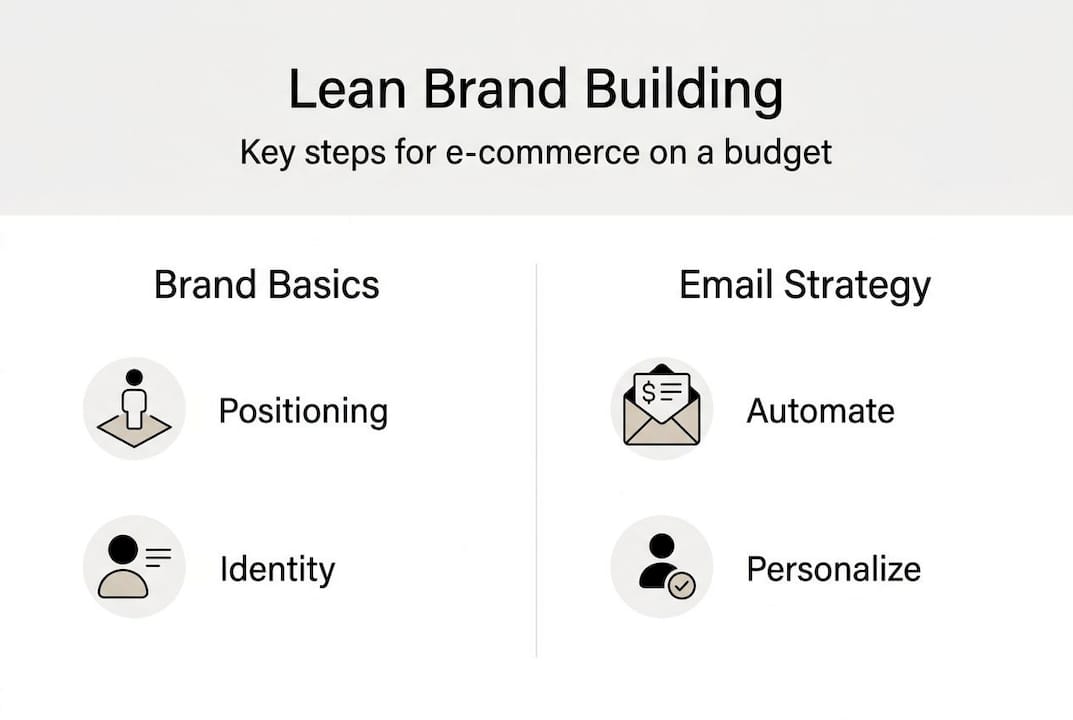
Lean eCommerce branding focuses on efficiency, clear positioning, a simple visual identity, and customer feedback loops. The idea is to strip away everything that does not directly serve your customer’s experience or your brand’s core promise. Instead of spending thousands on a rebrand, you invest in clarity.
Start with positioning. What do you stand for, and who exactly are you serving? A one-sentence answer to that question is worth more than any logo redesign. Once you have that, lock in a visual identity using no more than two fonts and two to three core colors. Consistency across your website, emails, and packaging builds recognition faster than complexity ever could.
Customer feedback is your cheapest and most powerful research tool. Send a short post-purchase survey. Read your reply emails. Track what questions your support team gets most often. These signals tell you exactly where your brand messaging is landing and where it is falling flat.
Here is how lean branding compares to traditional approaches:
| Factor | Lean branding | Traditional branding |
|---|---|---|
| Upfront cost | Under $500 | $5,000 to $50,000+ |
| Time to launch | Days to weeks | Months |
| Agility | High, easy to iterate | Low, costly to change |
| Customer input | Built in from day one | Often added late |
| Outcome focus | Revenue and retention | Awareness and aesthetics |
You can add custom branding touches to packaging or inserts without a huge spend, and those small details create memorable unboxing moments that drive word-of-mouth.
“Simplicity is the ultimate sophistication. Brands that focus on one clear message outperform those that try to say everything at once.”
For practical email marketing tips that reinforce your brand voice at every touchpoint, a consistent tone across campaigns matters just as much as your logo.
Pro Tip: Keep visual identity fixes under $100 using DIY design tools like Canva. Set up a brand kit with your colors, fonts, and logo so every email and social post stays consistent without extra effort.
Why email marketing is the smart budget choice
With lean branding principles in place, the next step is amplifying that foundation. No channel delivers better budget efficiency than email marketing.

The numbers are hard to argue with. Email returns $42 per $1 spent on average, with top-performing brands hitting 50:1 ratios. Compare that to paid social or search, where costs keep climbing and you lose access the moment you stop paying.
| Channel | Avg. ROI | Avg. open/CTR | Ownership |
|---|---|---|---|
| Email marketing | 36:1 to 50:1 | 30-40% open, 2-3% CTR | You own the list |
| Paid social ads | 2:1 to 5:1 | 0.5-1.5% CTR | Platform-dependent |
| Organic social | Hard to measure | 1-3% reach | Algorithm-dependent |
| Paid search | 2:1 to 8:1 | 2-5% CTR | Budget-dependent |
Email also wins on retention. Welcome series, loyalty rewards, and re-engagement campaigns directly increase customer lifetime value (LTV), which is the metric that separates profitable brands from ones that constantly chase new customers.
Here are three retention email types every e-commerce brand should run:
- Welcome series: Introduces your brand story, sets expectations, and converts new subscribers at rates up to 50% open rate
- Loyalty and VIP emails: Rewards repeat buyers, making them feel recognized and increasing purchase frequency
- Re-engagement campaigns: Wins back lapsed customers before they forget you exist, often at a fraction of acquisition cost
For more on how to structure these, explore newsletter retention ideas and email segmentation strategies that make each send more relevant.
You can also benchmark email results against industry averages to know exactly where your campaigns stand and where to improve.
Pro Tip: Set one clear call to action per email. Emails with a single CTA get higher click rates because readers know exactly what to do next. Multiple links create confusion and dilute results.
Maximize impact with automation and flows
Knowing email’s budget value, let’s zoom in on the tactics that work hardest for your brand with the least manual effort: automation and flows.
Automated flows generate 41% of email revenue from just 5% of total sends, with 18x higher revenue per recipient and 3x higher click rates compared to manual campaigns. That ratio is remarkable. You set them up once, and they keep earning.
Here are the four flows every budget-focused brand should deploy first:
- Welcome series (3 to 5 emails): Introduce your brand, share your story, offer a first-purchase incentive, and set expectations for what subscribers will receive
- Abandoned cart recovery (2 to 3 emails): Remind shoppers what they left behind, address common objections, and offer a time-sensitive nudge to complete the purchase
- Post-purchase follow-up (2 to 4 emails): Thank customers, provide product tips, encourage reviews, and plant the seed for the next purchase
- Win-back campaign (2 to 3 emails): Re-engage customers who have not bought in 60 to 180 days with a compelling reason to return
Here is how flows compare to manual campaigns:
| Metric | Automated flows | Manual campaigns |
|---|---|---|
| Open rate | 40-50% | 20-30% |
| Click rate | 5-10% | 1.5-3% |
| Revenue per recipient | Up to 18x higher | Baseline |
| Time investment | One-time setup | Ongoing effort |
For tool recommendations, check out this overview of email automation tools built for retailers. You can also explore free email tools that include flow templates to get started fast.
Do not overlook deliverability basics. Setting up SPF and DKIM authentication for your sending domain is free, takes under an hour, and keeps your emails out of spam folders. It is one of the highest-ROI technical tasks you can do.
Pro Tip: Use free or low-cost automation platforms with built-in templates to launch your first flows in a weekend. You do not need a developer or a big budget to get this running.
Segmentation and personalization on a budget
Technology makes it easier than ever to scale your email impact. Smarter segmentation and personalization take every dollar further without requiring a big team or expensive software.
Segmentation, personalization, and automation are the core budget strategies for retention-focused e-commerce brands. The principle is simple: send the right message to the right person, and you need fewer emails to get better results.
Here are the simplest segments to start with:
- VIP customers: High spenders or frequent buyers who deserve exclusive offers and early access
- First-time buyers: New customers who need nurturing to convert into repeat purchasers
- Lapsed customers: Shoppers who have not bought in 90-plus days and need a re-engagement push
- Browse abandoners: Visitors who viewed products but did not add to cart, a warm audience worth targeting
- Engaged non-buyers: Subscribers who open emails but have never purchased, ideal for a targeted conversion sequence
For a deeper look at how this works in practice, the benefits of segmentation and segmentation strategies are worth reviewing before you build your first segments.
“AI-driven personalization is boosting click-through rates significantly, and first-party data collected directly from your customers is now the most valuable and compliant asset you can build.”
Personalization does not have to mean complex dynamic content blocks. Using a subscriber’s first name, referencing their last purchase, or tailoring subject lines to their browsing behavior all count. Even personalized brand engagement in physical touchpoints reinforces the digital relationship you are building through email.
Pro Tip: Test one basic split first: repeat buyers versus first-time customers. Send each group a different version of your next campaign and compare open rates, click rates, and conversions. The difference will motivate you to segment further.
Free and low-cost tools for email-driven branding
None of these strategies work without the right tools. Here is a shortlist of platforms that make budget-driven email branding possible.
Free tiers from platforms like HubSpot, Omnisend, and Shopify Email give small brands access to automation, segmentation, and analytics without upfront cost. Each has strengths worth knowing:
- Klaviyo: Best-in-class for e-commerce automation and segmentation; free up to 250 contacts with full flow access
- Omnisend: Strong omnichannel features including SMS; free tier supports up to 500 emails per month
- HubSpot Email: Generous free tier with CRM integration; ideal if you want a full marketing stack
- Shopify Email: Native Shopify integration; extremely simple to use with pay-as-you-go pricing after the free monthly allowance
- Mailchimp: Widely used entry-level tool with solid template library; free up to 500 contacts
Every platform on this list includes deliverability features like SPF/DKIM setup guides, list warm-up recommendations, and bounce management at the free or basic tier. These are not premium add-ons. They are table stakes, and using them correctly keeps your sender reputation strong.
Also check for integrations with your e-commerce platform. Klaviyo and Omnisend connect natively with Shopify, WooCommerce, and BigCommerce, pulling in purchase data automatically so your flows and segments stay accurate without manual work. For content ideas that stretch your budget further, explore how to repurpose email content across channels.
Pro Tip: Ask your email platform directly about nonprofit, startup, or seasonal discounts. Many providers offer 30 to 50% off for qualifying businesses, and the savings can fund several months of growth.
Our take: What most e-commerce brands miss about budget brand building
Here is the honest truth we see repeatedly: most early-stage brands over-invest in aesthetics and under-invest in listening. A beautiful logo does not build loyalty. Consistent, relevant communication does.
The brands that grow on lean budgets are not the ones with the most polished visuals. They are the ones that iterate quickly, respond to what customers actually say, and treat email as a two-way relationship rather than a broadcast channel. When someone replies to your welcome email, that is data. When your cart abandonment series outperforms your campaign sends, that is a signal to double down.
Resourcefulness beats resources every time. We have seen brands with $200 monthly tool budgets outperform competitors spending ten times that amount, simply because they focused on clarity, consistency, and customer-centricity. Use sales-boosting tips as a starting point, but always let your own customer data guide your next move. The brands that win long-term are the ones that listen hardest.
Level up your email-driven brand with expert support
Ready to turn these strategies into results that last? Here is how you can get expert help implementing everything you have learned.
At Take Action, we specialize in helping e-commerce brands build scalable, automated email systems that drive real retention and revenue. Whether you need your first welcome flow set up, a full segmentation strategy built out, or a long-term partner to manage and optimize your Klaviyo account, we work within your budget to deliver measurable outcomes. Our approach combines automation, smart segmentation, and brand-aligned messaging to turn your email list into your most reliable growth channel. Reach out to our email marketing experts or explore our full range of retention strategy support to find the right fit for your brand.
Frequently asked questions
What’s the fastest way to build a brand on a tight budget?
Lean eCommerce branding prioritizes clear positioning and a simple visual identity. Pair that with automated email flows and you have a fast, low-cost brand-building engine that compounds over time.
How much budget do I need to start effective email marketing for my e-commerce brand?
Free tiers from HubSpot, Omnisend, and Shopify Email mean you can launch your first campaigns and flows with zero upfront spend, scaling costs only as your list and revenue grow.
Does email marketing really outperform social media for ROI?
Yes. Email averages $36 to $42 per $1 spent, which far exceeds paid social or organic channels, and you own the audience rather than renting access through an algorithm.
What are the best automated flows for small brands to set up first?
Start with a welcome series, cart abandonment recovery, post-purchase follow-ups, and a win-back campaign. These four flows generate disproportionate revenue relative to the effort required to build them.
How do I know my email branding efforts are working?
Track open rates, click rates, and repeat purchase frequency over 60 to 90 days. E-commerce email benchmarks show that automated flows consistently outperform manual campaigns across every major metric, so improving those numbers is a clear sign your strategy is working.
Recommended
- Boost ecommerce sales with top email marketing tips | Take Action Blog | Take Action
- Essential digital branding tips for ecommerce growth | Take Action Blog | Take Action
- How to Repurpose Content for Ecommerce Email Success | Take Action Blog | Take Action
- How to build an email list for ecommerce success in 2026 | Take Action Blog | Take Action