

Build dynamic newsletters in Klaviyo for real engagement
TL;DR:
- Most ecommerce brands still send the same email to all subscribers, ignoring behaviors and preferences, leading to lost revenue. Dynamic newsletters utilize conditional logic to personalize content based on customer data, increasing relevance and engagement. Combining intelligent automation with original messaging enhances retention and maximizes marketing impact.
Most ecommerce brands are still blasting the same email to every subscriber on their list, regardless of what those people have bought, browsed, or ignored. That approach made sense when email was simple. Today, it’s leaving serious revenue on the table. Dynamic content automatically aligns message components in real time to individual segments based on behavior and preferences, meaning every subscriber gets an email that feels made for them. This guide breaks down exactly how dynamic newsletters work in Klaviyo, what data powers them, and how to use them to build retention that compounds over time.
Table of Contents
- Why traditional newsletters fall short for ecommerce brands
- How dynamic newsletters work in Klaviyo
- Personalization tactics: From customer data to real-time content
- Lifecycle flows and retention: Integrating dynamic newsletters for growth
- Editorial perspective: Dynamic does not mean generic—originality is your edge
- Partner with experts to elevate your dynamic newsletter strategy
- Frequently asked questions
Key Takeaways
| Point | Details |
|---|---|
| Dynamic beats static | Personalized newsletters based on customer data drive far higher engagement and revenue than generic blasts. |
| Show/hide logic empowers targeting | Conditional blocks let you serve tailored content to every subscriber within a single template workflow. |
| Data quality drives success | Robust, unified customer profiles enable more relevant and profitable automated messaging. |
| Combine flows for retention | Dynamic newsletters paired with automated flows multiply retention, minimize unsubscribes, and boost lifetime value. |
| Editorial matters | Original, value-driven editorial is essential—dynamic technology enhances but does not replace compelling storytelling. |
Why traditional newsletters fall short for ecommerce brands
There’s a reason most email marketing feels forgettable. The default playbook for most ecommerce brands goes something like this: build a list, write one email, send it to everyone, and measure opens. It’s fast, it’s simple, and it consistently underperforms.
Generic batch campaigns, sometimes called “batch-and-blast,” treat a first-time buyer the same as a loyal customer who’s ordered a dozen times. They treat someone who browsed your winter clearance section the same as someone who only buys premium items at full price. When your emails ignore what you already know about each subscriber, you’re essentially introducing yourself to a friend every single time you talk to them.
The engagement data confirms this gap is real and significant. Campaigns make up 94.7% of email send volume, yet automated flows generate nearly 41% of total email revenue from just 5.3% of sends. Flows also deliver over 3x higher click rates at 5.58% compared to 1.69% for campaigns. That gap doesn’t happen by accident. It happens because flows respond to behavior, while campaigns broadcast to everyone at once.
Here’s what generic newsletters typically miss:
- Lifecycle relevance: A welcome email and a re-engagement email need completely different tones, urgency, and offers.
- Purchase context: Someone who just bought a product doesn’t need to see an ad for that exact product. They need a cross-sell or a usage tip.
- Preference alignment: If a subscriber only ever engages with skincare content, showing them footwear features is a wasted impression.
- Timing sensitivity: A subscriber who last purchased three days ago responds differently to a campaign than one who hasn’t opened an email in four months.
“The shift from volume to impact is the real unlock in modern email marketing. Fewer irrelevant sends, more targeted ones, is almost always the right direction.”
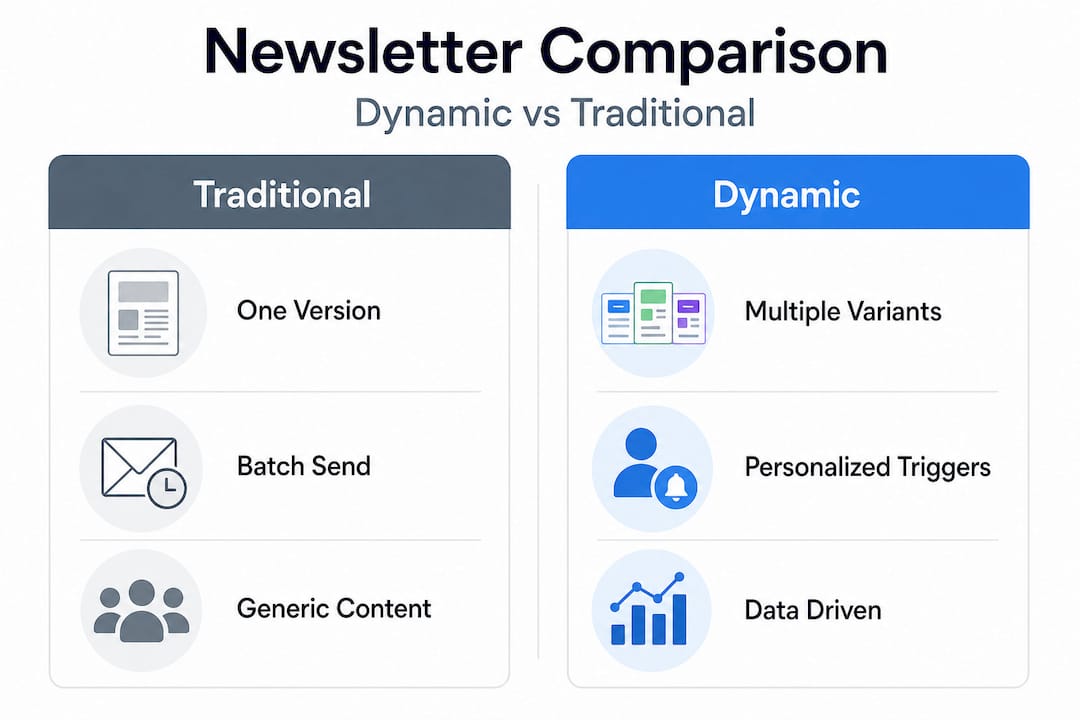
Dynamic newsletters bridge this gap by letting one email template serve multiple versions of itself. Instead of building five separate campaigns for five customer segments, you build one intelligent template that changes based on who’s reading it. If you’re looking for higher retention newsletter ideas to put this philosophy into practice right away, the concept starts here.
How dynamic newsletters work in Klaviyo
The technology behind dynamic newsletters sounds complex, but the core mechanism is straightforward once you understand it. Klaviyo uses conditional logic to control what content each subscriber sees inside a single email template. This is built around a feature commonly called show/hide blocks.

A show/hide block is exactly what it sounds like: a content section in your email that either displays or disappears based on conditions you set. Those conditions evaluate a subscriber’s profile data at send time, meaning the decision about what to show happens the moment Klaviyo generates the email for that specific person.
According to a detailed breakdown of Klaviyo’s approach, one email template can render entirely different sections for different subscribers at send time, all based on profile properties. In practical terms, that means one send can produce thousands of unique email versions simultaneously.
Here’s how you might use that in practice:
- Product recommendations: Show a “you might also like” block that pulls from a product feed and filters based on past purchase category.
- Offer personalization: Display a 15% discount to subscribers with three or more purchases and a stronger 20% offer to win back someone who’s been inactive for 90 days.
- Content blocks by lifecycle stage: Show onboarding tips to new subscribers while long-term customers see loyalty reward updates.
- VIP access blocks: Reveal early sale access content only to subscribers flagged as high-value based on lifetime spend.
- Replenishment triggers: Surface a “time to restock?” message to customers whose last purchase of a consumable product was 30 days ago.
| Approach | Traditional newsletter | Dynamic newsletter |
|---|---|---|
| Content variation | One version for all | Multiple versions per send |
| Personalization logic | Manual segmentation | Automated conditional blocks |
| Template management | One per segment | One flexible master template |
| Relevance | Generic | Behavior and preference based |
| Time to build | High for multiple variants | Lower with smart templates |
The underlying engine for all of this is customer data integrated via CRM platforms and APIs, which means your Klaviyo account needs to be synced with your store’s behavioral and transactional data to power these conditional rules effectively. The richer your data, the more precise your personalization becomes.
Pro Tip: Start with two or three show/hide blocks in your first dynamic newsletter. Test a simple condition like “has purchased vs. has not purchased” before layering in more complex logic. Getting one dynamic block working builds confidence and demonstrates ROI before you scale.
For a broader look at what’s possible, explore Klaviyo newsletter ideas that take this framework further, or see how personalized Klaviyo strategies can turn data into revenue.
Personalization tactics: From customer data to real-time content
Dynamic newsletters are only as good as the data feeding them. A perfectly built conditional template with weak customer data will still produce irrelevant emails. The quality and granularity of your customer profiles determine how precise your personalization can actually get.
The most effective personalization programs pull data from multiple sources simultaneously:
- Transactional data: Purchase history, product categories, average order value, frequency, and recency
- Behavioral data: Site browsing sessions, product page views, add-to-cart events, and email click patterns
- Preference data: Explicit information gathered through quizzes, surveys, or checkout questions
- Support data: Topics customers have contacted support about, returns history, product feedback
One of the most underused tactics is explicit preference capture at checkout. The Bottle Club demonstrated this clearly by adding a mandatory “who are you buying for?” question at checkout and storing the answer as a custom property in Klaviyo. That single data point allowed them to route customers into completely different automated journeys with content tailored to the actual purchase context, whether that was a gift buyer or a personal purchaser.
| Data type | Source | How it drives dynamic content |
|---|---|---|
| Purchase history | Store / Shopify | Product recs, replenishment, cross-sell blocks |
| Browse behavior | Website events | Category-specific content, browse abandonment |
| Lifecycle stage | Klaviyo profile | Onboarding vs. retention vs. win-back messaging |
| Explicit preferences | Checkout / surveys | Curated product blocks, content filters |
| Engagement history | Klaviyo activity | Send frequency optimization, offer escalation |
Unified customer data enables personalized marketing and retention, including consolidated data for targeted win-back campaigns, predictive churn risk, and post-purchase experiences. The key word here is unified. Fragmented data across disconnected tools produces personalization that feels off, like when a brand recommends a product you just returned.
Pro Tip: Run a quarterly data audit on your Klaviyo customer profiles. Check what percentage of your list has values filled in for your key segmentation properties. If fewer than 40% of subscribers have a purchase category on file, fix your data pipeline before adding more personalization complexity.
If you want to go deeper on building the segmentation engine behind all of this, start with segmentation strategies and then apply them through an email personalization guide built for ecommerce.
Lifecycle flows and retention: Integrating dynamic newsletters for growth
Personalized one-off campaigns are a step forward, but the real growth multiplier is embedding dynamic newsletters into automated lifecycle flows. This is where brands move from reactive email marketing to proactive retention infrastructure.
Lifecycle flows are automated sequences that trigger based on real customer behaviors and progression through key milestones: first purchase, second purchase, 60-day inactivity, subscription cancellation, or reaching a loyalty threshold. When your dynamic newsletter logic is woven into these flows, every communication point becomes relevant, timely, and appropriately personalized.
Here’s a practical approach to integrating dynamic content into key lifecycle moments:
- Post-purchase nurture: Send a dynamic email 72 hours after a first purchase that shows usage tips for the specific product category bought, cross-sell suggestions from complementary categories, and a soft introduction to your loyalty program.
- Win-back sequence: Trigger a three-part series for subscribers inactive for 90 days, where each email escalates the offer based on past purchase value and the subscriber’s last engaged content category.
- Replenishment flows: For consumable products, calculate the expected repurchase window and trigger a personalized “running low?” email with a one-click reorder link, adjusting urgency based on days since last purchase.
- Loyalty milestone emails: When a customer crosses a spending threshold, send a celebration email that dynamically shows benefits specific to their new tier and product recommendations they haven’t tried yet.
The results from brands doing this well are compelling. Minnow built 22 live flows and grew flow revenue by 37% year over year. Dermalogica reduced their flow unsubscribe rate to just 0.27% while increasing SMS revenue per recipient by 84.5%. These aren’t outlier results. They’re what happens when personalization and automation compound together over time.
“The brands that win in email aren’t sending more. They’re sending smarter, and automation is what makes that scale.”
Benchmarks consistently show that shifting work from broadcast campaigns toward lifecycle flows with personalization and relevance is a primary lever for revenue efficiency. It’s not about emailing your list more often. It’s about making every touchpoint earn its place in the subscriber’s inbox.
For a complete view of building this kind of automation architecture, explore automated retention strategies and real automated workflow examples from ecommerce brands.
Pro Tip: Map your customer lifecycle on a whiteboard before you build a single flow. Identify the three to five moments where a relevant, personalized email would change customer behavior. Build those first. Optimize them before adding more complexity.
Editorial perspective: Dynamic does not mean generic—originality is your edge
Here’s where most brands get it wrong, even the technically sophisticated ones. They invest in dynamic content setup, get the show/hide logic working, connect their product feeds, and then fill those beautifully personalized templates with content that says nothing interesting.
Technology is a multiplier. If your underlying message lacks originality, personalization just delivers that dullness more efficiently to more people. The real competitive advantage in email today is not that you can show a customer the right product at the right time. Most mature brands can do that now. The edge comes from how you say it, the editorial quality of the message itself.
Expert editorial perspectives caution against over-aggregation and emphasize originality and signal over sheer volume of personalized content. For ecommerce brands, this is a direct warning: dynamic personalization should not replace a genuine editorial strategy. It should amplify one.
The brands that build real loyalty through email do something different. They treat every automated touchpoint as an opportunity to reinforce their story. Their win-back email doesn’t just offer a discount. It reminds the customer why they bought in the first place and makes them feel something. Their post-purchase email isn’t just a cross-sell. It’s a moment of genuine usefulness.
What this means practically is that you should edit your dynamic content blocks with the same care you’d give a handwritten letter to a great customer. Automation handles the targeting and timing. You still have to handle the authentic personalization that makes someone feel seen rather than processed.
It’s not about more signals. It’s about better ones. Curate ruthlessly. Every content block in your dynamic newsletter should either deliver genuine value or reinforce the brand story. If it does neither, cut it, regardless of how well it targets.
Partner with experts to elevate your dynamic newsletter strategy
Building a dynamic newsletter program that actually performs takes more than good intentions. It requires clean data infrastructure, smart segmentation architecture, compelling editorial content, and ongoing optimization based on what the metrics are telling you.
That’s exactly what we do at Take Action. Our team helps ecommerce brands design and launch dynamic newsletter programs that convert, retain, and scale. We audit your existing data setup to find the gaps that are costing you relevance, build the flow architecture that keeps customers engaged through every lifecycle stage, and craft editorial content that sounds like your brand, not like a template.
Whether you’re starting from scratch or looking to upgrade an existing Klaviyo setup, our email marketing expertise and dedicated Klaviyo consulting give you the strategic and technical support to move from batch-and-blast to genuinely personalized, revenue-driving communication.
Frequently asked questions
What is a dynamic newsletter in Klaviyo?
A dynamic newsletter in Klaviyo automatically personalizes content for each recipient using customer data, preferences, and behaviors, so every subscriber receives a version of the email tailored to them.
How do show/hide blocks work in Klaviyo?
Show/hide blocks display or hide email sections using conditions set on blocks, with logic evaluated at send time from each subscriber’s profile properties, meaning no manual segmentation is needed for each version.
Why are automated flows more effective than campaigns?
Automated flows target specific behaviors and lifecycle triggers, which is why flows generate 41% of email revenue from only 5.3% of sends while delivering click rates over three times higher than standard campaigns.
What data should I collect to power dynamic emails?
Prioritize purchase history, browsing behavior, and explicit preferences gathered at checkout. The Bottle Club added a checkout question about purchase intent and stored the answer in Klaviyo to drive entirely separate, highly targeted customer journeys.
Does dynamic email personalization replace good editorial strategy?
No, and this distinction matters. Personalization should amplify editorial originality, not substitute for it. Technology delivers your message more precisely, but compelling, original content is still what drives real engagement and loyalty.
Recommended
- 7 Smart Newsletter Ideas for Brands Using Klaviyo | Take Action Blog | Take Action
- Engage Customers with Klaviyo: Boost Open Rates 40% in 2026 | Take Action Blog | Take Action
- Improving Customer Engagement with Klaviyo Automation | Take Action Blog | Take Action
- How to build a personal brand with Klaviyo email marketing | Take Action Blog | Take Action